

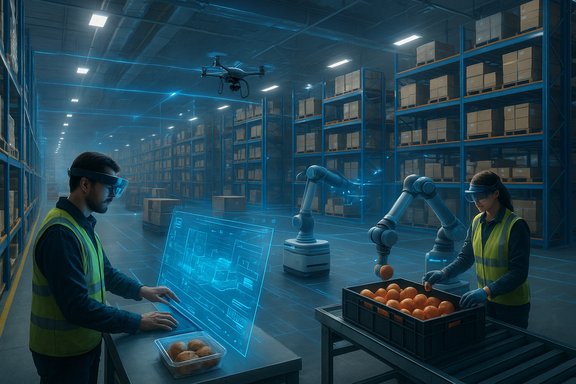
The warehouse floor is changing faster than many operations teams expected: robotics, smarter vision systems, edge computation and private networks are converging into tightly coordinated fleets and tools that promise to reshape fulfillment, inventory and manufacturing logistics. The Technology.org briefing the team provided captures this moment — highlighting Autonomous Mobile Robots (AMRs), collaborative robots (cobots), transformer-based vision for picking, soft grippers, drones, edge inference, private 5G, digital twins and safety advances — and frames the shift as both technical and organizational. That snapshot is accurate in describing the trendlines, but the real story is a more nuanced balancing act between measurable productivity gains, new integration work, and fresh operational risks that leaders must manage carefully.
Automation in warehouses is no longer a futuristic experiment; it is mainstream operations. A decade of maturation in sensors, compute, and machine learning has turned a variety of previously isolated technologies into production-grade systems that solve specific supply-chain pain points: walking time and picking throughput, fragile-product handling, inventory accuracy in tall racking, real-time coordination across fleets, and faster cycle counts. Vendors and integrators now deliver bundled solutions — robots plus vision, edge compute, and orchestration software — that integrate with Warehouse Management Systems (WMS) and Transportation Management Systems (TMS).
This article synthesizes the Technology.org brief with broader industry evidence, verifying technical claims and outcomes where possible, and offering practical, critical analysis for operations leaders planning next-generation deployments. Key claims are cross-checked with vendor case studies, independent tests and standards documents to separate vendor marketing from reproducible outcomes.
Source: Technology Org Innovative Robotics Advances Reshaping Supply Chains - Technology Org
 Background / Overview
Automation in warehouses is no longer a futuristic experiment; it is mainstream operations. A decade of maturation in sensors, compute, and machine learning has turned a variety of previously isolated technologies into production-grade systems that solve specific supply-chain pain points: walking time and picking throughput, fragile-product handling, inventory accuracy in tall racking, real-time coordination across fleets, and faster cycle counts. Vendors and integrators now deliver bundled solutions — robots plus vision, edge compute, and orchestration software — that integrate with Warehouse Management Systems (WMS) and Transportation Management Systems (TMS).This article synthesizes the Technology.org brief with broader industry evidence, verifying technical claims and outcomes where possible, and offering practical, critical analysis for operations leaders planning next-generation deployments. Key claims are cross-checked with vendor case studies, independent tests and standards documents to separate vendor marketing from reproducible outcomes.
Robotics breakthroughs elevating warehousing
Autonomous Mobile Robots (AMRs): what they really deliver
AMRs move goods to people or other machines with little or no infrastructure change. The most widely publicized benefits are reductions in walking time for pickers and large uplifts in throughput during peaks.- Vendors and integrators routinely report 2x to 3x improvements in per‑operator throughput after AMR deployment; large AMR suppliers publicize site milestones showing dramatic seasonal pick numbers. Locus Robotics, for example, reported record holiday volumes and public case figures showing fleet-driven doubling of throughput during peak seasons.
- Independent reviewers and industry tests confirm AMRs reduce unproductive travel and enable goods‑to‑person flows, a structural source of productivity gains in e‑commerce fulfillment.
- These gains are not automatic. Success depends on accurate slotting, order-clustering logic, robust site mapping, and orchestration with the WMS. Integrators often run multi-week pilot programs to tune throughput and congestion control.
- Seasonal scaling is feasible with a modular RaaS model, but it requires lead times for hardware delivery and staffing to run supplemental shifts and charge cycles.
Collaborative robots (cobots): augmentation, not wholesale replacement
Cobots are engineered to operate safely near humans and are widely used for sorting, light assembly, and packing.- Cobots lower the barrier to automation in constrained spaces and reduce the need for caging and complex safety fencing; many case studies show improved cycle time and reduced repetitive strain injuries when human workers are partnered with cobots.
- Safety standards like ISO/TS 15066 define power‑and‑force limits and risk‑assessment methods used to certify collaborative applications. These standards reinforce that “cobot” safety depends on the full application — end effector, payload, and environment — not just on the arm itself.
- Integrations succeed where teams receive both technical training and social onboarding to accept cobots as helpers. Deployment plans must include risk assessments, ergonomics reviews, and retraining for adjacent roles rather than promises of immediate headcount reductions.
Vision transformers and deep vision for picking
Vision Transformer (ViT) architectures and transformer-CNN hybrids are being adapted to robotic grasping, detection and pose estimation.- Recent academic work and applied research show transformer-based models (and hybrid Transformer-CNN variants) significantly improve grasp detection and pose estimation in cluttered scenes — crucial for generalizable order picking across thousands of SKUs. Practical experiments report high grasp accuracies on benchmark datasets and encouraging real‑world prototypes.
- Robotics companies leverage simulation, synthetic data and on‑premise GPUs/edge accelerators to train models that can generalize to many product shapes and packaging conditions. Covariant and other startups have shown that deep learning pipelines can handle thousands of SKUs with high accuracy when paired with proper robotic hands and grippers.
- Transformer models are data-hungry and compute-intensive. Robust deployment needs either large labeled datasets or synthetic data generation and simulation-based transfer learning to avoid brittle, overfit models.
- Real-world picking remains hard for transparent, reflective or deformable objects unless the perception stack is tuned with task-specific heuristics and multi-modal sensors (RGB‑D, tactile).
New approaches setting the pace
Soft grippers: biological inspiration for fragile goods
Soft, bio-inspired grippers reduce bruising and damage for delicate goods like fruit and bakery items.- Multiple food‑packing case studies show measurable reductions in product damage and meaningful throughput gains when soft grippers replace rigid tooling. Suppliers in fresh‑food packaging report higher yield and faster changeovers for product mixes.
- Soft grippers require pneumatic or compact actuation systems and careful maintenance programs to manage wear — they trade mechanical robustness for gentler contact.
- Food‑grade materials and hygienic design matter: deployments in grocery/produce must include cleaning regimes, material certifications, and easy-change tooling for SKU variety.
Warehouse drones: rapid cycle counts in tall racking
Drones enable fast inventory checks across high shelves and reduce ladder work.- Retail and distribution companies have operationalized drones for cycle counts and stock checks; IKEA’s drone program expanded to U.S. centers after demonstrating reliable indoor navigation and obstacle avoidance in dozens of warehouses. These solutions use indoor positioning and obstacle detection to run safe, continuous counts.
- Drones dramatically speed cycle counts for understaffed inventory teams, but indoor operation requires careful airspace rules, obstacle mitigation, and integration with inventory systems.
- Indoor drone programs must meet local occupational safety rules and internal risk policies. Drones are best used for counting and inspection, not for goods movement where collision risk and regulatory complexity increase.
Edge inference: instant decisions at the robot
Running inference on-board keeps robots responsive when connections to a central cloud are limited.- Edge compute platforms (NVIDIA Jetson, Intel Movidius/Movidius‑based modules, and specialized edge boxes) are widely used to run perception and control models on the robot itself. Case studies highlight lower latency, increased reliability, and privacy improvements by keeping raw sensor data on-site.
- On‑device inferencing reduces bandwidth needs and enables deterministic behaviors for safety-critical functions (e.g., human detection, emergency stop decisions).
- Edge stacks require model optimization (pruning/quantization) and a deployment pipeline to update models securely and reliably across robot fleets.
Private 5G: predictable connectivity for high‑density automation
Private cellular networks solve coverage and congestion issues inside large facilities.- Case studies from Ericsson and major integrators show private 5G yielding better coverage, lower latency and simplified radio planning compared with dense Wi‑Fi arrays. CJ Logistics and other early adopters report measurable productivity improvements and CAPEX/OPEX benefits for large sites.
- Telecommunications providers and integrators are now offering turnkey private 5G for ports, logistics hubs and factories where predictable L2/L3 performance is required for fleet coordination, video telemetry and AR.
- Private 5G needs spectrum access, a systems integrator, and ongoing telecom lifecycle management — it’s a capital program, not a plug‑and‑play upgrade.
Digital twins: simulation before you deploy
Digital twins are virtual replicas of warehouses, lines or systems that allow safe simulation of layout changes, robot paths and process variants.- Digital twin platforms are used by major manufacturers and logistics operators to test layout changes, run “what if” scenarios and validate automation before physical changes. Siemens, PTC and Dassault highlight cases where twins helped reduce downtime and identify bottlenecks before production changes.
- The twin’s usefulness depends on data fidelity and update cadence; outdated twins become misleading.
- Use a twin in pilot stages to validate throughput gains, run stress tests for seasonal peaks and to rehearse recovery steps for outage scenarios.
Safety innovations and self‑calibrating sensors
Proximity sensing, LIDAR, depth cameras and now self‑calibrating sensors work in concert to halt robots when humans enter dangerous zones.- Sensor fusion approaches and vendor safety suites can provide graded responses: slow down, reroute, or stop entirely. ISO and industry guidance require risk assessments and documented safety behaviors; integrators combine hardware and software interlocks to meet those regimes.
- Self‑calibrating sensors reduce manual maintenance and improve uptime, but they need careful validation scripts and rollback plans when false positives or drift occur.
Bridging people with technology: the organizational dimension
Technology adoption is as much a people problem as a technical one. The Technology.org brief correctly highlights that robotics succeed when teams understand both machines and process change. This section expands on the practical sequence for operations leaders.Training, governance and human-in-the-loop design
- Start with a measurable pilot: define KPIs (UPH, OTIF, MTTR, pick accuracy), implement instrumentation, and set a 3–6 month acceptance test.
- Build clear human-in-the-loop thresholds: define when the system can act autonomously and when operators must intervene.
- Invest in training across levels:
- Technical: robotics operators, support technicians, and integrators.
- Operational: supervisors, capacity planners, and safety officers.
- Executive: program governance, ROI tracking and vendor contracting.
Change management checklist
- Communicate benefits and expected disruptions early and often.
- Establish a rewards plan for workers who re-skill into higher-value roles.
- Publish runbooks and rollback plans for sensor drift, network outages and model regressions.
- Contract for joint support SLAs with integrators and vendors; require acceptance tests for peak throughput and safety scenarios.
Real‑world examples and what they demonstrate
- Grocery operations: soft grippers and vision-guided arms have been deployed to pick and pack fruit and produce with reduced bruising and measurable throughput gains in pilot programs. These case wins demonstrate that delicate-product automation is commercially viable with the right tooling.
- E‑commerce peaks: multiple AMR vendors and their customers report doubling of throughput during seasonal peaks through a combination of fleet scaling and orchestration. Locus Robotics’ published peak-season milestones and third‑party deployments with logistics partners confirm these uplifts in many deployments. That said, these are vendor- and site-specific outcomes; independent verification varies by customer and reporting methodology.
- Automotive suppliers and digital twins: automotive OEMs and tier‑one suppliers use digital twins to model lines and upstream bottlenecks, catching delays before they cascade to production. Siemens and major PLM/IIoT vendors publish case studies showing reduced downtime and better capacity planning with twins, though the precise ROI depends on the fidelity of the integration.
Critical analysis — strengths, limitations, and risk profile
Strengths and near-term upside
- Measured productivity gains. Goods‑to‑person flows with AMRs and improved vision for picking produce real per‑operator throughput increases and better peak capacity without wholesale re‑racking.
- Operational resilience. Edge inference and private 5G reduce single‑point dependencies on cloud connectivity; local autonomy improves uptime during intermittent network events.
- Flexible automation. Soft grippers and vision-guided manipulators support SKU diversity with faster changeovers than fixed tooling.
Risks, unknowns and areas needing governance
- Vendor claims vs. independent verification. Many performance numbers come from vendors or customer press releases. Operations teams should expect variance and require pilot acceptance criteria, not claims alone. (Vendor-sourced volume milestones are valid signals, but not universal guarantees.
- Integration debt. Orchestration across WMS, fleet managers, edge compute, and private cellular networks introduces integration complexity and long-tail support responsibilities.
- Data and model drift. Vision models need continuous retraining and validation to cope with new SKUs, lighting changes, packaging updates or seasonal variants.
- Safety and compliance. Collaborative environments require documented risk assessments per ISO/TS 15066 and ANSI/RIA guidance; sites must not assume “cobot” alone implies a safe application.
- Operational maturity of new tech. Self‑calibrating sensors and transformer-based grasp models are promising but require conservative rollout plans; early adopters should treat them as enabling elements of a phased automation roadmap, not immediate full-facility replacements.
Practical playbook for operations leaders
1. Define the problem precisely
- Quantify travel time, picking errors, damage rate, and cycle‑count frequency.
- Map current processes and pinpoint the highest-value automation candidate tasks.
2. Run a staged pilot
- Establish baseline KPIs and acceptance thresholds.
- Integrate a small fleet of AMRs or a cobot cell with edge inference and run for a single SKU family under peak and off‑peak loads.
- Verify safety behaviors and perform risk assessments per ISO/TS 15066.
3. Scale with guardrails
- Create runbooks for model updates, sensor recalibration, and network failover.
- Contract joint SLAs with vendors for escalations and peak-season scaling.
- Use digital twins to simulate fleet growth and layout changes before physical rearrangement.
4. Invest in workforce transition
- Retrain frontline staff to operate and maintain robots.
- Create clear career paths for automation technicians and system integrators.
- Use leadership training and structured supply‑chain education to align strategy with operations; programs such as the Hankamer School Online MBA offer supply-chain concentrations that can help managers plan and finance these changes.
Technology readiness and verification checklist
- Perception stack: Does your picking workflow have labeled datasets or simulation training pipelines?
- Edge hardware: Are Jetson/Movidius/edge VPU options validated for your models and target FPS?
- Network: Will private 5G or a hardened Wi‑Fi 6E plan deliver deterministic latency for your orchestration layer? Verify with a site survey and vendor‑backed SLA.
- Safety: Complete application-level risk assessment to meet ISO/TS 15066 requirements and maintain documentation for audits.
- Operations: Use a digital twin to stress‑test throughput models and human‑robot interactions before widescale changes.
Conclusion — how to lead the robotics era in supply chains
Robotics and associated technologies are moving from niche pilots to core supply-chain tools. The most successful adopters will be organizations that match technical investments with disciplined governance, realistic pilots and workforce strategies. Key truths for leaders:- Treat vendor performance claims as starting points; validate through measurable pilots.
- Prioritize safety, risk assessment and human-in-the-loop controls when cobots and mobile fleets share space with people.
- Use edge inference and private 5G to harden uptime and responsiveness where uptime is a business requirement.
- Invest in simulation and digital twins to test changes before they become expensive physical commitments.
- Prepare the workforce through focused training and strategic leadership development so robotics amplifies human capability rather than destabilizes it.
Source: Technology Org Innovative Robotics Advances Reshaping Supply Chains - Technology Org
