

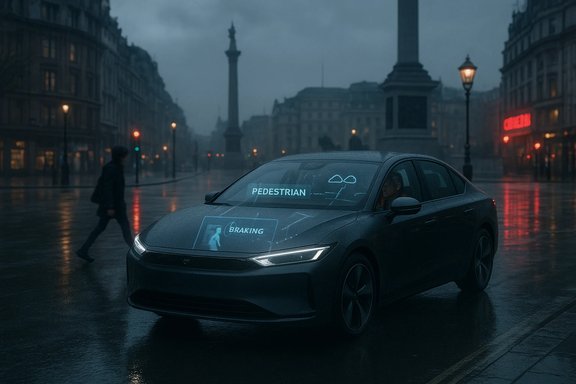
On a rain-slimmed morning in central London a few years ago, a four-door EV eased through traffic toward Trafalgar Square with a safety operator watching but not steering — the car braked precisely for an inattentive pedestrian and carried on. That scene captures the promise and the paradox of Wayve: a Cambridge-born startup that has bet its future on end-to-end, deep learning "embodied AI" to teach cars to see, reason, and drive using cameras and massive cloud compute — and that bet has drawn a wall of capital and a close collaboration with Microsoft Azure to scale training, simulation, and fleet learning at petabyte scale.
Wayve launched in 2017 with a contrarian thesis: instead of building stacks of hand-coded perception, mapping, and motion-planning modules, train a single neural policy that maps raw sensor inputs to driving actions. This "end-to-end" approach — often described as AV2.0 or embodied intelligence — leans on deep neural networks trained on billions of frames, imitation learning to capture human driving behavior, and reinforcement learning for policy improvement. Wayve calls its product line a foundation-model approach for driving: a generalizable driving model that can be fine-tuned for regions, vehicle types, or OEM requirements. In parallel with the research and on-road trials, Wayve has assembled a powerful industrial story: a $1.05 billion Series C led by SoftBank (with participation from NVIDIA and Microsoft) in May 2024; rapid geographic expansion into the U.S., Germany, and Japan; and early commercial tie-ups with automakers. Those deals and that capital underpin the company’s plan to move from research demonstrators to licensed production software for OEMs and fleets. Multiple press reports and Wayve’s own filings confirm the financing and investor list.
For the WindowsForum reader and the broader automotive and cloud communities, Wayve’s story is a useful bellwether: it shows how cloud platforms like Azure are central to modern SDV pipelines, how advanced GPUs and partnerships accelerate the path from research to OEM integration, and how innovation at the model level is changing the calculus of sensors, costs, and interoperability. But the ultimate arbiter will be sustained, audited safety performance in real commercial fleets — not demos or funding rounds.
Wayve’s ride through London — and now into Sunnyvale and Tokyo testing grounds — is an instructive chapter in autonomy’s evolution: it is both an example of what scale-first AI can achieve and a reminder that, for transportation, scale must be paired with certitude. The next two years will be decisive: production soft launches with OEMs, independent safety certifications, and real-world operational data will determine whether Wayve’s foundation models truly become the next platform for mass-market autonomy or remain an instructive technological experiment.
Source: Microsoft Source AI that drives change: Wayve rewrites self-driving playbook with deep learning in Azure
 Background and overview
Wayve launched in 2017 with a contrarian thesis: instead of building stacks of hand-coded perception, mapping, and motion-planning modules, train a single neural policy that maps raw sensor inputs to driving actions. This "end-to-end" approach — often described as AV2.0 or embodied intelligence — leans on deep neural networks trained on billions of frames, imitation learning to capture human driving behavior, and reinforcement learning for policy improvement. Wayve calls its product line a foundation-model approach for driving: a generalizable driving model that can be fine-tuned for regions, vehicle types, or OEM requirements. In parallel with the research and on-road trials, Wayve has assembled a powerful industrial story: a $1.05 billion Series C led by SoftBank (with participation from NVIDIA and Microsoft) in May 2024; rapid geographic expansion into the U.S., Germany, and Japan; and early commercial tie-ups with automakers. Those deals and that capital underpin the company’s plan to move from research demonstrators to licensed production software for OEMs and fleets. Multiple press reports and Wayve’s own filings confirm the financing and investor list. How Wayve’s technology actually works
The core idea: end-to-end embodied AI
Wayve’s flagship claim is that driving can be learned as a single policy: the model ingests camera imagery (and limited additional telemetry) and directly outputs steering, throttle, and braking commands or higher-level maneuvers. The company combines:- Imitation learning (learning from human drivers) to bootstrap safe behavior.
- Reinforcement learning and offline policy optimization to refine maneuvers and handle rare edge cases.
- Active learning and fleet learning loops to aggregate real-world and synthetic data, retrain continuously, and deploy updates.
Sensor strategy: cameras first, hardware-agnostic later
Wayve built its earliest demos around camera-based vision. Cameras are inexpensive, high-bandwidth, and similar to human senses; they let the company scale data collection cheaply and learn visual priors that resemble human driving. Public statements and product materials emphasize a "camera-first" approach — not necessarily camera-only for every deployment. When moving toward OEM production, Wayve has signaled that it will support hybrid sensor suites (cameras plus lidar/radar) to meet particular safety and regulatory needs. Automotive partnerships often combine Wayve’s software with OEM-selected sensors.Training and compute: cloud-first supercomputing
Wayve’s training pipeline is compute-heavy. To process and iterate on petabytes of video data, Wayve uses Azure Machine Learning and high-performance GPU clusters (Wayve’s own case studies and Microsoft customer stories state that Azure cut training turnaround times and enabled growth from millions to billions of examples). The cloud lets Wayve run large-scale simulated scenarios, manage labeled datasets, and orchestrate distributed training — all prerequisites for foundation-model scale. Microsoft’s Azure collaboration began as an engineering and supercomputing partnership and deepened as Microsoft became a strategic investor.Commercial traction: funding, partners, and global rollout
Wayve’s rapid fundraising and new OEM deals moved the company from lab curiosity to an industry contender.- In May 2024 Wayve closed a $1.05 billion Series C led by SoftBank, with participation from NVIDIA and Microsoft. That capital enabled accelerated hiring, global expansion, and productization efforts.
- By 2024–2025 Wayve opened testing operations in the United States and established a testing and development center in Japan to gather region-specific data; Nissan announced a plan to integrate Wayve’s software into its ADAS/ProPilot roadmap for 2027 models. These moves demonstrate both geographic and OEM momentum.
- NVIDIA’s involvement as a hardware partner (and investor) is strategic: Wayve’s inference and training pipelines leverage accelerated compute, making GPU partners essential for performance and qualification.
Why Microsoft and Azure matter to Wayve — and to AVs in general
Wayve’s reliance on Azure is both technical and strategic. Microsoft provides:- Elastic training clusters and high-performance GPUs for multi-petabyte model training.
- Azure Machine Learning and PyTorch integration for experiment management and reproducible pipelines.
- Secure, global cloud regions and machine-optimization tooling to scale dataset ingestion, simulation, and telemetry storage.
Where Wayve’s approach shines: strengths and strategic advantages
- Data efficiency and human-like behavior. Learning from human drivers produces policies that handle social driving nuances — yielding behavior that can feel natural and human-aligned in dense urban environments.
- Hardware-agnostic deployment model. By focusing on neural policies rather than vehicle-specific control stacks, Wayve aims to make its software adaptable to many vehicle makes and sensor configurations, lowering OEM integration cost.
- Lower sensor costs and faster rollouts. Camera-first systems reduce capital expenditure on expensive lidar hardware and make fleet rollout more economically viable for mass-market cars.
- Cloud scale and iteration speed. Azure-powered training and orchestration shorten the gap between data collection and policy updates; that continuous loop is critical for improving performance in rare or changing conditions.
- Investor and industrial backing. Heavyweight investors (SoftBank, NVIDIA, Microsoft) bring capital, compute partnerships, and OEM introductions that materially reduce commercialization friction.
The risks, trade-offs, and open questions
Wayve’s bold approach also carries measurable technical, commercial, and regulatory risks.1) Generalization and rare-event safety
Neural policies learn statistical patterns; they can fail on distributional shifts — scenarios not represented in training data. The AV safety bar is high: systems must be robust for rare but critical edge cases (sudden pedestrian darting from occlusion, unusual weather, degraded sensors). While Wayve invests heavily in fleet learning and simulation, independent long-term validation is still limited. Regulatory bodies and independent testers will demand reproducible evidence before certifying high levels of autonomy.2) Interpretability and certification
End-to-end models are notoriously hard to interpret. For regulators and OEM safety engineers used to modular stacks with deterministic behaviors, providing explainability and deterministic safety guarantees for a neural policy is challenging. Certifications for ADAS and AV systems typically require traceability, failure-mode analysis, and deterministic fallback behavior — constraints that put pressure on pure end-to-end approaches. Wayve and partners will need to show rigorous verification and validation workflows that satisfy ISO 26262–style functional safety frameworks.3) Liability and responsibility
When a learned policy takes an action that produces harm, assigning liability between OEMs, software suppliers, and cloud service providers becomes complex. Licensing Wayve software into OEM vehicles raises questions about warranty, OTA update policies, incident forensics, and legal responsibility across jurisdictions. These are non-technical but critical adoption barriers.4) Compute, data costs, and environmental footprint
Training and operating foundation models at fleet scale is expensive. Cloud inference for features that query a central model can be costly at scale, and training at petabyte and exabyte levels requires considerable energy. OEMs and fleet operators will weigh these operational costs against the benefits — and regulators may demand carbon and sustainability reporting for such compute-heavy pipelines.5) Overreliance on cloud and connectivity
While Wayve emphasizes on-device inference for safety-critical controls, cloud services are essential for iterative training and for features that require up-to-date models. In regions with intermittent connectivity, degraded performance or feature downgrades must be anticipated and tested robustly. Hybrid architectures that allow graceful degradation are essential.Safety in practice: how Wayve tests and the role of human oversight
Wayve’s on-road demos typically used a professional safety operator in the vehicle during public trials — a familiar model across the industry to allow supervised evaluation while limiting risk. Wayve blends:- Real-world supervised driving with safety drivers to collect data and validate behavior.
- Massive simulation to create edge-case scenarios at scale.
- Active learning pipelines to prioritize data collection in scenarios where the model is uncertain.
Practical implications for OEMs and fleet operators
OEMs considering Wayve’s stack must weigh three operational vectors:- Integration cost and validation overhead. OEMs will need to certify Wayve’s models against their vehicle control chains and safety architectures. That typically means co-engineering and extensive testing cycles.
- Sensor choices and redundancy. While Wayve’s models can operate on cameras, many OEMs will insist on sensor redundancy (radar/lidar) for safety-critical perception cues.
- Cloud governance and data residency. Using Azure or other cloud platforms implies contractual, legal, and operational frameworks for telemetry, OTA updates, and incident audits.
Competitive context: where Wayve fits among other AV strategies
The AV market currently splits across technical philosophies:- Map-heavy modular stacks (Waymo, Cruise in many of their early designs) use high-definition maps plus sensor fusion and careful rule-based planners.
- Sensor-diverse modular stacks (companies that combine lidar, radar, cameras, and modular planners) emphasize redundancy and hand-crafted safety guarantees.
- End-to-end, data-driven stacks (Wayve, to some extent Tesla’s direction) prioritize learning from scale and human demonstrations.
Recommendations and what to watch next
- Independent validation data. Release or enable third-party benchmarks and structured datasets that allow independent researchers and certifying bodies to test Wayve’s model behaviors across edge cases.
- Hybrid sensor options. For safety-critical commercial deployments, pair neural policies with redundancy (radar/lidar) and deterministic fallback behaviors to ease certification and consumer trust.
- Transparency and traceability. Invest in tools that expose why a policy chose a maneuver — not to explain every neuron, but to provide human-understandable traces for incident analysis.
- Economics and sustainability modeling. Publish expected TCO for large-scale deployments, including cloud costs for training and inference, and a sustainability plan for compute-heavy operations.
- Regulatory engagement. Work closely with regulators to co-design validation frameworks for learned policies rather than retrofitting traditional modular standards to neural systems.
Final assessment: promise tempered by proof
Wayve represents a high-stakes bet on scale-driven intelligence. The company’s approach is elegant: cheaper sensors, massive data, and powerful cloud compute yield a driving policy that generalizes across cities and vehicles. That model has attracted top-tier investors, heavy cloud support from Microsoft Azure, and early OEM interest — tangible validation that the industry takes this approach seriously. But promise alone does not equal production readiness. The critical work ahead is rigorous, independent safety validation; robust strategies for interpretability and certification; clear liability frameworks for OEM partners; and transparent evidence that learned policies can handle the long tail of rare, life-critical events. The technical and regulatory bar for hands-free autonomy is appropriately high, and Wayve will be judged by its ability to cross that bar repeatedly, region by region.For the WindowsForum reader and the broader automotive and cloud communities, Wayve’s story is a useful bellwether: it shows how cloud platforms like Azure are central to modern SDV pipelines, how advanced GPUs and partnerships accelerate the path from research to OEM integration, and how innovation at the model level is changing the calculus of sensors, costs, and interoperability. But the ultimate arbiter will be sustained, audited safety performance in real commercial fleets — not demos or funding rounds.
Wayve’s ride through London — and now into Sunnyvale and Tokyo testing grounds — is an instructive chapter in autonomy’s evolution: it is both an example of what scale-first AI can achieve and a reminder that, for transportation, scale must be paired with certitude. The next two years will be decisive: production soft launches with OEMs, independent safety certifications, and real-world operational data will determine whether Wayve’s foundation models truly become the next platform for mass-market autonomy or remain an instructive technological experiment.
Source: Microsoft Source AI that drives change: Wayve rewrites self-driving playbook with deep learning in Azure
