

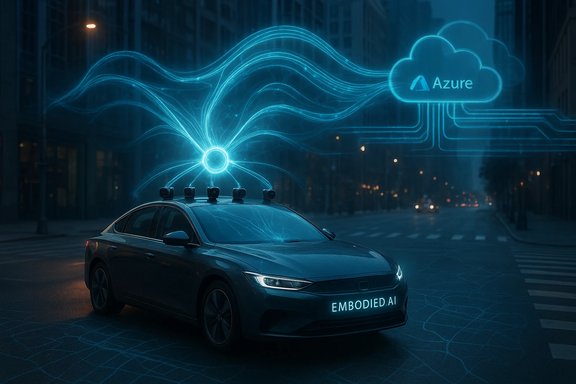
Wayve’s decision to build its next-generation self-driving stack around deep learning and Microsoft Azure marks a decisive pivot in how autonomous vehicles might scale from controlled testbeds to bustling city streets, and it raises as many practical questions as it does technological promise.
Wayve was founded in Cambridge, UK in 2017 with a clear, contrarian thesis: rather than continuing the industry’s reliance on expensive sensor arrays, HD maps, and hand-coded rules, a data-first and end-to-end deep learning approach could produce driving intelligence that generalizes across cities and vehicle types. The company brands this approach as AV2.0 or “embodied AI for autonomy”—a neural-network-driven driving intelligence that maps raw sensory inputs to motion outputs using learned representations rather than fixed rulebooks.
From the beginning Wayve emphasized a camera-first sensing stack, combined with radar when necessary, and an architecture that learns motion planning jointly with perception. The goal: develop driving models that learn directly from human driving data and can be adapted to new geographies and vehicle platforms with incremental fine-tuning and additional driving examples, rather than rebuilding bespoke stacks for each city.
Microsoft Azure has been a central partner in that strategy—Wayve moved large parts of its training pipeline to Azure Machine Learning and uses PyTorch-based tooling at scale to train models on massive amounts of driving data. The result, according to public statements and company materials, has been a dramatic acceleration in model iteration and throughput, enabling experiments at petabyte scale.
Key characteristics:
This is conceptually similar to the “foundation model + fine-tune” pattern now common in large-language-model workflows: a large pre-trained driving model is adapted to local rules and edge-case behaviors through targeted sampling of new data and short adaptation cycles.
Strategic implications:
Where Wayve reports that the same base model has driven in Tokyo, Milan, and Montana with minimal adaptation, that demonstrates promising generalization behavior in selective trials. Translating selective trial successes into broad, provably safe operations across global metropolitan networks at scale will require extensive public evaluation, regulatory approval, and reproducible third-party validation.
The potential benefits are significant: reduced vehicle hardware cost, faster feature velocity (via centralized model updates), and—if safety is demonstrably comparable to or better than human drivers—reduced accidents and more efficient road use. But realizing that vision requires more than raw model accuracy: it requires hardened safety engineering, regulatory frameworks that match the operational realities of learned systems, and public trust.
The next phase of credibility for learned autonomy will be measured in many small things: repeatable behavior in edge cases, well-documented validation across diverse cities, clear accountability for OTA updates, and demonstrable benefits for passengers and pedestrians alike. If Wayve and similar companies can meet those demands while keeping operating costs and complexity manageable, the promise of scalable, urban-ready autonomy will move much closer to everyday reality.
Source: Blockchain News Wayve Transforms Self-Driving Technology with Deep Learning on Azure
 Background
Wayve was founded in Cambridge, UK in 2017 with a clear, contrarian thesis: rather than continuing the industry’s reliance on expensive sensor arrays, HD maps, and hand-coded rules, a data-first and end-to-end deep learning approach could produce driving intelligence that generalizes across cities and vehicle types. The company brands this approach as AV2.0 or “embodied AI for autonomy”—a neural-network-driven driving intelligence that maps raw sensory inputs to motion outputs using learned representations rather than fixed rulebooks.From the beginning Wayve emphasized a camera-first sensing stack, combined with radar when necessary, and an architecture that learns motion planning jointly with perception. The goal: develop driving models that learn directly from human driving data and can be adapted to new geographies and vehicle platforms with incremental fine-tuning and additional driving examples, rather than rebuilding bespoke stacks for each city.
Microsoft Azure has been a central partner in that strategy—Wayve moved large parts of its training pipeline to Azure Machine Learning and uses PyTorch-based tooling at scale to train models on massive amounts of driving data. The result, according to public statements and company materials, has been a dramatic acceleration in model iteration and throughput, enabling experiments at petabyte scale.
What Wayve is doing: the technical picture
End-to-end deep learning and “embodied AI”
Wayve’s stack centers on an end-to-end neural network that takes visual streams from multiple monocular cameras (and supportive signals such as GPS/odometry and radar) and outputs a motion representation that a vehicle controller can execute. This differs from the more conventional modular approach that separates detection, tracking, mapping, prediction, planning, and control into discrete modules—each hand-engineered and often dependent on HD maps and LIDAR.Key characteristics:
- Camera-first sensing: prioritizes monocular/omnidirectional camera input to cut hardware costs and rely on learned visual representations.
- Joint perception-and-planning: the network learns representations of semantics, geometry, and dynamics and optimizes motion outputs directly via imitation and reinforcement learning.
- Fleet-scale learning: models are trained on aggregated driving data from multiple vehicles and geographies to build broad behavioral priors that can be fine-tuned for specific local driving norms.
Training at scale on Azure
Training these large visual models requires huge compute and storage. Wayve’s published accounts describe moving from on-premises clusters to Azure Machine Learning, adopting:- PyTorch workflows in Azure containers,
- distributed training across many nodes,
- experiment tracking and MLOps around model versions,
- integration with third-party tooling for monitoring and hyperparameter tuning.
Model generalization and fine-tuning
Wayve’s stated advantage is generalization: a core foundation model that learns universal driving behaviors (lane discipline, object avoidance, speed control) and that can be adapted to new regions with additional, incremental data. The company’s technical materials show experiments in which the same base model was adapted for different driving conventions (for example, turn behaviors and stop sign usage between UK and US) using a modest amount of local data and continued training.This is conceptually similar to the “foundation model + fine-tune” pattern now common in large-language-model workflows: a large pre-trained driving model is adapted to local rules and edge-case behaviors through targeted sampling of new data and short adaptation cycles.
Real-world application and commercial steps
Wayve has put a number of demonstrators and pilots into public view. These include urban driving demos in London and other cities, last-mile delivery pilots, and—more recently—commercial partnerships aimed at moving toward Level 4 ride-hailing trials. The company’s funding and strategic partner roster has grown substantially: large rounds and strategic investments have expanded its runway and given it access to both compute and automotive partners.Strategic implications:
- OEM integration: Wayve positions its software to integrate into different vehicle platforms with a flexible sensor/compute footprint, reducing barriers to adoption by carmakers.
- Fleet pilots: delivery and ride-hailing pilots supply continuous on-road data, which accelerates learning and produces commercial use cases while testing safety and operations.
- Industry partnerships: major investors and collaborators provide capital, specialized hardware (GPUs), and route-to-market channels.
Strengths and notable advances
- Scalability through cloud compute: Offloading massive training workloads to a cloud provider with enterprise AI tooling dramatically shortens iteration cycles for large models. This accelerates research-to-road velocity and reduces costly capital investment in on-prem clusters.
- Cost-effective sensor suite: Camera-first sensor arrays are cheaper than LiDAR-centric systems and can reduce vehicle hardware cost, which matters for scaled commercial deployment.
- Data-driven generalization: Learning from many hours of varied urban driving enables the model to acquire behaviors that are hard to hand-code, such as negotiating complex intersections or adapting to localized driver norms.
- Flexible product integration: A software-centric, sensor-agnostic driver can be adapted to multiple OEMs and vehicle types, offering a path to broader distribution without heavy hardware rework per vehicle.
- Strong financial and technology backing: Major funding rounds and partners with expertise in AI hardware and cloud compute provide the resources needed to attempt a capital-intensive challenge.
Critical concerns and risks
1. Safety, explainability, and regulatory readiness
End-to-end models can behave unpredictably in corner cases. Unlike modular systems where each component can be inspected and validated separately, learned systems can obscure failure modes. Regulators demand traceability, deterministic behavior, and robust evidence of equivalence to human drivers. The industry still lacks mature standards for evaluating and certifying end-to-end learned driving stacks across the entire operational design domain (ODD).2. Edge-case generalization and distribution shift
Urban driving contains long-tail scenarios—rare combinations of roadwork, weather, pedestrian behavior, and anomalous vehicles. While foundation models trained on fleet data can learn many patterns, perfecting performance on the long tail requires either massive data coverage or human-in-the-loop interventions. Relying on cloud-scale training does not eliminate the difficulty of guaranteeing safe behavior in previously unseen situations.3. Over-reliance on vision-only sensing
Camera-first setups are vulnerable to optical failure modes: glare, fog, heavy rain, or direct sun can degrade inputs. While radar and other sensors can be added, the minimalist sensor philosophy trades redundancy for cost. Critical safety architecture typically prefers sensor diversity (cameras + radar + LiDAR) to cross-check perception. The camera-first approach may require stronger fallback and uncertainty estimation systems to achieve robust safety.4. Explainability and validation tools
Large neural driving models are notoriously hard to interpret. For regulators, insurers, and OEMs, explainable failure modes and testable guarantees are essential. This requires a parallel investment in interpretability tooling, offline validation scenarios, and real-time uncertainty estimation, which is often as challenging as improving raw driving performance.5. Cloud dependency, cost, and vendor lock-in
Training and iterating large driving models in the cloud minimizes upfront capex but introduces sustained opex exposure to cloud GPU pricing, data egress, and vendor-specific tooling. For large-scale fleets, multi-year compute costs are non-trivial. Heavy dependence on a single cloud partner can also create operational lock-in and potential geopolitical or data-residency complications—particularly when operating in multiple countries with strict data localization rules.6. Cybersecurity and data governance
Fleets collecting massive amounts of video data raise privacy and data-protection concerns. Secure storage, controlled access, and compliant handling of personally identifiable information (PII) are required. Additionally, the attack surface expands when models are updated remotely or rely on cloud orchestration; ensuring model provenance, integrity, and secure deployment pipelines is essential.7. Hardware and inference constraints at the edge
While cloud training can scale, inference must run reliably on vehicle-grade compute within power, thermal, and cost envelopes. Large foundation models require optimization—quantization, model pruning, or specialized accelerators—to meet real-time constraints. Mismatch between cloud-scale model size and on-vehicle deployment capability is a practical engineering challenge.Verifiable claims and caution on hype
Wayve and associated cloud partners have reported substantial performance improvements after migrating training to cloud infrastructure—claims include dramatic increases in training throughput and shorter model iteration times. Those operational gains follow logically from access to modern GPUs, high-speed interconnects, and distributed training frameworks. However, some specific performance metrics (e.g., “training 90% faster,” “50x throughput increases,” or “fine-tuning in a couple of weeks”) are context-dependent and reflect internal baselines, particular experiments, and the exact hardware and software stack used. These figures should be interpreted as indicative outcomes in the scenarios described by the company and cloud partners, not as universal guarantees in all settings.Where Wayve reports that the same base model has driven in Tokyo, Milan, and Montana with minimal adaptation, that demonstrates promising generalization behavior in selective trials. Translating selective trial successes into broad, provably safe operations across global metropolitan networks at scale will require extensive public evaluation, regulatory approval, and reproducible third-party validation.
Strategic implications for stakeholders
For OEMs and Tier-1 suppliers
- Adopt software-first architectures that allow integration of third-party autonomy stacks while retaining safety override and redundancy.
- Negotiate clear terms about data ownership, OTA update pathways, and responsibilities for safety incidents associated with third-party autonomy software.
- Plan for hardware abstraction layers: enable modular compute packages that let evolving AI stacks run efficiently without full vehicle redesigns.
For regulators and cities
- Accelerate creation of test frameworks for learned driving systems, including standardized scenario libraries that cover rare but high-risk events.
- Require robust logging, explainability artifacts, and independent third-party audits of autonomy stacks before permitting scaled, driverless operations.
- Address data governance at the municipal level: define conditions for sensor data collection, anonymization, retention, and cross-border transfer.
For cloud providers
- Offer clearer pricing models for sustained large-scale model training that fleets require—beyond per-hour GPU rates—so operators can forecast long-term opex.
- Provide hardened MLOps pipelines that meet automotive-grade security and regulatory traceability requirements.
- Work with automotive partners to provide edge-optimized inferencing solutions and reproducible benchmarks for on-vehicle performance.
For insurers and fleets
- Develop new risk assessments for AI-driven operations that account for model drift, update cadence, and mixed-fleet interactions.
- Invest in continuous validation and staged rollouts where models are validated in shadow mode on production fleets before being enabled in control.
Practical checklist for cautious deployment
- Establish multi-sensor redundancy for safety-critical functions.
- Build offline scenario simulators and a long-tail test set for repeated stress testing.
- Adopt strict data governance: PII removal, consent mechanisms, and local storage where required.
- Implement robust model versioning, cryptographic signing, and rollback mechanisms for OTA updates.
- Create cross-disciplinary review teams (engineering, operations, legal, safety assurance) for release sign-off.
- Maintain transparent logs and post-incident analysis procedures to support regulatory review.
Where Wayve’s strategy could reshape urban mobility
If core technical and regulatory obstacles are met, Wayve’s combination of a foundation-model approach, camera-first economics, and cloud-scale training could shift the calculus of urban autonomous deployment from bespoke, sensor-expensive pilots to a software-driven ecosystem. That would lower entry barriers for last-mile delivery, micro-mobility, and on-demand ride services while enabling more rapid geographic expansion.The potential benefits are significant: reduced vehicle hardware cost, faster feature velocity (via centralized model updates), and—if safety is demonstrably comparable to or better than human drivers—reduced accidents and more efficient road use. But realizing that vision requires more than raw model accuracy: it requires hardened safety engineering, regulatory frameworks that match the operational realities of learned systems, and public trust.
Conclusion
Wayve’s use of deep learning on Azure exemplifies a broader trend in autonomy: the convergence of foundation-model thinking, cloud-scale training, and lean sensor economics. The approach has clear strengths—particularly in agility and data-driven generalization—and it benefits from strong funding, strategic partnerships, and modern cloud tooling. Yet the most critical tests remain ahead: enduring safety under rare, real-world stressors; transparent, auditable evidence for regulators; robust cybersecurity and data governance; and cost-effective, reliable on-vehicle inference.The next phase of credibility for learned autonomy will be measured in many small things: repeatable behavior in edge cases, well-documented validation across diverse cities, clear accountability for OTA updates, and demonstrable benefits for passengers and pedestrians alike. If Wayve and similar companies can meet those demands while keeping operating costs and complexity manageable, the promise of scalable, urban-ready autonomy will move much closer to everyday reality.
Source: Blockchain News Wayve Transforms Self-Driving Technology with Deep Learning on Azure
