

The Welsh Government’s use of Microsoft Copilot to help produce a review that recommended shutting down Industry Wales is the kind of AI governance story that should unsettle every public-sector boardroom. On the face of it, the administration says Copilot was used only to transcribe interviews and cluster comments into themes, while officials handled the actual analysis and options appraisal. But the chairman of Industry Wales told the Senedd that the process lacked proper validation, and the episode now sits at the intersection of AI hype, public accountability, and the practical limits of machine-assisted decision-making. (record.senedd.wales)
Industry Wales is not a minor quango tucked away at the edges of government. It is a Welsh Government-owned company created in 2013 to convene sector forums and support industrial engagement across aerospace, automotive, technology, and later net zero-focused businesses. In October 2025, Welsh ministers announced it would be dissolved after a government review, with closure now scheduled for 31 March 2026. (caerphilly.observer)
The immediate trigger for the shutdown was not, in itself, AI. It was a combination of a government-commissioned review and a bruising audit history, including the auditor general’s highly unusual disclaimer on Industry Wales’s 2023/24 accounts. That disclaimer followed concerns over procurement irregularities and insufficient evidence for more than £1 million in assets. In other words, the body had already become a test case for governance competence before Copilot entered the frame. (caerphilly.observer)
What makes the current controversy sharper is timing. Welsh Government had been publicly experimenting with Copilot for some time, with board papers in January 2024 noting a pilot and stating that several teams had already seen productivity gains. A later board paper described a 290-staff Early Access Programme and said Copilot was being used to assess benefits, risks, and resource dependencies. So the government was not improvising with a brand-new toy; it was working through a broader AI adoption agenda while simultaneously deciding the fate of a publicly funded body. (gov.wales)
That broader context matters because it explains why the Senedd committee’s questions landed so hard. If a government is telling staff to embrace AI responsibly, it needs particularly disciplined governance when AI is used in politically sensitive processes, especially one that ends with a recommendation to abolish an entity the state itself owns. The optics are bad enough; the procedural questions are worse. (gov.wales)
The Senedd evidence session on 4 March 2026 gave the story its most damaging contours. Industry Wales chair Professor Keith Ridgway said he saw the review copy on 9 January 2026 and was alarmed that it referenced Microsoft Copilot in evaluating returns. He argued that the report should have come back to the board for validation and triangulation rather than leaning on AI in the way it did. That criticism cuts to the heart of public-sector assurance: not whether a machine helped, but whether human judgement remained visibly in charge.
That explanation is plausible in a narrow technical sense, but it still leaves important governance questions unanswered. If an AI system is helping to frame themes from interviews, then it is no longer a passive office utility; it becomes part of the evidentiary chain. That means the public should reasonably expect traceable prompts, documented review steps, and clear sign-off showing where machine assistance ended and human judgement began. (gov.wales)
The government has, in fact, been explicit elsewhere that it sees AI as a productivity tool with risks attached. Its own board paper says the administration launched Copilot as part of a cross-organisational “AI Challenge,” and that it established communities of practice and drop-in support sessions. It also says teams have been asked to produce impact assessments for specific uses of Microsoft 365 Copilot, which suggests at least some awareness that context and controls matter. (gov.wales)
There is also a semantic issue here. Governments often describe AI as helping with “summaries,” “themes,” or “transcripts,” as though those functions are neutral plumbing. In practice, however, the framing of evidence can shape outcomes as strongly as any formal recommendation. Once a machine is helping structure testimony, there is a risk that its convenience quietly becomes authority. That is where caution should replace enthusiasm. (gov.wales)
A few practical lessons emerge from the government’s own explanation:
The company’s defenders would say it performs a distinctive function by convening sector conversations that UK-wide bodies may not replicate. That argument is important because Wales has a small, highly interconnected industrial base, and policy delivery often depends on trust, local relationships, and sector-specific knowledge. Ridgway’s evidence suggests exactly that tension: some interview evidence supported trimming scope, but it also backed a Wales-specific body rather than relying on broader UK organizations.
There is a broader institutional story here too. Industry forums like this often occupy a middle ground between government and business, where they are useful precisely because they are neither fully public nor fully private. But middle-ground institutions are also vulnerable when budgets tighten, audit problems emerge, or ministers want fewer bodies to explain. The result is often a search for “simplification” that risks flattening useful sector expertise. (caerphilly.observer)
This is why the closure matters beyond one company. Industry Wales was not merely a contractor; it was part of the architecture through which government tried to hear from industry. If that architecture is dismantled without a robust replacement, ministers may discover that consultation becomes more episodic, more London-centric, and less grounded in Wales-specific industrial realities. That would be an efficiency gain with a strategic cost.
But public-sector AI is not judged by efficiency slogans alone. It is judged by traceability, fairness, and whether decisions can be defended to auditors, committees, and the public. Welsh Government itself says AI must be embedded with ethical considerations, responsible use, and social partnership from the outset. That is an implicit admission that the technology is powerful enough to need guardrails from day one. (gov.wales)
But the technology is not a truth machine. It does not validate evidence, weigh political trade-offs, or understand the subtleties of institutional legitimacy. When AI is used to cluster interview comments, the model may impose structure that was not present in the raw evidence. That is why the chair’s warning about “reliance” on AI matters: it speaks to the danger of confusing organisation with judgement.
A responsible public-sector workflow should therefore look something like this:
That matters because public confidence depends less on whether technology was used and more on how openly it was used. A committee can tolerate a lot if the chain of responsibility is clear. What it cannot tolerate easily is the suspicion that AI helped shape a politically convenient conclusion while the supporting material stayed opaque.
There is another issue here that public bodies sometimes underestimate: the reputational spillover from one controversial case can slow adoption elsewhere. If staff hear that Copilot was involved in a review that led to dissolution and controversy, they may become more cautious, or more cynical, about the technology’s role. That would be unfortunate, because sensible AI adoption requires trust from the workforce as well as from ministers. (gov.wales)
The committee exchange also highlights a wider accountability problem in the public sector: too often, bodies are asked to trust that “officials handled it” when the visible evidence of that handling is thin. As Ridgway suggested, the review should have come back for validation and triangulation. That is not just a procedural nicety; it is how institutions protect themselves from drift, bias, and overconfidence.
But strategy is tested by edge cases, not by press releases. If Copilot works well in drafting notes or transcribing meetings, that is useful but uncontroversial. If it is involved, however indirectly, in a review that ends with the abolition of a state-owned body, the standards of proof have to rise dramatically. That is the difference between experimentation and governance. (gov.wales)
This is especially true in Wales, where public bodies often operate with lean teams and limited specialist capacity. AI can therefore look irresistibly attractive because it promises scale without large headcount increases. Yet the more attractive the promise, the more essential it becomes to prove that the gains are real and the errors are controlled. (gov.wales)
The Welsh Government’s own AI paper recognizes that adoption has implications for staff, rights, equality, and social justice. That is a healthier framing than pure efficiency talk, but it needs to be operationalized in a way that survives scrutiny. If not, each new controversy risks turning AI from a tool of modernization into a symbol of rushed decision-making. (gov.wales)
That said, the government is not wrong to question whether a body with serious audit failings should continue unchanged. Public confidence in industry support institutions depends on both relevance and probity. Once the latter is damaged, ministers are almost forced into a reset, even if the former remains valuable.
There is also a message here for companies that depend on public-sector engagement. Government is likely to demand stronger evidence, cleaner audit trails, and clearer value propositions from any intermediary it funds. That could improve discipline across the ecosystem, but it may also raise the bar for smaller organizations that lack the resources to manage more formal oversight. (caerphilly.observer)
The likely result is a recalibration rather than a wholesale retreat. Business groups will still need champions inside government, but those champions may have to operate through more centralized, more explicitly governed channels. That could make engagement tidier, though not necessarily more responsive. And responsiveness is often what local industry values most.
There is also a broader policy risk around AI adoption. If public servants conclude that using Copilot invites scrutiny only when things go wrong, they may either avoid the tool unnecessarily or use it quietly without proper documentation. Neither outcome is good. Responsible adoption needs confidence, but confidence must be earned through transparency. That is the missing ingredient in too many AI pilots. (gov.wales)
The practical test is simple: can the government now set out a process that is transparent enough to reassure auditors, boards, and businesses, while still allowing officials to use modern tools productively? If it can, this controversy may become a useful case study. If it cannot, the Industry Wales affair may become shorthand for the dangers of rushed AI governance in public life. (gov.wales)
What to watch next:
Source: theregister.com Wales used Copilot to justify axing publicly funded body
 Background
Industry Wales is not a minor quango tucked away at the edges of government. It is a Welsh Government-owned company created in 2013 to convene sector forums and support industrial engagement across aerospace, automotive, technology, and later net zero-focused businesses. In October 2025, Welsh ministers announced it would be dissolved after a government review, with closure now scheduled for 31 March 2026. (caerphilly.observer)The immediate trigger for the shutdown was not, in itself, AI. It was a combination of a government-commissioned review and a bruising audit history, including the auditor general’s highly unusual disclaimer on Industry Wales’s 2023/24 accounts. That disclaimer followed concerns over procurement irregularities and insufficient evidence for more than £1 million in assets. In other words, the body had already become a test case for governance competence before Copilot entered the frame. (caerphilly.observer)
What makes the current controversy sharper is timing. Welsh Government had been publicly experimenting with Copilot for some time, with board papers in January 2024 noting a pilot and stating that several teams had already seen productivity gains. A later board paper described a 290-staff Early Access Programme and said Copilot was being used to assess benefits, risks, and resource dependencies. So the government was not improvising with a brand-new toy; it was working through a broader AI adoption agenda while simultaneously deciding the fate of a publicly funded body. (gov.wales)
That broader context matters because it explains why the Senedd committee’s questions landed so hard. If a government is telling staff to embrace AI responsibly, it needs particularly disciplined governance when AI is used in politically sensitive processes, especially one that ends with a recommendation to abolish an entity the state itself owns. The optics are bad enough; the procedural questions are worse. (gov.wales)
The Senedd evidence session on 4 March 2026 gave the story its most damaging contours. Industry Wales chair Professor Keith Ridgway said he saw the review copy on 9 January 2026 and was alarmed that it referenced Microsoft Copilot in evaluating returns. He argued that the report should have come back to the board for validation and triangulation rather than leaning on AI in the way it did. That criticism cuts to the heart of public-sector assurance: not whether a machine helped, but whether human judgement remained visibly in charge.
What the Government Says It Did
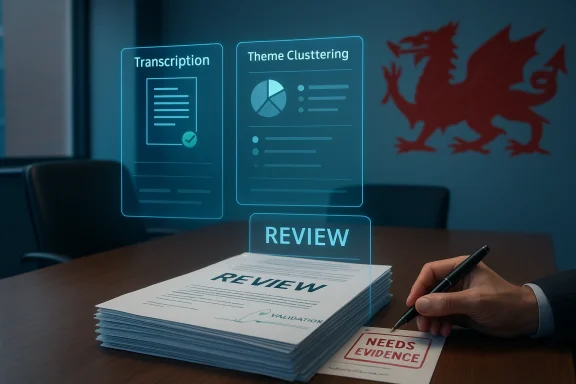
The Welsh Government’s defence is straightforward: officials say Copilot did not make the decision, and it did not write the final review. According to the government, the tool was used for producing full transcripts of interviews and for analyzing and grouping comments into common themes. Officials insist that the detailed analysis of evidence, assessment of options, and drafting of the review were carried out by Welsh Government staff. (record.senedd.wales)That explanation is plausible in a narrow technical sense, but it still leaves important governance questions unanswered. If an AI system is helping to frame themes from interviews, then it is no longer a passive office utility; it becomes part of the evidentiary chain. That means the public should reasonably expect traceable prompts, documented review steps, and clear sign-off showing where machine assistance ended and human judgement began. (gov.wales)
The government has, in fact, been explicit elsewhere that it sees AI as a productivity tool with risks attached. Its own board paper says the administration launched Copilot as part of a cross-organisational “AI Challenge,” and that it established communities of practice and drop-in support sessions. It also says teams have been asked to produce impact assessments for specific uses of Microsoft 365 Copilot, which suggests at least some awareness that context and controls matter. (gov.wales)
The Key Line Between Assistance and Judgment
The problem is not that Copilot was switched on. The problem is that the review appears to have relied on a process that may have been opaque to the very board whose future was under discussion. Ridgway’s view was blunt: if the findings needed validation, they should have returned to the board for scrutiny rather than being processed through AI and treated as settled. That is a classic governance failure mode: the consultation looks broad, but the accountability loop is narrow.There is also a semantic issue here. Governments often describe AI as helping with “summaries,” “themes,” or “transcripts,” as though those functions are neutral plumbing. In practice, however, the framing of evidence can shape outcomes as strongly as any formal recommendation. Once a machine is helping structure testimony, there is a risk that its convenience quietly becomes authority. That is where caution should replace enthusiasm. (gov.wales)
A few practical lessons emerge from the government’s own explanation:
- Transcription is not interpretation.
- Theme clustering is not neutral if the prompt design is hidden.
- A review that affects a public body’s existence needs visible human validation.
- Transparency matters as much as efficiency.
- The closer AI gets to a recommendation, the tighter the controls should be.
Why Industry Wales Became a Political Problem
Industry Wales had already been placed under strain by the audit findings published in 2025. The auditor general’s disclaimer was not a routine compliance notice; it signaled such serious accounting and evidence issues that an opinion could not be given at all. In public administration terms, that is radioactive. Once a body reaches that point, every subsequent decision about its future becomes politically charged, because ministers must show they are acting on evidence rather than simply managing embarrassment.The company’s defenders would say it performs a distinctive function by convening sector conversations that UK-wide bodies may not replicate. That argument is important because Wales has a small, highly interconnected industrial base, and policy delivery often depends on trust, local relationships, and sector-specific knowledge. Ridgway’s evidence suggests exactly that tension: some interview evidence supported trimming scope, but it also backed a Wales-specific body rather than relying on broader UK organizations.
From Useful Intermediary to Disposable Layer
That contradiction is what made the review so controversial. According to Ridgway, the evidence did not cleanly support the conclusion, and the recommendation seemed to leap to a wider abolition logic that the interviews themselves did not justify. When a review’s evidence and conclusion pull in different directions, confidence in the whole exercise evaporates.There is a broader institutional story here too. Industry forums like this often occupy a middle ground between government and business, where they are useful precisely because they are neither fully public nor fully private. But middle-ground institutions are also vulnerable when budgets tighten, audit problems emerge, or ministers want fewer bodies to explain. The result is often a search for “simplification” that risks flattening useful sector expertise. (caerphilly.observer)
This is why the closure matters beyond one company. Industry Wales was not merely a contractor; it was part of the architecture through which government tried to hear from industry. If that architecture is dismantled without a robust replacement, ministers may discover that consultation becomes more episodic, more London-centric, and less grounded in Wales-specific industrial realities. That would be an efficiency gain with a strategic cost.
Copilot and the Public-Sector AI Question
The Welsh Government has been trying to position itself as a serious early adopter of Microsoft Copilot. Board documents from 2024 describe pilots, productivity gains, and the need to understand both risks and costs. Officials have also talked up AI’s potential to reduce manual processing and free staff for higher-value work. In that sense, the Industry Wales controversy is not an isolated blunder; it is a stress test for a live policy direction. (gov.wales)But public-sector AI is not judged by efficiency slogans alone. It is judged by traceability, fairness, and whether decisions can be defended to auditors, committees, and the public. Welsh Government itself says AI must be embedded with ethical considerations, responsible use, and social partnership from the outset. That is an implicit admission that the technology is powerful enough to need guardrails from day one. (gov.wales)
What Copilot Can and Cannot Do
The strongest case for Copilot in government is obvious. It can transcribe meetings, summarise documents, and reduce clerical burden in ways that save staff time. It may be especially useful where disabled or neurodivergent employees benefit from faster drafting or more structured outputs, a point Welsh Government itself has acknowledged in its board paper. (gov.wales)But the technology is not a truth machine. It does not validate evidence, weigh political trade-offs, or understand the subtleties of institutional legitimacy. When AI is used to cluster interview comments, the model may impose structure that was not present in the raw evidence. That is why the chair’s warning about “reliance” on AI matters: it speaks to the danger of confusing organisation with judgement.
A responsible public-sector workflow should therefore look something like this:
- Collect evidence with clear consent and scope.
- Use AI only for bounded tasks such as transcription or first-pass categorisation.
- Preserve the raw inputs and the AI-assisted outputs.
- Have officials independently verify the themes and anomalies.
- Return contentious findings to a board or senior panel for challenge.
- Publish enough process detail for auditors and committees to test the logic.
Governance, Transparency, and the Committee Room
The Senedd Public Accounts and Public Administration Committee is exactly the kind of venue where AI-assisted policymaking gets tested in the real world. Its job is not to applaud modernization, but to interrogate whether public bodies are being managed properly. The committee had already received the review report in confidence, and Ridgway’s evidence turned what might have been a routine closure discussion into a question about process integrity. (record.senedd.wales)That matters because public confidence depends less on whether technology was used and more on how openly it was used. A committee can tolerate a lot if the chain of responsibility is clear. What it cannot tolerate easily is the suspicion that AI helped shape a politically convenient conclusion while the supporting material stayed opaque.
The Difference Between Efficiency and Accountability
A government can be both efficient and accountable, but only if it resists the temptation to treat those as interchangeable goals. Copilot may improve throughput, but it does not automatically improve legitimacy. In fact, if the underlying process is weak, AI can make the weakness faster and less visible. (gov.wales)There is another issue here that public bodies sometimes underestimate: the reputational spillover from one controversial case can slow adoption elsewhere. If staff hear that Copilot was involved in a review that led to dissolution and controversy, they may become more cautious, or more cynical, about the technology’s role. That would be unfortunate, because sensible AI adoption requires trust from the workforce as well as from ministers. (gov.wales)
The committee exchange also highlights a wider accountability problem in the public sector: too often, bodies are asked to trust that “officials handled it” when the visible evidence of that handling is thin. As Ridgway suggested, the review should have come back for validation and triangulation. That is not just a procedural nicety; it is how institutions protect themselves from drift, bias, and overconfidence.
The Wider Welsh AI Strategy
The Industry Wales row arrives while Wales is actively trying to build a reputation as an AI-capable administration. Welsh Government board papers talk about the productivity promise of AI, the role of digital transformation, and the pressure on public services to do more with less. Elsewhere in the Senedd, there have been positive references to Copilot, including its use in bilingual and administrative settings. The message from Cardiff Bay has been clear: AI is coming, and Wales wants to be seen as prepared. (gov.wales)But strategy is tested by edge cases, not by press releases. If Copilot works well in drafting notes or transcribing meetings, that is useful but uncontroversial. If it is involved, however indirectly, in a review that ends with the abolition of a state-owned body, the standards of proof have to rise dramatically. That is the difference between experimentation and governance. (gov.wales)
Enterprise vs. Consumer Thinking
One of the biggest public-sector mistakes in AI is importing consumer thinking into enterprise decision-making. A consumer might forgive a chatbot that drafts a messy email or misclassifies a note. A government cannot afford that casualness when the output informs jobs, contracts, organizational survival, or public spending priorities. (gov.wales)This is especially true in Wales, where public bodies often operate with lean teams and limited specialist capacity. AI can therefore look irresistibly attractive because it promises scale without large headcount increases. Yet the more attractive the promise, the more essential it becomes to prove that the gains are real and the errors are controlled. (gov.wales)
The Welsh Government’s own AI paper recognizes that adoption has implications for staff, rights, equality, and social justice. That is a healthier framing than pure efficiency talk, but it needs to be operationalized in a way that survives scrutiny. If not, each new controversy risks turning AI from a tool of modernization into a symbol of rushed decision-making. (gov.wales)
What This Means for Business and the Welsh Economy
For business audiences, the closure of Industry Wales is more than a bureaucratic shuffle. The body’s forums connected aerospace, automotive, technology, and net zero firms to government and one another, helping create a forum where policy and industry could meet on Welsh terms. Removing that platform may save money and simplify the state’s footprint, but it also risks weakening the connective tissue that helps smaller economies organize themselves. (caerphilly.observer)That said, the government is not wrong to question whether a body with serious audit failings should continue unchanged. Public confidence in industry support institutions depends on both relevance and probity. Once the latter is damaged, ministers are almost forced into a reset, even if the former remains valuable.
Sector Forums Still Matter
The deeper question is what replaces the old model. If ministers simply lean harder on UK-wide bodies, Wales may lose local specificity. If they build a leaner, more transparent substitute, they may preserve the benefits while reducing the governance risks.There is also a message here for companies that depend on public-sector engagement. Government is likely to demand stronger evidence, cleaner audit trails, and clearer value propositions from any intermediary it funds. That could improve discipline across the ecosystem, but it may also raise the bar for smaller organizations that lack the resources to manage more formal oversight. (caerphilly.observer)
The likely result is a recalibration rather than a wholesale retreat. Business groups will still need champions inside government, but those champions may have to operate through more centralized, more explicitly governed channels. That could make engagement tidier, though not necessarily more responsive. And responsiveness is often what local industry values most.
Strengths and Opportunities
The Welsh Government’s position is not without merit. It has acknowledged the risks of AI, not just the promise, and it has clearly tried to create internal guidance, impact assessments, and training around Copilot use. The controversy around Industry Wales also creates an opportunity to sharpen the rules for machine-assisted reviews, which could benefit the wider Welsh public sector if handled well. (gov.wales)- Clearer AI governance could emerge from the backlash.
- Better documentation standards may improve the quality of future reviews.
- Stronger board challenge might prevent weak conclusions from slipping through.
- Public scrutiny can force more transparent decision-making.
- Digital productivity gains remain real where tasks are bounded and controlled.
- Workforce support tools can aid staff if used responsibly.
- A reset of sector engagement may produce a leaner and cleaner model.
Risks and Concerns
The main risk is that the administration underestimates how much reputational damage follows from a single high-profile AI misstep. Even if Copilot only helped with transcription and thematic grouping, the perception that a machine was involved in closing a public body will linger. In politics, perception often hardens into fact long before the technical details are understood.- Opaque process design could erode trust in future reviews.
- Over-reliance on AI summaries may distort evidence.
- Weak validation chains can let flawed conclusions stand.
- Public-sector adoption fatigue may grow among staff.
- Business confidence could suffer if sector forums disappear abruptly.
- Ministerial defensiveness may deepen rather than resolve the controversy.
- Audit scrutiny may intensify across other Welsh bodies.
There is also a broader policy risk around AI adoption. If public servants conclude that using Copilot invites scrutiny only when things go wrong, they may either avoid the tool unnecessarily or use it quietly without proper documentation. Neither outcome is good. Responsible adoption needs confidence, but confidence must be earned through transparency. That is the missing ingredient in too many AI pilots. (gov.wales)
Looking Ahead
The next few months will be about more than one organization’s shutdown date. They will show whether Welsh ministers can explain, with evidence and discipline, how AI-assisted work was governed and why the final recommendation was still theirs rather than Copilot’s. They will also reveal whether the Senedd accepts the government’s explanation or treats the episode as a symptom of broader weaknesses in public-sector decision-making. (record.senedd.wales)The practical test is simple: can the government now set out a process that is transparent enough to reassure auditors, boards, and businesses, while still allowing officials to use modern tools productively? If it can, this controversy may become a useful case study. If it cannot, the Industry Wales affair may become shorthand for the dangers of rushed AI governance in public life. (gov.wales)
What to watch next:
- The final wind-down arrangements for Industry Wales before 31 March 2026.
- Any further Senedd questioning about the review methodology and Copilot’s role.
- Whether Welsh Government publishes stronger AI use safeguards for reviews and consultations.
- Whether successor arrangements preserve sector-specific engagement for Welsh industry.
- Whether other Welsh public bodies tighten their documentation and validation practices.
Source: theregister.com Wales used Copilot to justify axing publicly funded body
Last edited:
