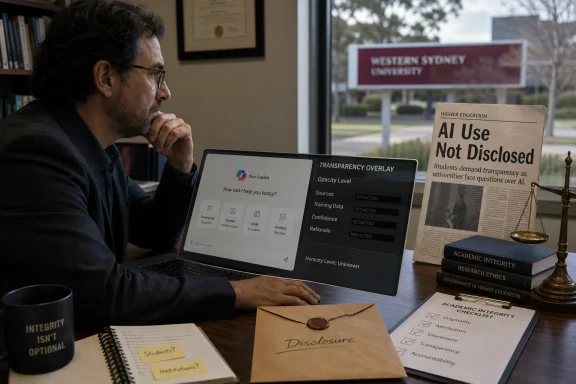
Western Sydney University pro vice-chancellor Cath Ellis admitted this week that Microsoft Copilot was used to help write an opinion piece for the Sydney Morning Herald, which was later removed after Guardian Australia asked about the undisclosed AI involvement in its preparation. The awkwardness was not merely that an academic used AI. It was that the undisclosed assistance sat inside an argument about students, shortcuts, and intellectual honesty. In one small publishing scandal, Australia got a clean view of the AI trust problem: the tools are becoming ordinary faster than the norms around them can harden.
The Ellis episode is easy to caricature because the irony is unusually neat. A senior university figure writes, with AI assistance, about students using large language models to cut corners; the use is not disclosed before publication; the newspaper pulls the piece after questions are asked. If a satirist invented the story, an editor might send it back for being too tidy.
But the better reading is not that one academic got caught doing something uniquely egregious. It is that the gap between institutional AI use and public AI expectations has become unstable. Many professionals already use ChatGPT, Copilot, Gemini, Claude, or similar systems as drafting aids, search companions, summarizers, coding assistants, and inbox triage machines. Many of the same people also recoil when they discover that a piece of work they were asked to trust had machine assistance hidden behind it.
That contradiction is not hypocrisy so much as a missing social contract. We have spent two years being told AI is a productivity layer, not a replacement for judgment. Yet the public is still rarely told where that layer begins and ends. The result is a trust vacuum in which every polished sentence can be treated as suspicious and every denial can sound lawyered.
The university, the masthead, and the author all sit inside that vacuum. The public does not know whether Copilot contributed a phrase, a structure, a paragraph, an argument, or a finished draft. That missing detail matters because AI use is not a single thing. It ranges from spellcheck-with-ambition to ghostwriting-with-a-human-nameplate.
That is not a niche technology adoption curve anymore. It is office software, homework help, coding support, shopping research, translation, legal-advice-adjacent brainstorming, and medical-question-adjacent searching. The AI layer is no longer waiting at the edge of the browser; it is being inserted into Microsoft 365, Google Workspace, search engines, smartphones, design tools, customer-service platforms, and operating systems.
Yet the Office of the Australian Information Commissioner’s latest privacy survey found that trust in AI remains vanishingly low. Only 4 percent of Australians reportedly trust AI, placing the sector barely above social media platforms and alongside data brokers in the public imagination. More strikingly, 79 percent say they want to know when AI is being used.
That last number is the key. Australians are not simply saying they want AI to disappear. They are saying they want visibility. The demand is less “ban the machine” than “do not smuggle the machine into places where human accountability is being sold.”
The problem for institutions is that transparency sounds easy until it becomes operational. Does an author need to disclose AI-assisted grammar edits? What about brainstorming? What about summarizing research? What about converting bullet points into prose? What about an executive who speaks notes into Copilot and then signs off on the resulting essay?
Those questions are tedious, but they are now unavoidable. The Ellis case became a controversy because the undisclosed AI use touched precisely the kind of work where authorship, judgment, and institutional credibility are the product. In a product review, a court filing, a student essay, a medical note, a news article, or a vice-chancellor’s opinion piece, the reader is not merely buying words. The reader is buying responsibility.
That does not mean AI-written work is automatically false or lazy. Human-written work has never been a guarantee of truth, originality, or effort. Anyone who has edited corporate commentary knows that ghostwriters, communications teams, interns, and consultants have long contributed to pieces signed by senior figures. The difference is that those arrangements exist inside known human chains of responsibility, even if the chains are sometimes opaque.
AI adds a different kind of uncertainty. A language model has no duty to the reader, no reputation to preserve, no professional standard to internalize, and no memory of what it owes the public. It can help a careful author express an idea more clearly, but it can also launder a vague brief into confident prose that nobody truly owns.
That is why disclosure is becoming a kind of metadata for trust. It tells the reader not just that a tool was used, but that the publisher has thought about the boundary between assistance and authorship. A crude disclosure — “AI was used in preparing this article” — may be insufficient, but even that begins to answer the most important question: is someone trying to hide the process?
The harder version is process disclosure. A serious newsroom, university, law firm, or government agency should be able to say whether AI was used for transcription, research summaries, drafting, editing, image generation, data analysis, or final prose. The disclosure does not need to become a confessional footnote on every comma. It does need to make clear where the human accountability sits.
The irony is that organizations resisting disclosure may be slowing the normalization they claim to want. If AI advocates believe the technology is a legitimate professional aid, they should be eager to describe its legitimate use. Secrecy teaches the opposite lesson: that AI is something to be hidden until someone else spots the seams.
That context makes the Ellis affair unusually damaging. Universities have been telling students that process matters, that disclosure matters, and that the point of assessment is not merely to produce text but to demonstrate learning. A senior academic using AI without disclosure in a public argument about student shortcuts makes that message look asymmetrical.
The defensible university position is not “students may never use AI.” That position is already collapsing under the weight of normal software integration. A student using Copilot in Word, Gemini in Docs, Grammarly’s generative features, or a browser-based assistant may not experience the boundary between ordinary editing and AI assistance as bright or obvious.
The more durable position is that students must disclose material assistance, understand the content they submit, and remain responsible for errors, omissions, and fabricated material. That is also the standard universities should apply to themselves. If institutional leaders use AI to prepare public arguments, they should say so before publication, not after a rival newsroom asks.
There is a pedagogical opportunity here, but it requires humility. A university could have published a useful opinion piece saying, in effect: “I used Copilot to test how these systems shape argument, and here is what that taught me about student assessment.” That would have been timely, practical, and honest. Instead, the undisclosed use turned the piece into evidence for the very suspicion it sought to manage.
The lesson for academia is blunt. If AI is now part of scholarly and administrative work, universities need rules that bind upward as well as downward. Students will not take disclosure norms seriously if professors and executives treat them as reputational inconveniences.
The Sydney Morning Herald’s decision to remove the piece after Guardian Australia’s inquiries reflects the sensitivity of that environment. Opinion pages are not merely containers for arguments; they are prestige spaces built around the authority of named voices. If a reader thinks the name on the page is functioning as a brand wrapper for machine-shaped text, the bargain changes.
This is not entirely new. Opinion pieces by executives, politicians, vice-chancellors, and CEOs have long passed through communications staff. Some are heavily edited. Some are drafted by teams. Some are polished to within an inch of their lives. Readers may understand this vaguely, but they still expect the named author to stand behind the argument and to have contributed the judgment that makes the piece worth publishing.
AI complicates that expectation because it can do more than polish. It can create structure, supply analogies, mimic seriousness, and fill gaps with fluent connective tissue. That is useful if the human author is directing the machine and checking every claim. It is corrosive if the machine is doing the intellectual assembly while the human supplies only status.
For newsrooms, the policy answer cannot be a vague promise that humans remain “in the loop.” The loop is the issue. A human who glances over a generated draft is not the same as a human who uses AI to clean up prose after doing the reporting, thinking, and verification. The disclosure standard should track that difference.
The media also has to be careful not to create an impossible purity test. If every use of transcription software, translation aid, grammar tool, or headline brainstorm becomes scandalous, disclosure will become theatrical rather than informative. The real line is materiality: did the AI meaningfully shape the work the audience is being asked to trust?
The director of RuPaul’s latest film, Stop! That! Train!, reportedly had to deny that scenes were made with AI after early viewers suspected machine involvement. That kind of public suspicion will become more common as generative tools improve and as audiences become more attuned to synthetic aesthetics. The risk is not only that AI work goes undisclosed; it is that human work becomes permanently vulnerable to accusation.
This is a serious cultural cost. Writers with plain styles, artists using digital tools, filmmakers working under budget constraints, and non-native English speakers polishing prose can all be swept into the suspicion economy. The old insult was “this looks Photoshopped.” The new insult is “this reads like AI.”
That accusation is powerful because it attacks effort as much as authenticity. It says the creator did not struggle, did not think, did not care. In a world where audiences are flooded with low-effort synthetic material, that reaction is understandable. But if it becomes the default posture, trust collapses in both directions: people distrust AI-assisted work, and creators distrust audiences to judge fairly.
This is why disclosure helps honest creators as well as skeptical readers. A clear statement of process gives audiences something firmer than vibes. It also gives creators a way to distinguish between ordinary digital assistance and deceptive substitution.
The alternative is a miserable equilibrium. Institutions hide AI use because they fear backlash; audiences assume concealment because institutions hide; every suspicious artifact becomes a mini-scandal; and the people using AI responsibly are punished alongside those using it to fake competence.
Reports this year have described a sharp rise in Fair Work applications, including claims that appear to have been generated with little understanding, weak prospects, or fabricated legal material. The commission has warned of an unsustainable increase in workload, and the government has moved toward giving it stronger powers to reject frivolous or vexatious applications. That is not just a legal administration story. It is a preview of what happens across institutions when text production stops being a meaningful filter.
For decades, bureaucracy has used paperwork as a kind of friction. That friction was often unfair, exclusionary, and maddening, but it also served as a rough signal that someone had invested time in a claim. AI breaks that signal. A person can now produce a lengthy, confident, formatted document with minimal understanding of the law, the facts, or the consequences.
The same dynamic is visible in job applications, customer complaints, public consultations, grant proposals, school assignments, and support tickets. Recipients respond by adding their own AI filters, which leads applicants to add more AI optimization, which leads institutions to distrust the entire intake stream. The result is an arms race of automated expression and automated suspicion.
This matters for WindowsForum readers because the workplace AI stack is arriving through familiar enterprise channels. Copilot is not an exotic app that users must seek out. It is becoming an ambient capability inside productivity software, identity systems, collaboration tools, and document workflows. IT departments will be asked not only to deploy or block these systems, but to help define the evidentiary status of the outputs they produce.
That is a governance problem, not a licensing problem. The question is not simply whether an organization has Copilot enabled. It is whether the organization knows when Copilot has materially shaped a document, whether sensitive data entered the prompt stream, whether generated claims were verified, and whether the final human signer understood what they approved.
For Windows users and administrators, this is the crucial shift. AI is no longer just something employees do in a separate tab that can be blocked by web filtering. It is increasingly woven into Word, Outlook, Teams, Edge, Windows, GitHub, Power Platform, and the security stack. The boundary between “using AI” and “using Microsoft software” is getting less obvious by design.
That makes disclosure harder. If Copilot summarizes a Teams meeting, drafts follow-up actions, rewrites a paragraph, and suggests a response, at what point has a human-authored document become AI-assisted? If a manager accepts generated language inside Word without thinking much about it, does the organization treat that as routine editing or machine contribution? If a university executive sends notes to a communications team and the team uses Copilot to produce a draft, who discloses what?
Microsoft can provide audit logs, admin controls, data-boundary promises, sensitivity labels, and policy templates. Those are necessary. They are not sufficient. The harder question is cultural: whether organizations treat AI output as a draft requiring accountable review or as a productivity miracle that lets everyone move faster without admitting what changed.
Enterprise IT will be caught in the middle. Legal wants reduced risk. Communications wants speed. Staff want convenience. Security wants data controls. Executives want transformation metrics. Users want to know whether they are allowed to use the shiny button that appeared in their software.
The Ellis episode is a reminder that the reputational blast radius of AI use may exceed the technical risk. No data breach is required for damage. No hallucinated citation is required. Sometimes the mere failure to disclose enough process at the right time is sufficient.
The first distinction is between private assistance and public representation. Using AI to summarize a long internal meeting is not the same as using it to draft a signed public essay. Using AI to generate code suggestions is not the same as using it to produce a legal claim. Using AI to rephrase a sentence is not the same as using it to build an argument.
The second distinction is between low-stakes convenience and high-stakes accountability. A restaurant blurb, a calendar summary, or a first draft of a routine email may not require ceremony. A medical note, disciplinary decision, academic assessment, public policy submission, legal filing, security advisory, or media article does.
The third distinction is between disclosure to the organization and disclosure to the public. An employer may need internal logging or attestation even when the public does not need a label. A reader, client, patient, student, or court may need explicit disclosure when AI materially shaped the work being presented.
The fourth distinction is between use and reliance. It is one thing to ask a model for possible angles. It is another to rely on its factual claims. The former may be a brainstorming aid. The latter demands verification, and the person signing off should be accountable for the result.
The worst policies will pretend that these distinctions are too complicated and retreat into slogans. The best will create practical defaults: disclose material AI drafting in public-facing signed work, prohibit undisclosed AI generation in assessment or legal contexts where authorship is central, require verification of factual claims, and preserve records where disputes are foreseeable.
The right starting point is a map of where AI already exists. Many organizations underestimate this because they think in terms of standalone subscriptions. In reality, AI features may be present in browsers, office suites, endpoint tools, CRM systems, HR platforms, service desks, design apps, developer environments, and shadow IT accounts.
The next step is classification. Not every AI interaction deserves the same level of governance. An internal draft email does not need the same control structure as a board paper, a termination letter, a student assessment, a regulatory submission, or a public byline. The governance burden should rise with the stakes.
Windows-heavy environments have an advantage if they use it. Identity, device management, data loss prevention, sensitivity labels, retention policies, and audit logs can all become part of AI governance. The danger is treating those controls as an afterthought to a procurement decision rather than as prerequisites for deployment.
Training also has to move beyond prompt tips. Users need to understand that fluent output is not verified output, that AI can fabricate legal and factual claims, that confidential data may create downstream risk, and that disclosure is not an admission of incompetence. The cultural message should be simple: using AI may be permitted, but pretending not to have used it when it materially shaped the work is not.
That distinction will matter more as AI becomes less visible. Today, users may know they opened ChatGPT or clicked Copilot. Tomorrow, the assistance may be embedded in autocomplete, suggested replies, meeting summaries, and workflow automation. If organizations wait until the tool feels invisible, retrofitting trust will be much harder.
Those fears are sometimes overstated. AI can genuinely help people write more clearly, translate across languages, navigate bureaucracy, understand code, and access information. For people with disabilities, language barriers, limited time, or limited institutional knowledge, these tools can reduce real barriers. A blanket moral panic would throw away those benefits.
But trust is not built by insisting that the benefits are obvious. Trust is built by showing the work. If an AI tool helped produce something important, say how. If a human verified the facts, say that too. If the tool was used only for grammar or formatting, be precise enough that the disclosure does not imply more than occurred.
The public’s low trust in AI is not irrational when so many deployments arrive through stealth, compulsion, or vague corporate enthusiasm. People are told AI will improve services, but they encounter chatbots that cannot solve problems. They are told AI will empower workers, but they see surveillance, deskilling, and job-cutting narratives. They are told AI will enhance creativity, but they are flooded with slop.
That word, slop, has become popular because it captures the emotional texture of the problem. It is not just that machine-generated material may be wrong. It is that it can feel like an insult to attention. Why should a reader, viewer, student, customer, or colleague invest care in something the creator may not have cared enough to make?
This is the danger for institutions. Once audiences suspect that effort has been faked, every interaction becomes more expensive. More proof is required. More skepticism is applied. More human time is spent sorting genuine work from synthetic filler. AI then delivers productivity gains locally while imposing trust costs system-wide.
A workable rule does not require labeling every spellcheck or autocomplete suggestion. It does require disclosure when AI materially shapes a signed, public, high-stakes, or evaluative work. The exact wording can vary, but the principle should not: readers deserve to know when the work they are judging was substantially assisted by a system that has no accountability of its own.
The Ellis incident will pass, as publishing controversies usually do, but the pattern will not. AI is moving from novelty to infrastructure, and infrastructure becomes trustworthy only when people understand its limits, its operators, and its failure modes. The next phase of adoption will not be won by organizations that hide the machine behind human signatures; it will be won by those confident enough to say where the machine helped, where the human judged, and who remains answerable when the words matter.
 The Scandal Was Small, but the Signal Was Loud
The Ellis episode is easy to caricature because the irony is unusually neat. A senior university figure writes, with AI assistance, about students using large language models to cut corners; the use is not disclosed before publication; the newspaper pulls the piece after questions are asked. If a satirist invented the story, an editor might send it back for being too tidy.But the better reading is not that one academic got caught doing something uniquely egregious. It is that the gap between institutional AI use and public AI expectations has become unstable. Many professionals already use ChatGPT, Copilot, Gemini, Claude, or similar systems as drafting aids, search companions, summarizers, coding assistants, and inbox triage machines. Many of the same people also recoil when they discover that a piece of work they were asked to trust had machine assistance hidden behind it.
That contradiction is not hypocrisy so much as a missing social contract. We have spent two years being told AI is a productivity layer, not a replacement for judgment. Yet the public is still rarely told where that layer begins and ends. The result is a trust vacuum in which every polished sentence can be treated as suspicious and every denial can sound lawyered.
The university, the masthead, and the author all sit inside that vacuum. The public does not know whether Copilot contributed a phrase, a structure, a paragraph, an argument, or a finished draft. That missing detail matters because AI use is not a single thing. It ranges from spellcheck-with-ambition to ghostwriting-with-a-human-nameplate.
Australia Is Using AI and Distrusting It at the Same Time
The Roy Morgan figures reported this week make the contradiction impossible to dismiss. A reported 13.6 million Australians aged over 14, or 58 percent of that population, now use AI each month. ChatGPT leads the pack, followed by Google Gemini and Microsoft Copilot, and usage is highest among adults in the prime working-age bands.That is not a niche technology adoption curve anymore. It is office software, homework help, coding support, shopping research, translation, legal-advice-adjacent brainstorming, and medical-question-adjacent searching. The AI layer is no longer waiting at the edge of the browser; it is being inserted into Microsoft 365, Google Workspace, search engines, smartphones, design tools, customer-service platforms, and operating systems.
Yet the Office of the Australian Information Commissioner’s latest privacy survey found that trust in AI remains vanishingly low. Only 4 percent of Australians reportedly trust AI, placing the sector barely above social media platforms and alongside data brokers in the public imagination. More strikingly, 79 percent say they want to know when AI is being used.
That last number is the key. Australians are not simply saying they want AI to disappear. They are saying they want visibility. The demand is less “ban the machine” than “do not smuggle the machine into places where human accountability is being sold.”
The problem for institutions is that transparency sounds easy until it becomes operational. Does an author need to disclose AI-assisted grammar edits? What about brainstorming? What about summarizing research? What about converting bullet points into prose? What about an executive who speaks notes into Copilot and then signs off on the resulting essay?
Those questions are tedious, but they are now unavoidable. The Ellis case became a controversy because the undisclosed AI use touched precisely the kind of work where authorship, judgment, and institutional credibility are the product. In a product review, a court filing, a student essay, a medical note, a news article, or a vice-chancellor’s opinion piece, the reader is not merely buying words. The reader is buying responsibility.
Disclosure Is Becoming the New Metadata
For years, digital trust was mostly about provenance in the narrow sense: who published this, where did it appear, and does the domain look legitimate? Generative AI scrambles that model because a document can now come from a reputable institution while still being materially shaped by a system that invents citations, flattens nuance, and optimizes for plausibility.That does not mean AI-written work is automatically false or lazy. Human-written work has never been a guarantee of truth, originality, or effort. Anyone who has edited corporate commentary knows that ghostwriters, communications teams, interns, and consultants have long contributed to pieces signed by senior figures. The difference is that those arrangements exist inside known human chains of responsibility, even if the chains are sometimes opaque.
AI adds a different kind of uncertainty. A language model has no duty to the reader, no reputation to preserve, no professional standard to internalize, and no memory of what it owes the public. It can help a careful author express an idea more clearly, but it can also launder a vague brief into confident prose that nobody truly owns.
That is why disclosure is becoming a kind of metadata for trust. It tells the reader not just that a tool was used, but that the publisher has thought about the boundary between assistance and authorship. A crude disclosure — “AI was used in preparing this article” — may be insufficient, but even that begins to answer the most important question: is someone trying to hide the process?
The harder version is process disclosure. A serious newsroom, university, law firm, or government agency should be able to say whether AI was used for transcription, research summaries, drafting, editing, image generation, data analysis, or final prose. The disclosure does not need to become a confessional footnote on every comma. It does need to make clear where the human accountability sits.
The irony is that organizations resisting disclosure may be slowing the normalization they claim to want. If AI advocates believe the technology is a legitimate professional aid, they should be eager to describe its legitimate use. Secrecy teaches the opposite lesson: that AI is something to be hidden until someone else spots the seams.
Universities Cannot Preach Process While Hiding Their Own
The academy has been one of the earliest battlefields for generative AI because student writing is both easy to generate and hard to police. Universities have spent the last few years rewriting assessment rules, warning students about academic misconduct, experimenting with oral defenses, and reconsidering take-home essays. They have also learned that AI detectors are unreliable enough to create their own injustices.That context makes the Ellis affair unusually damaging. Universities have been telling students that process matters, that disclosure matters, and that the point of assessment is not merely to produce text but to demonstrate learning. A senior academic using AI without disclosure in a public argument about student shortcuts makes that message look asymmetrical.
The defensible university position is not “students may never use AI.” That position is already collapsing under the weight of normal software integration. A student using Copilot in Word, Gemini in Docs, Grammarly’s generative features, or a browser-based assistant may not experience the boundary between ordinary editing and AI assistance as bright or obvious.
The more durable position is that students must disclose material assistance, understand the content they submit, and remain responsible for errors, omissions, and fabricated material. That is also the standard universities should apply to themselves. If institutional leaders use AI to prepare public arguments, they should say so before publication, not after a rival newsroom asks.
There is a pedagogical opportunity here, but it requires humility. A university could have published a useful opinion piece saying, in effect: “I used Copilot to test how these systems shape argument, and here is what that taught me about student assessment.” That would have been timely, practical, and honest. Instead, the undisclosed use turned the piece into evidence for the very suspicion it sought to manage.
The lesson for academia is blunt. If AI is now part of scholarly and administrative work, universities need rules that bind upward as well as downward. Students will not take disclosure norms seriously if professors and executives treat them as reputational inconveniences.
The Media’s AI Problem Is Really an Authorship Problem
News organizations have a particularly acute version of the same dilemma. Readers already suspect that parts of the media economy are optimized for volume over judgment. Generative AI makes that suspicion easier to apply everywhere, even when it is wrong.The Sydney Morning Herald’s decision to remove the piece after Guardian Australia’s inquiries reflects the sensitivity of that environment. Opinion pages are not merely containers for arguments; they are prestige spaces built around the authority of named voices. If a reader thinks the name on the page is functioning as a brand wrapper for machine-shaped text, the bargain changes.
This is not entirely new. Opinion pieces by executives, politicians, vice-chancellors, and CEOs have long passed through communications staff. Some are heavily edited. Some are drafted by teams. Some are polished to within an inch of their lives. Readers may understand this vaguely, but they still expect the named author to stand behind the argument and to have contributed the judgment that makes the piece worth publishing.
AI complicates that expectation because it can do more than polish. It can create structure, supply analogies, mimic seriousness, and fill gaps with fluent connective tissue. That is useful if the human author is directing the machine and checking every claim. It is corrosive if the machine is doing the intellectual assembly while the human supplies only status.
For newsrooms, the policy answer cannot be a vague promise that humans remain “in the loop.” The loop is the issue. A human who glances over a generated draft is not the same as a human who uses AI to clean up prose after doing the reporting, thinking, and verification. The disclosure standard should track that difference.
The media also has to be careful not to create an impossible purity test. If every use of transcription software, translation aid, grammar tool, or headline brainstorm becomes scandalous, disclosure will become theatrical rather than informative. The real line is materiality: did the AI meaningfully shape the work the audience is being asked to trust?
The Witch-Hunt Phase Was Predictable
One of the uglier side effects of undisclosed AI use is that it trains audiences to become amateur forensic analysts. People begin looking for tells: bland transitions, symmetrical paragraphs, overused phrases, excessive balance, strange metaphors, hallucinated specifics, or that unmistakable “on the one hand” rhythm of synthetic neutrality. Sometimes they will be right. Often they will be wrong.The director of RuPaul’s latest film, Stop! That! Train!, reportedly had to deny that scenes were made with AI after early viewers suspected machine involvement. That kind of public suspicion will become more common as generative tools improve and as audiences become more attuned to synthetic aesthetics. The risk is not only that AI work goes undisclosed; it is that human work becomes permanently vulnerable to accusation.
This is a serious cultural cost. Writers with plain styles, artists using digital tools, filmmakers working under budget constraints, and non-native English speakers polishing prose can all be swept into the suspicion economy. The old insult was “this looks Photoshopped.” The new insult is “this reads like AI.”
That accusation is powerful because it attacks effort as much as authenticity. It says the creator did not struggle, did not think, did not care. In a world where audiences are flooded with low-effort synthetic material, that reaction is understandable. But if it becomes the default posture, trust collapses in both directions: people distrust AI-assisted work, and creators distrust audiences to judge fairly.
This is why disclosure helps honest creators as well as skeptical readers. A clear statement of process gives audiences something firmer than vibes. It also gives creators a way to distinguish between ordinary digital assistance and deceptive substitution.
The alternative is a miserable equilibrium. Institutions hide AI use because they fear backlash; audiences assume concealment because institutions hide; every suspicious artifact becomes a mini-scandal; and the people using AI responsibly are punished alongside those using it to fake competence.
Fair Work Shows What Happens When Friction Disappears
The Fair Work Commission’s AI problem reveals another side of the same story. Generative AI does not merely change how polished documents look. It changes the cost of producing them. When the cost of drafting a plausible legal-style application falls toward zero, systems built around older assumptions about effort can be overwhelmed.Reports this year have described a sharp rise in Fair Work applications, including claims that appear to have been generated with little understanding, weak prospects, or fabricated legal material. The commission has warned of an unsustainable increase in workload, and the government has moved toward giving it stronger powers to reject frivolous or vexatious applications. That is not just a legal administration story. It is a preview of what happens across institutions when text production stops being a meaningful filter.
For decades, bureaucracy has used paperwork as a kind of friction. That friction was often unfair, exclusionary, and maddening, but it also served as a rough signal that someone had invested time in a claim. AI breaks that signal. A person can now produce a lengthy, confident, formatted document with minimal understanding of the law, the facts, or the consequences.
The same dynamic is visible in job applications, customer complaints, public consultations, grant proposals, school assignments, and support tickets. Recipients respond by adding their own AI filters, which leads applicants to add more AI optimization, which leads institutions to distrust the entire intake stream. The result is an arms race of automated expression and automated suspicion.
This matters for WindowsForum readers because the workplace AI stack is arriving through familiar enterprise channels. Copilot is not an exotic app that users must seek out. It is becoming an ambient capability inside productivity software, identity systems, collaboration tools, and document workflows. IT departments will be asked not only to deploy or block these systems, but to help define the evidentiary status of the outputs they produce.
That is a governance problem, not a licensing problem. The question is not simply whether an organization has Copilot enabled. It is whether the organization knows when Copilot has materially shaped a document, whether sensitive data entered the prompt stream, whether generated claims were verified, and whether the final human signer understood what they approved.
Microsoft’s Role Is Bigger Than a Button in Word
Microsoft Copilot’s appearance in this story is not incidental. Microsoft has done more than almost any company to make generative AI feel like a normal layer of office work. That strategy is commercially rational and technically impressive, but it also moves the trust problem from the web browser into the enterprise desktop.For Windows users and administrators, this is the crucial shift. AI is no longer just something employees do in a separate tab that can be blocked by web filtering. It is increasingly woven into Word, Outlook, Teams, Edge, Windows, GitHub, Power Platform, and the security stack. The boundary between “using AI” and “using Microsoft software” is getting less obvious by design.
That makes disclosure harder. If Copilot summarizes a Teams meeting, drafts follow-up actions, rewrites a paragraph, and suggests a response, at what point has a human-authored document become AI-assisted? If a manager accepts generated language inside Word without thinking much about it, does the organization treat that as routine editing or machine contribution? If a university executive sends notes to a communications team and the team uses Copilot to produce a draft, who discloses what?
Microsoft can provide audit logs, admin controls, data-boundary promises, sensitivity labels, and policy templates. Those are necessary. They are not sufficient. The harder question is cultural: whether organizations treat AI output as a draft requiring accountable review or as a productivity miracle that lets everyone move faster without admitting what changed.
Enterprise IT will be caught in the middle. Legal wants reduced risk. Communications wants speed. Staff want convenience. Security wants data controls. Executives want transformation metrics. Users want to know whether they are allowed to use the shiny button that appeared in their software.
The Ellis episode is a reminder that the reputational blast radius of AI use may exceed the technical risk. No data breach is required for damage. No hallucinated citation is required. Sometimes the mere failure to disclose enough process at the right time is sufficient.
Policy Cannot Be a PDF Nobody Reads
Most organizations now need an AI policy, but many are writing the wrong kind. A policy that says “AI may be used responsibly” is little more than a liability charm. A policy that bans everything will be ignored the moment AI appears inside approved software. A useful policy must distinguish between categories of use and levels of disclosure.The first distinction is between private assistance and public representation. Using AI to summarize a long internal meeting is not the same as using it to draft a signed public essay. Using AI to generate code suggestions is not the same as using it to produce a legal claim. Using AI to rephrase a sentence is not the same as using it to build an argument.
The second distinction is between low-stakes convenience and high-stakes accountability. A restaurant blurb, a calendar summary, or a first draft of a routine email may not require ceremony. A medical note, disciplinary decision, academic assessment, public policy submission, legal filing, security advisory, or media article does.
The third distinction is between disclosure to the organization and disclosure to the public. An employer may need internal logging or attestation even when the public does not need a label. A reader, client, patient, student, or court may need explicit disclosure when AI materially shaped the work being presented.
The fourth distinction is between use and reliance. It is one thing to ask a model for possible angles. It is another to rely on its factual claims. The former may be a brainstorming aid. The latter demands verification, and the person signing off should be accountable for the result.
The worst policies will pretend that these distinctions are too complicated and retreat into slogans. The best will create practical defaults: disclose material AI drafting in public-facing signed work, prohibit undisclosed AI generation in assessment or legal contexts where authorship is central, require verification of factual claims, and preserve records where disputes are foreseeable.
The Practical Lesson for Windows Shops Is Not to Wait for a Scandal
For administrators, the temptation is to treat AI trust as a communications or compliance issue. That is a mistake. The technical environment determines what users experience as normal, what gets logged, what can be investigated, and what defaults shape behavior. If Copilot and similar tools are enabled broadly before norms exist, the organization may discover its policy only after an embarrassing incident.The right starting point is a map of where AI already exists. Many organizations underestimate this because they think in terms of standalone subscriptions. In reality, AI features may be present in browsers, office suites, endpoint tools, CRM systems, HR platforms, service desks, design apps, developer environments, and shadow IT accounts.
The next step is classification. Not every AI interaction deserves the same level of governance. An internal draft email does not need the same control structure as a board paper, a termination letter, a student assessment, a regulatory submission, or a public byline. The governance burden should rise with the stakes.
Windows-heavy environments have an advantage if they use it. Identity, device management, data loss prevention, sensitivity labels, retention policies, and audit logs can all become part of AI governance. The danger is treating those controls as an afterthought to a procurement decision rather than as prerequisites for deployment.
Training also has to move beyond prompt tips. Users need to understand that fluent output is not verified output, that AI can fabricate legal and factual claims, that confidential data may create downstream risk, and that disclosure is not an admission of incompetence. The cultural message should be simple: using AI may be permitted, but pretending not to have used it when it materially shaped the work is not.
That distinction will matter more as AI becomes less visible. Today, users may know they opened ChatGPT or clicked Copilot. Tomorrow, the assistance may be embedded in autocomplete, suggested replies, meeting summaries, and workflow automation. If organizations wait until the tool feels invisible, retrofitting trust will be much harder.
The Real Cost of Hidden Assistance
The Ellis affair hurts because it taps into a fear broader than one opinion page. People worry that institutions are replacing effort with automation while continuing to charge the old price of human attention. They worry that expertise is becoming a costume worn by generated prose. They worry that they are being asked to trust outputs whose origins have been deliberately blurred.Those fears are sometimes overstated. AI can genuinely help people write more clearly, translate across languages, navigate bureaucracy, understand code, and access information. For people with disabilities, language barriers, limited time, or limited institutional knowledge, these tools can reduce real barriers. A blanket moral panic would throw away those benefits.
But trust is not built by insisting that the benefits are obvious. Trust is built by showing the work. If an AI tool helped produce something important, say how. If a human verified the facts, say that too. If the tool was used only for grammar or formatting, be precise enough that the disclosure does not imply more than occurred.
The public’s low trust in AI is not irrational when so many deployments arrive through stealth, compulsion, or vague corporate enthusiasm. People are told AI will improve services, but they encounter chatbots that cannot solve problems. They are told AI will empower workers, but they see surveillance, deskilling, and job-cutting narratives. They are told AI will enhance creativity, but they are flooded with slop.
That word, slop, has become popular because it captures the emotional texture of the problem. It is not just that machine-generated material may be wrong. It is that it can feel like an insult to attention. Why should a reader, viewer, student, customer, or colleague invest care in something the creator may not have cared enough to make?
This is the danger for institutions. Once audiences suspect that effort has been faked, every interaction becomes more expensive. More proof is required. More skepticism is applied. More human time is spent sorting genuine work from synthetic filler. AI then delivers productivity gains locally while imposing trust costs system-wide.
The Copilot Footnote That Every Institution Now Needs
The most concrete lesson from this week is that disclosure cannot remain a vibes-based decision made after publication. It needs to be designed into workflows before the next controversy. That is true for universities, newsrooms, courts, public agencies, software projects, and ordinary companies trying to keep Microsoft 365 from becoming an unmanaged authorship engine.A workable rule does not require labeling every spellcheck or autocomplete suggestion. It does require disclosure when AI materially shapes a signed, public, high-stakes, or evaluative work. The exact wording can vary, but the principle should not: readers deserve to know when the work they are judging was substantially assisted by a system that has no accountability of its own.
- Organizations should define “material AI assistance” before disputes arise, especially for public statements, legal documents, academic work, personnel decisions, and published analysis.
- Disclosure should describe the role of the tool, not merely name the product, because brainstorming, editing, summarizing, and drafting carry different trust implications.
- Human sign-off should mean factual verification and intellectual ownership, not a quick skim of fluent machine prose.
- IT administrators should treat AI deployment as a governance project involving identity, logging, data protection, retention, and user training.
- Institutions that demand AI transparency from students, employees, applicants, or citizens should apply the same standard to their own public work.
The Ellis incident will pass, as publishing controversies usually do, but the pattern will not. AI is moving from novelty to infrastructure, and infrastructure becomes trustworthy only when people understand its limits, its operators, and its failure modes. The next phase of adoption will not be won by organizations that hide the machine behind human signatures; it will be won by those confident enough to say where the machine helped, where the human judged, and who remains answerable when the words matter.
References
- Primary source: The Guardian
Published: 2026-06-05T06:50:31.343794
A uni professor admitted using AI to write an opinion piece. Here’s what it revealed about trust in the technology | Australia news | The Guardian
Without disclosing that work has been generated using the technology, faith in existing industries will continue to be underminedwww.theguardian.com - Related coverage: oaic.gov.au
Australians more concerned about privacy as trust in AI languishes, survey finds | OAIC
The Australian Community Attitudes to Privacy Survey (ACAPS), conducted by the OAIC every 3 years, provides a comprehensive view of Australians’ privacy attitudes and experiences, including how recent events have impacted them.www.oaic.gov.au - Related coverage: abc.net.au
What do the pope and most Australians have in common? Neither trust AI companies - ABC News
Most Australians appear to distrust and dislike artificial intelligence despite using technology more than people in other countries. www.abc.net.au