

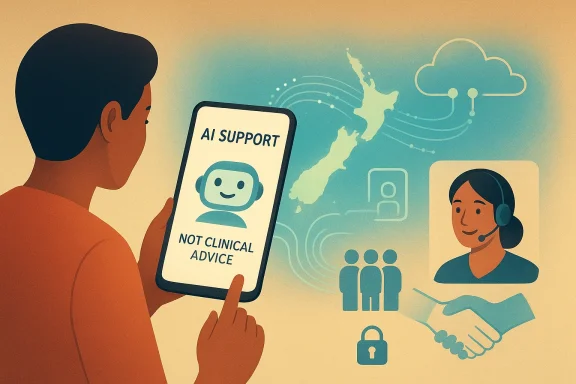
Whakarongorau Aotearoa is making one of the clearest statements yet about where AI belongs in healthcare: not at the end of the line, but at the very front of it. The New Zealand telehealth provider is preparing to launch a Microsoft Azure AI-powered Welcome service that greets people instantly in digital channels, gathers context, and keeps them supported until a trained human takes over. The move is designed to reduce waiting, reduce repetition, and improve the quality of every handoff, while preserving a firm boundary between empathetic digital support and clinical advice.
Whakarongorau Aotearoa / New Zealand Telehealth Services is not a niche call centre experiment. It is a national service provider handling more than 7,000 interactions a day and reaching more than 735,000 people a year across health, mental health, and social support channels, including Healthline, Emergency Triage, 1737 Need to talk?, and Family and Sexual Harm services. That scale matters because it changes the nature of the problem: the challenge is no longer simply answering the phone, but managing a continuous stream of people who need timely, appropriate, and emotionally safe support.
The new Welcome service is an attempt to solve a very specific bottleneck. When people contact Whakarongorau by text or webchat, a human kaimahi typically has to spend precious time collecting the basics: who the person is, why they are reaching out, what they need, and how urgent the situation might be. That front-end work is essential, but it delays the start of meaningful support, and in a high-stress setting, delay can make the experience feel colder and more disconnected than it needs to be.
The service is also a response to a structural trend in New Zealand mental health support. According to the Microsoft Source account, the number of people seeking help who are at risk of harming themselves or others has risen sharply since 2019, while mental health sessions now take significantly longer on average. That is the kind of operational pressure where small efficiencies can become meaningful service gains, especially when the service is trying to maintain empathy, privacy, and safety at the same time.
This is not Whakarongorau’s first step toward a more digital operating model. Microsoft reported in 2024 that the provider had become an anchor tenant of the new New Zealand hyperscale cloud region, with a broader digital innovation strategy centered on analytics and AI tools that help clinicians work more effectively while safeguarding health data. The Welcome service is therefore best understood as the next phase of a longer modernization journey, not a standalone pilot.
The service is especially notable because it addresses the pre-conversation phase. Many AI deployments focus on answering questions or generating summaries. Welcome instead handles the awkward but important work of making the exchange feel less abrupt, more contextual, and more human before a clinician or support worker joins. That is a subtle distinction, but in telehealth it is the difference between automation as a replacement and automation as a bridge. That nuance matters.
It also changes the experience for people waiting in queue. Rather than sitting in silence, they receive acknowledgment, pacing, and reassurance, which can reduce anxiety in precisely the moment when uncertainty is highest. That is not a replacement for care, but it can be a meaningful pre-care layer that improves trust.
The service will launch in May 2026, starting with SMS in the 1737 Need to talk? service and webchat for one of the Whakarongorau-run Family and Sexual Harm services, Women’s Refuge webchat. Those are sensible starting points because text-based channels are already inherently structured, and the digital format makes it easier to standardize the opening exchange without pretending that a machine can replace a trained support worker.
From there, Welcome collects contact details and the reason for contact, checks in on how the person is doing, and reflects what they have said back to them. It then offers support options such as breathing techniques only after obtaining permission, which is a thoughtful way to keep the interaction collaborative rather than prescriptive. That is a smart design pattern.
This is also where the cloud story becomes more practical than promotional. Microsoft says the provider has already seen savings of $10,000 per month in IT fees simply from moving to the datacenter region. That kind of cost reduction matters, but the larger point is that cloud modernization has created room for new service design, including near real-time reporting through Microsoft Fabric and future workflow automation.
The New Zealand hyperscale cloud region also matters politically and operationally because it aligns with local expectations around data stewardship. Microsoft has repeatedly emphasized that the region helps organizations keep sensitive data onshore while taking advantage of advanced cloud services. For a telehealth provider, that combination is likely to be more persuasive than generic cloud efficiency claims.
Gary Thompson, a mental health and addictions team leader at Whakarongorau, describes the service as a way to “get ready” for the person on the other end. That language is revealing because it implies a shift from reactive intake to prepared engagement. In high-pressure services, being ready before the conversation begins can change the tone, the pace, and the outcome of the interaction.
There is also a subtle morale benefit. Staff who know that a person has not been left alone in silence may feel less pressure to rush, and less guilt about queueing delays. That psychological relief can matter in services where compassion fatigue is already a risk. The human benefit may be as important as the efficiency gain.
That distinction matters because healthcare has a long history of technologies that were introduced as support tools and later expanded beyond their safe remit. By keeping Welcome deliberately narrow, Whakarongorau reduces the chance of role confusion and makes it easier for users and staff to understand what the system can and cannot do.
That is why the non-clinical framing is so important. If users know the system is not there to advise on treatment, they are less likely to over-rely on it. If staff know the system is not trying to think like a clinician, they are less likely to treat its output as authoritative.
We have already seen similar logic in customer service, banking, and public-sector workflows, where AI is used to reduce wait times, summarize cases, and speed up resolution without removing the human layer. Whakarongorau’s example is especially compelling because it places those ideas in a context where empathy is not optional but core to the service design.
For Microsoft, these stories also serve a strategic purpose. They show that Azure AI and regional cloud investment are not abstract platform bets; they are tools for solving specific service problems. That makes the case for cloud adoption more concrete, especially for public-interest organizations that need visible returns.
It also creates a platform for future improvements. If the organization can safely capture better context at the front end, it can potentially improve triage, staffing, reporting, and service routing over time. That is where the real long-term value may sit: not in the greeting itself, but in the better system it enables.
There is also the risk of over-automation creep. Once an organization sees the efficiency gains from an AI welcome layer, pressure can build to expand the system into more judgment-heavy tasks. That would be a mistake if it erodes the human judgment and nuance that these services depend on.
The other key question is how far the organization goes with adjacent capabilities. Microsoft says Whakarongorau is also exploring workflow tools to reduce administrative load, a Healthline system that can connect people with a local available GP, and AI assistants to help kaimahi find the right guidance while staying focused on the person in front of them. Those are promising ideas, but they will require the same discipline the Welcome service appears to have been designed with.
Source: Microsoft Source Whakarongorau Aotearoa / New Zealand Telehealth Services launches AI welcome service to support faster, more connected care - Source Asia
 Overview
Whakarongorau Aotearoa / New Zealand Telehealth Services is not a niche call centre experiment. It is a national service provider handling more than 7,000 interactions a day and reaching more than 735,000 people a year across health, mental health, and social support channels, including Healthline, Emergency Triage, 1737 Need to talk?, and Family and Sexual Harm services. That scale matters because it changes the nature of the problem: the challenge is no longer simply answering the phone, but managing a continuous stream of people who need timely, appropriate, and emotionally safe support.The new Welcome service is an attempt to solve a very specific bottleneck. When people contact Whakarongorau by text or webchat, a human kaimahi typically has to spend precious time collecting the basics: who the person is, why they are reaching out, what they need, and how urgent the situation might be. That front-end work is essential, but it delays the start of meaningful support, and in a high-stress setting, delay can make the experience feel colder and more disconnected than it needs to be.
The service is also a response to a structural trend in New Zealand mental health support. According to the Microsoft Source account, the number of people seeking help who are at risk of harming themselves or others has risen sharply since 2019, while mental health sessions now take significantly longer on average. That is the kind of operational pressure where small efficiencies can become meaningful service gains, especially when the service is trying to maintain empathy, privacy, and safety at the same time.
This is not Whakarongorau’s first step toward a more digital operating model. Microsoft reported in 2024 that the provider had become an anchor tenant of the new New Zealand hyperscale cloud region, with a broader digital innovation strategy centered on analytics and AI tools that help clinicians work more effectively while safeguarding health data. The Welcome service is therefore best understood as the next phase of a longer modernization journey, not a standalone pilot.
Why This Launch Matters
At a surface level, the launch sounds like another AI customer-service announcement. In practice, it is more interesting than that because it sits at the intersection of public health delivery, digital triage, and frontline workload management. The value proposition is not just faster response times; it is also a better mental model for how scarce human attention should be used when demand outstrips staffing.The service is especially notable because it addresses the pre-conversation phase. Many AI deployments focus on answering questions or generating summaries. Welcome instead handles the awkward but important work of making the exchange feel less abrupt, more contextual, and more human before a clinician or support worker joins. That is a subtle distinction, but in telehealth it is the difference between automation as a replacement and automation as a bridge. That nuance matters.
The operational logic
The logic behind Welcome is straightforward. If an AI service can gather baseline information, explain that it is AI, and keep the person engaged with reflective, non-clinical language, then the human worker arrives better prepared. That means less time spent on administrative warm-up and more time spent on actual care, which is the scarce and valuable part of the interaction.It also changes the experience for people waiting in queue. Rather than sitting in silence, they receive acknowledgment, pacing, and reassurance, which can reduce anxiety in precisely the moment when uncertainty is highest. That is not a replacement for care, but it can be a meaningful pre-care layer that improves trust.
- It reduces the friction of first contact.
- It keeps users informed that they are interacting with AI.
- It captures useful context for human kaimahi.
- It helps people stay engaged while waiting.
- It preserves a hard boundary against clinical advice.
The Service Design
The design choices described by Microsoft suggest an intentionally narrow use case. Welcome is being positioned as a non-clinical support layer that provides empathetic language, asks permission before offering calming techniques, and avoids medical advice entirely. That boundary is crucial. In health and mental health settings, the wrong kind of automation is not merely inconvenient; it can be dangerous.The service will launch in May 2026, starting with SMS in the 1737 Need to talk? service and webchat for one of the Whakarongorau-run Family and Sexual Harm services, Women’s Refuge webchat. Those are sensible starting points because text-based channels are already inherently structured, and the digital format makes it easier to standardize the opening exchange without pretending that a machine can replace a trained support worker.
How the flow appears to work
According to the Microsoft Source description, the person is told from the outset that they are interacting with AI. That transparency is important because it prevents deception and sets expectations for the rest of the exchange. It also helps avoid the trust damage that can occur when people later realize they were speaking to a machine without realizing it.From there, Welcome collects contact details and the reason for contact, checks in on how the person is doing, and reflects what they have said back to them. It then offers support options such as breathing techniques only after obtaining permission, which is a thoughtful way to keep the interaction collaborative rather than prescriptive. That is a smart design pattern.
- The user is told clearly that AI is being used.
- The AI gathers context rather than diagnosing.
- The system checks in emotionally, not clinically.
- Support options are offered with consent.
- The handoff to a human keeps continuity intact.
Why Microsoft Azure Matters Here
The fact that the service is built on Microsoft Azure AI is not a footnote. It sits inside a broader strategic move in which Whakarongorau migrated to Microsoft’s New Zealand datacenter region to modernize operations and enable more AI innovation, while also improving data locality and security posture. In a healthcare context, the infrastructure choice is part of the product, because trust depends not just on what the AI says but on where the data goes and how it is handled.This is also where the cloud story becomes more practical than promotional. Microsoft says the provider has already seen savings of $10,000 per month in IT fees simply from moving to the datacenter region. That kind of cost reduction matters, but the larger point is that cloud modernization has created room for new service design, including near real-time reporting through Microsoft Fabric and future workflow automation.
The infrastructure-to-service link
A lot of enterprise AI talk skips the intermediate layer between infrastructure and impact. Here, the chain is visible: cloud locality enables modernization, modernization enables better data flow, better data flow enables AI, and AI then gets used in a constrained service role. That is a more credible path than buying a chatbot and hoping it improves care.The New Zealand hyperscale cloud region also matters politically and operationally because it aligns with local expectations around data stewardship. Microsoft has repeatedly emphasized that the region helps organizations keep sensitive data onshore while taking advantage of advanced cloud services. For a telehealth provider, that combination is likely to be more persuasive than generic cloud efficiency claims.
- Local cloud infrastructure supports data residency goals.
- AI becomes easier to deploy when the data stack is modernized.
- Operational savings can fund better service design.
- Real-time reporting improves response to demand spikes.
- Trust increases when infrastructure choices are visible and local.
The Human Impact on Kaimahi
One of the strongest arguments for Welcome is that it is framed as a support tool for staff, not just a convenience for users. Whakarongorau’s leaders describe the system as something that “helps the helpers,” which is more than a slogan. It reflects a common problem in digital care: staff absorb not only the emotional burden of the work but also the repetitive administrative overhead that delays actual connection.Gary Thompson, a mental health and addictions team leader at Whakarongorau, describes the service as a way to “get ready” for the person on the other end. That language is revealing because it implies a shift from reactive intake to prepared engagement. In high-pressure services, being ready before the conversation begins can change the tone, the pace, and the outcome of the interaction.
Better first minutes, better overall experience
In many support settings, the first few minutes determine whether the user feels heard or processed. If the AI has already gathered context, the human worker can begin at a deeper level and spend more time on empathy, risk assessment, and meaningful support. That should not be overstated as a cure-all, but it is a realistic way to improve service quality without asking the workforce to do even more with the same limited time.There is also a subtle morale benefit. Staff who know that a person has not been left alone in silence may feel less pressure to rush, and less guilt about queueing delays. That psychological relief can matter in services where compassion fatigue is already a risk. The human benefit may be as important as the efficiency gain.
- Reduces repetitive intake work.
- Improves the quality of the handoff.
- Helps staff start with more context.
- Eases the emotional burden of waiting queues.
- Reinforces the idea that technology supports human care.
What Makes This Different from a Standard Chatbot
The word “AI” can obscure more than it explains. In this case, the important part is not that a chatbot exists; it is that the chatbot has been constrained to behave like a very specific kind of front-desk aide. It is meant to orient, reassure, and collect context, not to interpret symptoms or make judgments.That distinction matters because healthcare has a long history of technologies that were introduced as support tools and later expanded beyond their safe remit. By keeping Welcome deliberately narrow, Whakarongorau reduces the chance of role confusion and makes it easier for users and staff to understand what the system can and cannot do.
Boundaries are the product
In a consumer chatbot, flexibility is often a virtue. In a health workflow, constraint is a virtue. The safest AI systems in regulated settings are usually the ones that know their own limits and hand off quickly when the conversation moves into danger, diagnosis, or uncertainty.That is why the non-clinical framing is so important. If users know the system is not there to advise on treatment, they are less likely to over-rely on it. If staff know the system is not trying to think like a clinician, they are less likely to treat its output as authoritative.
- Narrow purpose improves safety.
- Transparency reduces confusion.
- Hard boundaries protect users.
- Human handoff remains central.
- The AI is there to prepare, not replace.
Enterprise Lessons Beyond Healthcare
Although this is a New Zealand telehealth story, it has wider enterprise significance. Microsoft is effectively showcasing a pattern that other organizations will recognize: use AI to absorb routine front-end work, use cloud modernization to support data flow, and keep humans in the most judgment-heavy part of the process. That model is likely to resonate far beyond health and social services.We have already seen similar logic in customer service, banking, and public-sector workflows, where AI is used to reduce wait times, summarize cases, and speed up resolution without removing the human layer. Whakarongorau’s example is especially compelling because it places those ideas in a context where empathy is not optional but core to the service design.
The broader AI pattern
The recurring pattern is clear: AI is most defensible when it prepares work rather than impersonates expertise. Whether the setting is contact centres, HR support, or telehealth, the strongest use cases are the ones that remove friction before a human specialist steps in. This is one reason the industry is increasingly talking about AI as a workflow layer rather than a standalone destination.For Microsoft, these stories also serve a strategic purpose. They show that Azure AI and regional cloud investment are not abstract platform bets; they are tools for solving specific service problems. That makes the case for cloud adoption more concrete, especially for public-interest organizations that need visible returns.
- AI works best when it supports a workflow.
- Human expertise remains the final authority.
- Data modernization unlocks smarter service design.
- Regulated sectors need narrow, auditable use cases.
- Practical examples drive broader enterprise adoption.
Strengths and Opportunities
The strongest feature of this launch is that it combines operational efficiency with service sensitivity. Rather than pitching AI as a cost-cutting substitute for people, Whakarongorau is using it to improve the quality of the human interaction that follows. That makes the initiative easier to defend publicly and more likely to scale responsibly.It also creates a platform for future improvements. If the organization can safely capture better context at the front end, it can potentially improve triage, staffing, reporting, and service routing over time. That is where the real long-term value may sit: not in the greeting itself, but in the better system it enables.
- Faster first contact for people in distress.
- Better prepared kaimahi and more focused conversations.
- Lower administrative burden on frontline staff.
- Stronger visibility into demand patterns.
- A safer introduction to healthcare AI for the public.
- A credible on-ramp to more advanced workflow tools.
- Better use of cloud and data investments already made.
Risks and Concerns
The biggest concern is that users in distress may still place too much trust in an AI-led opening, even when it is clearly disclosed. In a mental health or family harm setting, the tone of the first exchange can shape what the person believes the system is capable of doing. That makes transparency necessary, but not sufficient; the design also has to be careful, minimal, and fail-safe.There is also the risk of over-automation creep. Once an organization sees the efficiency gains from an AI welcome layer, pressure can build to expand the system into more judgment-heavy tasks. That would be a mistake if it erodes the human judgment and nuance that these services depend on.
- Users may misunderstand what the AI can do.
- Emotional reliance on the system could outpace its actual role.
- Scope creep could push the AI beyond safe boundaries.
- Poor handoff design could create new friction.
- Data governance must remain strict and visible.
- Staff may feel pressure if AI expectations rise too fast.
- A technical outage could affect the front door to care.
Looking Ahead
The next phase of this story will not be about whether AI can say hello. It will be about whether the system measurably improves outcomes for people waiting for support, and whether frontline workers feel the difference in their day-to-day workload. If the answer is yes, Whakarongorau may have found a model other public-interest organizations can copy with caution.The other key question is how far the organization goes with adjacent capabilities. Microsoft says Whakarongorau is also exploring workflow tools to reduce administrative load, a Healthline system that can connect people with a local available GP, and AI assistants to help kaimahi find the right guidance while staying focused on the person in front of them. Those are promising ideas, but they will require the same discipline the Welcome service appears to have been designed with.
Watch for these milestones
- Whether the May 2026 launch stays limited to SMS and webchat.
- Whether user satisfaction improves alongside reduced wait friction.
- Whether frontline staff report less cognitive load during peak demand.
- Whether Whakarongorau expands the model to other services.
- Whether Microsoft and other partners point to it as a repeatable public-sector template.
Source: Microsoft Source Whakarongorau Aotearoa / New Zealand Telehealth Services launches AI welcome service to support faster, more connected care - Source Asia
Last edited:
