

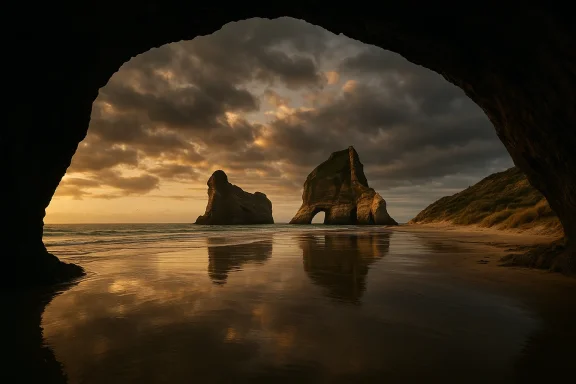
For millions of people the image of a sunlit beach seen through the dark mouth of a sea cave is instantly familiar — it’s the Windows 10 lock‑screen photo that greeted users for years — but that image is not a Photoshop invention or a Hollywood backdrop: it’s a real place, the remote Wharariki Beach and the Archway Islands at the northern tip of New Zealand’s South Island.
Wharariki Beach sits on the Tasman Sea coast, west of Cape Farewell in Golden Bay, and is bordered by Pūponga Farm Park and the outer fringe of Kahurangi National Park. The place that millions saw as a stylized graphic on their lock screens is a sequence of sea arches and stacks known locally as the Archway Islands — geological features that capture low‑tide reflections in a way that photographs beautifully.
The image’s global reach began in earnest after Microsoft shipped Windows 10 in 2015, when the photograph — in one of its variants — became a default lock‑screen or Spotlight image on many machines. The association hardened quickly: casual users, photographers and travel writers started naming the place, and the view moved from anonymous coastline to an identifiable, visitable landmark.
What makes this story worth a longer look is not just the trivia of image identity. It’s how a remote natural place becomes a global visual icon through software distribution, and how that fame interacts with local access, conservation, photography practice, and the lived experience of a landscape that is, in reality, dynamic and often inhospitable.
Source: thetraveler.org Windows 10’s Famous Beach Is a Remote Gem in New Zealand
 Background / Overview
Wharariki Beach sits on the Tasman Sea coast, west of Cape Farewell in Golden Bay, and is bordered by Pūponga Farm Park and the outer fringe of Kahurangi National Park. The place that millions saw as a stylized graphic on their lock screens is a sequence of sea arches and stacks known locally as the Archway Islands — geological features that capture low‑tide reflections in a way that photographs beautifully.The image’s global reach began in earnest after Microsoft shipped Windows 10 in 2015, when the photograph — in one of its variants — became a default lock‑screen or Spotlight image on many machines. The association hardened quickly: casual users, photographers and travel writers started naming the place, and the view moved from anonymous coastline to an identifiable, visitable landmark.
What makes this story worth a longer look is not just the trivia of image identity. It’s how a remote natural place becomes a global visual icon through software distribution, and how that fame interacts with local access, conservation, photography practice, and the lived experience of a landscape that is, in reality, dynamic and often inhospitable.
Geography and access: how remote is “remote”?
Location and landscape
Wharariki Beach is at the northernmost stretch of the South Island, facing the Tasman Sea. The coastline here is open to ocean swells, sculpted into sand plains, dunes and rock stacks that form the Archway Islands. The setting includes broad tidal flats that, at low tide, produce the reflective sheets of water photographers prize. These geographic facts are documented in regional and national park sources.Getting there
Reaching the car park requires a drive through Golden Bay — typically from Takaka or Collingwood — then on to Pūponga and the end of Wharariki Road, where an access track leads across farmland and through pockets of coastal scrub. The final section is a 15–20 minute walk over tracks that are sandy and exposed; visitors should expect wind and changing weather. These practical details are emphasised in official track notes and regional visitor guides.Why the remoteness matters
The relative isolation — the nearest substantial service town is more than an hour away over a mountain pass — is why Wharariki remained largely off mainstream international tourist circuits before it emerged as a near‑ubiquitous digital image. That same remoteness preserves the character of the place but also complicates visitor management, emergency response and conservation.The photograph, Microsoft, and the making of a screensaver icon
From photograph to operating system
The precise provenance of the various Windows lock‑screen and Spotlight images has been the subject of forensic interest among photographers and users. Multiple image repositories and Windows wallpaper indices identify the photography as depicting Wharariki Beach and the Archway Islands, often noting that the stock or modified files appear in Windows distributions as default images (commonly labeled by Microsoft’s internal image IDs). Over time the image was edited for color, contrast and cloud content to fit Windows skinning and marketing needs.Windows 10’s role
Windows 10’s general release on July 29, 2015, marked a high‑visibility venue for imagery; Microsoft’s Spotlight program and default wallpaper sets provided a distribution channel that put curated landscapes on millions of lock screens worldwide. The cave/beach vista became one of the memorable scenes from that collection, surfacing daily in workplaces, classrooms and homes. The platform‑level exposure is a modern variant of the way the Windows XP “Bliss” photo popularized a California hillside two decades earlier.Image editing and recognition
Photographers and image archivists have observed that Windows’ packaged image often appears slightly altered from raw photographs — warmer color tones, higher contrast and selective cloud removal or replacement to improve composition on screens of different aspect ratios. Where a photograph’s exact creator or image credit is publicly declared, it is usually in photographer portfolios or stock sources rather than inside the packaged system image itself. Where ft transparent, some claims (for example, attribution to a single photographer) should be treated with caution unless corroborated by the copyright holder.What the fame has meant on the ground
Recognition, arrival and the tourist “Easter egg”
For people who grew up seeing the cave image daily, stepping onto Wharariki’s sand can produce a jarring moment of recognition: that’s where the picture was taken. Travel editors and forum users report visitors making a detour specifically to stand in the place their OS had shown them. That kind of destination recognition demonstrates how digital culture can reconfigure travel motivations.Numbers, congestion and seasonality (what we know — and what we don’t)
There is no public evidence of large‑scale, permanent overcrowding at Wharariki like that seen at some internationally famous sites. The area’s low population, limited parking and walk‑in access act as natural controls. That said, local managers are alert to the potential for spikes during peak travel seasons, long weekends and when social media posts go viral. Official track pages and regional advisories stress visitor care and planning.Local response and stewardship
Local conservation projects — including a community‑led ecosanctuary initiative that covers sections of the Wharariki coastline — and DOC track management show an awareness that rising awareness must be balanced with habitat protection. Volunteer groups and iwi partners participate in species protection and dune restoration, and official guidance encourages visitors to stay on marked tracks and give wildlife space. These are practical measures that reflect evolving stewardship in a place newly valued for international publicity as well as local ecology.Practical advice for visitors (what the operating system won’t tell you)
If you’re planning to see the place in person, some simple practicalities will make the trip safer and more enjoyable.- Check tide times. The dramatic reflections happen at or near low tide; high tide narrows the sand and reduces reflective surfaces.
- Dress for wind and sand. The coast is exposed; wind can be strong and carry sand. Sturdy footwear and layered clothing are sensible.
- Allow time for the walk. The access walk is typically 15–20 minutes from the car park but can take longer when the track is soft or windy.
- Respect wildlife. New Zealand fur seals and birds use the area; maintain distances, especially during breeding seasons.
Photography, composition and the difference between screen and place
Why the image works
The composition that became famous uses a natural frame — the dark cave entrance — to direct the eye to the illuminated stacks and their mirrored reflections. On a flat screen this creates a tight, iconic image that reads well at small sizes and in dark UI modes. The elements that aid recognition are:- Strong foreground frame (the cave mouth)
- Distinctive midground shapes (the Archway Islands’ arches and stacks)
- Broad reflective plane (wet sand at low tide)
- Balanced sky and cloud texture, often softened or selectively edited for clarity
The editing continuum
Operating‑system vendors and content curators selectively edit images to optimize for screens: color grading, contrast tweaks, and cloud removal or replacement can change the mood without changing the scene’s geographic identity. That means the version millions saw on Windows 10 may be warmer, darker inside the cave, and less clouded than a raw photo taken on site. When you go there in person the palette and cloudscape will vary by the weather and the time of day, and part of the joy is seeing the landscape in motion rather than a single frozen, stylised frame.Conservation, risk and ethical tourism
Ecological sensitivity
Wharariki’s dunes, coastal vegetation and nearshore habitats host species that are sensitive to trampling and disturbance. Local conservation groups and the Department of Conservation advise staying on tracks and observing wildlife from a distance to avoid stressing animals during breeding. The very features that make the scene photogenic — undisturbed sand flats and accessible tide pools — are also fragile and susceptible to damage from too many visitors or poor path choices.Safety hazards
The archways and sea cave settings can look inviting but are not controlled environments: sneaker waves, rising tides and slippery rocks pose hazards. Visitors should avoid climbing unstable stacks, respect warning signage, and be mindful that rescue and medical services can be tens of minutes away. No lock‑screen image can substitute for situational awareness.The ethics of image‑driven travel
The Windows 10 image made Wharariki a kind of digital pilgrimage — people go because a piece of software made the place familiar. That raises ethical questions familiar from other “Instagram famous” sites: how to enjoy and share the place without turning it into a spectacle that degrades the very qualities that drew attention. Local stewards emphasize education, low‑impact practices and coordination with community conservation efforts.A closer look: what’s reliable and what needs caution
- The identification of the Windows arariki Beach and the Archway Islands is supported by multiple independent sources — image archives, Windows wallpaper indices and authoritative geographic descriptions — making the identification robust.
- Claims about a single specific photographer or exclusive copyright ownership for every variant of the image should be treated carefully unless the copyright owner or Microsoft’s image credits explicitly confirm authorship. Some packaged images have been edited by vendors; attribution can be muddled between original photographer, image licensor and in‑house editors. Where possible, look for photographer portfolios or stock credits to confirm authorship.
- The assertion that Windows 10 made the beach “world famous” is accurate in the sense of global exposure, but fame has not equalled large‑scale overdevelopment; the site’s remoteness and management structures have so far limited damage. That could change if social media trends or travel packages concentrate visitors in ways that exceed park management capacity, which is why local conservation initiatives remain important.
- Practicalities like access times, tide windows and seasonal weather patterns are subject to change and should be checked via official park or local tourism sources before travel; DO NOT rely on recollection from a laptop wallpaper when planning a coastal visit.
The cultural resonance: software as curator
The story of Wharariki Beach shows how a software platform can act as an inadvertent cultural curator. When a desktop OS distributes curated images broadly, it does more than supply aesthetics: it builds a visual lexicon shared by millions. That shared lexicon can shift public curiosity toward distant places and, occasionally, funnel that curiosity into tourism. The Wharariki example feels benign: a quiet, beautiful corner of New Zealand discovered by people because their computers pictured it for them. But it is an instructive case study about modern image economies: exposure, attribution, destination impact and stewardship all collide where pixels meet place.For photographers, travelers and local managers: a short checklist
- For photographers:
- Scout tides and approach the cave area with an eye for reflective plane, not just the arch silhouette.
- Respect the environment: limit trampling and avoid moving driftwood or disturbing wildlife.
- For travelers:
- Plan for wind, sand and walk times; pack water, layers and a tide chart.
- Use local information centres or DOC updates for track conditions.
- For local managers and communities:
- Continue investing in visitor education, track maintenance and monitoring to keep visitor impact manageable.
- Consider digital signage and online guidance timed to peak seasons to reduce surprises for first‑time visitors.
Conclusion
The Wharariki Beach image is a tidy emblem of the 21st‑century interplay between software and place: a small, windswept New Zealand shore became a globally recognised stroke of landscape design simply by being included in an operating system’s visual catalogue. That fame carries responsibilities — for visitors to act with care, for image curators to use attribution responsibly, and for local communities to steward fragile landscapes prudently. When you stand on the sand and watch light move across the Archway Islands, you encounter something that a lock screen can hint at but never fully capture: a living, changeable coastline whose beauty is inseparable from its weather, tides and the quiet work of keeping it whole for future visitors.Source: thetraveler.org Windows 10’s Famous Beach Is a Remote Gem in New Zealand
