

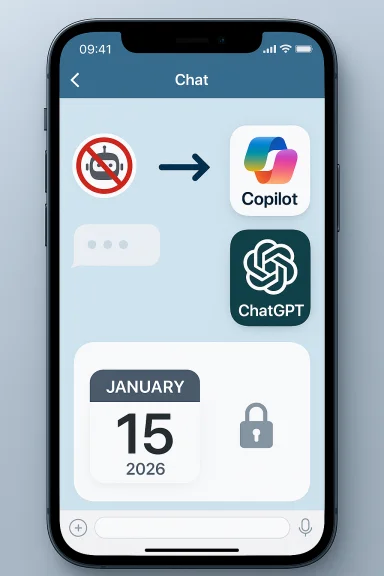
WhatsApp’s latest terms rewrite pulls the plug on third‑party, general‑purpose AI chatbots — including ChatGPT and Microsoft’s Copilot — forcing a mass migration from in‑chat assistants to vendor‑owned apps and authenticated surfaces effective January 15, 2026.
Background / Overview
WhatsApp’s parent company, Meta, updated the WhatsApp Business Solution (commonly called the WhatsApp Business API) in mid‑October 2025 to add a new “AI Providers” restriction that prohibits providers of large language models, generative AI platforms, and general‑purpose assistants from using the Business Solution when those AI capabilities are the primary functionality being delivered. The change has a clearly stated enforcement date of January 15, 2026.That single clause is narrow in wording but wide in effect: it preserves the Business API for transactional and customer‑support automation, while drawing a line under the low‑friction distribution model many AI vendors exploited to reach WhatsApp’s huge user base. The result is a coordinated wind‑down by major AI providers — Microsoft confirmed Copilot will stop responding on WhatsApp on the January 15, 2026 deadline, and OpenAI has told users ChatGPT will also cease operation on the platform after that date.
What changed — the policy in plain English
The rule and its scope
- WhatsApp’s Business Solution terms now include an explicit prohibition on “AI Providers” using the Business API where AI is the primary product being offered.
- The ban targets general‑purpose chatbots and large language model (LLM) assistants that operated as a conversational contact inside WhatsApp rather than as part of a business’s authenticated, transactional workflow.
- Crucially, the policy is scoped to the Business API — it is not an absolute ban on all AI inside the WhatsApp app; customer‑service automation and AI used incidentally in business processes remain permitted.
Effective date and enforcement discretion
The effective (enforcement) date is January 15, 2026. Meta’s language gives the company broad discretion to decide what counts as an “AI Provider” and whether a use case is “primary” or merely ancillary, which creates interpretive room in enforcement and uncertainty for developers.Who is affected — immediate winners and losers
Directly affected vendors
- Microsoft Copilot: Microsoft confirmed Copilot’s WhatsApp presence will be discontinued on January 15, 2026 and has published migration guidance pointing users toward Copilot mobile apps, Copilot on the web, and Copilot integrated in Windows. Microsoft also warned Copilot chats on WhatsApp cannot be migrated automatically because those sessions were unauthenticated.
- OpenAI / ChatGPT: OpenAI told users ChatGPT on WhatsApp will stop operating after the January 15 deadline and advised users to link their WhatsApp phone number to a ChatGPT account where supported to preserve history. OpenAI has stated that more than 50 million people used ChatGPT via WhatsApp — a vendor‑reported number that should be treated as the company’s claim unless independently verified.
- Smaller assistant providers (Perplexity, startups and regional bots): Many of these services used WhatsApp as a discovery and distribution channel; they now face either shutdown, migration work, or redesign of service delivery.
Who remains allowed
- Businesses using AI incidentally inside verified business workflows — for example, an airline’s automated triage that uses ML only to route tickets, or an e‑commerce bot that confirms orders — can continue to use the Business API. The policy’s carve‑out preserves conventional business automation use cases.
Winners and losers — strategic effects
- Winners: Platform owners that operate integrated AI (Meta’s own Meta AI), and AI vendors that can quickly move users to authenticated, monetizable first‑party surfaces.
- Losers: Startups and small vendors that depended on WhatsApp for reach and discovery, and users who valued the convenience of in‑chat assistants without installing separate apps.
Why Meta changed the rules — official rationale and plausible incentives
Meta’s stated reasons center on product fit and infrastructure: the WhatsApp Business Solution was built for predictable, transactional messaging between businesses and customers, not for unpredictable, resource‑intensive, open‑ended chatbot traffic. Such uses can produce long sessions, high token counts, and multimodal payloads that strain the platform’s intended operational model.Beyond operational logic, there are plausible strategic incentives. The new language consolidates control over the in‑app AI experience and positions Meta to favor its own assistant inside WhatsApp. The combination of operational and commercial factors means the change is both defensible from an engineering perspective and strategically beneficial to Meta. Observers therefore view the move as a hybrid of product governance and platform competition.
Data portability, migration, and the user experience
Migration guidance from vendors
- OpenAI: Provided guidance for linking a WhatsApp number to a ChatGPT account in order to preserve conversational history where supported. This provides a path for some users to retain historical context.
- Microsoft: Explicitly warned that Copilot’s WhatsApp sessions were unauthenticated and cannot be migrated into Copilot accounts; the company recommends users export chat transcripts locally before the January 15 cutoff.
Practical, immediate steps for users (export and link)
- Export any WhatsApp chat threads with an AI assistant you wish to keep via WhatsApp’s Export Chat tool.
- Where a vendor offers account linking (e.g., OpenAI’s phone‑link workflow), complete the linking before January 15, 2026.
- Install the first‑party app or sign up for the web client of your assistant (Copilot app, ChatGPT app/web) and authenticate an account for future continuity.
Why portability is messy
The WhatsApp integrations for many assistants were contact‑based and unauthenticated by design — a tradeoff that maximized convenience but sacrificed account linkage. That design choice now means some threads cannot be seamlessly migrated into vendor accounts, producing friction and potential data loss unless users proactively export or link.Technical considerations: load, moderation, and product fit
Open‑ended LLM conversations differ from typical Business API traffic in predictable ways: sessions are longer, message rates can spike, users often exchange multimedia and long context windows are common. Those patterns complicate rate‑limiting, moderation, content‑safety workflows, and billing models for an API optimized for transactional messaging. Meta’s operational argument — that the Business Solution was being used outside its intended envelope — is consistent with these technical realities.At the same time, the Business API’s architecture allowed message routing and template enforcement that are useful for commerce-oriented bots. Reining in general‑purpose assistants restores the API’s original performance envelope but also removes a convenient discovery vector for assistant vendors.
Strategic and regulatory risks
Competition and antitrust exposure
Restricting third‑party assistants from a dominant messaging surface raises legitimate competition questions. Critics argue this is effectively gatekeeping: by closing off a major distribution channel, Meta may be advantaging its own AI product while increasing friction for rivals. Industry observers expect closer regulatory attention and potential scrutiny over whether the policy is a legitimate product governance choice or an anti‑competitive barrier.Consumer impact and fairness
The change disproportionately affects regions where WhatsApp is the primary internet interface and where installing additional apps is a higher friction step. There is a risk of eroding access and discovery for users who relied on the convenience of messaging‑based assistants. Equitable access may therefore decline unless alternative distribution channels are available and affordable.Enforcement ambiguity
Meta’s wording grants the company discretion to interpret terms like “AI Provider” and “primary functionality.” That ambiguity forces developers into conservative designs and increases legal uncertainty. Startups face heavier product and compliance burdens as a result.Business and developer implications — immediate and medium term
For businesses using AI for customer service
- If AI is genuinely ancillary to a verified customer workflow (order confirmations, support triage), businesses can remain on the Business API with minimal change. They should, however, audit their usage to ensure it aligns with WhatsApp’s updated terms.
- Businesses that built consumer‑facing assistants primarily for discovery inside WhatsApp must migrate to alternative channels or rearchitect their offering as an authenticated, account‑linked service.
For startups and independent AI vendors
- Plan multi‑channel distribution strategies that don’t depend on a single messaging platform for discovery. Expect higher user‑acquisition costs as vendors migrate users out of WhatsApp and into native apps or web clients.
- Invest in account linkage, portability, and richer authenticated experiences. The market is shifting toward identity‑backed assistants where vendors can offer richer features and better safety controls.
Practical migration checklist for users and admins
- Export chats that contain important information or that you wish to archive. WhatsApp’s Export Chat can create local copies with or without media.
- Follow vendor instructions for linking phone numbers to accounts when offered (OpenAI’s ChatGPT linking workflow is an example).
- Install vendor first‑party apps (Copilot app, ChatGPT app) and create authenticated accounts to preserve future history and get feature parity.
- For businesses, audit Business API flows and classify which automations are transactional vs. general‑purpose assistant features; rework architecture where necessary.
Long‑term outlook — what this means for conversational AI
This policy change is a bellwether for the tension between platform control and open distribution of AI. Expect the following trends:- More assistant experiences anchored to authenticated, vendor‑owned surfaces (apps, web, OS integrations).
- Growth of alternative distribution channels (other messaging apps, browser‑based assistants, and native OS integrations) as vendors diversify.
- Increased regulatory scrutiny over platform gatekeeping and data portability, with policymakers likely to examine the competitive effects of such restrictions.
- A push for portability standards and interoperable assistant protocols that could, over time, reduce the fragility of single‑channel dependence.
Strengths and risks of Meta’s approach — critical analysis
Notable strengths
- Operational alignment: The Business API can return to its original enterprise focus, which simplifies moderation, rate control, and cost allocation.
- Safety and accountability: Moving assistants to authenticated surfaces makes it easier to apply consistent safety controls, user account management, and monetization.
- Predictable infrastructure: Reducing unpredictable LLM traffic stabilizes message volumes and lowers support overhead for enterprise messaging.
Material risks
- Reduced consumer convenience and discovery: Users lose a low‑friction way to try assistants inside a familiar chat app, which could slow adoption in certain regions.
- Potential anti‑competitive signal: The policy advantaging first‑party experiences inside a dominant messaging platform invites regulatory scrutiny and public backlash.
- Data portability friction: The unauthenticated design of many WhatsApp‑based assistants means conversation histories may be lost or difficult to migrate, increasing user risk unless vendors provide robust export/link options.
What Windows users should care about
Windows customers who relied on Copilot inside WhatsApp will need to:- Export any important WhatsApp threads with Copilot before January 15, 2026 because Microsoft has stated those conversations cannot be migrated automatically into Copilot’s account backbone.
- Install the Copilot app on their mobile device, use Copilot on the web, or adopt the Windows‑integrated Copilot experience to retain access and sync history going forward.
Final assessment and conclusion
WhatsApp’s prohibition on third‑party, general‑purpose AI chatbots via the Business API — effective January 15, 2026 — is a consequential policy decision with predictable technical justification and non‑trivial strategic consequences. It closes a widely used distribution channel for assistant vendors and forces a migration to authenticated, vendor‑owned surfaces where safety, monetization, and identity controls are easier to enforce.The immediate practical takeaway is simple and urgent: export any WhatsApp conversation you want to keep and follow vendor migration guidance now. For vendors and developers, diversify distribution, adopt authenticated experiences, and plan for a world in which platform policy is a first‑class constraint on product design. For regulators and industry observers, the change sharpens a debate about whether platform product governance is an operational necessity or a competitive lever.
This episode is more than a service deprecation: it is a structural nudge that will shape how conversational AI is discovered, delivered, and regulated for the foreseeable future.
Source: ProPakistani WhatsApp is Kicking Out ChatGPT, Copilot, and Other Chatbots
