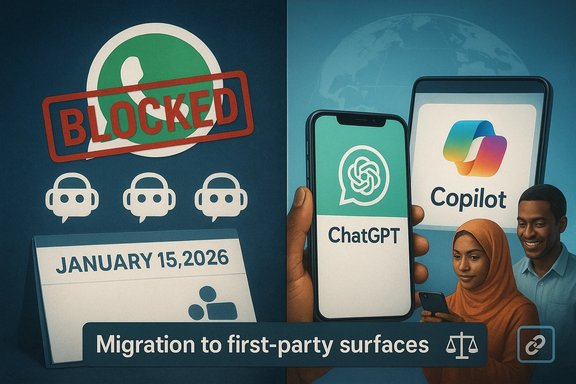
The abrupt disappearance of ChatGPT from WhatsApp on January 15, 2026 marks a significant pivot in how conversational AI is distributed — a policy-driven closure of one of the simplest, lowest‑friction ways millions accessed large language model assistants inside a messaging app they already use every day. WhatsApp’s mid‑October 2025 rewrite of its Business Solution (the Business API) added a new “AI Providers” restriction that explicitly bars third‑party, general‑purpose LLM chatbots from operating as primary functionality through the API, and vendors including OpenAI and Microsoft publicly confirmed they would stop supporting their WhatsApp contacts on the enforcement date.
WhatsApp’s Business Solution was designed for enterprise‑grade, authenticated business messaging — confirmations, appointment reminders, order tracking, and predictable customer service workflows. That design intent changed in practice when several AI providers began using the Business API as a distribution channel for consumer‑facing chat assistants: users could message a phone number and receive open‑ended conversational replies without installing a separate app or signing into a vendor account.
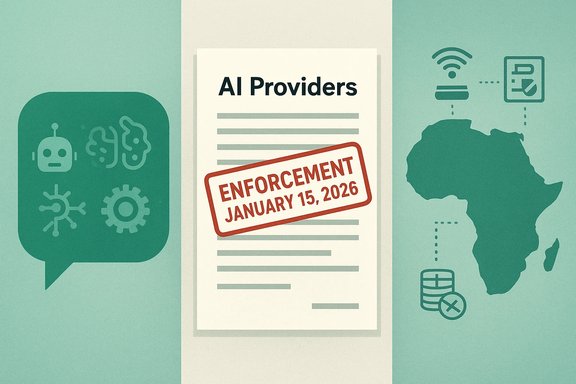
In October 2025 Meta added an “AI Providers” clause to the Business Solution terms that disallows developers and providers of large language models, generative AI platforms, and general‑purpose AI assistants from using the Business Solution when those AI capabilities are the primary functionality offered. The clause includes broad, discretionary language that gives WhatsApp latitude to determine what counts as “primary,” and Meta set a firm enforcement date of January 15, 2026. Vendors reacted. OpenAI published transition guidance telling users ChatGPT would no longer be available on WhatsApp6 and offered an account‑linking workflow to preserve history in ChatGPT’s native apps and web experience. Microsoft posted an advisory confirming Copilot on WhatsApp would be discontinued on the same date and recommended users export any chat transcripts they wish to keep because many WhatsApp integrations were unauthenticated and cannot be migrated automatically.
When third‑party AI assistants were made available through WhatsApp contacts, they effectively became a low‑cost window to advanced web tools for users on constrained data plans. Removing those integrations severs a vital, inexpensive path to AI‑assisted learning, research, small business operations, and everyday problem‑solving for people who cannot afford full internet access. This is not abstract: African tech reporters and local outlets documented how WhatsApp bots were used widely as study aids, translation helpers, and small‑business assistants, and local commentators warned that the January 15 enforcement would disproportionately harm users dependent on WhatsApp bundles.
Important qualification: precise populaton how many WhatsApp‑bundle users relied specifically on third‑party AI contacts are thin. The qualitative effect is clear from local reporting and vendor notices, but the magnitude — the exact number of affected people — is typically reported as vendor or local news estimates rather than independently verifiable, population‑scale surveys. Treat regional impact descriptions as empirically grounded but unevenly quantified.
For everyday users the immediate cost is convenience and — for regions dependent on WhatsApp bundles — potentially meaningful loss of access. For developers and businesses, the episode is a clear cautionary tale: reach through a dominant platform is powerful, but vendor control over authenticated identity, portability, and multi‑channel distribution is the only insurance against sudden policy‑driven disruption. Vendors that invest in authenticated onboarding, export/import standards, and resilient distribution channels will be better placed to survive future platform realignments.
The core facts to lock in: WhatsApp updated its Business Solution to forbid third‑party general‑purpose AI assistants as primary functionality in October 2025; Meta set an enforcement date of January 15, 2026; OpenAI and Microsoft confirmed ChatGPT and Copilot would no longer operate via WhatsApp after that date and advised users on migration steps and exporting histories. These developments reshape the distribution landscape for conversational AI and highlight the need for portability, authenticated identity, and multi‑channel resilience.
Source: Techzim ChatGPT No Longer Available on WhatsApp: Here is Why and What It Means for You
 Background / Overview
WhatsApp’s Business Solution was designed for enterprise‑grade, authenticated business messaging — confirmations, appointment reminders, order tracking, and predictable customer service workflows. That design intent changed in practice when several AI providers began using the Business API as a distribution channel for consumer‑facing chat assistants: users could message a phone number and receive open‑ended conversational replies without installing a separate app or signing into a vendor account.In October 2025 Meta added an “AI Providers” clause to the Business Solution terms that disallows developers and providers of large language models, generative AI platforms, and general‑purpose AI assistants from using the Business Solution when those AI capabilities are the primary functionality offered. The clause includes broad, discretionary language that gives WhatsApp latitude to determine what counts as “primary,” and Meta set a firm enforcement date of January 15, 2026. Vendors reacted. OpenAI published transition guidance telling users ChatGPT would no longer be available on WhatsApp6 and offered an account‑linking workflow to preserve history in ChatGPT’s native apps and web experience. Microsoft posted an advisory confirming Copilot on WhatsApp would be discontinued on the same date and recommended users export any chat transcripts they wish to keep because many WhatsApp integrations were unauthenticated and cannot be migrated automatically.
What exactly changed: the “AI Providers” provision explained
The policy gist
The Business Solution update inserts a narrowly framed but operationally wide‑ranging restriction. In plain English, it says:- If a business uses the Business API to sell, offer, or make available a general-purpose conversational AI assistant as the primary product, that use is prohibited.
- Enterprise bots that use AI incidentally for support workflows (booking, status updates, authentication) remain permitted — the carve‑out preserves the API’s original transactional purpose.
- Meta reserves the right to determine, at its sole discretion, whether a given implementation is “primary” or “incidental.”
Why this matters technically and economically
- Operational load: Meta has argued that high‑volume, open‑ended AI traffic imposed burdens on WhatsApp’s intended infrastructure and support model. Whether that technical pressure alone justified the change is contested, but the company framed the update as preserving the Business API’s reliability for enterprise messaging. ([economictimes.indiatimes.com](Meta bans general-purpose AI chatbots from WhatsApp Business platform - The Economic Times and monetisation: By closing the Business API to consumer LLMs, Meta preserves a single, native on‑platform AI experience — Meta AI — and reduces third‑party access to WhatsApp’s three‑billion‑user reach. That structurally advantages Meta’s first‑party ecosystem and raises competition questions.
Who is affected — scale and immediate impact
Conns
- OpenAI (ChatGPT): OpenAI announced that ChatGPT on WhatsApp would stop functioning after January 15, 2026 and urged users to link their WhatsApp phone number to a ChatGPT account to preserve histories in ChatGPT where supported. OpenAI reported that more than 50 million people had used ChatGPT on WhatsApp — a figure the company presented as its own usage metric. That number is a vendor‑reported statistic and should be treated as such unless independently verified.
- Microsoft (Copilot): Microsoft confirmed Copilot on WhatsApp would be discontinued on January 15, 2026 and directed users to Copilot’s standalone mobile apps, web client, and Windows app. Microsoft warned that Copilot interactions on WhatsApp were unauthenticated — meaning conversations were not tied to Microsoft accounts — and therefore cannot be migrated automatically into Copilot accounts; users were advised to export chat history via WhatsApp tools if they wanted an archive.
- Smaller assistants: Several startups and independent assistants (Perplexity, Luzia, Poke, and others) that used WhatsApp as a discovery channel signaled they would wind down WhatsApp services or pivot to standalone apps and other messaging platforms.
Who remains allowed
- Business‑facing AI that is incidental or ancillary to a verified business use case — for example, airline booking bots that use AI to triage requests — remain permitted under the Business Solution when implemented within the policy’s scope. The policy explicitly preserves transactional and customer‑support use cases.
Why Meta changed the rules — motives and interpationale from Meta centers on product intent and operational sustainability: the Business Solution is for predictable, authenticated business messaging rather than free distribution of consumer chat assistants. Yet a layered interpretation is required.
Operational explanation
WhatsApp argued the Business API was being repurposed for high‑volume, open‑ended assistant traffic that created unexpected infrastructure demands and support complexity. That justification has plausibility in engineering terms: streaming open‑ended AI queries at scale requires different capacity planning and moderation commitments than transactional notifications. But Meta has not published specific threshold numbers or load metrics that show a defined tipping point for the policy. Treat the operational claim as Meta’s public explanation rather than independently audited fact.Strategic and competitive incentives
Platform governance is also power. By closing the Business API to third‑party consumer assistants, Meta both protects the API’s intended enterprise use and materially reduces rivals’ ability to reach users inside WhatsApp. Meta’s own assistant, Meta AI, remains available on the platform, which concentrates on‑platform AI experiences under the company’s control. Industry observers and regulators have noted the anti‑competitive optics: the policy change centralises distribution and data capture opportunities inside Meta’s ecosystem.Regulatory angle
Regulators in the EU and other jurisdictions have already shown interest in platform gatekeeping around AI. The new WhatsApp policy is the type of behavior that could attract regulatory scrutiny for potential exclusionary conduct, particularly where a platform owner pivots to a first‑party AI while restricting third‑party distribution. Legal outcomes will depend on jurisdiction, market definitions, and whether regulators deem WhatsApp an essenttform in relevant markets. Observers are watching.The “WhatsApp bundles” problem: why this is severe in parts of Africa
For many users in Zimbabwe and across Africa, WhatsApp is often the default — and sometimes the only — gateway to the online world. Mobile operators in multiple African countries sell WhatsApp‑only or Facebook‑only data bundles at dramatically lower prices than full internet plans. Those bundles allow users to message, share photos, and use services that operate inside WhatsApp without paying for unlimited general internet access.When third‑party AI assistants were made available through WhatsApp contacts, they effectively became a low‑cost window to advanced web tools for users on constrained data plans. Removing those integrations severs a vital, inexpensive path to AI‑assisted learning, research, small business operations, and everyday problem‑solving for people who cannot afford full internet access. This is not abstract: African tech reporters and local outlets documented how WhatsApp bots were used widely as study aids, translation helpers, and small‑business assistants, and local commentators warned that the January 15 enforcement would disproportionately harm users dependent on WhatsApp bundles.
Important qualification: precise populaton how many WhatsApp‑bundle users relied specifically on third‑party AI contacts are thin. The qualitative effect is clear from local reporting and vendor notices, but the magnitude — the exact number of affected people — is typically reported as vendor or local news estimates rather than independently verifiable, population‑scale surveys. Treat regional impact descriptions as empirically grounded but unevenly quantified.
What this means for users — practical consequences
- Convenience lost: Messaging ChatGPT or Copilot inside WhatsApp no longer works after January 15, 2026. That convenience — no app install, no account sign‑in — is gone.
- Data portability friction: Portability depends on prior authentication choices. OpenAI offered an account‑linking workflow so som histories in ChatGPT; Microsoft warned Copilot’s WhatsApp sessions were generally unauthenticated and cannot be migrated, recommending users export chat logs manuad not assume automatic migration is possible.
- Feature tradeoffs: Moving to first‑party apps generally unlocks richer capabilities — voice, image understanding, larger context windows, memory features — and authenticated, account‑backed histories. But it also demands full internet access and, in some cases, subscription tiers or login friction.
- Business impact: Companies that used WhatsApp as a discovery surface for conversational AI must re‑architect — build standalone apps, authenticated chat experiences, or multi‑channel fallbacks. The ruling is a forcing function to invest in portability and authenticat Migration checklist — immediate steps for affected users and businesses
- Link accounts where vendors provide a supported workflow (OpenAI provided instructions to link WhatsApp numbers to ChatGPT accounts). Verify history appears after linking.
- Export chat transcripts from WhatsApp using the built‑in export tool if you need a record and the vendor cannot import chats automatically. Microsoft explicitly recommended exporting Copilot chats because the integration was unauthenticated.
- Install vendor first‑party apps (ChatGPT, Copilot) or use the vendor web experiences; register and enable authentication to preserve history going forward.
- For businesses that used third‑party assistants: redesign workflows to ensure AI is ancillary to authenticated busft to other messaging platforms that permit third‑party assistants (subject to their own policies). Plan marketing and user onboarding to migrate users away from WhatsApp.
- Archive exports securely and maintain records of the migration process to protect user data and compliance obligations. Export formats vary by device and OS.
Alternatives and replacement pathpp: Meta’s own assistant remains available on the platform and is the only general‑purpose assistant now permitted to occupy that native distribution surface. For users who must stay inside WhatsApp, Meta AI is the immediate on‑platform option. Keep in mind Meta AI’s feature set, data practices, and regional availability will differ from third‑phcrunch.
- Vendor apps and web clients: ChatGPT (OpenAI) and Copilot (Microsoft) offer full‑featured apps and web experiences that include richer capabilities but require installation, accounts, and full internet access. These surfaces are the vendor‑recommended continuity path.
- Other messaging platforms: Some providers may shift to alternative messengers that permit third‑part) or to native mobile apps and SMS fallbacks. This requires rebuilds and user acquisition investment.
Critical analysis — strengths, tradeoffs, and risks
Strengths of Meta’s approach (from a platform/operator lens)
- Restores Business API clarity: The Business Solution returns to a clearer enterprise focus, reducing ambiguous consumer use cases that stretched its transactional design. That lowers some operational complexity for WhatsApp.
- Encourages authenticated experiences: By nudging AI providers toward first‑party apps and authenticated sessions, the change promotes better identity, persistence, and potentially better moderation and safety controls tied to account management.
Real concerns and systemic risks
- Accessibility and equity: The removal disproportionately affects users who relied on WhatsApp as an affordable portal to advanced AI features — particularly in regions where WhatsApp‑only data bundles are widespread. For those users, access moved from a zero‑install, low‑cost channel to standalone apps that require open internet access and possibly paid subscriptions. That’s a material reduction in access.
- Competition and gatekeeping: The policy consolidates control over conversational AI inside a platform owner’s ecosystem. When a platform simultaneously operates as a dominant distribution channel and a first‑party AI provincentives to restrict rivals are strong. Regulators will likely examine whether this structure unreasonably forecloses competition.
- Portability and user rights: The situation exposed how many integrations were built as unauthenticated contacts with no robust portability plan. That design choice left users and conversation data vulnerable when platform policy chang need for standardised portability and export/import mechanisms for conversational data.
Where vendors fell short
- Overreliance on one distribution channel: Many AI providers allowed WhatsApp to become their primary discovery surface without embedding authenticated identity or robust export/importegic dependency created single‑point failure risk. The vendors’ public advice — link accounts where possible, export chats — is pragmatic but reactive. The episode illustrates a core product lesson: distribution reach is valuable, but vendor control over authenticable user relationships and data portability is essential for resiuently asked questions (short, practical answers)
Is ChatGPT completely gone from WhatsApp?
Yes — third‑party ChatGPT access via the WhatsApp Business API was discontinued on January 15, 2026 as part of WhatsApp’s updated Business Solution terms. For continuity, OpenAI provided an account‑linking flow and encourages users to switch to the ChatGPT app or web.Could I have kept my WhatsApp conversation history?
Possibly. OpenAI offered an account‑linking mechanism that, where available, lets a user associate a WhatsApp phone number with a ChatGPT account to import some history. Microsoft warned Copilot interactions were unauthenticated and cannot be migrated automatically, so Copilot users were advised to export chats manually. Always verify the vendor’s migration instructions early.Why did Meta ban third‑party AI assistants?
Meta’s public rationale stresses product fit (the Business API is meant for enterprise messaging), operational strain from high‑volume open‑ended usage, and the desire to keep transactional and support flows reliable. The policy also reduces third‑party access to WhatsApp’s massive user base, which has strategic competitive implications.Are there legal or regulatory remedies?
Regulators will likely scrutinise platform rules that materially restrict competitors’ access to a dominant communications channel. Any legal remedy would depend on the jurisdiction, market definitions, and an assessment of whether Meta’s actions distort competition. Observers expect regulatory interest but outcomes will vary by region.Longer‑term implications and what to watch
- Portability standards: The episode creates momentum for industry and regulators to press for better portability standards for conversational data and authenticated onboarding channels that prevent unauthenticated, unported message histories. Expect debates on export/import standards and neutral onboarding APIs.
- Platform governance as product strategy: Companies building AI services must design distribution strategies that minimise dependence on a single third‑party platform and prioritise authenticated user relationships. The winners will be vendors who control identity, portability, and multi‑channel reach.
- Regulator action and competitive pressure: Watch Europe and jurisdictions with active competition authorities for interventions or guidance on whether platform owners can lawfully restrict third‑party AI distribution inside a dominant communications product. The resolution will shape conversational AI distribution for years.
Final assessment
The January 15, 2026 removal of ChatGPT and other third‑party LLM assistants from WhatsApp is both predictable in its mechanics and consequential in its real‑world effects. Meta’s policy rewrite realigns the Business Solution with its transactional origins and materially privileges Meta’s own AI offering. That move reduces friction for enterprise messaging at the cost of user choice and accessibility for those who relied on WhatsApp as the low‑cost gateway to advanced AI.For everyday users the immediate cost is convenience and — for regions dependent on WhatsApp bundles — potentially meaningful loss of access. For developers and businesses, the episode is a clear cautionary tale: reach through a dominant platform is powerful, but vendor control over authenticated identity, portability, and multi‑channel distribution is the only insurance against sudden policy‑driven disruption. Vendors that invest in authenticated onboarding, export/import standards, and resilient distribution channels will be better placed to survive future platform realignments.
The core facts to lock in: WhatsApp updated its Business Solution to forbid third‑party general‑purpose AI assistants as primary functionality in October 2025; Meta set an enforcement date of January 15, 2026; OpenAI and Microsoft confirmed ChatGPT and Copilot would no longer operate via WhatsApp after that date and advised users on migration steps and exporting histories. These developments reshape the distribution landscape for conversational AI and highlight the need for portability, authenticated identity, and multi‑channel resilience.
Source: Techzim ChatGPT No Longer Available on WhatsApp: Here is Why and What It Means for You