

Where Winds Meet is now available through the Xbox store listing for Xbox players, bringing Everstone Studio and NetEase’s free-to-play open-world wuxia action RPG into Microsoft’s ecosystem with advertised cross-play across Xbox, PlayStation 5, PC, and mobile platforms. That single storefront appearance matters because it turns a once PlayStation-and-PC-centered launch into a genuinely platform-agnostic service game. The pitch is not just “another big RPG on Xbox”; it is a sprawling Chinese martial-arts sandbox arriving with the infrastructure expectations of 2026 gaming already attached. For Xbox owners, the real story is less the download button than the way Where Winds Meet tests whether modern free-to-play RPGs can move across console boundaries without dragging players back into old platform silos.
For years, Xbox players have watched open-world action RPGs arrive with a familiar pattern: a flashy trailer, a platform carve-out, a delayed port, and a community already established somewhere else by the time Microsoft’s console joins the party. Where Winds Meet complicates that script. Its Xbox listing does not read like a late, compromised arrival; it reads like an attempt to fold Xbox into an already expanding cross-platform world.
The game’s store description is almost aggressively broad. Xbox, PS5, PC, and mobile are presented not as separate audiences but as entry points into one shared jianghu, the term wuxia fiction uses for the unruly martial world of wanderers, sects, grudges, loyalties, and reputation. That is not just marketing texture. It signals the genre fantasy and the business model at the same time: a world where your identity follows you, your friends are not necessarily on the same hardware, and the game survives by keeping all of those paths connected.
That is why the Xbox arrival lands differently from a conventional port. If Where Winds Meet were merely a boxed single-player RPG, the question would be whether it runs well and whether its combat is worth the install. But as a free-to-play, content-heavy, online-capable RPG with solo, co-op, guild, dungeon, raid, and competitive features, its platform support is part of the product. A fragmented audience is not an inconvenience in this design; it is an existential problem.
Microsoft has spent years arguing that games should follow players across devices. Sometimes that message has been strategic cover for a weaker console position; sometimes it has been genuinely ahead of the market. Where Winds Meet is the kind of third-party release that makes the argument feel concrete. The game does not need Xbox to be the center of the universe. It needs Xbox to be one more door into the same universe.
That abundance is part of the appeal and part of the risk. The game is rooted in the Five Dynasties and Ten Kingdoms period, a politically fractured era of tenth-century China that gives the developers a natural backdrop for instability, factionalism, and shifting loyalties. It is a smart setting for an online RPG because it gives conflict a historical and mythic frame rather than reducing it to generic kingdoms with interchangeable banners.
The player fantasy is similarly elastic. You are a young sword master uncovering forgotten truths and your own identity, but the listing also promises a world that responds to misbehavior with bounties, pursuit, and even jail. That kind of systems-driven consequence is often easier to advertise than to sustain. Still, it is exactly the sort of promise that gives a game like this its hook: the possibility that wandering is not just traversal, but authorship.
The broader claim is that wuxia fits the open-world service-game format unusually well. Western fantasy RPGs often bolt multiplayer systems onto chosen-one narratives that were designed for solitude. Wuxia, by contrast, has always been about reputation, rivalry, masters, disciples, hidden manuals, public duels, sect politics, and the tension between personal honor and social obligation. A persistent multiplayer layer does not have to fight that fiction. It can amplify it.
This is where Where Winds Meet enters a crowded but still unsettled category. The industry has no shortage of enormous free-to-play RPGs, but the successful ones tend to specialize. Some emphasize character collection, some emphasize MMO progression, some emphasize action combat, and some emphasize narrative spectacle. Where Winds Meet appears to be making a more difficult bet: that a martial-arts sandbox can be expansive enough to satisfy solo explorers and structured enough to retain online communities.
The Xbox listing’s language about weapon switching, bows, stealth, Taichi, fans, umbrellas, spears, swords, dual blades, and glaives is classic feature-stack marketing. But underneath it is a more important question for players: whether combat identity can stay flexible without becoming weightless. If everyone can do everything, builds blur. If specialization is too rigid, the promised freedom becomes decorative.
The same tension applies to the open world. Thousands of points of interest and more than 20 regions sound impressive, but scale has become the least trustworthy metric in games marketing. Players no longer need to be told a map is large. They need to know whether the size produces stories worth remembering. In a wuxia game, the difference between a meaningful hermit shrine and another map icon is the difference between romance and homework.
A social RPG lives or dies by population density. If Xbox players were isolated from existing PC, PlayStation, and mobile communities, the launch would feel like a regional server opening after the main festival had already begun. Cross-play changes the psychology. New Xbox players can arrive late without necessarily feeling alone, and existing players can bring Xbox friends into the fold without restarting their social graph.
That matters especially for guilds and raids. Group content is brutally sensitive to platform fragmentation because it relies on scheduling, voice coordination, role coverage, and social inertia. The more platforms that can participate in the same pool, the less likely a guild is to collapse because half its members chose the “wrong” device. The strongest online games are not always the ones with the best mechanics; they are the ones that reduce friction between intention and play.
The mobile piece is equally important, even for a WindowsForum audience that may instinctively prioritize PC and console. Mobile support means the game is not merely cross-platform in the traditional living-room-versus-desktop sense. It is trying to become ambient: a world you can check in on, maintain, and socialize through even when you are away from the main screen. That can deepen attachment, but it also raises the specter of grind design shaped around constant availability.
The listing’s cross-play language is broad, but players should still treat first login as consequential. Games that span console, PC, and mobile often use a publisher account as the connective tissue between platform identities. If the wrong account is created first, or if a console profile becomes bound in a way that is hard to reverse, the theoretical elegance of cross-progression can become a support-ticket maze.
That is not a reason to avoid the game; it is a reason to slow down before mashing through the opening screens. Anyone who already plays on PC, PlayStation, or mobile should verify how existing progress is linked before launching fresh on Xbox. New players should decide whether they intend to stay inside the Xbox ecosystem or eventually move between devices. The earlier that decision is made, the less painful account housekeeping becomes later.
This is the unromantic side of the modern multi-platform RPG. The fantasy says you are a wandering sword master unconstrained by borders. The backend says your destiny depends on whether a third-party account recognizes your console identity properly. In 2026, both statements are true.
That does not mean every wall is coming down. First-party prestige games, subscription strategies, and platform-holder negotiations still shape release calendars. But games like Where Winds Meet expose the commercial gravity pulling in the other direction. A free-to-play RPG with guilds, raids, duels, and seasonal content benefits from reach more than from scarcity. Every closed door is a smaller community, fewer potential spenders, and a harder retention problem.
For Microsoft, this is useful optics. Xbox no longer has to “win” every content negotiation in the old sense if its platform remains a meaningful endpoint for broad ecosystems. For Sony, the calculus is more complicated, but even PlayStation has spent the last several years becoming more comfortable with PC and live-service reach. The industry’s rhetoric may still be tribal, but its infrastructure increasingly is not.
The irony is that third-party service games are now doing some of the cultural work that platform holders used to claim for themselves. They teach players to expect continuity across devices. They normalize shared communities. They make isolation feel archaic. Once players internalize that expectation, it becomes harder for any platform owner to explain why a friend list should stop at the edge of a plastic box.
That is good news for enthusiasts and a headache for administrators of their own households. The PC version is likely to be where players chase frame rates, experiment with input methods, tune graphics settings, and troubleshoot network or anti-cheat behavior. It is also where cross-progression problems often become most visible because PC users tend to have multiple storefront identities layered on top of publisher accounts.
The Xbox listing’s existence in Microsoft’s store ecosystem also raises familiar questions about Xbox on Windows. Microsoft wants the Xbox app, Game Bar, cloud saves, PC Game Pass, and Microsoft Store distribution to feel like a coherent gaming platform. Third-party free-to-play games complicate that picture because they often bring their own launchers, account systems, and patching logic. The result can be powerful, but rarely simple.
For WindowsForum readers, the practical advice is to think of Where Winds Meet as a networked application as much as a game. Expect account binding, background downloads, controller and keyboard considerations, possible overlay conflicts, and the usual dance between platform services. The romance is in the bamboo forests; the troubleshooting is in the authentication stack.
But free-to-play also shifts scrutiny from purchase value to design ethics. The question becomes not “is this worth $70?” but “what does the game ask of me after I care?” That can include cosmetics, battle passes, convenience items, progression accelerators, gacha-adjacent systems, or time pressure. The listing provided to Xbox users emphasizes world, combat, exploration, and community rather than monetization details, so caution is warranted until players see the economy in practice.
A service RPG does not need to be predatory to become demanding. Daily tasks, limited-time events, guild obligations, and seasonal grinds can create pressure even when the cash shop is relatively restrained. Cross-platform access can intensify that loop because the game is always reachable. The same mobility that lets you check in from a phone can make it harder to log off psychologically.
That is the central bargain of modern persistent games. The best ones turn continuity into belonging. The worst ones turn continuity into obligation. Where Winds Meet has enough aesthetic ambition and mechanical breadth to deserve attention, but Xbox players should judge it not only by the first five hours of wonder but by the thirtieth hour of routine.
That is not automatically a problem. An open-world RPG does not need to be Sekiro to be compelling, and a multiplayer service game cannot always demand frame-perfect mastery from every participant. But it does need a combat model with a readable skill ceiling. Players should feel the difference between a novice swinging through animations and a veteran who understands timing, spacing, counters, weapon swapping, and build synergy.
The weapon list is promising because it extends beyond the standard sword-and-bow template. Fans and umbrellas are not just cosmetic variations if they carry distinct rhythms and tactical identities. Taichi, if implemented as more than visual flourish, could give the combat a defensive or redirection-based vocabulary that fits the genre. The danger is that too many options become a blur of cooldowns with martial-arts names.
For Xbox, controller feel will be decisive. PC players can forgive a lot if keybinds are flexible and performance is high. Console players are less patient with overloaded inputs, radial menus, camera fights, or targeting systems that buckle in group combat. If Where Winds Meet wants Xbox to be a first-class platform rather than a compatible endpoint, its combat must feel native on a controller.
That matters because open-world games increasingly compete on texture. Players have seen mountains, forests, ruins, and bandit camps. What makes a world memorable is not the presence of a temple, but why the temple matters; not the existence of a city, but the political, social, and emotional pressure inside it. Wuxia gives the developers a vocabulary of wandering justice, private vengeance, sect loyalty, hidden knowledge, and morally ambiguous heroism.
The listing’s promise that players can become heroes or agents of chaos is familiar, but the wuxia frame can make that choice more interesting than a binary morality meter. In martial-world fiction, honor is not always lawful, rebellion is not always noble, and personal loyalty can clash with public duty. If the game’s systems reflect even some of that ambiguity, it could avoid the flattening that plagues many open-world consequence systems.
The challenge is localization in the broad sense. Translation quality matters, but so does cultural legibility. A global Xbox audience needs enough context to understand factions, titles, rituals, rivalries, and historical references without sanding away what makes the setting distinctive. The worst outcome would be a rich Chinese historical fantasy reduced to generic “ancient martial vibes.” The best outcome would be a game that trusts players to learn its world.
The law-and-bounty language is especially interesting. A system that punishes chaos with pursuit or jail could give the world a social spine. It suggests that freedom is not simply permission to behave badly, but a set of actions with consequences. In a wuxia setting, that could be richer than a standard crime meter because reputation is central to the fiction.
Still, consequence systems are hard to reconcile with multiplayer. If one player is a noble village defender and another is a serial rooftop menace, what does the shared world believe? Does reputation affect only personal instances, or does it alter social spaces? Can co-op partners drag each other into trouble? These are not nitpicks; they are design questions that determine whether advertised freedom becomes meaningful or merely decorative.
The most likely answer is compromise. Major story identity may be personal, while social and multiplayer layers remain stable enough to keep the service functioning. That is understandable. But the more Where Winds Meet asks players to believe in their legend, the more it must provide moments where the world seems to have heard of them.
That can be intimidating. Newcomers entering a live RPG often face a strange duality: the game is fresh to them, but old to everyone else. Guides exist, optimal builds circulate, guilds have expectations, and the community may already have decided which activities are efficient and which are a waste of time. The joy of discovery competes with the pressure to catch up.
The best live games solve this by making late arrival feel adventurous rather than remedial. They give new players a strong solo path, clear onboarding, generous catch-up systems, and reasons for veterans to help rather than ignore them. The Xbox listing’s emphasis on 150-plus hours of solo content may help here. It implies that a player can inhabit the world on their own terms before worrying about guild wars and raids.
That solo foundation is crucial. Cross-play gives Xbox players access to a larger community, but a larger community is not always welcoming by default. A strong narrative and exploration track lets players build competence and attachment before entering the social churn. For many, that will be the difference between Where Winds Meet becoming a long-term hobby and becoming a weekend curiosity.
That distinction matters for games rooted outside the usual Western publishing pipeline. NetEase and Everstone are not asking Xbox players merely to sample an exotic setting. They are presenting Where Winds Meet as a major contemporary RPG that belongs in the same platform conversation as any other persistent open-world release. The difference is aesthetic, historical, and cultural, not necessarily commercial scale.
For Microsoft, carrying more of these games helps diversify the Xbox library beyond the familiar poles of shooters, racers, Western RPGs, and licensed sports. Xbox has sometimes struggled with perception among players who follow Asian-developed console and action RPGs closely. A stronger pipeline of cross-platform global releases can soften that weakness, even when those games are not exclusive.
For players, the benefit is straightforward: more worlds, more genres, and fewer artificial barriers. But the cost is a marketplace that can feel increasingly crowded with service games competing for the same finite attention. The install may be free. The time is not.
The harder test comes later, when spectacle gives way to structure. Are activities meaningfully varied, or do they become a rotation of icons? Does co-op feel integrated, or merely allowed? Are guild systems compelling without becoming chores? Does the story maintain momentum across a world built to distract? Does the economy respect players who spend time but not money?
These are not reasons for cynicism. They are reasons to evaluate the game on the terms it has chosen. A traditional single-player RPG can be judged largely by narrative, combat, presentation, and pacing. A cross-platform service RPG must also be judged by retention design, social friction, patch cadence, platform parity, and account reliability. Where Winds Meet has volunteered for the harder exam.
The Xbox version’s importance is therefore conditional. If the cross-play works smoothly, if controller support feels deliberate, if account linking is sane, and if the world gives latecomers a fair runway, this could become one of the more interesting free-to-play additions to the Xbox library. If not, it will be another ambitious service game whose best ideas are buried under logistical drag.
The practical read is simple:
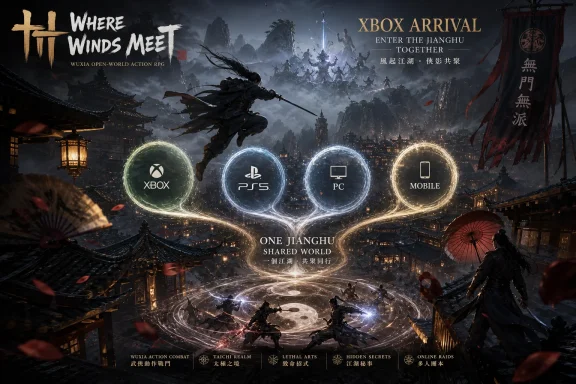 Xbox Gets the Jianghu After the Walls Start Coming Down
For years, Xbox players have watched open-world action RPGs arrive with a familiar pattern: a flashy trailer, a platform carve-out, a delayed port, and a community already established somewhere else by the time Microsoft’s console joins the party. Where Winds Meet complicates that script. Its Xbox listing does not read like a late, compromised arrival; it reads like an attempt to fold Xbox into an already expanding cross-platform world.The game’s store description is almost aggressively broad. Xbox, PS5, PC, and mobile are presented not as separate audiences but as entry points into one shared jianghu, the term wuxia fiction uses for the unruly martial world of wanderers, sects, grudges, loyalties, and reputation. That is not just marketing texture. It signals the genre fantasy and the business model at the same time: a world where your identity follows you, your friends are not necessarily on the same hardware, and the game survives by keeping all of those paths connected.
That is why the Xbox arrival lands differently from a conventional port. If Where Winds Meet were merely a boxed single-player RPG, the question would be whether it runs well and whether its combat is worth the install. But as a free-to-play, content-heavy, online-capable RPG with solo, co-op, guild, dungeon, raid, and competitive features, its platform support is part of the product. A fragmented audience is not an inconvenience in this design; it is an existential problem.
Microsoft has spent years arguing that games should follow players across devices. Sometimes that message has been strategic cover for a weaker console position; sometimes it has been genuinely ahead of the market. Where Winds Meet is the kind of third-party release that makes the argument feel concrete. The game does not need Xbox to be the center of the universe. It needs Xbox to be one more door into the same universe.
A Wuxia RPG Sells Freedom, but It Also Sells Persistence
The store copy leans hard into freedom: scale rooftops, wander mountains, play flutes, drink under lanterns, break the law, become a hero, or live as chaos in a robe. That sounds like standard open-world exuberance until you notice how many systems are being promised at once. Where Winds Meet is positioning itself as solo epic, social MMO-lite, martial-arts brawler, historical fantasy, profession simulator, guild battleground, and cross-device hangout.That abundance is part of the appeal and part of the risk. The game is rooted in the Five Dynasties and Ten Kingdoms period, a politically fractured era of tenth-century China that gives the developers a natural backdrop for instability, factionalism, and shifting loyalties. It is a smart setting for an online RPG because it gives conflict a historical and mythic frame rather than reducing it to generic kingdoms with interchangeable banners.
The player fantasy is similarly elastic. You are a young sword master uncovering forgotten truths and your own identity, but the listing also promises a world that responds to misbehavior with bounties, pursuit, and even jail. That kind of systems-driven consequence is often easier to advertise than to sustain. Still, it is exactly the sort of promise that gives a game like this its hook: the possibility that wandering is not just traversal, but authorship.
The broader claim is that wuxia fits the open-world service-game format unusually well. Western fantasy RPGs often bolt multiplayer systems onto chosen-one narratives that were designed for solitude. Wuxia, by contrast, has always been about reputation, rivalry, masters, disciples, hidden manuals, public duels, sect politics, and the tension between personal honor and social obligation. A persistent multiplayer layer does not have to fight that fiction. It can amplify it.
The Store Listing Reads Like a Product Strategy Document
The Xbox page promises more than 150 hours of solo gameplay, seamless co-op for up to four friends, guild activities, multiplayer dungeons, raids, competitive duels, and a shared world with thousands of adventurers. That is a lot of words doing a lot of jobs. They reassure single-player RPG fans that this is not merely a lobby with swords, while also reassuring online players that the world will not run out of things to do after the story credits roll.This is where Where Winds Meet enters a crowded but still unsettled category. The industry has no shortage of enormous free-to-play RPGs, but the successful ones tend to specialize. Some emphasize character collection, some emphasize MMO progression, some emphasize action combat, and some emphasize narrative spectacle. Where Winds Meet appears to be making a more difficult bet: that a martial-arts sandbox can be expansive enough to satisfy solo explorers and structured enough to retain online communities.
The Xbox listing’s language about weapon switching, bows, stealth, Taichi, fans, umbrellas, spears, swords, dual blades, and glaives is classic feature-stack marketing. But underneath it is a more important question for players: whether combat identity can stay flexible without becoming weightless. If everyone can do everything, builds blur. If specialization is too rigid, the promised freedom becomes decorative.
The same tension applies to the open world. Thousands of points of interest and more than 20 regions sound impressive, but scale has become the least trustworthy metric in games marketing. Players no longer need to be told a map is large. They need to know whether the size produces stories worth remembering. In a wuxia game, the difference between a meaningful hermit shrine and another map icon is the difference between romance and homework.
Cross-Play Is the Feature That Makes the Xbox Version Matter
The most important line in the listing is the simplest one: cross-play across Xbox, PS5, PC, and mobile. In 2026, cross-play is no longer a novelty, but it remains unevenly implemented, inconsistently messaged, and sometimes sabotaged by account systems that feel designed by rival legal departments. For Where Winds Meet, the feature is not a perk; it is the backbone of the whole proposition.A social RPG lives or dies by population density. If Xbox players were isolated from existing PC, PlayStation, and mobile communities, the launch would feel like a regional server opening after the main festival had already begun. Cross-play changes the psychology. New Xbox players can arrive late without necessarily feeling alone, and existing players can bring Xbox friends into the fold without restarting their social graph.
That matters especially for guilds and raids. Group content is brutally sensitive to platform fragmentation because it relies on scheduling, voice coordination, role coverage, and social inertia. The more platforms that can participate in the same pool, the less likely a guild is to collapse because half its members chose the “wrong” device. The strongest online games are not always the ones with the best mechanics; they are the ones that reduce friction between intention and play.
The mobile piece is equally important, even for a WindowsForum audience that may instinctively prioritize PC and console. Mobile support means the game is not merely cross-platform in the traditional living-room-versus-desktop sense. It is trying to become ambient: a world you can check in on, maintain, and socialize through even when you are away from the main screen. That can deepen attachment, but it also raises the specter of grind design shaped around constant availability.
Xbox Players Should Watch the Account Layer, Not Just the Combat
The most practical question for anyone installing on Xbox is not whether the game has a sword. It is how the account binding works. Cross-play and cross-progression live or die in the unglamorous territory of login flows, platform entitlements, region availability, and save migration.The listing’s cross-play language is broad, but players should still treat first login as consequential. Games that span console, PC, and mobile often use a publisher account as the connective tissue between platform identities. If the wrong account is created first, or if a console profile becomes bound in a way that is hard to reverse, the theoretical elegance of cross-progression can become a support-ticket maze.
That is not a reason to avoid the game; it is a reason to slow down before mashing through the opening screens. Anyone who already plays on PC, PlayStation, or mobile should verify how existing progress is linked before launching fresh on Xbox. New players should decide whether they intend to stay inside the Xbox ecosystem or eventually move between devices. The earlier that decision is made, the less painful account housekeeping becomes later.
This is the unromantic side of the modern multi-platform RPG. The fantasy says you are a wandering sword master unconstrained by borders. The backend says your destiny depends on whether a third-party account recognizes your console identity properly. In 2026, both statements are true.
The PlayStation-to-Xbox Path Is Becoming Less Exotic
The arrival of Where Winds Meet on Xbox also reflects a larger shift in the console business. Platform exclusivity is not dead, but its edges are softer than they used to be. Timed exclusives, PC launches, cloud distribution, mobile extensions, and service-game economics have made the old “this game belongs to one box” model harder to defend for anything that depends on scale.That does not mean every wall is coming down. First-party prestige games, subscription strategies, and platform-holder negotiations still shape release calendars. But games like Where Winds Meet expose the commercial gravity pulling in the other direction. A free-to-play RPG with guilds, raids, duels, and seasonal content benefits from reach more than from scarcity. Every closed door is a smaller community, fewer potential spenders, and a harder retention problem.
For Microsoft, this is useful optics. Xbox no longer has to “win” every content negotiation in the old sense if its platform remains a meaningful endpoint for broad ecosystems. For Sony, the calculus is more complicated, but even PlayStation has spent the last several years becoming more comfortable with PC and live-service reach. The industry’s rhetoric may still be tribal, but its infrastructure increasingly is not.
The irony is that third-party service games are now doing some of the cultural work that platform holders used to claim for themselves. They teach players to expect continuity across devices. They normalize shared communities. They make isolation feel archaic. Once players internalize that expectation, it becomes harder for any platform owner to explain why a friend list should stop at the edge of a plastic box.
The Windows Angle Is Bigger Than the Xbox Badge
For Windows users, Where Winds Meet is another reminder that the PC is no longer merely one platform among several. It is the hinge. The same game can exist on Steam, Epic, a publisher launcher, console stores, and mobile devices, but PC often becomes the place where account management, performance scaling, streaming setups, community tools, and troubleshooting all converge.That is good news for enthusiasts and a headache for administrators of their own households. The PC version is likely to be where players chase frame rates, experiment with input methods, tune graphics settings, and troubleshoot network or anti-cheat behavior. It is also where cross-progression problems often become most visible because PC users tend to have multiple storefront identities layered on top of publisher accounts.
The Xbox listing’s existence in Microsoft’s store ecosystem also raises familiar questions about Xbox on Windows. Microsoft wants the Xbox app, Game Bar, cloud saves, PC Game Pass, and Microsoft Store distribution to feel like a coherent gaming platform. Third-party free-to-play games complicate that picture because they often bring their own launchers, account systems, and patching logic. The result can be powerful, but rarely simple.
For WindowsForum readers, the practical advice is to think of Where Winds Meet as a networked application as much as a game. Expect account binding, background downloads, controller and keyboard considerations, possible overlay conflicts, and the usual dance between platform services. The romance is in the bamboo forests; the troubleshooting is in the authentication stack.
Free-to-Play Makes the Door Wide and the Fine Print Important
The free-to-play label lowers the barrier to entry, which is exactly what a new Xbox arrival needs. Nobody has to decide whether the promise of wuxia parkour, martial combat, and factional drama is worth a full-price gamble. They can install it, test the feel, and leave if the world does not catch.But free-to-play also shifts scrutiny from purchase value to design ethics. The question becomes not “is this worth $70?” but “what does the game ask of me after I care?” That can include cosmetics, battle passes, convenience items, progression accelerators, gacha-adjacent systems, or time pressure. The listing provided to Xbox users emphasizes world, combat, exploration, and community rather than monetization details, so caution is warranted until players see the economy in practice.
A service RPG does not need to be predatory to become demanding. Daily tasks, limited-time events, guild obligations, and seasonal grinds can create pressure even when the cash shop is relatively restrained. Cross-platform access can intensify that loop because the game is always reachable. The same mobility that lets you check in from a phone can make it harder to log off psychologically.
That is the central bargain of modern persistent games. The best ones turn continuity into belonging. The worst ones turn continuity into obligation. Where Winds Meet has enough aesthetic ambition and mechanical breadth to deserve attention, but Xbox players should judge it not only by the first five hours of wonder but by the thirtieth hour of routine.
The Combat Pitch Needs Precision, Not Just Spectacle
Martial-arts games live or die by feel. A wuxia RPG can have gorgeous mountains, historical texture, and elaborate factions, but if swordplay feels mushy, the fantasy collapses. The listing’s emphasis on responsive combat, weapon variety, ranged options, stealth, and mystic martial arts suggests a game chasing breadth rather than the narrow perfection of a pure character-action title.That is not automatically a problem. An open-world RPG does not need to be Sekiro to be compelling, and a multiplayer service game cannot always demand frame-perfect mastery from every participant. But it does need a combat model with a readable skill ceiling. Players should feel the difference between a novice swinging through animations and a veteran who understands timing, spacing, counters, weapon swapping, and build synergy.
The weapon list is promising because it extends beyond the standard sword-and-bow template. Fans and umbrellas are not just cosmetic variations if they carry distinct rhythms and tactical identities. Taichi, if implemented as more than visual flourish, could give the combat a defensive or redirection-based vocabulary that fits the genre. The danger is that too many options become a blur of cooldowns with martial-arts names.
For Xbox, controller feel will be decisive. PC players can forgive a lot if keybinds are flexible and performance is high. Console players are less patient with overloaded inputs, radial menus, camera fights, or targeting systems that buckle in group combat. If Where Winds Meet wants Xbox to be a first-class platform rather than a compatible endpoint, its combat must feel native on a controller.
The Historical Setting Gives the Game a Chance to Stand Apart
The Five Dynasties and Ten Kingdoms period is not just a backdrop with unfamiliar names. It gives Where Winds Meet a chance to differentiate itself in an open-world market saturated with medieval Europe analogues, post-apocalyptic wastelands, science-fantasy megacities, and mythological mashups. A tenth-century Chinese world of fractured regimes, shifting capitals, and contested legitimacy is fertile ground for factional storytelling.That matters because open-world games increasingly compete on texture. Players have seen mountains, forests, ruins, and bandit camps. What makes a world memorable is not the presence of a temple, but why the temple matters; not the existence of a city, but the political, social, and emotional pressure inside it. Wuxia gives the developers a vocabulary of wandering justice, private vengeance, sect loyalty, hidden knowledge, and morally ambiguous heroism.
The listing’s promise that players can become heroes or agents of chaos is familiar, but the wuxia frame can make that choice more interesting than a binary morality meter. In martial-world fiction, honor is not always lawful, rebellion is not always noble, and personal loyalty can clash with public duty. If the game’s systems reflect even some of that ambiguity, it could avoid the flattening that plagues many open-world consequence systems.
The challenge is localization in the broad sense. Translation quality matters, but so does cultural legibility. A global Xbox audience needs enough context to understand factions, titles, rituals, rivalries, and historical references without sanding away what makes the setting distinctive. The worst outcome would be a rich Chinese historical fantasy reduced to generic “ancient martial vibes.” The best outcome would be a game that trusts players to learn its world.
Scale Is Impressive Only If the World Remembers You
The listing advertises a world shaped by time, weather, and player action. That is one of the most overused promises in open-world design, but it remains powerful when true. Players do not need every NPC to simulate a full life. They need the game to remember enough of their choices to make wandering feel less like tourism.The law-and-bounty language is especially interesting. A system that punishes chaos with pursuit or jail could give the world a social spine. It suggests that freedom is not simply permission to behave badly, but a set of actions with consequences. In a wuxia setting, that could be richer than a standard crime meter because reputation is central to the fiction.
Still, consequence systems are hard to reconcile with multiplayer. If one player is a noble village defender and another is a serial rooftop menace, what does the shared world believe? Does reputation affect only personal instances, or does it alter social spaces? Can co-op partners drag each other into trouble? These are not nitpicks; they are design questions that determine whether advertised freedom becomes meaningful or merely decorative.
The most likely answer is compromise. Major story identity may be personal, while social and multiplayer layers remain stable enough to keep the service functioning. That is understandable. But the more Where Winds Meet asks players to believe in their legend, the more it must provide moments where the world seems to have heard of them.
Xbox Owners Are Joining a Living Game, Not Opening a Sealed Box
One advantage of arriving now is that Where Winds Meet is not an unknown concept being thrown cold into the market. It has already been discussed, tested, played, patched, praised, criticized, and explained by communities on other platforms. Xbox users can benefit from that accumulated knowledge, but they also inherit an ecosystem that may already have its meta, its veterans, and its social hierarchies.That can be intimidating. Newcomers entering a live RPG often face a strange duality: the game is fresh to them, but old to everyone else. Guides exist, optimal builds circulate, guilds have expectations, and the community may already have decided which activities are efficient and which are a waste of time. The joy of discovery competes with the pressure to catch up.
The best live games solve this by making late arrival feel adventurous rather than remedial. They give new players a strong solo path, clear onboarding, generous catch-up systems, and reasons for veterans to help rather than ignore them. The Xbox listing’s emphasis on 150-plus hours of solo content may help here. It implies that a player can inhabit the world on their own terms before worrying about guild wars and raids.
That solo foundation is crucial. Cross-play gives Xbox players access to a larger community, but a larger community is not always welcoming by default. A strong narrative and exploration track lets players build competence and attachment before entering the social churn. For many, that will be the difference between Where Winds Meet becoming a long-term hobby and becoming a weekend curiosity.
Microsoft’s Storefront Is Now a Discovery Surface for Global RPGs
The Norwegian-language Microsoft listing supplied here is a reminder that Xbox’s global storefront is not just a checkout page. It is a distribution signal. When a game like Where Winds Meet appears there with localized copy, platform claims, social links, and a clear cross-play pitch, it tells players that the title is being positioned for a broad international audience rather than treated as a niche import.That distinction matters for games rooted outside the usual Western publishing pipeline. NetEase and Everstone are not asking Xbox players merely to sample an exotic setting. They are presenting Where Winds Meet as a major contemporary RPG that belongs in the same platform conversation as any other persistent open-world release. The difference is aesthetic, historical, and cultural, not necessarily commercial scale.
For Microsoft, carrying more of these games helps diversify the Xbox library beyond the familiar poles of shooters, racers, Western RPGs, and licensed sports. Xbox has sometimes struggled with perception among players who follow Asian-developed console and action RPGs closely. A stronger pipeline of cross-platform global releases can soften that weakness, even when those games are not exclusive.
For players, the benefit is straightforward: more worlds, more genres, and fewer artificial barriers. But the cost is a marketplace that can feel increasingly crowded with service games competing for the same finite attention. The install may be free. The time is not.
The Real Test Begins After the First Rooftop Leap
The most seductive part of Where Winds Meet will likely be the opening hours: the first sprint across a roofline, the first duel that sells the rhythm of the combat, the first misty temple discovered off the main road, the first hint that the world is stranger and older than it looks. Games like this are built to overwhelm in the best sense. They want you to feel that every mountain path is an invitation.The harder test comes later, when spectacle gives way to structure. Are activities meaningfully varied, or do they become a rotation of icons? Does co-op feel integrated, or merely allowed? Are guild systems compelling without becoming chores? Does the story maintain momentum across a world built to distract? Does the economy respect players who spend time but not money?
These are not reasons for cynicism. They are reasons to evaluate the game on the terms it has chosen. A traditional single-player RPG can be judged largely by narrative, combat, presentation, and pacing. A cross-platform service RPG must also be judged by retention design, social friction, patch cadence, platform parity, and account reliability. Where Winds Meet has volunteered for the harder exam.
The Xbox version’s importance is therefore conditional. If the cross-play works smoothly, if controller support feels deliberate, if account linking is sane, and if the world gives latecomers a fair runway, this could become one of the more interesting free-to-play additions to the Xbox library. If not, it will be another ambitious service game whose best ideas are buried under logistical drag.
The Xbox Store Listing Tells Players Exactly Where to Look
For anyone deciding whether to install, the strongest signal is not any single feature but the combination of features. Where Winds Meet is selling itself as a full-scale wuxia RPG that can be played alone, with friends, inside guilds, across devices, and across rival console ecosystems. That is a big promise, and the Xbox release makes it bigger.The practical read is simple:
- Xbox players can treat Where Winds Meet as a new entry point into an existing cross-platform wuxia RPG rather than as an isolated console port.
- Players with existing progress on another platform should understand account linking before starting on Xbox.
- The advertised cross-play across Xbox, PS5, PC, and mobile is the feature that most directly affects the game’s long-term community health.
- The free-to-play model makes the game easy to sample, but its monetization and time demands should be judged after the honeymoon period.
- The game’s historical Chinese setting and wuxia identity give it a chance to stand apart if the writing, localization, and world systems support the premise.
- The Xbox version will ultimately be measured by platform parity, controller feel, performance, and whether new players can join without feeling permanently behind.
References
- Primary source: Microsoft
Published: 2026-06-07T20:53:07.173622
Skaff deg Where Winds Meet | Xbox
Where Winds Meet is an epic Wuxia open-world action-adventure RPG set in ancient China at the tenth century. Players will assume the role of a young sword master as they embark on a journey to uncover the mysteries of their own identity. Let the wind carry your legend on an epic journey to the...www.microsoft.com - Related coverage: xbox.com
Get Where Winds Meet | Xbox
Where Winds Meet is an epic Wuxia open-world action-adventure RPG set in ancient China at the tenth century. Players will assume the role of a young sword master as they embark on a journey to uncover the mysteries of their own identity. Let the wind carry your legend on an epic journey to the...www.xbox.com - Related coverage: game8.co
Is There Cross-Play and Cross-Progression? | Where Winds Meet|Game8
Where Winds Meet features cross-play and cross-progression for PC,PS5 and Mobile. Learn more about cross-play and cross-progression for Where Winds Meet here.game8.co - Related coverage: explosion.com
Is Where Winds Meet Cross Platform? Crossplay Guide 2026 — Explosion
No, Where Winds Meet does not support cross-platform play. The game is currently only available on PC and PlayStation 5, with no crossplay functionalitywww.explosion.com - Related coverage: gamespot.com
Where Winds Meet Will Officially Launch On Mobile This Month - GameSpot
Later this month, Where Winds Meet players can take their adventure with them on mobile.www.gamespot.com - Related coverage: allthings.how
Where Winds Meet cross play explained: PC, PS5, and shared progression
How cross-progression works, what can go wrong, and the safest ways to link accounts on Steam, Epic, the official launcher, and PlayStation 5.allthings.how
- Related coverage: gematsu.com
Where Winds Meet - Gematsu
Where Winds Meet is an open-world action role-playing video game developed and published by Everstone Studio. About Where Winds Meet is an interactive open…www.gematsu.com - Related coverage: crosswatch.info
Where Winds Meet Cross-Play
Does Where Winds Meet support cross-play? Our investigation uses official sources only.www.crosswatch.info - Related coverage: ixbt.games
Everstone Studio Confirms Where Winds Meet Release on iOS and Android - Global Launch on December 12
The mobile version supports cross-play and shared progress with PC and PlayStation 5.ixbt.games - Related coverage: techradar.com
Free open-world RPG Where Winds Meet finally hits mobile next week after a successful PC and PS5 launch | TechRadar
The game already reached more than 9 million playerswww.techradar.com - Related coverage: pocketgamer.biz
Where Winds Meet hits 15 million players within one month of release | PocketGamer.biz
Where Winds Meet has surpassed 15 million players within its first month on the market.www.pocketgamer.biz
- Related coverage: tomshardware.com
Sony reportedly working on 'Cross-Buy' feature for unified game ownership between PlayStation 5 and PC — Leaked icons indicate Sony's answer to Xbox Play Anywhere is coming | Tom's Hardware
One purchase across two platforms.www.tomshardware.com - Related coverage: windowscentral.com
Xbox Games Showcase 2026 will debut Gears of War: E-Day gameplay and bring back Xbox Fanfest — Here's when you can expect these events to go live | Windows Central
The road to the biggest Xbox Games Showcase of the year has begun as Microsoft announces when the event will go live, while confirming that Gears of War: E-Day and Xbox Fanfest will be therewww.windowscentral.com - Related coverage: gamesradar.com
Everything announced at the Xbox Developer Direct 2026 | GamesRadar+
All the announcements, reveals, and news about Fable, Forza Horizon 6, Beast of Reincarnation, and Kilnwww.gamesradar.com
