

The hyperscalers are not throwing money into a bonfire — they are erecting the industrial plumbing of the AI economy, and what looks like reckless spending today is the most defensible, long-horizon strategic pivot the cloud era has seen.
Big Tech’s recent earnings season clarified something investors have suspected for months: AI is reshaping the economics of cloud computing, and Amazon, Alphabet, and Microsoft are deliberately front‑loading capital to own the compute, networking, and software stack that will host large‑scale generative AI for years. The numbers are eye‑watering: year‑over‑year acceleration in cloud revenue across the trio, multi‑year capital expenditure commitments measured in the hundreds of billions, and an unprecedented concentration of GPU/accelerator demand that has created a scramble for capacity and supply.
Short term, markets fret about profitability and cash returns. Long term — five years and beyond — the bets start to look like infrastructures: once built, these data centers and custom silicon pathways collapse cost, raise barriers to entry, and create recurring cash flows. That’s the thesis investors are underpricing now, and why the recent spending, while painful for quarterly margins, can be considered rational and even visionary.
Short‑term economics favor renting when:
Investors see costs now; the companies are trying to lock-in customers and economics for decades.
Key financial tradeoffs:
If adoption stalls, if geopolitical constraints dramatically limit addressable markets, or if competitors deliver comparable economics without the heavy capex, the spending could look reckless. Right now, the market is debating which future will happen. The safest conclusion for pragmatists: the strategy is rational, high‑variance, and long‑dated — it’s built to win in a world that values compute‑dense AI services, but it will test investors’ patience and the companies’ capital discipline in the near term.
Source: The Globe and Mail Here's Why Amazon, Alphabet, and Microsoft's AI Spending Is a Genius Move
 Overview
Big Tech’s recent earnings season clarified something investors have suspected for months: AI is reshaping the economics of cloud computing, and Amazon, Alphabet, and Microsoft are deliberately front‑loading capital to own the compute, networking, and software stack that will host large‑scale generative AI for years. The numbers are eye‑watering: year‑over‑year acceleration in cloud revenue across the trio, multi‑year capital expenditure commitments measured in the hundreds of billions, and an unprecedented concentration of GPU/accelerator demand that has created a scramble for capacity and supply.Short term, markets fret about profitability and cash returns. Long term — five years and beyond — the bets start to look like infrastructures: once built, these data centers and custom silicon pathways collapse cost, raise barriers to entry, and create recurring cash flows. That’s the thesis investors are underpricing now, and why the recent spending, while painful for quarterly margins, can be considered rational and even visionary.
Background: Why cloud providers are spending like builders
Cloud as a rental economy for compute
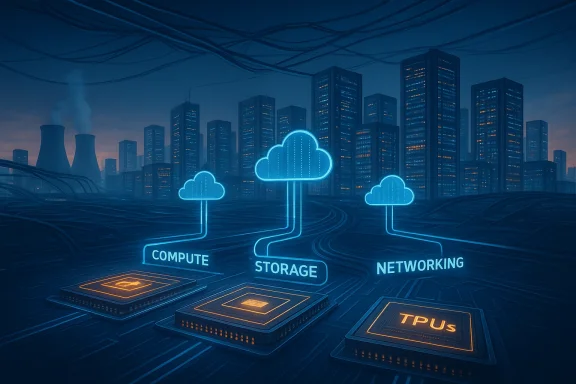
At its simplest, cloud computing is a rental model: hyperscalers build excess capacity and rent compute, storage, networking, and higher‑order platform services to customers who prefer operating expense over capital expenditure. That tradeoff becomes even more compelling for AI workloads, where the upfront hardware cost for training and serving models can dwarf a startup’s budget and where the optimal hardware is specialized and rapidly evolving.Short‑term economics favor renting when:
- Model architecture or business product/market fit is uncertain.
- The hardware life cycle is short and disruptive (GPU generations, new accelerators).
- Scale economics (bulk purchasing, colocated networking) matter.
The AI build cycle: buy now, harvest later
These companies are in an explicit build phase — shells, racks, power plants, networking, accelerator fleets (GPUs, TPU/Trainium families), and higher‑level AI services. That front‑loaded spending produces temporary pressure on margins and cash flow, but the architectural payoff arrives when utilization normalizes and customers consume services as steady, recurring revenue.Investors see costs now; the companies are trying to lock-in customers and economics for decades.
The Q4 snapshot: growth plus capex — what the numbers show
The most recent quarter (end of calendar 2025 / Microsoft fiscal Q2 FY26) gave a clear, consistent message: cloud revenue is re‑accelerating and companies are spending ahead of demand.Amazon Web Services (AWS)
- AWS growth re‑accelerated to roughly 24% year‑over‑year, with revenue in the quarter in the mid‑thirties of billions (reported at about $35.6 billion for the quarter), marking the fastest growth in several quarters.
- Amazon emphasized the momentum from custom silicon — Graviton (server CPU family) and Trainium (AI accelerator family) — citing a combined annual revenue run‑rate north of $10 billion and triple‑digit year‑over‑year growth for that business line as AWS pushes customers toward in‑house silicon to lower cost and retain economics.
- Amazon signaled very large capital plans — a major multi‑year capex increase — reflecting a shift to a sustained, scale‑first posture for AI infrastructure.
Google Cloud
- Google Cloud posted the fastest growth rate among the big three in the latest quarter — roughly 48% year‑over‑year, reaching the high‑teens in quarterly revenue (just over $17 billion in the quarter).
- Importantly, Google’s growth has come with margin improvement and a quickly expanding backlog of multi‑year commitments, driven by demand for Gemini‑powered enterprise AI offerings, TPUs (Google’s in‑house accelerators), and integrated AI solutions.
- Alphabet signaled very large planned capital investment for the next year — an order of magnitude higher than typical — as it accelerates data center and TPU capacity to meet demand.
Microsoft Azure
- Microsoft reported Azure and other cloud services growing roughly 39% year‑over‑year in the quarter — strong by any historical standard.
- The company disclosed a very large commercial backlog (remaining performance obligations) in the hundreds of billions, with management characterizing a significant portion of that backlog as linked to major AI customers and strategic partnerships. Microsoft also recorded a large, step‑change increase in capital spending as it scales GPU‑dense capacity.
- Microsoft’s narrative centers on leveraging Microsoft 365, Dynamics, and Azure to embed AI deeply across enterprise workloads — a different but complementary strategy to Amazon and Google.
Technical plumbing: chips, racks, and efficiency levers
To understand why spending is rational, you must understand what they are buying.Specialized accelerators and custom silicon
- GPUs (NVIDIA and others) remain the primary choice for large language model training today. The hyperscalers are the largest buyers of high‑end GPUs and have aggressively expanded GPU datacenter fleets. Supply and export controls have created near‑term constraints that favor whoever can secure chips at scale.
- Custom silicon (AWS Graviton, Trainium; Google TPUs) is the second major lever. These chips are built to be price‑performant for either general server workloads (Graviton) or AI training/inference (Trainium, TPUs). The economics: custom silicon reduces dependence on external suppliers, lowers per‑workload cost, and preserves more margin for the cloud provider. AWS reports Graviton can be up to ~40% more price‑performant than leading x86 processors for certain workloads, and Trainium/TPU capacity reduces serving and training costs for AI models.
Data center scale and operational investments
- The hyperscalers are buying more than chips: power substations, cooling systems, datacenter shells, high‑bandwidth networking, and multi‑region failover capacity. AI compute is energy and I/O‑intensive; capacity without adequate power and cooling is useless.
- Many of the dollars being spent are on short‑lived compute inventory (GPUs that depreciate fast) and longer‑lived facility shells. That mix explains why capital spending spikes but depreciation may compress margins in the near term.
Strategic dynamics: competition, lock‑in, and vertical edge
Spending so heavily has strategic benefits that go beyond raw revenue growth.- Customer lock‑in via integrated services: Enterprises and model developers prefer integrated stacks where models, tooling, deployment, monitoring, and governance work together. Hyperscalers can sell a full bouquet of services that are hard to replicate on‑premises.
- Capture both training and inference dollars: Training is massive but episodic; inference is continuous and higher margin. Owning the serving layer (and lowering its cost with proprietary silicon) converts episodic training spikes into long‑term recurring revenue.
- Reduce dependency on third‑party accelerator vendors: Custom silicon reduces the "GPU tax" paid to outside suppliers and captures more value inside the cloud provider.
- Platform moat: Over time, hyperscalers can lock in customers through richer AI tooling, proprietary optimizations, and the inability of most enterprises to replicate hyperscale economics.
Financial tradeoffs and investor concerns
The market’s impatience is understandable: capex shows up now, benefits may not be visible until utilization and tooling capture kick in.Key financial tradeoffs:
- Margins compress while infrastructure ramps: Heavy spending on short‑lived compute increases depreciation and lowers gross margins until utilization rises.
- Cash flow timing: Cash used to build capacity delays return on invested capital; investors used to software‑like margins may penalize hardware‑heavy trajectories.
- Concentration risk: Large backlogs tied to a single partner or a handful of buyers (big model developers) expose the provider to customer concentration and renegotiation risk. That’s particularly relevant where a significant portion of contracted backlog is attributable to one partner.
- Supply chain and geopolitics: Export controls and semiconductor supply limits can both constrain growth and create pricing power for providers who secure capacity.
Risks worth underscoring
No strategy is risk‑free. Here are the most material downsides:- Capital intensity and slow payback: If the AI market grows more slowly than forecast, hyperscalers could be left with underutilized capacity and impaired returns.
- Customer concentration: When a large share of forward revenue is tied to one partner, contract renewals and pricing leverage become critical single‑points of failure.
- Competitive escalation and double‑ordering: Hyperscalers and enterprises may overbuy or double‑order capacity to secure chips, creating demand volatility and eventual oversupply.
- Regulatory and antitrust risk: Massive investments to dominate infrastructure could attract regulatory scrutiny in multiple jurisdictions. Policies aimed at limiting market concentration or protecting national AI sovereignty could raise costs or force structural changes.
- Export controls and geopolitics: Restrictions on high‑end accelerator exports can limit addressable markets and shift supply dynamics in unpredictable ways.
- Unproven monetization on some AI services: While platform and enterprise integrations have clear monetization paths, some consumer‑facing AI features may struggle to convert to durable, high‑margin revenue.
Why this is still a defensible, long‑term play
There are three core reasons the spending makes strategic sense over a multi‑year horizon:- Demand elasticity and lock‑in: If models that materially boost enterprise productivity are widely adopted, customers will pay for low‑latency, secure, compliant, and high‑throughput compute. Hyperscalers that own that compute can capture both the value and the incremental margin.
- Scale economics: AI is a scale game. Whoever can amortize model serving and storage across the broadest base of users will have structural cost advantages. Early builders get the scale edge.
- Control of the software + hardware layer: Vertical integration (models, accelerators, cloud) reduces per‑inference cost and improves developer velocity. That combination is harder to replicate by smaller cloud providers or on‑prem customers.
Practical implications for investors and enterprise buyers
For investors
- Patience is essential: These investments are not judged well by quarterly arithmetic alone. Durable returns depend on utilization, ecosystem lock‑in, and marginal cost improvements over time.
- Look beyond headline capex: Distinguish between spending that buys long‑lived facility shells and spending that goes into short‑lived compute inventory; the mix matters for depreciation and margin trajectories.
- Watch concentration and RPO/backlog disclosure: Large contract backlogs can be both a promise and a dependency; track who is behind those numbers.
- Evaluate custom silicon adoption: The speed with which customers adopt in‑house accelerators (and migrate away from third‑party GPUs) will materially affect long‑term margins.
For enterprise IT leaders
- Assess vendor lock‑in vs. operational flexibility: The hyperscalers’ integrated stacks are tempting but bind you to their tooling and economics. Consider hybrid or multi‑cloud architectures where appropriate.
- Factor in performance per dollar and data locality: Some workloads need proximity to data and specialized hardware; empirical benchmarking on real workloads is crucial when selecting a provider.
- Plan for governance and compliance complexity: As more sensitive workloads move to cloud‑hosted AI, governance, access control, and compliance overhead increase.
What to watch next (near‑term indicators)
- Utilization metrics and margin improvement in cloud segments — signals that capital is converting to revenue.
- Adoption rates for custom silicon (how many customers switch to Graviton/Trainium/TPU offerings).
- Backlog conversion pace — how quickly large contracts start contributing to recognized revenue.
- GPU supply and lead times — changes here affect near‑term capacity and price.
- Regulatory developments that could reshape competitive dynamics or force structural changes.
Claims that need cautious treatment
Some narratives are repeatedly repeated but deserve a health warning:- Claims that a single AI customer is “the company” driving most future revenue should be treated with caution unless supported by contract disclosures and filing‑level detail. Customer concentration can be real, but exact percentages and conversion timing are often opaque.
- Assertions that model developers are universally moving off the hyperscalers to “build their own data centers” are mixed — some players are diversifying, whether for cost, control, or compliance, but hyperscalers retain structural advantages in procurement, networking, and operational scale. Reports that any single model developer has wholly abandoned hyperscale providers and is self‑hosting all production workloads are not uniformly corroborated and should be marked as speculative without direct company confirmation.
- Vendor claims about exact price‑performance gains (e.g., “up to X% faster”) are often marketing‑framed and should be validated against independent benchmarks for specific workloads.
Bottom line — genius move or expensive experiment?
Calling the hyperscalers’ AI spending “genius” is defensible only if you accept a few conditions: that AI adoption continues, that model serving becomes a durable and high‑margin business, and that scale economics materially favor the hyperscalers. If those things happen, the companies that spent to own the compute layer will enjoy durable market power and improved long‑term returns.If adoption stalls, if geopolitical constraints dramatically limit addressable markets, or if competitors deliver comparable economics without the heavy capex, the spending could look reckless. Right now, the market is debating which future will happen. The safest conclusion for pragmatists: the strategy is rational, high‑variance, and long‑dated — it’s built to win in a world that values compute‑dense AI services, but it will test investors’ patience and the companies’ capital discipline in the near term.
Practical checklist for readers
- If you’re an investor:
- Assess tolerance for capital‑intensive growth.
- Monitor cloud segment margins and RPO/backlog conversion.
- Watch custom silicon adoption and GPU supply signals.
- If you’re an enterprise buyer:
- Benchmark providers on your workloads, not vendor claims.
- Evaluate hybrid and multi‑cloud strategies for risk mitigation.
- Build governance and cost visibility for AI consumption.
- If you’re an IT leader:
- Prepare for a future where AI compute costs dominate architecture decisions.
- Invest in skills for model orchestration, cost engineering, and governance.
- Negotiate commitments with clear exit and audit clauses to avoid lock‑in surprises.
Conclusion
The hyperscalers’ AI spending is a high‑stakes, high‑conviction bet: they are building the rails of the AI economy now so they can collect the tolls for years. It’s a strategy that creates rare optionality but brings near‑term pain. Whether it proves “genius” will depend on how quickly utilization grows, how efficiently the capex is deployed, and whether geopolitics or competing architectures alter the economics. For investors and technology leaders, the prudent stance is neither euphoric acceptance nor reflexive dismissal — it is careful, data‑driven scrutiny, patience for long horizons, and contingency planning for the many ways the AI era could unfold.Source: The Globe and Mail Here's Why Amazon, Alphabet, and Microsoft's AI Spending Is a Genius Move
