

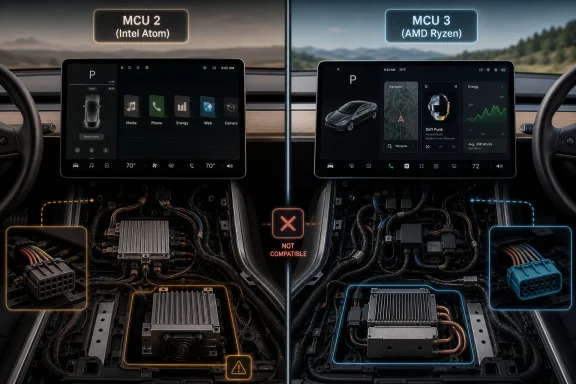
Tesla owners with Intel Atom-based MCU 2 infotainment systems are unlikely to receive a factory upgrade to the AMD Ryzen-based MCU 3 hardware introduced in late 2021 and 2022 vehicles, because the newer computer appears to use different physical packaging, power delivery, and vehicle harnessing. The important part is not that Tesla has made another faster screen computer; it is that the company’s rolling-hardware model is again colliding with customer expectations of upgradeability. For a brand that trained buyers to think of the car as a software platform, the MCU 2-to-MCU 3 divide is a reminder that software-defined vehicles still have very physical limits. The touchscreen may look like a tablet, but behind it is an automotive computer wired into a car that was never designed to be a normal PC.
Tesla did not become the most closely watched automaker by treating electronics as an afterthought. Long before legacy manufacturers were promising “software-defined vehicles,” Tesla was shipping cars whose central screen, connectivity stack, navigation, media apps, games, diagnostics, and many comfort functions were visibly improved over time. The company made a persuasive argument that a car could age differently if enough of its personality lived in software.
That promise was never purely fictional. Tesla owners have received major interface redesigns, new entertainment apps, driver-assistance improvements, navigation changes, and feature unlocks through over-the-air updates. The car in the driveway often did feel less static than a conventional vehicle.
But the MCU 2-to-MCU 3 story shows the boundary line. A car may be software-defined in the user experience, but it is still hardware-constrained in the engineering reality. When the computer changes architecture, power needs, connectors, cooling, and packaging, “just swap the chip” becomes a fantasy.
The speculation from Tesla hacker @greentheonly landed because it sounded less like rumor and more like teardown logic. The claim was not merely that Tesla had chosen not to offer a retrofit. It was that the Ryzen-based unit in newer cars looked physically and electrically different enough that retrofitting it into Intel cars would be impractical without a broader redesign.
That distinction matters. A corporate “no” can change if enough owners complain or if a service business case emerges. A wiring-and-packaging “no” is harder to argue with. If the harnesses, thickness, mounting, and power architecture are different, the retrofit stops being a computer replacement and starts becoming a partial vehicle rebuild.
Tesla’s response was not perfect, but it was real. The company offered a paid MCU 2 upgrade for many older Model S and Model X owners, replacing the aging Tegra-era infotainment computer with an Intel Atom-based unit. It was expensive, and some owners lost or needed additional work for features such as radio support, but it created a template: when the screen computer gets old, Tesla may eventually sell you the newer one.
That history now cuts against Tesla. Owners of Intel-based Model 3, Model Y, Model S, and Model X vehicles can reasonably point to the MCU 1 upgrade and ask why the same logic should not apply again. If Tesla could move legacy S and X owners from Tegra to Intel, why not move Intel owners to Ryzen?
The answer appears to be that the earlier upgrade was a designed service path for a narrower set of legacy vehicles and a different hardware transition. MCU 1 to MCU 2 was difficult enough, but it served cars whose infotainment aging had become both a feature problem and a reliability problem. MCU 2 to MCU 3, by contrast, spans a much larger modern fleet and seems entangled with other vehicle changes introduced around the same era.
That makes this less like a normal laptop upgrade and more like discovering that a motherboard swap also requires a different power supply, chassis bracket, cooling path, and wiring harness. The touchscreen is the visible part, but the Media Control Unit is embedded in a broader vehicle architecture.
Autopilot and FSD run on separate hardware. That distinction is crucial because a Tesla can have one generation of infotainment computer and another generation of driver-assistance computer. An Intel Atom MCU 2 car can still have Hardware 3 for FSD. A Ryzen MCU 3 car can exist alongside different Autopilot hardware depending on model year and production timing.
For owners, however, the distinction can feel academic. If the screen is slow, if Netflix takes longer to load, if the browser feels stale, or if a new app arrives only on Ryzen cars, the vehicle feels older. The driver may not care whether the limitation comes from infotainment silicon or autonomy silicon.
This is where Tesla’s design philosophy creates a strange inversion. The central screen makes the car feel futuristic, but it also makes aging more obvious. In a conventional car, an old head unit might be annoying but peripheral. In a Tesla, the screen is the cockpit.
MCU 3’s AMD Ryzen processor brought a visible improvement in responsiveness. Apps load faster, maps and menus feel smoother, and media functions behave more like a modern consumer device. The improvement is not just benchmark vanity; it changes the way the car feels during ordinary use.
Two buyers can purchase what appears to be the same model within months of each other and receive materially different computing hardware. One gets Intel Atom; another gets AMD Ryzen. The outside of the vehicle may look nearly identical, but the long-term software runway may not be the same.
That is the bargain Tesla rarely states plainly. Rapid iteration benefits the next buyer more than the last buyer. It keeps the product fresh, but it also means the fleet becomes a patchwork of hardware capabilities.
In consumer electronics, that is normal. Nobody expects every older iPad to run every new feature forever. But cars are not tablets. They cost tens of thousands of dollars, are financed over years, and are expected to remain useful for a decade or more.
Tesla has tried to bridge that contradiction with software support. The company often backports features where possible, and Intel MCU 2 cars are not suddenly obsolete. But each new hardware generation widens the gap between “still supported” and “feature-complete.” That gap is where customer frustration lives.
If the MCU 3 unit uses different harnesses, the service challenge immediately grows. Wiring harnesses in modern vehicles are not casual accessories; they are carefully routed, validated, and documented assemblies. Replacing or adapting them can affect service time, reliability, regulatory compliance, warranty exposure, and manufacturing complexity.
Power delivery is even more important. Ryzen-based Tesla systems have been associated with broader electrical changes in newer vehicles, including the move in some models toward lithium low-voltage batteries and higher low-voltage architecture. Even where the exact configuration varies by model and production period, the point remains: a higher-performance infotainment computer is not necessarily drop-in compatible with the electrical environment of an older Intel car.
Then there is packaging. A unit with different thickness, mounting points, cooling needs, or connector placement may physically fit only after additional parts are replaced. That is not impossible in a custom shop sense, but Tesla service is not a custom fabrication business. For a manufacturer-backed retrofit, “possible” must mean repeatable, safe, warrantable, and economically rational at scale.
This is where enthusiast logic and automaker logic diverge. Enthusiasts ask whether a talented technician could make it work. Automakers ask whether thousands of service centers can perform the job reliably without creating new failures, warranty claims, or regulatory problems. Those are very different thresholds.
If Tesla formally says there will never be an MCU 3 retrofit, it angers owners who bought Intel cars near the transition. If Tesla promises a retrofit, it creates a service obligation that may be costly, complex, and technically compromised. Silence preserves flexibility.
But silence also allows expectations to inflate. Owners see the MCU 1-to-MCU 2 upgrade and assume history will repeat. They see newer cars getting smoother interfaces and newer entertainment features and assume a paid path will eventually arrive. The longer Tesla avoids a clear answer, the more that uncertainty becomes part of the ownership experience.
There is also a sales incentive hiding in plain sight. If Ryzen responsiveness becomes one more reason to buy a newer Tesla, a retrofit could reduce the appeal of upgrading the whole vehicle. That does not mean Tesla is cynically withholding an easy upgrade; the engineering issues appear real. But when technical complexity and commercial incentives point in the same direction, owners should not expect heroic retrofit programs.
The most likely path is the least dramatic one. Tesla will continue supporting MCU 2 where practical, reserve some features for MCU 3 when performance or architecture demands it, and avoid offering a broad Intel-to-Ryzen upgrade unless forced by a reliability or regulatory issue. That is not satisfying, but it is consistent with how hardware platforms age.
The risk is gradual divergence rather than sudden abandonment. New apps may target Ryzen first. Interface effects may be tuned for newer hardware. Browser performance may become more constrained as modern web content grows heavier. Games and video services may become harder to support consistently across older silicon.
This is exactly how platforms age in computing. A device remains functional long after it stops being the preferred target for new features. The owner notices not because the product fails, but because the newest software experience stops arriving in full.
For Tesla, that creates a communications problem. The company sells cars with the aura of continuous improvement, but continuous improvement has tiers. Some improvements are universal. Some depend on sensors. Some depend on autonomy hardware. Some depend on infotainment compute. Owners need a clearer map of which lane their car is in.
The irony is that Tesla’s central-screen architecture makes these differences more visible than they would be in a fragmented legacy cockpit. When everything flows through one display, the speed of that display becomes the personality of the vehicle. A slow MCU makes the whole car feel slow, even if the motors and battery are fine.
The critical driving systems are not supposed to depend on the MCU generation in the same way entertainment and interface features do. Autopilot and FSD capability are governed by separate computers and sensors. A Ryzen infotainment unit may make the cabin experience smoother, but it is not the dividing line for whether the vehicle can drive, charge, or receive safety-related updates.
That does not make the frustration trivial. The screen is central to Tesla ownership, and customers who bought late Intel cars understandably feel caught on the wrong side of a quiet transition. A 2021 vehicle can feel psychologically older than its age if a near-identical 2022 car has a noticeably better computer.
Resale value may also reflect the split. As buyers become more aware of Intel versus Ryzen, used listings may increasingly call out the infotainment processor alongside battery size, drivetrain, FSD computer, and warranty status. The difference may not dominate pricing, but it will matter to shoppers who care about long-term software features.
This is where transparency would help Tesla and buyers alike. A clear processor listing in vehicle details, a plain-language feature matrix, and an explicit retrofit policy would reduce rumor-driven disappointment. Tesla does not need to promise impossible upgrades, but it should not leave owners to decode teardown threads to understand what they bought.
Legacy automakers once refreshed infotainment systems slowly and often badly. The upside was that buyers had low expectations. If the navigation system aged poorly, nobody was shocked. Tesla raised the bar by making the software experience central, but that also raised the penalty when hardware ages.
Volkswagen, GM, Hyundai, Mercedes, BMW, and the Chinese EV makers are all chasing software-defined architectures. They want fewer electronic control units, more centralized compute, faster update cycles, and new revenue from services. That strategy will inevitably produce the same question Tesla owners are asking now: when the computer gets old, what does the manufacturer owe the customer?
The answer cannot simply be “buy a new car.” Regulators, fleet buyers, and consumers will all push back if expensive vehicles lose important software functionality too quickly. At the same time, manufacturers cannot realistically guarantee indefinite hardware parity across rapidly evolving compute platforms.
The middle ground will require clearer lifecycle commitments. Automakers may need to specify how long core software support lasts, which feature classes are tied to hardware generations, and whether paid upgrade paths will exist. The PC industry learned to talk about minimum requirements. The auto industry is only beginning to admit that cars now have them.
For enthusiasts, that is disappointing because Tesla seemed closer than anyone to making cars upgradeable like computers. For IT-minded readers, it is familiar. Platform migrations are always messier than marketing suggests, especially when hardware dependencies have been abstracted away from the user until the day they matter.
The MCU 1 upgrade may turn out to be the exception that created the wrong expectation. It solved a specific legacy problem in a specific product set at a specific moment. It did not prove that every Tesla computer generation would be field-upgradable forever.
That does not absolve Tesla of responsibility. If the company benefits from selling vehicles as evolving platforms, it should be clearer about the lifecycle of the hardware inside them. Owners should not need to follow hacker teardowns to know whether a $50,000 vehicle has a realistic path to the next infotainment generation.
The fairest reading is that Tesla is not betraying the idea of software-defined cars; it is exposing the idea’s unresolved contract. Software can extend a vehicle’s life, but it cannot erase design decisions made years earlier in copper, plastic, silicon, and sheet metal.
That does not mean every buyer should reject an Intel car. Price matters, condition matters, battery health matters, warranty coverage matters, and the availability of the features a buyer actually uses matters. A well-priced Intel MCU 2 car may still be a better purchase than a more expensive Ryzen car for someone who mostly drives, charges, navigates, and streams music.
But buyers who care about the fastest interface, the longest likely runway for entertainment features, and the most modern in-cabin experience should prioritize Ryzen. The difference is not imaginary. It is one of the clearest examples of how Tesla’s rolling hardware changes can affect daily ownership.
Sellers will also need to adapt. Listings that say only “Model Y Long Range” or “Model 3 Performance” are increasingly incomplete. The software-defined vehicle has made hardware disclosure more important, not less.
For service planning, owners should also be realistic. If an Intel MCU fails, the likely repair path is replacement with compatible hardware, not conversion to Ryzen. Independent experimentation may exist, but that is a very different thing from a supported Tesla retrofit.
Tesla spent a decade proving that cars could improve after sale, and that achievement remains real. The next decade will test whether automakers can be honest about the other half of the bargain: every software platform has hardware beneath it, and every hardware platform eventually becomes the older one. If Tesla wants owners to keep believing in the updatable car, it will need to explain not just what tomorrow’s update brings, but where yesterday’s wiring finally draws the line.
 Tesla’s Upgrade Myth Meets the Wiring Loom
Tesla did not become the most closely watched automaker by treating electronics as an afterthought. Long before legacy manufacturers were promising “software-defined vehicles,” Tesla was shipping cars whose central screen, connectivity stack, navigation, media apps, games, diagnostics, and many comfort functions were visibly improved over time. The company made a persuasive argument that a car could age differently if enough of its personality lived in software.That promise was never purely fictional. Tesla owners have received major interface redesigns, new entertainment apps, driver-assistance improvements, navigation changes, and feature unlocks through over-the-air updates. The car in the driveway often did feel less static than a conventional vehicle.
But the MCU 2-to-MCU 3 story shows the boundary line. A car may be software-defined in the user experience, but it is still hardware-constrained in the engineering reality. When the computer changes architecture, power needs, connectors, cooling, and packaging, “just swap the chip” becomes a fantasy.
The speculation from Tesla hacker @greentheonly landed because it sounded less like rumor and more like teardown logic. The claim was not merely that Tesla had chosen not to offer a retrofit. It was that the Ryzen-based unit in newer cars looked physically and electrically different enough that retrofitting it into Intel cars would be impractical without a broader redesign.
That distinction matters. A corporate “no” can change if enough owners complain or if a service business case emerges. A wiring-and-packaging “no” is harder to argue with. If the harnesses, thickness, mounting, and power architecture are different, the retrofit stops being a computer replacement and starts becoming a partial vehicle rebuild.
MCU 2 Was the Upgrade That Taught Owners to Expect Another One
The disappointment around MCU 3 is sharpened by Tesla’s own precedent. MCU 1, used in older Model S and Model X vehicles, became a visible pain point as software demands grew beyond the original NVIDIA Tegra-based hardware. Owners saw sluggish screens, missing entertainment features, and eventually hardware reliability concerns tied to embedded memory wear.Tesla’s response was not perfect, but it was real. The company offered a paid MCU 2 upgrade for many older Model S and Model X owners, replacing the aging Tegra-era infotainment computer with an Intel Atom-based unit. It was expensive, and some owners lost or needed additional work for features such as radio support, but it created a template: when the screen computer gets old, Tesla may eventually sell you the newer one.
That history now cuts against Tesla. Owners of Intel-based Model 3, Model Y, Model S, and Model X vehicles can reasonably point to the MCU 1 upgrade and ask why the same logic should not apply again. If Tesla could move legacy S and X owners from Tegra to Intel, why not move Intel owners to Ryzen?
The answer appears to be that the earlier upgrade was a designed service path for a narrower set of legacy vehicles and a different hardware transition. MCU 1 to MCU 2 was difficult enough, but it served cars whose infotainment aging had become both a feature problem and a reliability problem. MCU 2 to MCU 3, by contrast, spans a much larger modern fleet and seems entangled with other vehicle changes introduced around the same era.
That makes this less like a normal laptop upgrade and more like discovering that a motherboard swap also requires a different power supply, chassis bracket, cooling path, and wiring harness. The touchscreen is the visible part, but the Media Control Unit is embedded in a broader vehicle architecture.
Ryzen Changed the Feel of the Car, Not the Autopilot Brain
The technical nuance is easy to lose because Tesla’s acronyms are a swamp. The MCU is not the same as the Autopilot or Full Self-Driving computer. The Media Control Unit governs the infotainment experience: touchscreen responsiveness, media playback, apps, connectivity, navigation rendering, browser performance, games, and much of the cabin interface. It is the computer owners touch every day.Autopilot and FSD run on separate hardware. That distinction is crucial because a Tesla can have one generation of infotainment computer and another generation of driver-assistance computer. An Intel Atom MCU 2 car can still have Hardware 3 for FSD. A Ryzen MCU 3 car can exist alongside different Autopilot hardware depending on model year and production timing.
For owners, however, the distinction can feel academic. If the screen is slow, if Netflix takes longer to load, if the browser feels stale, or if a new app arrives only on Ryzen cars, the vehicle feels older. The driver may not care whether the limitation comes from infotainment silicon or autonomy silicon.
This is where Tesla’s design philosophy creates a strange inversion. The central screen makes the car feel futuristic, but it also makes aging more obvious. In a conventional car, an old head unit might be annoying but peripheral. In a Tesla, the screen is the cockpit.
MCU 3’s AMD Ryzen processor brought a visible improvement in responsiveness. Apps load faster, maps and menus feel smoother, and media functions behave more like a modern consumer device. The improvement is not just benchmark vanity; it changes the way the car feels during ordinary use.
Intel Owners Are Learning the Cost of Rolling Hardware
Tesla does not wait for clean model-year boundaries the way traditional automakers often do. The company introduces hardware changes when production is ready, sometimes midstream and sometimes by factory or region. That approach lets Tesla iterate quickly, but it also produces ownership cohorts that can feel stranded by timing.Two buyers can purchase what appears to be the same model within months of each other and receive materially different computing hardware. One gets Intel Atom; another gets AMD Ryzen. The outside of the vehicle may look nearly identical, but the long-term software runway may not be the same.
That is the bargain Tesla rarely states plainly. Rapid iteration benefits the next buyer more than the last buyer. It keeps the product fresh, but it also means the fleet becomes a patchwork of hardware capabilities.
In consumer electronics, that is normal. Nobody expects every older iPad to run every new feature forever. But cars are not tablets. They cost tens of thousands of dollars, are financed over years, and are expected to remain useful for a decade or more.
Tesla has tried to bridge that contradiction with software support. The company often backports features where possible, and Intel MCU 2 cars are not suddenly obsolete. But each new hardware generation widens the gap between “still supported” and “feature-complete.” That gap is where customer frustration lives.
The Retrofit Problem Is Bigger Than a Faster Processor
The phrase “chip upgrade” understates what MCU 3 represents. AMD Ryzen is not a socketed processor sitting on a hobbyist-friendly board. It is part of an integrated automotive computing module designed around specific electrical, thermal, mechanical, and software assumptions.If the MCU 3 unit uses different harnesses, the service challenge immediately grows. Wiring harnesses in modern vehicles are not casual accessories; they are carefully routed, validated, and documented assemblies. Replacing or adapting them can affect service time, reliability, regulatory compliance, warranty exposure, and manufacturing complexity.
Power delivery is even more important. Ryzen-based Tesla systems have been associated with broader electrical changes in newer vehicles, including the move in some models toward lithium low-voltage batteries and higher low-voltage architecture. Even where the exact configuration varies by model and production period, the point remains: a higher-performance infotainment computer is not necessarily drop-in compatible with the electrical environment of an older Intel car.
Then there is packaging. A unit with different thickness, mounting points, cooling needs, or connector placement may physically fit only after additional parts are replaced. That is not impossible in a custom shop sense, but Tesla service is not a custom fabrication business. For a manufacturer-backed retrofit, “possible” must mean repeatable, safe, warrantable, and economically rational at scale.
This is where enthusiast logic and automaker logic diverge. Enthusiasts ask whether a talented technician could make it work. Automakers ask whether thousands of service centers can perform the job reliably without creating new failures, warranty claims, or regulatory problems. Those are very different thresholds.
Tesla’s Silence Is Doing Strategic Work
Tesla has not built its brand around detailed public roadmaps for service retrofits. The company often lets hardware changes appear in deliveries before explaining them fully, and owners piece together differences through teardown photos, service documents, parts catalogs, and software behavior. That ambiguity has benefits for Tesla.If Tesla formally says there will never be an MCU 3 retrofit, it angers owners who bought Intel cars near the transition. If Tesla promises a retrofit, it creates a service obligation that may be costly, complex, and technically compromised. Silence preserves flexibility.
But silence also allows expectations to inflate. Owners see the MCU 1-to-MCU 2 upgrade and assume history will repeat. They see newer cars getting smoother interfaces and newer entertainment features and assume a paid path will eventually arrive. The longer Tesla avoids a clear answer, the more that uncertainty becomes part of the ownership experience.
There is also a sales incentive hiding in plain sight. If Ryzen responsiveness becomes one more reason to buy a newer Tesla, a retrofit could reduce the appeal of upgrading the whole vehicle. That does not mean Tesla is cynically withholding an easy upgrade; the engineering issues appear real. But when technical complexity and commercial incentives point in the same direction, owners should not expect heroic retrofit programs.
The most likely path is the least dramatic one. Tesla will continue supporting MCU 2 where practical, reserve some features for MCU 3 when performance or architecture demands it, and avoid offering a broad Intel-to-Ryzen upgrade unless forced by a reliability or regulatory issue. That is not satisfying, but it is consistent with how hardware platforms age.
The Software-Defined Car Still Has an End-of-Life Curve
The MCU 2 fleet is not doomed. Intel Atom-based Teslas remain far more capable than most infotainment systems from the same period, and many core vehicle functions are unaffected by the Ryzen transition. Navigation, charging, climate control, phone key behavior, media playback, and driver-assistance features continue to work.The risk is gradual divergence rather than sudden abandonment. New apps may target Ryzen first. Interface effects may be tuned for newer hardware. Browser performance may become more constrained as modern web content grows heavier. Games and video services may become harder to support consistently across older silicon.
This is exactly how platforms age in computing. A device remains functional long after it stops being the preferred target for new features. The owner notices not because the product fails, but because the newest software experience stops arriving in full.
For Tesla, that creates a communications problem. The company sells cars with the aura of continuous improvement, but continuous improvement has tiers. Some improvements are universal. Some depend on sensors. Some depend on autonomy hardware. Some depend on infotainment compute. Owners need a clearer map of which lane their car is in.
The irony is that Tesla’s central-screen architecture makes these differences more visible than they would be in a fragmented legacy cockpit. When everything flows through one display, the speed of that display becomes the personality of the vehicle. A slow MCU makes the whole car feel slow, even if the motors and battery are fine.
Owners Should Separate Annoyance From Actual Risk
For current MCU 2 owners, the practical question is not whether Ryzen is better. It is. The practical question is whether Intel MCU 2 meaningfully undermines the car they own. For most owners, the answer today is still no.The critical driving systems are not supposed to depend on the MCU generation in the same way entertainment and interface features do. Autopilot and FSD capability are governed by separate computers and sensors. A Ryzen infotainment unit may make the cabin experience smoother, but it is not the dividing line for whether the vehicle can drive, charge, or receive safety-related updates.
That does not make the frustration trivial. The screen is central to Tesla ownership, and customers who bought late Intel cars understandably feel caught on the wrong side of a quiet transition. A 2021 vehicle can feel psychologically older than its age if a near-identical 2022 car has a noticeably better computer.
Resale value may also reflect the split. As buyers become more aware of Intel versus Ryzen, used listings may increasingly call out the infotainment processor alongside battery size, drivetrain, FSD computer, and warranty status. The difference may not dominate pricing, but it will matter to shoppers who care about long-term software features.
This is where transparency would help Tesla and buyers alike. A clear processor listing in vehicle details, a plain-language feature matrix, and an explicit retrofit policy would reduce rumor-driven disappointment. Tesla does not need to promise impossible upgrades, but it should not leave owners to decode teardown threads to understand what they bought.
The Industry Is Copying Tesla’s Problem, Not Just Its Interface
The Tesla MCU debate is not a niche concern for Tesla fans. It is an early version of a problem every automaker is about to face. As more vehicles rely on centralized computing, app ecosystems, subscription features, and over-the-air updates, hardware generations will matter more than trim levels used to.Legacy automakers once refreshed infotainment systems slowly and often badly. The upside was that buyers had low expectations. If the navigation system aged poorly, nobody was shocked. Tesla raised the bar by making the software experience central, but that also raised the penalty when hardware ages.
Volkswagen, GM, Hyundai, Mercedes, BMW, and the Chinese EV makers are all chasing software-defined architectures. They want fewer electronic control units, more centralized compute, faster update cycles, and new revenue from services. That strategy will inevitably produce the same question Tesla owners are asking now: when the computer gets old, what does the manufacturer owe the customer?
The answer cannot simply be “buy a new car.” Regulators, fleet buyers, and consumers will all push back if expensive vehicles lose important software functionality too quickly. At the same time, manufacturers cannot realistically guarantee indefinite hardware parity across rapidly evolving compute platforms.
The middle ground will require clearer lifecycle commitments. Automakers may need to specify how long core software support lasts, which feature classes are tied to hardware generations, and whether paid upgrade paths will exist. The PC industry learned to talk about minimum requirements. The auto industry is only beginning to admit that cars now have them.
The Real Lesson Is Printed on the Harness
The MCU 3 retrofit story is ultimately less about AMD versus Intel than about the limits of modularity. Tesla made the car feel like an updatable device, but the device is still wrapped in automotive engineering. The harness, the connectors, the power system, and the thermal design are the hard edges of the software dream.For enthusiasts, that is disappointing because Tesla seemed closer than anyone to making cars upgradeable like computers. For IT-minded readers, it is familiar. Platform migrations are always messier than marketing suggests, especially when hardware dependencies have been abstracted away from the user until the day they matter.
The MCU 1 upgrade may turn out to be the exception that created the wrong expectation. It solved a specific legacy problem in a specific product set at a specific moment. It did not prove that every Tesla computer generation would be field-upgradable forever.
That does not absolve Tesla of responsibility. If the company benefits from selling vehicles as evolving platforms, it should be clearer about the lifecycle of the hardware inside them. Owners should not need to follow hacker teardowns to know whether a $50,000 vehicle has a realistic path to the next infotainment generation.
The fairest reading is that Tesla is not betraying the idea of software-defined cars; it is exposing the idea’s unresolved contract. Software can extend a vehicle’s life, but it cannot erase design decisions made years earlier in copper, plastic, silicon, and sheet metal.
The Intel-to-Ryzen Divide Is Now Part of the Tesla Buying Checklist
The most concrete consequence is for used Tesla buyers. Processor generation should now be treated as a real purchase factor, not an enthusiast footnote. Anyone shopping a Model 3, Model Y, Model S, or Model X from the transition years should check whether the car has Intel Atom or AMD Ryzen infotainment hardware before assuming it will behave like newer examples.That does not mean every buyer should reject an Intel car. Price matters, condition matters, battery health matters, warranty coverage matters, and the availability of the features a buyer actually uses matters. A well-priced Intel MCU 2 car may still be a better purchase than a more expensive Ryzen car for someone who mostly drives, charges, navigates, and streams music.
But buyers who care about the fastest interface, the longest likely runway for entertainment features, and the most modern in-cabin experience should prioritize Ryzen. The difference is not imaginary. It is one of the clearest examples of how Tesla’s rolling hardware changes can affect daily ownership.
Sellers will also need to adapt. Listings that say only “Model Y Long Range” or “Model 3 Performance” are increasingly incomplete. The software-defined vehicle has made hardware disclosure more important, not less.
For service planning, owners should also be realistic. If an Intel MCU fails, the likely repair path is replacement with compatible hardware, not conversion to Ryzen. Independent experimentation may exist, but that is a very different thing from a supported Tesla retrofit.
A Faster Screen Became a Lesson in Platform Debt
The MCU 2-to-MCU 3 story leaves owners with a few grounded conclusions rather than a satisfying upgrade path.- Tesla has not offered a broad factory retrofit from Intel-based MCU 2 vehicles to AMD Ryzen-based MCU 3 vehicles.
- The apparent differences in harnessing, power requirements, physical packaging, and vehicle architecture make a simple swap unlikely.
- Autopilot and Full Self-Driving hardware are separate from the infotainment MCU, so the Ryzen divide mainly affects the cabin interface, media, browser, apps, and perceived responsiveness.
- Intel MCU 2 cars remain usable and supported, but they may receive fewer new infotainment-heavy features over time.
- Used Tesla buyers should verify the infotainment processor before purchase, especially on vehicles built around the 2021–2022 transition period.
- Tesla’s earlier MCU 1-to-MCU 2 upgrade created expectations that may not apply to later hardware generations.
Tesla spent a decade proving that cars could improve after sale, and that achievement remains real. The next decade will test whether automakers can be honest about the other half of the bargain: every software platform has hardware beneath it, and every hardware platform eventually becomes the older one. If Tesla wants owners to keep believing in the updatable car, it will need to explain not just what tomorrow’s update brings, but where yesterday’s wiring finally draws the line.
References
- Primary source: Not a Tesla App
Published: 2026-06-26T09:30:20.715388
Loading…
www.notateslaapp.com - Related coverage: vehiclers.com
Loading…
www.vehiclers.com - Related coverage: go-parts.com
Loading…
www.go-parts.com - Related coverage: tomshardware.com
Loading…
www.tomshardware.com - Related coverage: tesla-navigation.expert
Loading…
tesla-navigation.expert - Related coverage: fr.motor1.com
Loading…
fr.motor1.com