

Microsoft’s new e-book argues that stitching together dozens of point solutions leaves security teams slower, dirties telemetry, and blocks AI from delivering on its promise — and the company is backing that argument with a coordinated product push that ties Microsoft Defender, Microsoft Sentinel, and Security Copilot into a single, AI‑ready platform designed to replace today’s patchwork SecOps stacks.
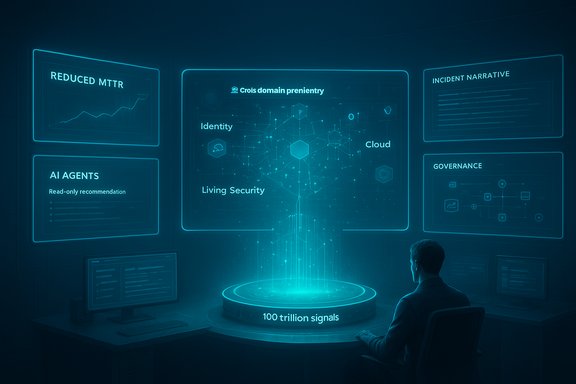
Microsoft published a short blog post and accompanying e‑book titled “3 reasons point solutions are holding you back” that frames tool sprawl as a structural barrier to modern security: fragmented telemetry prevents AI from seeing cross‑product attack patterns, duplicate consoles inflate operational cost, and disconnected workflows extend mean time to detect and mean time to remediate. The blog points organizations toward a unified, AI‑ready security platform that consolidates SIEM, a data lake, a living security graph, exposure management, and agentic AI assistance. At the same time, Microsoft’s product announcements around Ignite 2025 — notably Agent 365, expanded Security Copilot agents across Defender/Entra/Intune/Purview, and updated Defender for Cloud posture tooling — make the vendor’s case operational: telemetry scale (Microsoft cites processing more than 100 trillion signals per day) and integrated control planes are the mechanisms Microsoft says will let organizations move from reactive containment to predictive defense. Independent reporting and community analysis confirm the direction and the marketing claims, while also flagging operational and governance trade‑offs that come with consolidation and agentic automation.
For CISOs and security architects, the path forward is pragmatic: pilot, measure, govern, and iterate. If your organization already runs significant Microsoft workloads, the unified stack offers a genuine operational shortcut. For multi‑vendor estates, consolidation is attractive but should be balanced by staged pilots, data‑sovereignty reviews, and clear off‑ramp plans. The e‑book is a clear call to action; the right answer for your business will be the one that pairs Microsoft’s integration advantages with rigorous governance and measurable, repeatable results.
Source: Microsoft New Microsoft e-book: 3 reasons point solutions are holding you back | Microsoft Security Blog
 Background
Microsoft published a short blog post and accompanying e‑book titled “3 reasons point solutions are holding you back” that frames tool sprawl as a structural barrier to modern security: fragmented telemetry prevents AI from seeing cross‑product attack patterns, duplicate consoles inflate operational cost, and disconnected workflows extend mean time to detect and mean time to remediate. The blog points organizations toward a unified, AI‑ready security platform that consolidates SIEM, a data lake, a living security graph, exposure management, and agentic AI assistance. At the same time, Microsoft’s product announcements around Ignite 2025 — notably Agent 365, expanded Security Copilot agents across Defender/Entra/Intune/Purview, and updated Defender for Cloud posture tooling — make the vendor’s case operational: telemetry scale (Microsoft cites processing more than 100 trillion signals per day) and integrated control planes are the mechanisms Microsoft says will let organizations move from reactive containment to predictive defense. Independent reporting and community analysis confirm the direction and the marketing claims, while also flagging operational and governance trade‑offs that come with consolidation and agentic automation. What Microsoft’s e‑book says (concise summary)
- The e‑book centers on three core claims:
- Hidden costs of fragmented tools: point solutions increase staffing time, duplicate telemetry, and raise licensing and integration costs.
- The power of unification: a single platform that unifies SIEM, data lake, a security graph, and exposure management enables predictive defense and AI that can reason across identity, endpoint, cloud, and data.
- Real‑world outcomes: consolidation can reduce breach exposure, accelerate incident response (shorter MTTR), and reduce total cost of ownership. The e‑book frames these benefits as measurable and repeatable when organizations move from point tools to a platform model.
- Practical capabilities Microsoft highlights in the e‑book and associated materials:
- Predictive exposure management to map likely attack paths.
- AI‑accelerated remediation and agentic response to reduce containment time.
- Continuous SOC optimization via central analytics and enrichment.
Why this message lands now: three contextual forces
1. Tool sprawl is real and measurable
Security teams routinely run many vendor consoles and ingest heterogeneous telemetry formats. Industry surveys and Microsoft’s Foundry/analyst materials show consolidation is a top priority for organizations that run large best‑of‑breed portfolios. The operational friction — from alert triage to forensic correlation — is a recurring cost center that drives analysts away from proactive defenses and toward repetitive manual work.2. AI raises the data‑integration bar
AI models need consistent, contextualized data to detect subtle, cross‑domain attack patterns. Without unified telemetry (identity + endpoint + cloud + data), models can’t correlate small signals into high‑confidence detections. Microsoft’s pitch is straightforward: unify telemetry into a scalable data lake and graph so AI can predict attack paths and recommend prioritized remediations. This technical rationale is sound — models improve with richer, labeled, and correlated inputs — but the devil is in implementation and governance.3. Vendors are building toward an agentic future
Microsoft and other big vendors are embedding agents — prebuilt, tenant‑scoped automations — into product flows to automate triage and remediation. At Ignite 2025 Microsoft introduced Agent 365 (a control plane for agents) and expanded Security Copilot agents, and announced inclusion of a baseline Security Copilot allocation for Microsoft 365 E5 customers (400 Security Compute Units per 1,000 user licenses). These moves are meant to accelerate adoption but also create new governance, billing, and operational decisions for buyers.Verifying key technical and commercial claims
- Security Copilot inclusion for Microsoft 365 E5 and SCU allocation: Microsoft documentation and pricing pages confirm that Security Copilot agents will be made available to Microsoft 365 E5 customers, with 400 Security Compute Units (SCUs) per 1,000 paid user licenses, up to 10,000 SCUs per month as an included allocation. Microsoft Learn and the Security Copilot pricing pages provide detailed rollout and eligibility guidance. These are vendor confirmations of the commercialization claim.
- Telemetry scale: Microsoft’s Digital Defense reporting and product materials repeatedly state the company processes over 100 trillion signals daily. This figure appears across Microsoft’s Digital Defense and product communications and is echoed by coverage of Ignite and security press write‑ups. It is a directional metric that underpins Microsoft’s argument about threat‑intelligence scale; organizations should treat it as a vendor‑reported telemetry advantage rather than a directly comparable third‑party index.
- Agentic automation and MTTR improvements: Microsoft and early trials report significant reductions in analyst effort and faster triage with agentic assistants; Microsoft materials claim that AI‑accelerated detection and automation can compress containment windows “from hours to minutes.” Those results are plausible — automation and enriched correlation do reduce human latency — but specific claims about halting ransomware “before encryption begins” are scenario‑dependent and should be validated in pilots and tabletop exercises with measured telemetry. Treat outcome statements as aspirational until you can reproduce them in your environment.
- Independent corroboration: coverage from The Verge, Windows Central, TechRadar and multiple community analyses independently confirm the Agent 365 and Security Copilot agent announcements, and they highlight the same benefits and operational caveats Microsoft describes. Use these independent write‑ups to triangulate vendor messaging during procurement and pilots.
Strengths of Microsoft’s unified, AI‑ready platform approach
- Enterprise‑grade integration out of the box. Microsoft’s stack is designed to interoperate tightly: Entra for identity, Purview for data governance, Defender for threat protection, Sentinel for SIEM/SOAR, and Security Copilot for generative guidance and agents. For heavy Microsoft customers, this reduces connector sprawl and integration lift.
- Telemetry scale and historical context. Access to broad telemetry — identity, mail, endpoints, cloud workloads — can materially improve detection quality and help models learn adversary behaviors at enterprise scale. Microsoft’s claim of more than 100 trillion signals feeds this narrative; the scale advantage is real for telemetry‑centric detection strategies.
- Operational acceleration with agents. Prebuilt agents (phishing triage, hunting, conditional access optimization, DLP automation) can reduce routine toil, free up senior analysts for high‑value tasks, and standardize repetitive responses across tenants. When governed correctly, agentic automation is a force multiplier for understaffed SOCs.
- Clear commercial packaging for customers. Inclusion of Security Copilot capacity for Microsoft 365 E5 simplifies procurement for many customers and gives enterprises a baseline entitlement to trial agentic scenarios without immediate extra licensing negotiations. That lowers the barrier to operationalizing agentic workflows.
Risks, trade‑offs, and the things Microsoft’s e‑book (and marketing) underplays
- Concentration risk and vendor lock‑in. Consolidation reduces integration friction but increases dependence on a single vendor’s telemetry, decisioning, and roadmap. Organizations should weigh the operational benefits against the strategic cost of deep platform coupling and consider escape, interoperability, and exit scenarios before full consolidation. Independent analyst write‑ups and community commentary point this out repeatedly.
- Governance of agentic automation. Agents acting as principals introduce a new class of identity and lifecycle risk. Agent 365 addresses discovery and governance, but treating agents like employees requires new processes (AgentOps): identity issuance, least‑privilege grants, approval workflows, deprovisioning playbooks, and auditable logs. Early adopters must build these governance primitives before enabling writeback or remediation actions at scale.
- False positives, noisy telemetry, and cost. Aggressive posture scans, on‑upload content scanning, or broad serverless posture enforcement can generate false positives and increase cloud scanning/egress costs. Microsoft and third‑party practitioners advise pilot tuning and phased rollouts to balance coverage against noise and cost.
- Unverified or preview‑stage features. Some named features (for example, product briefing references to “Predictive Shielding” or exact agent remediation playbooks) have been discussed in briefings or previews but may not be fully documented in GA product pages. Organizations should validate feature sets, SLAs, and supported actions in procurement and test programs rather than relying solely on preview demos.
- Data governance and privacy challenges. Centralizing telemetry and exposing it to generative AI agents raises legitimate concerns: what data is copied for model context, how long outputs/contexts are retained, and how to comply with privacy and residency rules. Microsoft documents indicate tenants can opt out of certain integrations, but each organization must validate the data flows, retention policies, and access controls.
Practical, pragmatic steps for security teams evaluating consolidation
- Inventory and categorize your controls and telemetry producers.
- Map identity providers, endpoints, cloud workloads, email flows, and data stores.
- Label by business criticality and regulatory impact.
- Pilot the unified platform on a high‑value use case.
- Choose one workload (e.g., phishing triage or ransomware response) and run a 60–90 day pilot with measurable KPIs (MTTD, MTTR, alert volume, analyst hours saved).
- Validate Security Copilot agent behaviour in read‑only or recommendation mode before enabling automated remediations.
- Build AgentOps and governance playbooks.
- Define agent identity lifecycle (issuance, RBAC, approvals, revocation).
- Require human approval for any agent that can modify production state until controls mature.
- Test cross‑product incident playbooks.
- Simulate incidents that require coordinated disruption (endpoint isolation + account disable + cloud enforcement) and validate end‑to‑end behaviour with partner integrations (Okta, Proofpoint, AWS).
- Measure cost and capacity.
- Model SCU consumption under likely scenarios and consider included E5 entitlements vs pay‑as‑you‑go scaling.
- Keep telemetry egress and scanning costs under review during pilots.
- Preserve escape hatches and diversification where needed.
- Maintain best‑of‑breed detectors in parallel for critical surfaces until detection parity and operational confidence are proven.
Realistic outcomes: what consolidation will and won’t deliver
- Consolidation will likely reduce integration overhead and streamline incident narratives. Analysts can see correlated context across identity, endpoint, and cloud within a single incident canvas — that does accelerate investigations, provided signal quality and normalization are good.
- Consolidation will help AI models operate at scale by feeding them richer, unified data; this is necessary for predictive defenses and cross‑domain reasoning. However, AI is not a silver bullet: model tuning, adversarial testing, and human‑in‑the‑loop governance remain essential.
- Consolidation does not erase the need for security fundamentals. Inventory, least privilege, patching, secure development, and robust IR playbooks remain the backbone of resilience. The platform may make these easier to operationalize, but it does not replace them.
Conclusion — a cautious, operationally focused verdict
Microsoft’s e‑book and concurrent product announcements make a credible argument that a unified, AI‑ready security platform reduces friction, improves detection quality, and unlocks AI‑driven automation that point solutions cannot deliver alone. Microsoft’s product packaging — from Agent 365 to Security Copilot inclusion for Microsoft 365 E5 — is designed to accelerate that shift for customers invested in the Microsoft ecosystem. However, the transition requires careful operational discipline: build AgentOps, pilot agentic automations conservatively, measure SCU consumption and scanning costs, validate that vendor telemetry actually improves detection in your environment, and retain prioritized best‑of‑breed protections where strategic. Vendor claims about halting ransomware “before encryption” or blanket MTTR improvements should be validated in your telemetry and playbooks — impressive as the marketing is, outcomes are environment and configuration dependent.For CISOs and security architects, the path forward is pragmatic: pilot, measure, govern, and iterate. If your organization already runs significant Microsoft workloads, the unified stack offers a genuine operational shortcut. For multi‑vendor estates, consolidation is attractive but should be balanced by staged pilots, data‑sovereignty reviews, and clear off‑ramp plans. The e‑book is a clear call to action; the right answer for your business will be the one that pairs Microsoft’s integration advantages with rigorous governance and measurable, repeatable results.
Source: Microsoft New Microsoft e-book: 3 reasons point solutions are holding you back | Microsoft Security Blog
