

Georgia's “top travel spot” depends less on AI hype than on what kind of trip you want. The new SIXT analysis says Martin Luther King, Jr. National Historical Park was the most consistently recommended landmark in Georgia across five major AI platforms, but that is a measure of recommendation frequency, not a verdict on scenery, popularity, or overall visitor satisfaction. The park’s real strength is obvious: it bundles some of the most powerful Civil Rights landmarks in America into one walkable Atlanta district, and the National Park Service itself calls it Atlanta’s top tourist destination. Still, Georgia is a state of very different travel identities, and the “best” stop for one traveler may be a terrible fit for another.
The idea that an AI system can name a state’s top landmark sounds new, but the underlying logic is familiar. Travel rankings have long mixed hard data, editorial judgment, and marketing pull; the AI layer simply adds a new filter over old assumptions. In this case, the result elevated a landmark that already carries enormous historical weight, which makes the ranking feel intuitive even if the methodology is narrow.
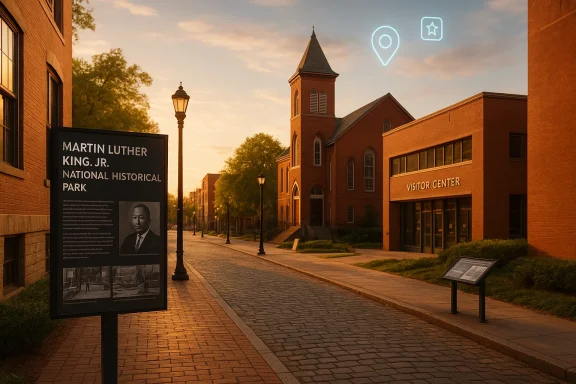
The Martin Luther King, Jr. National Historical Park is not a generic sightseeing stop. It preserves the places where Dr. King was born, lived, worshiped, worked, and is buried, creating a concentrated narrative of the Civil Rights Movement in Atlanta’s Sweet Auburn neighborhood. The National Park Service describes the park as a place to “walk in his footsteps,” which is exactly why AI models may gravitate toward it when asked for an iconic Georgia landmark.
That matters because AI recommendation systems are pattern machines, not travel critics. They tend to favor destinations that are broadly famous, culturally legible, easy to describe, and associated with universally recognized themes such as civil rights, architecture, or national identity. A place like MLK National Historical Park checks all of those boxes, while many other Georgia destinations are more experiential, more seasonal, or harder to summarize in a few lines.
The park itself also has an unusually strong institutional profile. The National Park Service highlights ranger-led programs, free admission, a visitor center, and a cluster of historic buildings and exhibits that turn the site into a structured cultural experience rather than a simple walk-through monument. That kind of accessibility likely increases its odds of appearing in AI-generated travel suggestions, especially when a prompt asks for a “must-see” or “iconic” destination.
At the same time, Georgia’s tourism identity is broad enough to make any single “best” label a stretch. The state includes mountain escapes, barrier islands, urban attractions, college towns, film locations, and outdoor recreation corridors that appeal to completely different audiences. The AI ranking is therefore best understood as a spotlight on one symbolically powerful destination, not a definitive judgment on the state’s travel hierarchy. That distinction is the whole story.
That distinction matters because the structure of the question shapes the answer. Ask an AI for “iconic,” and it will likely choose places with strong symbolic meaning and broad name recognition. Ask for “best for families,” “best for hiking,” or “best beach trip,” and the answer may change dramatically, because the evaluation criteria are no longer centered on fame or cultural significance.
The result is especially important in Georgia, where the most recommended site and the most broadly “fun” destination may not overlap. Civil rights history, coastal relaxation, mountain scenery, and family entertainment all live under the same state flag, but each serves a different traveler. A ranking that collapses all of that into one winner inevitably favors landmarks with the richest narrative density.
There is also a practical issue: when a model is uncertain, it often chooses the safest universally defensible answer. A Civil Rights site in Atlanta is a low-risk recommendation because it is educational, meaningful, centrally located, and widely respected. A remote waterfall, niche museum, or less famous beach might be more exciting to some travelers, but it is harder for an AI to present as the single most iconic statewide choice.
Its location also helps. Atlanta is Georgia’s largest city and a major travel gateway, so the park is both geographically central and logistically convenient. The NPS highlights free admission, regular hours, ranger-led interpretation, and a visitor center, making the site feel accessible to first-time visitors and school groups alike.
The park also fits the way many travelers now plan trips. People increasingly search for meaningful experiences, not just checklists, and cultural landmarks can perform well in that environment. AI tools, in turn, are more likely to recommend destinations that sound substantial, educational, and socially important. The park is almost tailor-made for that kind of query.
Georgia has too many travel identities to crown one universal winner. The coast offers a completely different experience from the mountains; Atlanta offers a different experience from Savannah; historical tourism operates under different expectations than outdoor recreation. The MLK park is one of the state’s strongest landmarks, but it is not a substitute for the full breadth of Georgia travel.
This is why AI travel advice needs translation, not blind trust. The model may be right about what is famous, but fame is only one dimension of trip quality. The smartest reading of the study is that it identifies a consensus symbol, not a universal favorite.
That is why the AI result should be read as a spotlight on one category of travel, not a verdict on the entire state. MLK National Historical Park sits at the intersection of history tourism and urban visitation, which gives it a huge advantage in any broad “must-see” prompt. Other destinations may be more geographically dramatic, but they are less likely to be described by models as universally essential.
Georgia also benefits from being a state where history and leisure often overlap. A traveler might spend a morning at MLK National Historical Park, an afternoon in Midtown Atlanta, and the next day somewhere entirely different. That flexibility is a strength, but it also means one landmark can never fully stand in for the state itself. Travel works best as a constellation, not a crown.
The site’s current setup also reflects adaptation rather than stagnation. The park’s temporary visitor center is at Historic Fire Station No. 6, and the NPS continues to direct visitors there for orientation and tour logistics. That detail matters because it shows the park is still being managed as a dynamic urban historic site, not merely preserved as a frozen relic.
It is also one of the few tourist sites where the word “must-see” feels ethically grounded. The park does not sell escapism so much as perspective, and that can be exactly what many travelers are looking for in 2026. In a crowded travel market, meaning has become a premium product.
For tourism boards and destination marketers, that creates a new kind of competition. It is no longer enough to be good; a place also needs to be easily described, widely recognized, and frequently discussed online. Sites with strong national narratives, like MLK National Historical Park, are naturally advantaged in that environment.
That also suggests a problem. If travelers increasingly rely on AI-generated recommendations, the travel market may start favoring places that are semantically rich over places that are experientially exceptional but less discussed. That would be a real change in how destinations compete for attention.
For tourism businesses and destination operators, the stakes are more strategic. AI visibility can shape demand long before a visitor sees an ad or reads a brochure, which means content quality, structured web presence, and plain-language descriptions matter more than ever. The old SEO lesson is returning in a new form: if systems cannot easily identify what you are, they may not recommend you.
In Georgia’s case, the ranking likely benefits Atlanta’s heritage tourism ecosystem as a whole. A traveler drawn to MLK National Historical Park may also visit nearby attractions, eat locally, and extend their stay. That is a classic halo effect, and it is probably not accidental.
For Georgia, the most likely outcome is not a single winner but a more visible portfolio of travel identities. MLK National Historical Park will remain one of the state’s most important landmarks, but coastal, mountain, and urban destinations will continue to compete for attention in different trip categories. The healthiest version of this trend is not a crown for one site; it is a richer conversation about what Georgia travel can be.
Source: Online Athens AI says this is Georgia's top travel spot, but is it really?
 Background
The idea that an AI system can name a state’s top landmark sounds new, but the underlying logic is familiar. Travel rankings have long mixed hard data, editorial judgment, and marketing pull; the AI layer simply adds a new filter over old assumptions. In this case, the result elevated a landmark that already carries enormous historical weight, which makes the ranking feel intuitive even if the methodology is narrow.The Martin Luther King, Jr. National Historical Park is not a generic sightseeing stop. It preserves the places where Dr. King was born, lived, worshiped, worked, and is buried, creating a concentrated narrative of the Civil Rights Movement in Atlanta’s Sweet Auburn neighborhood. The National Park Service describes the park as a place to “walk in his footsteps,” which is exactly why AI models may gravitate toward it when asked for an iconic Georgia landmark.
That matters because AI recommendation systems are pattern machines, not travel critics. They tend to favor destinations that are broadly famous, culturally legible, easy to describe, and associated with universally recognized themes such as civil rights, architecture, or national identity. A place like MLK National Historical Park checks all of those boxes, while many other Georgia destinations are more experiential, more seasonal, or harder to summarize in a few lines.
The park itself also has an unusually strong institutional profile. The National Park Service highlights ranger-led programs, free admission, a visitor center, and a cluster of historic buildings and exhibits that turn the site into a structured cultural experience rather than a simple walk-through monument. That kind of accessibility likely increases its odds of appearing in AI-generated travel suggestions, especially when a prompt asks for a “must-see” or “iconic” destination.
At the same time, Georgia’s tourism identity is broad enough to make any single “best” label a stretch. The state includes mountain escapes, barrier islands, urban attractions, college towns, film locations, and outdoor recreation corridors that appeal to completely different audiences. The AI ranking is therefore best understood as a spotlight on one symbolically powerful destination, not a definitive judgment on the state’s travel hierarchy. That distinction is the whole story.
What the SIXT Study Actually Measured
The SIXT study did not ask travelers where they most enjoyed visiting Georgia. It asked five AI platforms—Google Gemini, ChatGPT, Claude, Microsoft Copilot, and Meta AI—to identify the most iconic or must-see landmark in the state, then ranked destinations by recommendation frequency, position in the response, and overall search popularity. That is a useful lens, but it is not the same thing as a consumer preference survey or a tourism performance study.That distinction matters because the structure of the question shapes the answer. Ask an AI for “iconic,” and it will likely choose places with strong symbolic meaning and broad name recognition. Ask for “best for families,” “best for hiking,” or “best beach trip,” and the answer may change dramatically, because the evaluation criteria are no longer centered on fame or cultural significance.
Recommendation frequency is not traveler satisfaction
A landmark that shows up often in AI responses is not necessarily the one travelers enjoy most. It simply means the models have a strong association between the prompt and that location, which can reflect training data, public prominence, and the way travel content is written online. In other words, visibility and quality of experience are related, but they are not identical. That gap is where these rankings can mislead.The result is especially important in Georgia, where the most recommended site and the most broadly “fun” destination may not overlap. Civil rights history, coastal relaxation, mountain scenery, and family entertainment all live under the same state flag, but each serves a different traveler. A ranking that collapses all of that into one winner inevitably favors landmarks with the richest narrative density.
- The study measured AI recommendation patterns, not visitor reviews.
- The output rewards fame, clarity, and broad recognizability.
- It does not directly compare value, scenery, or trip satisfaction.
- Different prompts could produce different “top” Georgia destinations.
- The result is a snapshot of AI behavior, not a full tourism audit.
Why AI tends to overreward famous landmarks
AI systems are trained on enormous volumes of text, so they tend to reproduce the most common associations in public discourse. For Georgia, that means landmarks with national historical resonance may outrank quieter gems that locals love but the internet mentions less often. MLK National Historical Park benefits from exactly that kind of information richness.There is also a practical issue: when a model is uncertain, it often chooses the safest universally defensible answer. A Civil Rights site in Atlanta is a low-risk recommendation because it is educational, meaningful, centrally located, and widely respected. A remote waterfall, niche museum, or less famous beach might be more exciting to some travelers, but it is harder for an AI to present as the single most iconic statewide choice.
Why MLK National Historical Park Ranks So Highly
The park is exceptionally easy to justify in one sentence, and AI systems love destinations that can be explained cleanly. It combines birthplace, church, memorial, museum-style interpretation, and a historic neighborhood into one coherent story, which gives it an editorial advantage over places that require more context. The National Park Service emphasizes that visitors can see where King was born, lived, worshiped, worked, and is buried, all within the same broader site.Its location also helps. Atlanta is Georgia’s largest city and a major travel gateway, so the park is both geographically central and logistically convenient. The NPS highlights free admission, regular hours, ranger-led interpretation, and a visitor center, making the site feel accessible to first-time visitors and school groups alike.
A landmark with built-in narrative power
Few tourist sites offer such a complete story in such a small footprint. The park is tied to one of the defining figures of the 20th century, and its significance extends far beyond state boundaries. That combination of place, personality, and historical consequence gives it a different kind of travel value than a beach, trail, or theme park.The park also fits the way many travelers now plan trips. People increasingly search for meaningful experiences, not just checklists, and cultural landmarks can perform well in that environment. AI tools, in turn, are more likely to recommend destinations that sound substantial, educational, and socially important. The park is almost tailor-made for that kind of query.
- High historical significance gives the site automatic legitimacy.
- Central Atlanta location makes it easy to include in a short itinerary.
- Free admission lowers the barrier to entry.
- Walkable cluster of sites increases perceived trip value.
- National Park Service branding adds authority and trust.
Is It Really Georgia’s Best Travel Spot?
If “best” means most iconic, then the answer is defensible. If “best” means most fun, most scenic, or most representative of a full Georgia vacation, then the answer becomes far more debatable. AI rankings often blur that distinction, but travelers should not.Georgia has too many travel identities to crown one universal winner. The coast offers a completely different experience from the mountains; Atlanta offers a different experience from Savannah; historical tourism operates under different expectations than outdoor recreation. The MLK park is one of the state’s strongest landmarks, but it is not a substitute for the full breadth of Georgia travel.
The difference between iconic and ideal
The park’s appeal is strongest for travelers who value history, civic memory, and educational depth. Families with children, repeat visitors to Atlanta, and anyone interested in the Civil Rights era will likely find the park deeply rewarding. But a beach lover, hiker, or weekend leisure traveler may rank another Georgia destination much higher.This is why AI travel advice needs translation, not blind trust. The model may be right about what is famous, but fame is only one dimension of trip quality. The smartest reading of the study is that it identifies a consensus symbol, not a universal favorite.
- Best for history-focused visitors.
- Best for first-time Atlanta itineraries.
- Best for travelers seeking educational value.
- Not necessarily best for scenery or adventure.
- Not a full measure of visitor delight or repeat-trip appeal.
The Broader Georgia Travel Landscape
Georgia’s tourism story is deliberately multi-threaded. Atlanta anchors business travel, sports, music, and Civil Rights tourism. Savannah attracts architecture lovers and coastal romantics. The mountains in North Georgia support hiking, cabin trips, and leaf-season tourism, while the coast delivers beaches, marshes, and historic island communities. One ranking cannot capture that spread without flattening the experience.That is why the AI result should be read as a spotlight on one category of travel, not a verdict on the entire state. MLK National Historical Park sits at the intersection of history tourism and urban visitation, which gives it a huge advantage in any broad “must-see” prompt. Other destinations may be more geographically dramatic, but they are less likely to be described by models as universally essential.
How travelers actually choose
In practice, most visitors choose destinations by trip purpose. They ask what fits the time they have, the people they are traveling with, and the kind of memories they want to make. An AI ranking that ignores that logic can still be useful, but only if readers understand the limits of the method.Georgia also benefits from being a state where history and leisure often overlap. A traveler might spend a morning at MLK National Historical Park, an afternoon in Midtown Atlanta, and the next day somewhere entirely different. That flexibility is a strength, but it also means one landmark can never fully stand in for the state itself. Travel works best as a constellation, not a crown.
- Atlanta is the state’s cultural and transportation hub.
- Savannah and the coast deliver a different travel promise.
- North Georgia competes on landscape and outdoor activity.
- The MLK park dominates in historical importance.
- A statewide “best” depends on the lens used to judge it.
What the Park Experience Is Actually Like
The National Park Service describes the site as an active, structured visitor experience rather than a static memorial. Travelers can explore the birth home area, Ebenezer Baptist Church, the visitor center, and nearby interpretive spaces, with ranger-led programming adding context. That makes the park feel like a living classroom as much as a tourist stop.The site’s current setup also reflects adaptation rather than stagnation. The park’s temporary visitor center is at Historic Fire Station No. 6, and the NPS continues to direct visitors there for orientation and tour logistics. That detail matters because it shows the park is still being managed as a dynamic urban historic site, not merely preserved as a frozen relic.
Why the visit resonates
The emotional effect of the park comes from proximity. Visitors do not just read about King’s legacy; they encounter the neighborhood, church, memorial spaces, and interpretive material in a concentrated walkable area. That physical closeness can be more powerful than a large museum because it turns history into place.It is also one of the few tourist sites where the word “must-see” feels ethically grounded. The park does not sell escapism so much as perspective, and that can be exactly what many travelers are looking for in 2026. In a crowded travel market, meaning has become a premium product.
- The site offers interpretive programming.
- The experience is walkable and concentrated.
- The park mixes memorial, museum, and neighborhood elements.
- It is better described as educational tourism than pure sightseeing.
- Its value increases for visitors who want context, not just photos.
What the Ranking Means for Travel and Search
This story is really about how travel decisions are changing. AI is becoming the first stop for inspiration, which means the destinations most visible to language models may gain an advantage before travelers even compare options. That shift is significant because it moves influence upstream from booking sites and review platforms into the recommendation layer itself.For tourism boards and destination marketers, that creates a new kind of competition. It is no longer enough to be good; a place also needs to be easily described, widely recognized, and frequently discussed online. Sites with strong national narratives, like MLK National Historical Park, are naturally advantaged in that environment.
AI search rewards clarity
A destination with a clear identity is easier for AI to recommend confidently. That helps explain why the Georgia result feels so inevitable: the park is famous, historically important, and easy to summarize in a single answer. AI systems are not necessarily wrong here—they are just optimizing for comprehensibility rather than nuance.That also suggests a problem. If travelers increasingly rely on AI-generated recommendations, the travel market may start favoring places that are semantically rich over places that are experientially exceptional but less discussed. That would be a real change in how destinations compete for attention.
- AI may become a gatekeeper for discovery.
- Destinations with strong narrative identity gain a visibility edge.
- Less famous but excellent places may struggle for algorithmic attention.
- Travel planning may become more consensus-driven.
- The “best” destinations may increasingly reflect searchability, not just quality.
Enterprise and Consumer Impact
For consumers, the practical takeaway is simple: use AI as a starting point, not a final authority. The MLK park is a wonderful suggestion for many travelers, but a good trip planner should still compare it with other Georgia experiences based on interest, distance, season, and budget. The more specific the question, the better the answer will be.For tourism businesses and destination operators, the stakes are more strategic. AI visibility can shape demand long before a visitor sees an ad or reads a brochure, which means content quality, structured web presence, and plain-language descriptions matter more than ever. The old SEO lesson is returning in a new form: if systems cannot easily identify what you are, they may not recommend you.
Who benefits most
The biggest winners are destinations with simple, memorable stories and strong public records. The biggest losers are places that rely on word-of-mouth charm or niche appeal without much digital footprint. That does not mean these places are worse; it means they are harder for AI to surface in a competitive recommendation environment.In Georgia’s case, the ranking likely benefits Atlanta’s heritage tourism ecosystem as a whole. A traveler drawn to MLK National Historical Park may also visit nearby attractions, eat locally, and extend their stay. That is a classic halo effect, and it is probably not accidental.
- Consumers should treat AI as one input among many.
- Businesses should optimize for clear, structured storytelling.
- Tourism agencies should think about machine readability as well as branding.
- Heritage sites often convert AI visibility into real-world foot traffic.
- Destination competition is moving toward algorithmic discoverability.
Strengths and Opportunities
The strongest case for the ranking is that it points to a landmark with unquestioned substance. The site is not only historically important, but also easy to visit, widely recognized, and supported by the National Park Service with a robust interpretive program. That gives Georgia a flagship landmark that can anchor broader travel marketing while also standing on its own.- National significance gives the park immediate credibility.
- Free admission makes it accessible to almost any visitor.
- Atlanta location fits short city breaks and multi-stop itineraries.
- Ranger-led tours improve the depth of the experience.
- Strong AI recognition can translate into more first-time visits.
- Heritage tourism spillover can support nearby businesses.
- Educational appeal makes it attractive to schools and families.
Risks and Concerns
The biggest risk is confusing recommendation frequency with travel excellence. If readers assume the AI-generated result means MLK National Historical Park is the best Georgia destination for everyone, they may overlook better fits for their own travel goals. There is also the risk that less famous Georgia attractions get buried beneath algorithm-friendly icons simply because they are harder for AI to summarize.- Methodological narrowness can distort perception.
- AI bias toward fame may crowd out quieter destinations.
- Overreliance on one landmark can flatten Georgia’s travel identity.
- Visitor expectations may be mismatched with the actual experience.
- Infrastructure strain can rise if AI-driven attention grows quickly.
- Historical sites need context, not just traffic.
- Travelers may miss variety if they stop at one recommendation.
Looking Ahead
The next question is whether AI-driven travel recommendations become a novelty or a durable part of tourism planning. If they become durable, the destinations that win will be the ones that can communicate a clear identity across multiple platforms and prompts. That could reshape how cities, states, and attractions think about digital storytelling in the years ahead.For Georgia, the most likely outcome is not a single winner but a more visible portfolio of travel identities. MLK National Historical Park will remain one of the state’s most important landmarks, but coastal, mountain, and urban destinations will continue to compete for attention in different trip categories. The healthiest version of this trend is not a crown for one site; it is a richer conversation about what Georgia travel can be.
- Watch whether AI tools keep elevating heritage sites over scenic ones.
- Watch whether Georgia tourism groups adjust their digital strategy.
- Watch for more studies comparing AI recommendations vs. traveler behavior.
- Watch whether visitors use AI for planning, inspiration, or booking.
- Watch whether other states see the same consensus effect around iconic landmarks.
Source: Online Athens AI says this is Georgia's top travel spot, but is it really?
