

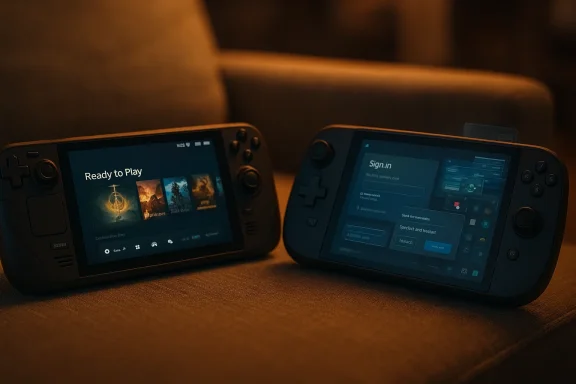
The first hour with a Windows gaming handheld is still too confusing, and that is exactly why the Steam Deck continues to matter. Even as Windows-based handhelds deliver better raw compatibility for certain PC games, the out-of-box experience still feels fragmented in ways that make simple things feel harder than they should. By contrast, Valve’s handheld succeeds because it removes friction before the player even realizes friction exists. That difference is not cosmetic; it is the defining reason the Steam Deck remains the benchmark for portable PC gaming.
The handheld gaming PC market did not appear fully formed. It was pushed into the mainstream by the Steam Deck, which changed expectations around what a portable gaming computer could be by making console-like simplicity feel possible on top of a PC ecosystem. Before that, Windows handhelds existed, but they were niche devices with awkward software, poor controller-first navigation, and interfaces clearly designed for laptops rather than a seven-inch screen.
The Steam Deck changed the conversation by pairing hardware, software, and storefront into a single experience. Valve’s SteamOS and Gaming Mode were designed around one central idea: if a handheld is meant to be used on a couch, in bed, or on a train, the operating system should behave like it understands that. That meant larger touch targets, controller-friendly menus, clearer game compatibility cues, and far less time spent fighting the device before actually launching a game.
Windows handhelds, meanwhile, brought a different promise. Their pitch has always been straightforward: if you want the broadest library, the most familiar desktop environment, and compatibility with the widest array of launchers and anti-cheat systems, Windows is the safer bet. That remains true in 2026. Yet the tradeoff is still exactly what critics have been saying for years: Windows solves compatibility, but often at the expense of cohesion and ease of use.
What makes the current moment interesting is that Microsoft clearly understands the problem now. The company has been building toward handheld-specific features, including a more console-like Xbox full screen experience and broader handheld compatibility initiatives for Windows 11 devices. But these improvements also underline the original critique: if a company has to rebuild the front door of its operating system for handhelds, that is a sign the legacy interface was never designed for this form factor in the first place.
The XDA argument lands so effectively because it is not really about specs, and it is not even about whether Windows handhelds are good. It is about the first 60 minutes, which is where most products win or lose trust. A great handheld should invite play immediately. If it instead invites setup screens, updates, account prompts, sleep-mode confusion, and UI oddities, the device is asking too much of the customer too soon.
That matters because first impressions on gaming hardware are unusually sticky. Users are not just judging a laptop alternative; they are comparing the experience against a console-like mental model. If a device looks like a console, costs like a premium console, and advertises portable gaming convenience, people will subconsciously expect console-like flow.
That tax is especially visible when the device is marketed as portable and approachable. Consumers do not buy a handheld to manage a mini IT project. They buy it because they want gaming to feel available in the gaps of daily life.
This is where the Steam Deck’s design philosophy feels superior. Valve does not pretend the underlying system is simple. Instead, it builds a simple layer on top of complexity, and it keeps that layer visible at all times. The user knows what mode they are in, where they are going, and what state the device is in.
That coherence is what Windows handhelds often lack. Their software stack can include OEM overlays, Xbox apps, game launchers, performance tools, driver utilities, and the Windows shell itself, all layered on a screen far too small for desktop assumptions. Even when each component is individually useful, the total experience can feel busy and overdesigned.
The critical thing is that the Deck’s interface does not constantly remind you that you are using a Linux-based PC. It reminds you that you are using a gaming handheld. That subtle distinction shapes confidence, and confidence shapes enjoyment.
That difference matters because users tend to forgive a game incompatibility more easily than they forgive an operating system that makes sleep, wake, or app switching feel unpredictable. A game can be patched. A broken interaction model is much harder to mentally file away.
That is the central tension in the handheld market. Windows wins on software breadth, but often loses on product elegance. SteamOS wins on focus, but still cannot match Windows for every edge case. Consumers are not choosing between perfect and imperfect; they are choosing between two different kinds of compromise.
That is why many reviewers continue to describe Windows handhelds as technically impressive but emotionally tiring. The device may do more, but the user often has to do more too. In the handheld category, that is a dangerous trade.
Still, these efforts also reveal how far Windows has had to travel. SteamOS did not need to be retrofitted for the handheld moment. It was built for it.
That is why the Steam Deck remains such a powerful reference point. It showed that a handheld can feel premium without feeling complicated. It also showed that convenience is a performance feature, even if it never shows up in a benchmark chart.
Consumers remember the friction more vividly than they remember a few extra frames per second. That is a painful truth for the Windows handheld segment, because it means better performance is not always enough to justify a worse opening experience.
This is where Windows often disappoints. If sleep is unreliable, wake behavior is inconsistent, or background processes interfere with state restoration, the device starts to feel like a laptop in disguise. The Steam Deck’s ability to fade in and out of gameplay more naturally is one of the reasons it feels so much more portable than competitors.
That gap is why Windows handhelds can look excellent in spec sheets yet still fail to inspire the kind of loyalty the Steam Deck enjoys. In consumer hardware, emotional clarity often beats platform universality.
The Steam Deck benefits from that mindset because it narrows expectations in a productive way. Users expect Steam first, compatibility second, and everything else after that. Windows handhelds promise more, but that promise can become a burden when the user just wants to play.
But even power users often appreciate a clean default state. They may want control, yet they still benefit from a better starting point. That is why the Steam Deck’s influence has been so profound: it has raised the expectation that a handheld should be usable before it becomes customizable.
The challenge for Microsoft is not just adding features. It is making them feel native, integrated, and default rather than optional, experimental, or device-specific. The best handheld software disappears into the hardware. Users should not feel that they are beta testing a vision.
Yet a shell is only part of the fix. If the surrounding OS still pushes pop-ups, background tasks, and fragmented settings, the improvement may feel partial. Windows needs less ceremony and more consistency.
The result is healthy competition, but it also raises the stakes. The market will not reward vague progress forever. Consumers can tell when a company understands the problem versus when it is merely acknowledging it.
The biggest danger for Windows handhelds is not being worse in a benchmark. It is being less lovable. A category this personal, this tactile, and this lifestyle-oriented depends on attachment as much as on performance.
That is why the Steam Deck has such a strong identity. Valve owns the software story, the compatibility story, and the usability story. Competitors may match pieces of the hardware, but they still struggle to match the totality of the experience.
Windows handhelds have to earn that trust every time a user boots them. If they cannot, then the category will continue to split into two camps: people who want compatibility at any cost, and people who value a streamlined handheld more than the widest possible PC support.
The most important signal to watch is whether vendors treat onboarding as a feature. If the first hour gets simpler, the category could broaden beyond enthusiasts and early adopters. If it does not, the Steam Deck will remain the device everyone else is measured against.
In the end, the first hour is where handheld loyalty is earned or lost, and that is why the Steam Deck continues to shine. Windows gaming handhelds can be impressive, versatile, and even best-in-class in narrow scenarios, but they still often ask too much too early. Until that changes, Valve’s simpler vision will remain the more persuasive one for the vast majority of players.
Source: The first hour with a Windows gaming handheld is still too confusing, and that's where the Steam Deck really shines
 Background
The handheld gaming PC market did not appear fully formed. It was pushed into the mainstream by the Steam Deck, which changed expectations around what a portable gaming computer could be by making console-like simplicity feel possible on top of a PC ecosystem. Before that, Windows handhelds existed, but they were niche devices with awkward software, poor controller-first navigation, and interfaces clearly designed for laptops rather than a seven-inch screen.The Steam Deck changed the conversation by pairing hardware, software, and storefront into a single experience. Valve’s SteamOS and Gaming Mode were designed around one central idea: if a handheld is meant to be used on a couch, in bed, or on a train, the operating system should behave like it understands that. That meant larger touch targets, controller-friendly menus, clearer game compatibility cues, and far less time spent fighting the device before actually launching a game.
Windows handhelds, meanwhile, brought a different promise. Their pitch has always been straightforward: if you want the broadest library, the most familiar desktop environment, and compatibility with the widest array of launchers and anti-cheat systems, Windows is the safer bet. That remains true in 2026. Yet the tradeoff is still exactly what critics have been saying for years: Windows solves compatibility, but often at the expense of cohesion and ease of use.
What makes the current moment interesting is that Microsoft clearly understands the problem now. The company has been building toward handheld-specific features, including a more console-like Xbox full screen experience and broader handheld compatibility initiatives for Windows 11 devices. But these improvements also underline the original critique: if a company has to rebuild the front door of its operating system for handhelds, that is a sign the legacy interface was never designed for this form factor in the first place.
The XDA argument lands so effectively because it is not really about specs, and it is not even about whether Windows handhelds are good. It is about the first 60 minutes, which is where most products win or lose trust. A great handheld should invite play immediately. If it instead invites setup screens, updates, account prompts, sleep-mode confusion, and UI oddities, the device is asking too much of the customer too soon.
The First-Hour Problem
The biggest issue with Windows gaming handhelds is not that they are unusable. It is that they are unnecessarily effortful right when the user expects delight. A handheld should make the transition from box to game feel obvious, but Windows often turns that first hour into a sequence of small decisions, interruptions, and uncertain outcomes.That matters because first impressions on gaming hardware are unusually sticky. Users are not just judging a laptop alternative; they are comparing the experience against a console-like mental model. If a device looks like a console, costs like a premium console, and advertises portable gaming convenience, people will subconsciously expect console-like flow.
Setup friction is a product issue, not a user issue
A Windows handheld can ask the user to do too much too soon. There may be Windows account steps, firmware updates, vendor software setup, launcher sign-ins, and configuration decisions before a single game starts. Each step may be rational on its own, but collectively they create a tax on enthusiasm.That tax is especially visible when the device is marketed as portable and approachable. Consumers do not buy a handheld to manage a mini IT project. They buy it because they want gaming to feel available in the gaps of daily life.
- Too many prompts dilute the sense of immediacy.
- Multiple launchers fragment the user journey.
- Vendor utilities often compete for attention.
- Updates can interrupt the moment when curiosity is highest.
- Poor defaults make the device feel unfinished.
The hidden cost of “PC flexibility”
The appeal of Windows is obvious: it lets a handheld behave like a tiny computer. But that flexibility is a double-edged sword, because every extra degree of freedom can become another point of confusion. A console can hide complexity; a PC often exposes it.This is where the Steam Deck’s design philosophy feels superior. Valve does not pretend the underlying system is simple. Instead, it builds a simple layer on top of complexity, and it keeps that layer visible at all times. The user knows what mode they are in, where they are going, and what state the device is in.
Why the Steam Deck Still Feels Easier
The Steam Deck’s real advantage is not just that SteamOS is cleaner than Windows. It is that the whole device behaves like a deliberate product instead of a compromise between desktop heritage and portable ambition. The interface, system behavior, and game-launch flow all reinforce one another.That coherence is what Windows handhelds often lack. Their software stack can include OEM overlays, Xbox apps, game launchers, performance tools, driver utilities, and the Windows shell itself, all layered on a screen far too small for desktop assumptions. Even when each component is individually useful, the total experience can feel busy and overdesigned.
Game Mode is a design philosophy
Steam Deck Game Mode works because it reduces decision fatigue. It presents the user with a gaming-first environment, not a general-purpose operating system with gaming bolted on. That single choice influences everything from navigation to sleep behavior to library access.The critical thing is that the Deck’s interface does not constantly remind you that you are using a Linux-based PC. It reminds you that you are using a gaming handheld. That subtle distinction shapes confidence, and confidence shapes enjoyment.
- The interface stays focused on play.
- Controller inputs are treated as first-class.
- Game compatibility is surfaced clearly.
- System state is easier to understand.
- Navigation feels intentional rather than adapted.
Valve’s “rough edges” are still fewer than Windows’ obvious ones
To be fair, the Steam Deck is not perfect. Some games do not run as expected, some launchers are annoying, and not every PC title plays nicely with Proton. But those are usually game-specific problems, not systemic ones. Windows handhelds often feel like the opposite: the platform itself creates the friction even when the game would otherwise run fine.That difference matters because users tend to forgive a game incompatibility more easily than they forgive an operating system that makes sleep, wake, or app switching feel unpredictable. A game can be patched. A broken interaction model is much harder to mentally file away.
Windows Compatibility Is Still the Selling Point
None of this means Windows handhelds are pointless. In fact, there are entire categories of players for whom Windows remains the correct answer. If someone regularly uses anti-cheat-heavy multiplayer games, multiple storefronts, Game Pass, mod managers, or non-Steam launchers, Windows still offers the broadest path with the fewest compatibility detours.That is the central tension in the handheld market. Windows wins on software breadth, but often loses on product elegance. SteamOS wins on focus, but still cannot match Windows for every edge case. Consumers are not choosing between perfect and imperfect; they are choosing between two different kinds of compromise.
Anti-cheat and launcher reality still shape buying decisions
A huge portion of the gaming audience does not think in operating-system philosophy. They think in terms of whether their favorite games run, whether updates are painless, and whether they can jump into a match without dealing with workarounds. For those users, Windows remains the safer bet.That is why many reviewers continue to describe Windows handhelds as technically impressive but emotionally tiring. The device may do more, but the user often has to do more too. In the handheld category, that is a dangerous trade.
Microsoft knows it needs a handheld story
Microsoft’s recent work on handheld-oriented features shows that the company recognizes the problem. Handheld compatibility programs, better full-screen gaming interfaces, and device-tailored Windows experiences all suggest a larger strategic shift. The company is trying to make Windows feel less like a desktop borrowed by a handheld and more like a platform that belongs there.Still, these efforts also reveal how far Windows has had to travel. SteamOS did not need to be retrofitted for the handheld moment. It was built for it.
The Real Battle Is Interface, Not Silicon
The handheld market often gets framed as a hardware arms race, but the first hour with a device proves that the deeper battle is about interface design. Faster chips, more RAM, and brighter screens matter, but they cannot compensate for a confusing onboarding flow or a UI that fights the user.That is why the Steam Deck remains such a powerful reference point. It showed that a handheld can feel premium without feeling complicated. It also showed that convenience is a performance feature, even if it never shows up in a benchmark chart.
Hardware excellence can be undermined by poor software
A Windows handheld can outperform the Steam Deck in many synthetic or real-world cases. It can also offer better access to some games and services. But if the device wakes unreliably, asks too many questions, or takes the player through a maze of first-run prompts, the hardware advantage loses emotional weight.Consumers remember the friction more vividly than they remember a few extra frames per second. That is a painful truth for the Windows handheld segment, because it means better performance is not always enough to justify a worse opening experience.
- Better specs do not erase poor onboarding.
- Faster hardware does not fix clumsy menus.
- Wide compatibility does not guarantee confidence.
- A handheld must feel instant more than it feels advanced.
- The UI is part of the product, not a wrapper around it.
The importance of sleep, wake, and return-to-game behavior
One of the most underappreciated handheld features is how well a device handles interruption. On a phone, you can lock and unlock quickly. On a console, you can suspend a game and come back later. A handheld gaming PC should do the same.This is where Windows often disappoints. If sleep is unreliable, wake behavior is inconsistent, or background processes interfere with state restoration, the device starts to feel like a laptop in disguise. The Steam Deck’s ability to fade in and out of gameplay more naturally is one of the reasons it feels so much more portable than competitors.
Consumer Impact Versus Enterprise Logic
For consumers, the issue is simple: they want a handheld that behaves like a game machine first and a PC second. For enterprises, the Windows argument is more straightforward because standardization, management tools, and ecosystem familiarity often matter more than the user’s subjective delight. The problem is that handheld gaming is not an enterprise category, so the usual Windows strengths do not automatically translate into consumer satisfaction.That gap is why Windows handhelds can look excellent in spec sheets yet still fail to inspire the kind of loyalty the Steam Deck enjoys. In consumer hardware, emotional clarity often beats platform universality.
Why consumers value coherence over completeness
Most buyers of a handheld are not trying to maximize the total number of things the device can theoretically do. They want to maximize the number of moments where the device simply works. That is a subtle but important distinction.The Steam Deck benefits from that mindset because it narrows expectations in a productive way. Users expect Steam first, compatibility second, and everything else after that. Windows handhelds promise more, but that promise can become a burden when the user just wants to play.
Why Windows still appeals to power users
Power users are more likely to tolerate Windows because they see the device as an extension of their existing PC habits. They may want desktop access, game launchers beyond Steam, mods, emulation tools, or compatibility with niche software. For them, the chaos can be a feature.But even power users often appreciate a clean default state. They may want control, yet they still benefit from a better starting point. That is why the Steam Deck’s influence has been so profound: it has raised the expectation that a handheld should be usable before it becomes customizable.
Microsoft’s Response Is Improving, But Late
Microsoft’s recent handheld-focused work suggests the company is no longer dismissing the category as a novelty. Features like the Xbox full screen experience and newer handheld compatibility tools show a serious attempt to reduce friction. That is encouraging, but the timing matters, because the Steam Deck already taught the market what good handheld UX looks like.The challenge for Microsoft is not just adding features. It is making them feel native, integrated, and default rather than optional, experimental, or device-specific. The best handheld software disappears into the hardware. Users should not feel that they are beta testing a vision.
Full-screen gaming is the right direction
A full-screen gaming shell is conceptually the right answer because it reduces the visual and cognitive footprint of Windows. It gives the user a destination rather than a desktop. That alone can significantly improve the first-hour experience.Yet a shell is only part of the fix. If the surrounding OS still pushes pop-ups, background tasks, and fragmented settings, the improvement may feel partial. Windows needs less ceremony and more consistency.
The market is now forcing urgency
SteamOS has become more than a platform for the Steam Deck. It is a design reference that competitors have to measure themselves against. That pressures Microsoft, ASUS, Lenovo, and other vendors to treat handheld UX as a first-class product requirement rather than an accessory.The result is healthy competition, but it also raises the stakes. The market will not reward vague progress forever. Consumers can tell when a company understands the problem versus when it is merely acknowledging it.
Competitive Implications for the Handheld Market
The Steam Deck no longer competes only as a device. It competes as a standard of expectation. That has major implications for the rest of the handheld market, especially for Windows OEMs that have spent years focusing on CPU and GPU upgrades while underinvesting in software identity.The biggest danger for Windows handhelds is not being worse in a benchmark. It is being less lovable. A category this personal, this tactile, and this lifestyle-oriented depends on attachment as much as on performance.
OEM differentiation is getting harder
A lot of Windows handhelds share similar shapes, similar chips, similar display classes, and similar thermal constraints. As the hardware converges, software becomes the main place where brands can stand out. If that software is inconsistent across vendors, the whole category risks feeling commoditized.That is why the Steam Deck has such a strong identity. Valve owns the software story, the compatibility story, and the usability story. Competitors may match pieces of the hardware, but they still struggle to match the totality of the experience.
Steam Deck advantage is not just technical
The Steam Deck’s moat is often described in technical terms, but that misses the bigger point. Its real advantage is trust. Users trust that it will put them into a game quickly, and that trust builds repeat usage. Repeat usage builds loyalty. Loyalty is what makes a platform hard to displace.Windows handhelds have to earn that trust every time a user boots them. If they cannot, then the category will continue to split into two camps: people who want compatibility at any cost, and people who value a streamlined handheld more than the widest possible PC support.
Strengths and Opportunities
The handheld PC market is still expanding, which means there is plenty of room for improvement, segmentation, and product experimentation. The good news for Windows vendors is that the criticisms are also a roadmap. If they solve the right problems, they can turn today’s weaknesses into tomorrow’s selling points.- Broader game compatibility remains Windows’ clearest advantage.
- Game Pass and launcher flexibility make Windows attractive to many buyers.
- Desktop access adds utility beyond gaming for advanced users.
- Microsoft’s handheld initiatives show that the platform is finally moving in the right direction.
- OEM competition could accelerate better first-run experiences across the category.
- SteamOS success has proven that UX matters, which benefits the entire market.
- Better full-screen gaming shells could make Windows handhelds much easier to recommend.
Risks and Concerns
The risk is that the market confuses progress with resolution. A few new features may make Windows handhelds better, but not automatically good enough if the operating system still feels awkward in the first hour. There is also a danger that each OEM ships its own half-finished solution, leaving consumers with more choice but not more clarity.- Setup friction can still ruin the first impression.
- Sleep and wake issues undermine handheld confidence.
- Fragmented software overlays create confusion and visual clutter.
- Driver and update complexity can still interrupt casual use.
- Battery-life tradeoffs remain a concern on Windows-based devices.
- Too much emphasis on specs can distract from usability.
- Brand inconsistency across OEMs weakens the category as a whole.
What to Watch Next
The next phase of handheld gaming will be defined less by raw performance and more by how much of the desktop OS can be hidden without losing PC flexibility. Microsoft’s handheld strategy will be especially important, because it will determine whether Windows can become genuinely handheld-friendly rather than merely handheld-capable. Valve, meanwhile, will continue benefiting from the perception that it solved the problem first.The most important signal to watch is whether vendors treat onboarding as a feature. If the first hour gets simpler, the category could broaden beyond enthusiasts and early adopters. If it does not, the Steam Deck will remain the device everyone else is measured against.
- How Microsoft expands the full-screen gaming experience
- Whether OEMs standardize better first-run flows
- How SteamOS influences non-Valve handheld designs
- Whether Windows sleep and wake improve materially
- Whether handheld-specific app ecosystems become more coherent
In the end, the first hour is where handheld loyalty is earned or lost, and that is why the Steam Deck continues to shine. Windows gaming handhelds can be impressive, versatile, and even best-in-class in narrow scenarios, but they still often ask too much too early. Until that changes, Valve’s simpler vision will remain the more persuasive one for the vast majority of players.
Source: The first hour with a Windows gaming handheld is still too confusing, and that's where the Steam Deck really shines
