

Microsoft’s next Windows — widely discussed under the shorthand “Windows 12” — has become the kind of rumour that doesn’t just excite enthusiasts: it could, if the patterns and technical levers people are talking about become reality, push a measurable number of mainstream users off the Windows upgrade treadmill and toward Linux. erview
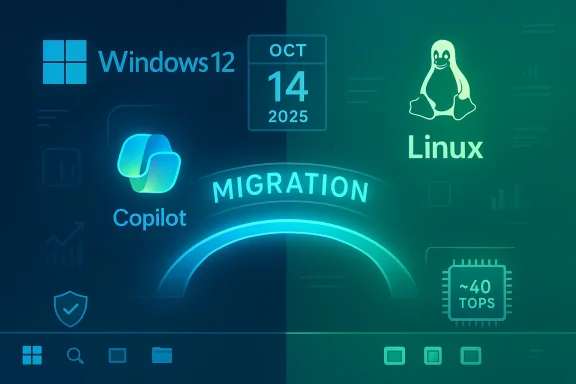
Microsoft’s product cadence and the push to embed AI deeply into client operating systems have combined with a concrete timing event — the formal end of mainstream support for Windows 10 on October 14, 2025 — to create a migration pressure point that projects and community data already show is real. The date for Windows 10’s end of mainstream support is official Microsoft policy.
Around that milestone, migration behavior changed noticeably: some Linux distributions, most prominently Zorin OS, reported a major surge of installs and downloads that the project and multiple industry outlets attributed substantially to displaced Windows users. Independent reporting and vendor statements put Zorin OS’s downloads in the mid‑six‑figure to multi‑million range in the weeks and months after Windows 10’s support ended — a rare, measurable spike for desktop Linux.
At the same time, leaks and reporting about a successor to Windows 11 — variously codenamed Hudson Valley Next or CorePC in different reports — painted a picture of a modular, AI‑first OS where many advanced features are tethered to dedicated neural acc(NPUs) and to a new licensing/feature mix that could emphasize Copilot and subscription models. Those claims remain unconfirmed product details in many respects, and some reporting has pushed back on the most extreme takes; the situation is a blend of verifiable facts, plausible company strategy, and persistent rumor.
This article pulls the threads together: what Microsoft appears to be building; the practical, economic, and privacy pressures that create a migration moment; how Linux distributions are responding; and — crucially — what normal users and IT managers should expect and do next.
Microsoft’s upgrade cycles over the past decade show a recognizable dynamic: each major client release tends to
That’s the context the rumour writers use when they say “Windows 12 could be the tipping point”: if the next major Windows release tightens hardware requirements further, embeds agentic AI deeply into the system, or ties advanced features to paid Copilot tiers or Copilot+ hardware, that combination of friction, cost, and privacy concern becomes a clear exit vector for some users.
Separately, several reporting outlets and analyst writeups have claimed a hardware gating threshold (commonly cited as an NPU capable of ~40 TOPS) required to unlock the “full” experience of the next Windows leak/rumour set. That specific number has been widely reported in the enthusiast press, and it is the very sort of threshold that could turn a software upgrade into an effective hardware tax for users who want the whole feature set. At present, Microsoft has not published universal, definitive Windows‑12 hardware requirements, and the leaks are best treated as plausible but unconfirmed.
Why does this matter? Because local, agentic AI features imply:
Microsoft’s public Copilot privacy pages explain controls and deletion options for Copilot activity, but the practical concerns remain:
If Microsoft errs toward more opaque telemetry, aggressive hardware gating, or hard subscription walls for core desktop features, expect a sustained and detectable migration to Linux and other alternatives. If Microsoft opts for openness, clear privacy controls, and a path that doesn’t force new hardware to deliver reasonable experiences, the Windows majority will largely remain.
For readers: this is a pivotal moment to be deliberate. Back up, experiment, and, if you’re concerned about privacy or future hardware costs, try Linux on a spare USB stick this weekend. The tools to test and to switch are better than they have ever been — and that reality is exactly why this moment matters.
Conclusion
Windows 12 — whether it arrives under that name or as a sequence of Windows 11 extensions — represents a plausible inflection point for desktop computing because it ties three powerful levers together: hardware requirements, pervasive AI, and new monetization models. Those levers are potent precisely because they touch money, privacy, and everyday workflows. The evidence collected from vendor statements, community data around Windows 10’s end of support, and coverage of Copilot and Copilot+ hardware shows the ingredients for a migration moment are present. Users who prize control, predictability, and privacy now have better non‑Windows options than at any time in the recent past — and some are already voting with their downloads. The final shape of Microsoft’s next steps will determine whether the migration widens into a long‑term market shift or settles into a predictable churn of early adopters and holdouts.
Source: ZDNET Windows 12 could be the tipping point that finally pushes you to Linux - here's why
Microsoft’s product cadence and the push to embed AI deeply into client operating systems have combined with a concrete timing event — the formal end of mainstream support for Windows 10 on October 14, 2025 — to create a migration pressure point that projects and community data already show is real. The date for Windows 10’s end of mainstream support is official Microsoft policy.
Around that milestone, migration behavior changed noticeably: some Linux distributions, most prominently Zorin OS, reported a major surge of installs and downloads that the project and multiple industry outlets attributed substantially to displaced Windows users. Independent reporting and vendor statements put Zorin OS’s downloads in the mid‑six‑figure to multi‑million range in the weeks and months after Windows 10’s support ended — a rare, measurable spike for desktop Linux.
At the same time, leaks and reporting about a successor to Windows 11 — variously codenamed Hudson Valley Next or CorePC in different reports — painted a picture of a modular, AI‑first OS where many advanced features are tethered to dedicated neural acc(NPUs) and to a new licensing/feature mix that could emphasize Copilot and subscription models. Those claims remain unconfirmed product details in many respects, and some reporting has pushed back on the most extreme takes; the situation is a blend of verifiable facts, plausible company strategy, and persistent rumor.
This article pulls the threads together: what Microsoft appears to be building; the practical, economic, and privacy pressures that create a migration moment; how Linux distributions are responding; and — crucially — what normal users and IT managers should expect and do next.
 The pattern: why a new Windows release can trigger defection
Microsoft’s upgrade cycles over the past decade show a recognizable dynamic: each major client release tends to- raise baseline system requirements (sometimes locking out older hardware),
- bundle new first‑party services and integrations (Copilot, Teams, OneDrive, Microsoft 365 hooks),
- accelerate the company’s preferred monetization models (subscriptions, premium hardware tiers),
- and increase telemetry/telemetry‑adjacent data collection and feature‑level AI processing that can make full functionality hardware‑sensitive.
That’s the context the rumour writers use when they say “Windows 12 could be the tipping point”: if the next major Windows release tightens hardware requirements further, embeds agentic AI deeply into the system, or ties advanced features to paid Copilot tiers or Copilot+ hardware, that combination of friction, cost, and privacy concern becomes a clear exit vector for some users.
AI as the wedge: what’s plausible and what’s just rumor
There are two related claims about the direction of Windows that, combined, have the most potential to push users away:- Microsoft will embed Copilot and other AI features much deeper into core OS functions — not just as an app, but as the default way to manage services, updates, searches, and context-aware automation.
- Some of those advanced, low‑latency features will be gated behind hardware thresholds (on‑device NPUs with a certain TOPS capability) or by premium Copilot subscriptions.
Separately, several reporting outlets and analyst writeups have claimed a hardware gating threshold (commonly cited as an NPU capable of ~40 TOPS) required to unlock the “full” experience of the next Windows leak/rumour set. That specific number has been widely reported in the enthusiast press, and it is the very sort of threshold that could turn a software upgrade into an effective hardware tax for users who want the whole feature set. At present, Microsoft has not published universal, definitive Windows‑12 hardware requirements, and the leaks are best treated as plausible but unconfirmed.
Why does this matter? Because local, agentic AI features imply:
- local data capture and context buffering (e.g., “recall” features that snapshot screen history),
- continuous or frequent model inference that benefits from specialized hardware, and
- new privacy and telemetry surfaces that many users will find unfamiliar or undesirable, particularly if they’re opaque by default.
Privacy and the “Recall” conversation
One concrete example of how system‑level AI can become a privacy and UX flashpoint is Microsoft’s previously announced “Recall” capability and the broader Copilot memory story. Recall — which was announced for Copilot+ PCs and then delayed for some devices after privacy concerns — would let the system take periodic snapshots of on‑screen content to provide “remember what you saw” functionality. That feature drew regulatory and user scrutiny precisely because it blurs the line between helpful context and continuous monitoring. AP and other outlets covered Microsoft delaying Recall on new devices following concerns from researchers, regulators, and enterprise customers.Microsoft’s public Copilot privacy pages explain controls and deletion options for Copilot activity, but the practical concerns remain:
- Users often don’t read or understand fine‑grained privacy controls.
- Persistent, local screen capture — even when stored locally — changes the threat model for device compromise.
- System‑wide AI that “reads the screen” increases telemetry and context collection in ways that feel very different from traditional Update / Telemetry checkboxes.
Hardware gating and economic pressure
History shows that raising system requirements is an effective — if blunt — way to push the install base toward new hardware and services. An OS that requires stronger silicon to unlock integrated AI features creates three economic frictions:- Users of older hardware must buy new machines to access the full feature set.
- Vendors can sell premium “Copilot+” devices at higher margins, making Microsoft’s partners an active part of the push.
- Enterprises and ISVs must make clear migration decisions (buy, subsidize, or avoid).
Why Linux is in a position to absorb defections now
For years the primary barrier to Linux adoption for mainstream users was application compatibility and polish. Those barriers have shifted significantly:- Desktop distributions like Zorin OS have shipped migration‑focused tooling and layouts that mimic Windows UX expectations. Zorin timed a major release to Windows 10’s end‑of‑support and reported very large download numbers that industry outlets corroborated.
- Compatibility layers for Windows apps — Wine and the Proton toolchain used by Valve — have advanced considerably. Recent major releases of Wine have restored 32/64‑bit subsystem compatibility and improved Wayland/graphics support, making a wider swath of legacy Windows applications usable on Linux.
- Gaming on Linux is far more viable than it was a few years ago, with SteamOS and Proton raising the floor for game compatibility and performance on common hardware. That reduces a historically important reason many users stayed on Windows.
- The Linux desktop ecosystem has matured in terms of drivers, installer ease, and out‑of‑box hardware support — a trend made visible by community reactions during the Windows 10 EOL surge.
Strengths of Microsoft’s approach — and why some users will still prefer it
It’s important to be balanced. Microsoft’s AI integration efforts also produce potential real benefits:- Contextual automation and productivity gains. Local inference and short, secure agent loops can speed common tasks — summarizing documents, triaging inboxes, automating repetitive workflows — in ways that matter to knowledge workers.
- Security and platform consistency. Copilot+ PCs and Secured-core / Pluton features target supply‑chain and firmware protections that many businesses need.
- Tighter ecosystem for businesses. Enterprises that standardize on Microsoft 365 and Azure services see clear integration value, especially where identity and device management are central.
Risks, unknowns, and what is unverifiable right now
The most consequential claims about a Windows “12” that would trigger mass migration remain partly speculative:- Microsoft has not published an official “Windows 12” product plan with final hardware requirements or a binding release date. Some rumor sources are credible early leaks; others are aggregations and translations that stretched older claims. Treat absolute release dates and universal NPU requirements as rumour‑level until Microsoft confirms them.
- The precise nature of Copilot gating — which features would be local vs. cloud, premium vs. free, hardware‑gated vs. broadly available — is still debated in reporting. Some features will undeniably be better with local NPUs; whether Microsoft locks basic productivity features behind silicon or subscription remains to be seen.
- The regulatory and enterprise pushback over privacy could shape Microsoft’s final choices. The Recall story showed that public scrutiny can delay or reshape feature rollouts. Regulation and enterprise procurement practices will matter as much as engineering choices.
Practical migration paths: how to evaluate Linux without burning bridges
If the thought of a deeply embedded Copilot experience, hardware‑gated features, or increased data capture makes you nervous, there are practical, low‑risk ways to evaluate or adopt Linux.- Back up everything. Create a full system image and a verified data backup before making any partition or OS changes.
- Try before you commit. Most modern distributions support booting from a USB “live” session with no install required; test hardware, Wi‑Fi, and peripherals first.
- Use virtualization. Run a Linux VM inside Windows (or vice versa) to test workflows before repartitioning.
- Choose a migration‑focused distro if you want the easiest transition:
- Zorin OS for a Windows‑like UI and migration tools.
- Ubuntu or Linux Mint for broad community and vendor support.
- Manjaro or Fedora for rolling or cutting‑edge stacks if you want newer kernels and drivers.
- Test application compatibility. Try Wine, Proton, or a VM for mission‑critical Windows apps and confirm performance on your hardware. Recent releases of Wine have meaningfully improved compatibility.
- Consider dual‑boot or keep a Windows system image for a transition period. That reduces risk and preserves access to Windows‑only workflows.
What IT managers should watch and prepare for
- Track Microsoft’s official statements for confirmed Windows release timelines and system requirements. If the company announces hardware‑gated experiences, quantify the number of at‑risk endpoints and the budget needed for replacements or Copilot subscriptions.
- Assess application stack portability. Identify line‑of‑business apps that are Windows‑exclusive and evaluate virtualization or replacement strategies.
- Revisit endpoint privacy and telemetry policies. If system‑level AI features arrive, update guidance on what can be enabled on corporate devices, and consider segmented rollouts for sensitive groups.
- Run a pilot of Linux on a subset of noncritical endpoints to measure desktop‑support load and user acceptance if migration is being considered.
Final analysis: a real tipping point — but not an automatic exodus
There are three concrete reasons why the “Windows 12 pushes users to Linux” thesis has legs right now.- Timing and pressure: Windows 10’s end of mainstream support created a concrete moment for users to reevaluate their path forward. Real adoption signals followed.
- AI tethering: The combination of deeper Copilot integration, system‑level “recall” features, and a push for local inference on NPUs changes the naturom optional to consequential, touching privacy, cost, and hardware lifecycles.
- Linux readiness: Desktop Linux is demonstrably more capable, friendlier, and more compatible than in the recent past, and at least one major distro saw a measurable surge that demonstrates the option is viable for many users.
If Microsoft errs toward more opaque telemetry, aggressive hardware gating, or hard subscription walls for core desktop features, expect a sustained and detectable migration to Linux and other alternatives. If Microsoft opts for openness, clear privacy controls, and a path that doesn’t force new hardware to deliver reasonable experiences, the Windows majority will largely remain.
For readers: this is a pivotal moment to be deliberate. Back up, experiment, and, if you’re concerned about privacy or future hardware costs, try Linux on a spare USB stick this weekend. The tools to test and to switch are better than they have ever been — and that reality is exactly why this moment matters.
Conclusion
Windows 12 — whether it arrives under that name or as a sequence of Windows 11 extensions — represents a plausible inflection point for desktop computing because it ties three powerful levers together: hardware requirements, pervasive AI, and new monetization models. Those levers are potent precisely because they touch money, privacy, and everyday workflows. The evidence collected from vendor statements, community data around Windows 10’s end of support, and coverage of Copilot and Copilot+ hardware shows the ingredients for a migration moment are present. Users who prize control, predictability, and privacy now have better non‑Windows options than at any time in the recent past — and some are already voting with their downloads. The final shape of Microsoft’s next steps will determine whether the migration widens into a long‑term market shift or settles into a predictable churn of early adopters and holdouts.
Source: ZDNET Windows 12 could be the tipping point that finally pushes you to Linux - here's why
