

A developer has done something improbably nostalgic: the much-maligned, tile‑first Windows 8 interface has been recreated as a working shell for modern Linux desktops, and at the same time a major games storefront is openly questioning Windows’ quality and publicly putting Linux support on the strategic roadmap. Both stories landed in the last week and they matter for different, intersecting audiences — tinkerers who love desktop experiments and gamers watching platform shifts — because they reveal a larger trend: more energy is flowing into alternative desktop models and Linux gaming, and both experiments and commercial signals are underscoring a loosening of Windows’ historical monopoly on PC workflows and play.
Windows 8’s UI was one of Microsoft’s most polarizing design gambits. Launched in 2012 with a touch-first, full‑screen “Start” built around large, live tiles, it split user opinion and catalyzed decades‑long debates about UI consistency, discoverability, and platform direction. The tiled UI was praised by some for clarity and touch ergonomics, and reviled by others for breaking desktop muscle memory and desktop-first workflows. That controversy is the cultural soil in which a small open‑source project, and a candid GOG leadership interview, have both recently sprouted headlines.
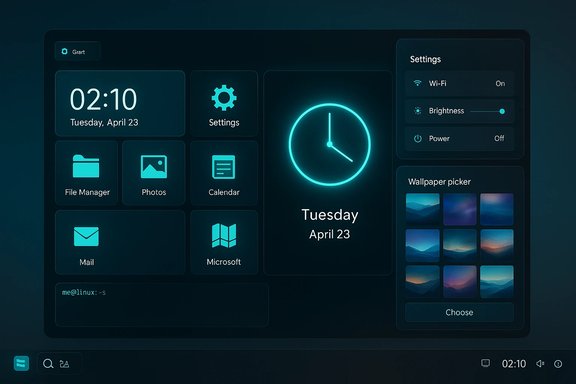
One story is technical and community‑facing: a GitHub project named Win8DE (by user er‑bharat) reconstructs the Windows 8 aesthetic and interaction model as a Wayland shell, with a start screen, lock screen, on‑screen display (OSD) components and a settings app packaged for Wayland compositors like Labwc and Hyprland. That project is real, public, and documented in a GitHub repository with build/install scripts and screenshots. The second story is commercial and strategic: GOG’s new ownership and senior management were interviewed recently and delivered unusually blunt public criticism of Microsoft Windows, while confirming that Linux — already a growing play for game platforms thanks to Valve’s SteamOS and handheld ecosystem — is a formal item in GOG’s strategy for the year. The CEO’s quote calling Windows “such poor‑quality software” is being widely circulated, and the managing director explicitly said Linux is “one of the things we’ve put in our strategy for this year to look closer at.” Those comments were published after a PC Gamer interview and picked up by multiple outlets. Both items are different in scope and risk, but together they expose the same macro currents: users and companies are increasingly open to alternative operating models and to experimentation outside the Windows orthodoxy.
GOG’s senior leadership, by contrast, is performing a different kind of public work: signaling dissatisfaction with a dominant platform and placing Linux explicitly on the company’s strategic radar. That move matters because platform owners shape where developer attention and QA budgets flow. It is a commercial hint more than a deliverable, but such hints can evolve into concrete support once the economics align.
Both items matter in the same ecosystem: one shows how easy it is to iterate on desktop form factors in open source; the other shows how serious, public commercial dissatisfaction with Windows can be when it comes from a platform operator who must serve users frustrated by perceived regressions. The combination of grassroots UI experimentation and platform‑level strategic reappraisal points to a future where desktop UI plurality and cross‑platform play become increasingly normal — with benefits for choice, but also new responsibilities for testing, security, and long‑term maintenance.
If you plan to try Win8DE, start in a VM, read the README and build scripts on GitHub, and remember: this is nostalgia with a modern stack — delightful to explore, but not yet production‑grade. If you follow platform and gaming news, keep an eye on GOG’s product updates through the year: a few concrete Linux‑support announcements from a major store would be a clear signal that the industry’s Linux momentum is entering a new phase.
Source: MSN https://www.msn.com/en-us/money/oth...n-windows-as-linux-is-considered/ar-AA1UcEc6]
 Background / Overview
Windows 8’s UI was one of Microsoft’s most polarizing design gambits. Launched in 2012 with a touch-first, full‑screen “Start” built around large, live tiles, it split user opinion and catalyzed decades‑long debates about UI consistency, discoverability, and platform direction. The tiled UI was praised by some for clarity and touch ergonomics, and reviled by others for breaking desktop muscle memory and desktop-first workflows. That controversy is the cultural soil in which a small open‑source project, and a candid GOG leadership interview, have both recently sprouted headlines.One story is technical and community‑facing: a GitHub project named Win8DE (by user er‑bharat) reconstructs the Windows 8 aesthetic and interaction model as a Wayland shell, with a start screen, lock screen, on‑screen display (OSD) components and a settings app packaged for Wayland compositors like Labwc and Hyprland. That project is real, public, and documented in a GitHub repository with build/install scripts and screenshots. The second story is commercial and strategic: GOG’s new ownership and senior management were interviewed recently and delivered unusually blunt public criticism of Microsoft Windows, while confirming that Linux — already a growing play for game platforms thanks to Valve’s SteamOS and handheld ecosystem — is a formal item in GOG’s strategy for the year. The CEO’s quote calling Windows “such poor‑quality software” is being widely circulated, and the managing director explicitly said Linux is “one of the things we’ve put in our strategy for this year to look closer at.” Those comments were published after a PC Gamer interview and picked up by multiple outlets. Both items are different in scope and risk, but together they expose the same macro currents: users and companies are increasingly open to alternative operating models and to experimentation outside the Windows orthodoxy.
Win8DE: Windows 8’s Start screen, rebuilt for Wayland
What Win8DE actually is
Win8DE bills itself as a “windows 8 like de for linux.” It is not a drop‑in replacement for GNOME or KDE Plasma; it is a shell layer designed to run on top of Wayland compositors (the README names Labwc and Hyprland explicitly). The repo contains modular components — Win8Start, Win8Lock, Win8OSD, Win8Wall, Win8Settings — plus build and install scripts so curious users can compile and test it locally. The project is public on GitHub and has attracted a few hundred stars and some media coverage. Key technical points verified from the repository and reporting:- Targets Wayland compositors (Labwc, Hyprland) rather than X11.
- Ships with build/install scripts (build.sh, install.sh) and a clear README describing features and the session integration approach.
- Uses a mix of QML for UI elements and Python for optional live‑tile logic; the README documents a design where tile behavior can be driven by tile.qml files or optional logic.py scripts for live tiles. The author explicitly notes the “choice of python is due to non compiled nature and ease of programming.”
What it recreates and what it leaves out
Win8DE reproduces the broad look and feel of Windows 8:- Tile‑based Start screen with multiple tile sizes and drag‑and‑drop arrangement.
- Horizontally scrolling “pages” of tiles, evoking the original Windows 8 orientation.
- Animated lock screen, wallpaper utility, and a lightweight OSD handling volume and brightness overlays.
- A settings app for accent colors and wallpapers.
Verified limitations and platform caveats
A few technical realities and limitations are evident from the source and reporting:- Win8DE is a shell, not a full desktop environment: deep system settings, power profiles, distribution integrations, and session management remain the responsibility of the underlying compositor and distro. Expect edge cases and integration gaps.
- Wayland GPU and vendor quirks matter. Historically, proprietary NVIDIA drivers have lagged on some Wayland features compared with open drivers; compositors and driver stacks still vary in behavior across hardware. That risk is widely flagged in community commentary and editorial coverage of the project. Test carefully if you rely on multi‑monitor setups or hybrid GPU laptops.
- Maintenance and longevity risk: the repo is small, community‑driven and has a limited contributor base. That’s fine for a weekend project but means long‑term compatibility with compositor changes or Wayland protocol tweaks could require hands‑on maintenance.
How to try it safely (step‑by‑step)
If you’re curious and technically comfortable, here’s a conservative path to trial Win8DE without wrecking your primary desktop:- Clone the GitHub repository (er‑bharat/Win8DE) and read README carefully.
- Use a disposable environment: a virtual machine that supports Wayland guests, a separate test partition, or a spare device. Avoid running it on a production desktop without a fallback.
- Build locally using ./build.sh to produce local binaries in build/bin, or use ./install.sh only after you are confident. The repo documents both flows.
- Configure a separate Wayland session and keep your original compositor config untouched (examples are included in the README). Create a .desktop session entry so you can select the Win8 session at login instead of replacing your default session.
- Inspect the code before running, especially any scripts that modify /usr/bin or session files. Prefer local build/bin usage until you’re comfortable.
- If you use NVIDIA, search your distro’s guidance for recent driver + Wayland compositor compatibility and test in a VM first.
Strengths: why the project is more than a gag
- Design preservation and experimentation. It’s a distilled UI experiment that interrogates whether tile‑first workflows still have value in 2026’s context of smaller devices, hybrid form factors, and composited Wayland UX.
- Modularity. Splitting start, lock, OSD and settings into separate components reduces complexity and makes targeted fixes easier.
- Open toolchain. Using QML + Python lowers the barrier for contributors who want to add live tile integrations or small UX tweaks.
Risks: what to watch out for
- Security and distribution hygiene. Small projects sometimes ship helper scripts that run with elevated privileges; prefer local builds and review install scripts. The README is explicit about build/install, but prudence is essential.
- Maintenance. A small contributor pool means patch lag for compositor API changes. If you run this daily, be prepared to troubleshoot.
- Legal gray area. Recreating a “look and feel” sits in a legal grey zone; the safe route is to use original, non‑Microsoft assets (which Win8DE attempts to do), but commercialized derivatives would need legal guidance.
GOG’s leadership: a blunt assessment and a Linux roadmap item
What the executives actually said
In a PC Gamer interview, Michał Kiciński (GOG’s new owner and co‑founder of CD Projekt) was unusually forthright about Windows. The line being repeated across outlets: “I’m really surprised at Windows. It’s such poor‑quality software and product, and I’m so surprised that it [spent] so many years on the market. I can’t believe it!” He said he no longer uses Windows daily and only interacts with it when repairing family PCs. The company’s managing director, Maciej Gołębiewski, was less dramatic but clear that Linux is a deliberate item in the company’s near‑term strategy: “Linux is one of the things that we’ve put in our strategy for this year to look closer at,” he said, without committing to specific deliverables. Those quotes are confirmed in PC Gamer’s coverage and picked up widely by other outlets.Why this statement matters
- Public statements from a platform operator are strategic signals. GOG’s store focuses on DRM‑free, classic and indie titles; it has a community that includes many technically savvy and libertarian users who favor open platforms. When GOG’s leadership says Linux is on the roadmap, that’s a commercial nudge in an ecosystem where developer effort and QA attention can follow platform interest.
- The statement amplifies a broader industry pattern: Valve’s investment in Proton/Steam Deck and SteamOS has materially improved Linux gaming compatibility, and other platform operators are watching. If GOG signals stronger Linux support, it could accelerate tooling, QA, and even curated Linux catalog efforts.
What to not read into these comments
- These remarks are a strategic consideration, not a firm commitment to a full platform pivot. GOG’s execs were explicit that they were looking at Linux and might improve support, but they did not announce product timelines, funding commitments, or a dedicated GOG Linux storefront. Treat this as a commercial intention signal, not a roadmap with dates.
- Shifting a storefront’s platform support is non‑trivial: it requires QA, packaging pipelines, compatibility testing (Proton/Steam Play or native ports), and support infrastructure. Statement ≠ delivery. Flagging Linux as a priority is significant — but the scale and timing of any change remain speculative.
Potential implications for gamers and the ecosystem
- If GOG invests seriously in Linux compatibility, expect incremental but meaningful changes that benefit players:
- More native Linux ports or curated Proton compatibility certifications for GOG titles.
- Increased tooling or documentation for running GOG games on SteamOS and other Linux platforms.
- Potential cross‑store collaboration on preservation and porting for classic titles.
- For Windows, the comments are an unwelcome but blunt reminder of market perception risks: heavy platform UI/feature churn (for example heavy AI integrations in the OS) can damage goodwill among key developer and platform stakeholders. That reputational friction can create openings for competitors.
What both stories together reveal about platform dynamics in 2026
Design experiments meet commercial pressure
- Win8DE is a cultural and technical experiment: it demonstrates how modular, userland shells on Wayland let small teams resurrect and re‑evaluate old UI ideas without touching vendor code. That’s how desktop innovation happens now — small, composable experiments that can be tried safely by enthusiasts.
- GOG’s comments are a commercial counterpoint: platform operators are sensitive to quality perceptions and to where gamers are migrating. When a prominent store publicly elevates Linux to a strategic item, even tentatively, it nudges developer and QA attention toward the platform.
Deeper technical enablers
- Wayland is the enabling platform for modern shell experiments. Compared with X11, Wayland’s compositing primitives make overlays, smooth animations, and tightly coupled OSD elements simpler to implement — provided compositor and driver maturity align. Win8DE’s choice to target Wayland is intentional and practical.
- Linux gaming infrastructure — Proton, Proton‑experimental, Steam Deck testing workflows — is steadily reducing the cost of making games playable on Linux. That infrastructure lowers the barrier for stores like GOG to support Linux more aggressively.
Practical takeaways and next steps for readers
- For tinkerers: Win8DE is a charming, technically modern homage you can try in a VM or spare session — but treat it as an experimental project. Read the README, build locally, and don’t install systemwide until you’ve validated behavior.
- For gamers and admins: GOG’s remarks are a signal worth watching. They increase the probability that GOG will invest more engineering time into Linux support during the year, but they are not a guarantee of a major platform pivot. Monitor product announcements and job postings from GOG for concrete follow‑through.
- For IT decision‑makers: these stories are a reminder to maintain platform‑agnostic contingency options for critical workflows. If a significant number of ISVs or user communities shift testing and support to Linux (or Apple), the long‑term risk of single‑platform dependency rises.
Final analysis: experimentality vs. strategic intent
Win8DE is a tidy encapsulation of what modern Linux desktop communities do best: they experiment. The project reopens an old UI debate under modern technical constraints and invites curiosity. It is not a commercial threat to mainstream desktops, but it is a useful stress test of how modular shell design and Wayland compositing make unusual UX models viable again.GOG’s senior leadership, by contrast, is performing a different kind of public work: signaling dissatisfaction with a dominant platform and placing Linux explicitly on the company’s strategic radar. That move matters because platform owners shape where developer attention and QA budgets flow. It is a commercial hint more than a deliverable, but such hints can evolve into concrete support once the economics align.
Both items matter in the same ecosystem: one shows how easy it is to iterate on desktop form factors in open source; the other shows how serious, public commercial dissatisfaction with Windows can be when it comes from a platform operator who must serve users frustrated by perceived regressions. The combination of grassroots UI experimentation and platform‑level strategic reappraisal points to a future where desktop UI plurality and cross‑platform play become increasingly normal — with benefits for choice, but also new responsibilities for testing, security, and long‑term maintenance.
If you plan to try Win8DE, start in a VM, read the README and build scripts on GitHub, and remember: this is nostalgia with a modern stack — delightful to explore, but not yet production‑grade. If you follow platform and gaming news, keep an eye on GOG’s product updates through the year: a few concrete Linux‑support announcements from a major store would be a clear signal that the industry’s Linux momentum is entering a new phase.
Source: MSN https://www.msn.com/en-us/money/oth...n-windows-as-linux-is-considered/ar-AA1UcEc6]
