

CPU shipments rose again in Q3 2025, and this time the bump looks less like a cyclical blip and more like a reaction to Windows 10’s end-of-life and the practical barriers consumers face when moving to Windows 11. Jon Peddie Research (JPR) reports a modest 2.2% quarter‑on‑quarter increase in client CPU shipments for Q3’25 and a server CPU market up roughly 13–14% year‑over‑year, while desktop and notebook shares remain near a 70/30 split—patterns that point to replacement demand, OEM refreshes, and a market still responding to earlier tariff-driven buying behavior.
The semiconductor and PC supply chain has behaved unusually throughout 2025. After a typical lull in the first half of the year, the first two quarters showed unexpected growth—largely attributed to “buy‑ahead” behavior ahead of proposed U.S. import tariffs and inventory adjustments at OEMs and distributors. JPR quantified that unusual Q2 spike (approximately a 7.9% QoQ increase for client CPUs), then followed with a smaller seasonal rise in Q3, which JPR attributes primarily to Windows 10’s end of support and, to a lesser extent, residual tariff effects. Microsoft’s formal end-of-support date for Windows 10—October 14, 2025—moved many households and businesses to evaluate upgrades at the device level rather than simply at the OS level. Microsoft’s guidance and the limited consumer Extended Security Updates (ESU) options have made hardware replacement or Windows 11 migration practical imperatives for many users who prefer to remain fully patched and supported.
Source: Wccftech CPU Shipments Saw Noticeable Growth In Third Quarter, Mostly Due To Windows 10 EOL
 Background
The semiconductor and PC supply chain has behaved unusually throughout 2025. After a typical lull in the first half of the year, the first two quarters showed unexpected growth—largely attributed to “buy‑ahead” behavior ahead of proposed U.S. import tariffs and inventory adjustments at OEMs and distributors. JPR quantified that unusual Q2 spike (approximately a 7.9% QoQ increase for client CPUs), then followed with a smaller seasonal rise in Q3, which JPR attributes primarily to Windows 10’s end of support and, to a lesser extent, residual tariff effects. Microsoft’s formal end-of-support date for Windows 10—October 14, 2025—moved many households and businesses to evaluate upgrades at the device level rather than simply at the OS level. Microsoft’s guidance and the limited consumer Extended Security Updates (ESU) options have made hardware replacement or Windows 11 migration practical imperatives for many users who prefer to remain fully patched and supported. Overview of the quarter: raw data and what changed
Client vs. server shipments — the headline numbers
- Client CPUs: JPR reports a +2.2% quarter‑on‑quarter increase in client CPU shipments in Q3’25 compared with Q2’25. That outcome continues the unusual three‑quarter run of growth for client CPUs in 2025.
- Server CPUs: JPR states the server market rose about 2.7% quarter‑on‑quarter and ~13.6% year‑on‑year, a solid performance that tracks recovery and capacity growth in data center spending. The year‑over‑year server gain contrasts with the smaller, seasonal client uptick.
Desktop vs. laptop share
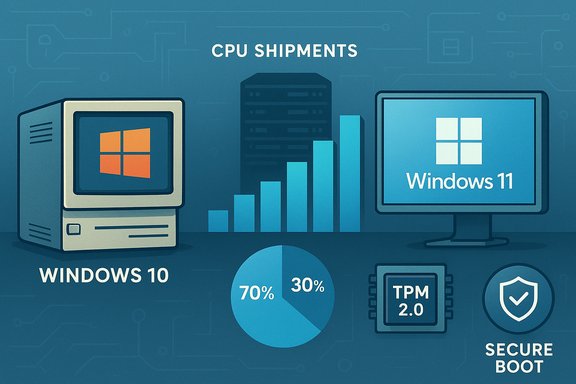
Desktops and laptops maintained a roughly 70% desktop / 30% laptop share of client CPU shipments in Q3’25, returning to the Q3’24 ratio after a brief laptop share uptick in Q2. That balance suggests suppliers and OEMs reacted to Windows 10 EOL by shipping more desktop platforms (which are both easier and cheaper to spec for secure‑boot and TPM compliance) while laptops remained steady relative to prior quarters. JPR’s charts show the desktop segment retaining dominance in the shipment mix for this quarter.Why Windows 10 EOL matters to CPU shipments
The mechanics: Windows 11 minimums and real‑world compatibility
Windows 11’s baseline hardware requirements—especially TPM 2.0 and UEFI Secure Boot—created a technical gate for many older systems. Microsoft’s published Windows 11 requirements list TPM 2.0, Secure Boot–capable UEFI firmware, a compatible 64‑bit dual‑core processor and minimum RAM/storage thresholds; these rules mean many otherwise functioning Windows 10 PCs require hardware changes or full replacement to maintain Microsoft‑supported status. As Microsoft and PC builders stressed, the free upgrade path is available only for devices that meet those checks. For consumers and SMBs weighing their options in Q3, the calculus was simple: enroll in consumer ESU for a year (if eligible), perform potentially risky BIOS or registry workarounds to bypass checks, retrofit TPM modules (where possible), or buy a new Windows 11–compatible system. OEMs and retail channels frequently promoted new Windows 11 PCs in the months leading to and following Windows 10’s final support date, accelerating replacement cycles. JPR explicitly named Windows 10 EOL as the main driver for the Q3 client CPU increase.Practical effects on older CPUs and upgrade pathways
- Many older platforms lack a physical or firmware TPM that meets the 2.0 spec. Some vendors provide firmware‑based TPM (fTPM) options on recent BIOS updates, but older motherboards either cannot be updated or lack compatible connectors for add‑on TPM modules.
- Secure Boot requires a UEFI firmware configuration; legacy BIOS machines can’t be converted without motherboard replacement.
- Even where BIOS/firmware workarounds exist, official upgrade and support may be void or restricted; Microsoft and manufacturers have repeatedly cautioned that unsupported upgrades can lead to loss of updates or degraded system reliability.
Tariffs and the Q2 “pull‑forward”: context for Q3 activity
The supply‑chain story of 2025 included proposed U.S. import tariffs on certain Chinese‑manufactured goods, which created a “ship‑now” effect across the PC ecosystem. JPR’s Q2 analysis documented a nearly 8% QoQ client CPU shipment jump attributed primarily to buy‑ahead behavior—distributors and OEMs ordering ahead of tariff implementation to avoid cost increases and sourcing disruptions. Coverage across the technology press documented a similar pattern for GPUs and other PC components in Q2 as buyers stockpiled hardware. By Q3, that tariff‑driven surge had largely worked through the channels. JPR’s Q3 statement explicitly separates the Q3 effect from the Q2 tariff pull: Q3’s modest seasonal rise shows the EOL migration effect layered on top of earlier inventory moves, not a continuation of panic buying. Analysts caution that pulled‑forward demand will likely temper future quarters’ growth, making 2025’s aggregate pattern lumpy rather than indicative of sustained, organic market expansion.OEMs, channel dynamics, and who benefited
OEMs and system integrators
OEMs were primary beneficiaries of the Windows 10 EOL-driven refresh cycle. Their Q3 shipments included systems preconfigured for Windows 11 compliance—bundled with TPM 2.0, UEFI firmware, and Secure Boot settings enabled at the factory. Those prebuilt systems reduce end‑user friction and warranty concerns versus DIY upgrades, and they appeared in both desktop tower SKUs and thin‑and‑light laptop segments promoted aggressively during the OS migration window. JPR’s data suggest OEM order flows were meaningfully stronger in Q3 than the seasonal baseline.Channel inventory and retail promotions
Retailers and distribution partners used the EOL milestone to push promotions on trade‑ins and Windows 11–ready packages. Inventory replenishment patterns varied by vendor: some PC makers reported faster than usual sell‑through on consumer SKUs, while enterprise channels saw more cautious, staged migrations. The demand mix—consumer replacements, SMB refreshes, and targeted enterprise buys for compliance—left a composite signature in shipment data that shows up as a modest QoQ client increase and a stronger YoY server rise.Risks, caveats and what the numbers don’t show
Shipments vs. sell‑through
JPR’s shipment figures measure semiconductor shipments to OEMs/ODMs and are a leading indicator of supply‑side activity, not direct retail or enterprise adoption metrics. A shipment increase can reflect inventory build at OEMs, distribution reshuffles, or channel stocking in anticipation of demand. That distinction matters: a high shipment quarter can precede a weaker retail sell‑through quarter as inventory clears. The community should read JPR’s shipments data as supply‑channel activity rather than instantaneous consumer uptake.Forecast reliability and forward guidance
JPR flagged that while Q3’s growth was real, it does not expect Q4 to be particularly strong—partly because prior quarters pulled demand forward and because seasonal patterns typically favor the holiday quarter, which in this cycle may be muted by earlier purchases. Any projection about Q4 strength carries uncertainty: tariffs may reappear in trade negotiations, OEM inventory strategies can shift rapidly, and enterprise migrations often follow different timelines than consumer ones. Treat Q3’s numbers as evidence of a migration‑driven pulse rather than a durable rebound.Unverifiable claims and the need for triangulation
Some media narratives imply that Windows 10 EOL alone explained the entire 2025 growth pattern. That is an oversimplification. While JPR explicitly cites Windows 10 EOL as the primary prompt for Q3’s client uptick, it also points to lingering tariff effects and earlier inventory behavior as contributory factors. Observers should be cautious about single‑cause explanations—market dynamics in 2025 are the product of multiple overlapping shocks, and some vendor‑level behavior (discounting, promotional cadence, OEM contract timing) is not public and therefore harder to verify. Where claims cannot be independently corroborated in public filings or by multiple unbiased measurements, they should be considered plausible but not proven.Technical implications: TPM 2.0, Secure Boot, and CPU compatibility
Why TPM 2.0 and Secure Boot are practical blockers
- TPM 2.0: Many older PCs either lack a TPM module or ship with TPM 1.2; firmware‑based TPM (fTPM) solutions exist for later motherboards but are not universal. Enabling TPM can require BIOS updates or hardware retrofits that are not feasible for all users. Microsoft and PC makers have published guidance for enabling TPM and checking devices, but the practical outcome for many users was a purchase decision rather than a firmware tweak.
- Secure Boot (UEFI): Legacy BIOS machines cannot meet Secure Boot requirements. While some devices support dual modes, migrating from legacy BIOS to UEFI often requires repartitioning drives and additional steps that impede a frictionless OS upgrade.
Workarounds exist—but they carry tradeoffs
There are documented methods to bypass Windows 11 checks (registry edits, modified install media, or third‑party installer tools). However, Microsoft’s guidance and community experience warn that bypassing minimum requirements can lead to unsupported devices, missed updates, and potential security implications. For enterprises focused on compliance, such approaches are typically unacceptable. The existence of bypasses reduces some replacement pressure for technically confident users but does not erase the migration incentive for risk-averse consumers and organizations.What this means for vendors, buyers, and the market
For OEMs and silicon suppliers
OEMs who positioned Windows 11–ready inventory and promoted trade‑ins benefited from the EOL timing. CPU vendors supplying desktop and laptop platforms—especially those offering newer architecture SKUs that pair well with TPM/fTPM—saw strengthened order books in Q3. Vendors should prepare for a potentially softer Q4 as inventory normalizes but should also expect continued spot demand from enterprises that deferred earlier upgrades. JPR’s own commentary warns that the three‑quarter growth streak is likely unsustainable without new demand drivers.For enterprise buyers and IT teams
Enterprises that moved quickly to retire or upgrade Windows 10 endpoints reduced future security risk but created short‑term procurement pressure. Organizations that used ESU or virtualized legacy workloads may still face hardware timelines for complete migration. IT planners should treat Q3 shipment increases as one indicator that the migration wave is underway but not as proof that every endpoint has already been addressed. A staged, risk‑prioritized migration remains best practice.For consumers
Consumers faced a clear choice in late 2025: continue on Windows 10 with ESU risk tradeoffs, attempt a technical workaround (and accept potential update restrictions), or buy new hardware. The small QoQ lift in client CPU shipments indicates that many consumers chose replacement. However, anecdotal reports and vendor commentary suggest that price sensitivity and the availability of aftermarket solutions mean a sizable portion of the market will continue to run older hardware for some time.Practical takeaways and guidance
- For buyers who need a supported Microsoft environment, prioritize systems that explicitly list Windows 11 compatibility and TPM 2.0/UEFI in the spec sheet.
- For IT teams, inventory and classify endpoints by upgradeability (TPM/UEFI support) and business criticality; ESU is a stop‑gap, not a long‑term security plan.
- For system builders and enthusiasts, enabling fTPM and Secure Boot where possible can extend a device’s useful life—bearing in mind the potential for unsupported configurations if Microsoft’s policies change.
Conclusion
Q3 2025’s CPU shipment increase was real, but nuanced. JPR’s data show a modest 2.2% QoQ rise in client CPU shipments and a robust ~13–14% YoY gain in server shipments—figures that reflect a market responding to both policy shocks (tariff‑related pull‑forward in Q2) and a major software lifecycle event (Windows 10 EOL). OEMs captured much of the migration demand by supplying Windows 11–compatible platforms, while consumers and enterprises balanced ESU, workarounds, and replacement choices across differing risk tolerances. The net effect: a year of lumpy, front‑loaded demand rather than a smooth recovery. JPR’s forecast for a subdued Q4 underscores that this year’s growth largely redistributed demand across quarters rather than signaling a sustained cyclical upswing. Taken together, the data and the context show how an OS lifecycle event—when combined with trade policy uncertainty—can materially shift hardware flows through the supply chain. The next few quarters will show whether this was a one‑time replacement pulse or the start of a more lasting refresh cycle tied to new PC security baselines and broader platform investments.Source: Wccftech CPU Shipments Saw Noticeable Growth In Third Quarter, Mostly Due To Windows 10 EOL
