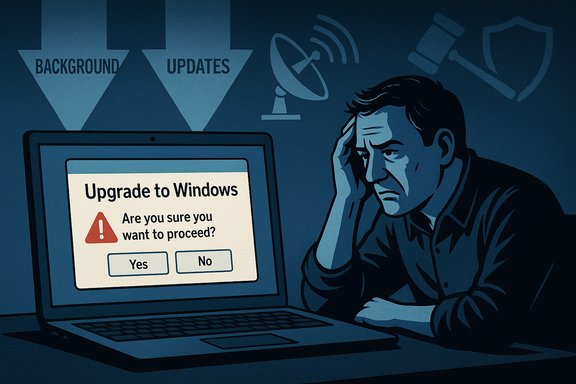
When a Windows 10 upgrade landed without consent and destroyed a small business user’s workflow, the fallout quickly grew from a single small‑claims verdict into a broader wave of consumer complaints, public‑interest pressure and follow‑on litigation that forced a close look at how operating‑system vendors manage updates, user consent and the real costs of “automatic” downloads.
Microsoft shipped Windows 10 as a free upgrade campaign in 2015 and, over the next months and years, faced an unusual mix of technical, legal and reputational problems from users who said upgrades were pushed onto their machines without clear consent. The most visible early incident was a small‑claims victory by a Sausalito travel‑agency owner, Teri Goldstein, who obtained a monetary judgment after her primary work PC was upgraded and rendered unreliable — a case that many outlets reported as resulting in a $10,000 award to the plaintiff. At the same time, high‑profile anecdotes — including a conservation NGO in the Central African Republic whose satellite‑metered connection downloaded many gigabytes of upgrade files and risked enormous connectivity bills — amplified the narrative that Microsoft’s background delivery of Windows 10 could cause tangible, even catastrophic, financial harm in certain settings. News outlets covered the Chinko Project incident as an example of how background downloads can translate into real costs in remote, metered networks. Those events did more than generate headlines. Local newspapers like the Rockland County Times and state law enforcement offices began to collect complaints and explore potential consumer‑protection actions. In New York, the regional reporting prompted outreach from the New York State Attorney‑General’s office, and officials signaled they would review aggregated complaints about allegedly “forced” or misleading upgrade prompts.
Microsoft’s technical and security rationale for aggressive, centralized updates has merit: fewer fragmented versions and rapid patch deployment reduce systemic exposure. But design choices matter: when background downloads, opaque prompts, or default settings produce harmful outcomes, the vendor’s legal and reputational risk rises and public officials may intervene. The Goldstein judgment and the ensuing collection of complaints illustrate how a single, well‑documented harm can catalyze broader scrutiny.
For users and administrators, the clear takeaway is proactive: inventory, control updates where possible, use ESU if eligible and needed, and treat metered or mission‑critical endpoints as high‑risk until migration is planned and tested. For policymakers and advocates, the episode underscores the need for clearer consent standards for disruptive upgrades, stronger protections for metered users and a policy approach that balances vendor lifecycle economics against social and environmental externalities.
The debate that began with a handful of anecdotes continues to shape how vendors design update mechanisms and how regulators and consumers respond — and it remains a critical case study in the real‑world costs of software distribution choices.
Source: Mashdigi After the first case, more people filed lawsuits against Microsoft over Win 10 upgrades
 Background
Microsoft shipped Windows 10 as a free upgrade campaign in 2015 and, over the next months and years, faced an unusual mix of technical, legal and reputational problems from users who said upgrades were pushed onto their machines without clear consent. The most visible early incident was a small‑claims victory by a Sausalito travel‑agency owner, Teri Goldstein, who obtained a monetary judgment after her primary work PC was upgraded and rendered unreliable — a case that many outlets reported as resulting in a $10,000 award to the plaintiff. At the same time, high‑profile anecdotes — including a conservation NGO in the Central African Republic whose satellite‑metered connection downloaded many gigabytes of upgrade files and risked enormous connectivity bills — amplified the narrative that Microsoft’s background delivery of Windows 10 could cause tangible, even catastrophic, financial harm in certain settings. News outlets covered the Chinko Project incident as an example of how background downloads can translate into real costs in remote, metered networks. Those events did more than generate headlines. Local newspapers like the Rockland County Times and state law enforcement offices began to collect complaints and explore potential consumer‑protection actions. In New York, the regional reporting prompted outreach from the New York State Attorney‑General’s office, and officials signaled they would review aggregated complaints about allegedly “forced” or misleading upgrade prompts. What happened: the early cases and the patterns they revealed
Teri Goldstein — small claims and precedent
The Goldstein case remains the clearest single‑user narrative that tied unwanted upgrade behaviour to monetary harm. Goldstein told the court that her Windows 7 machine attempted or received a Windows 10 upgrade without her knowledge, that the upgrade left the computer slow and unstable, and that repeated support calls failed to restore reliable operation — forcing her to lose business and ultimately replace the machine. Multiple reputable outlets reported that Microsoft dropped an appeal and the matter concluded with a payout to the plaintiff. Note on inconsistent reporting: some re‑summaries and regional web posts have conflated different settlement details in secondary coverage; the strongest contemporaneous reporting attributes a $10,000 award to the Goldstein small‑claims judgment rather than a nominal $1. The record of the $10,000 outcome is corroborated by a range of independent tech publications.The Chinko Project and metered networks
The Chinko Project story is not a legal case but a vivid illustration of consequences. Donated laptops in a remote reserve downloaded tens of gigabytes of upgrade data over satellite links that charged per megabyte, producing an estimate of thousands to tens of thousands of dollars in potential overage costs. The NGO’s complaint focused not only on money but on safety: patriation of critical communications and the risk that a broken or busy workstation could imperil anti‑poaching operations. Newsweek, Chip and other outlets reported the event in 2016, and the story has been repeatedly cited as a cautionary example.Local government and consumer‑protection outreach
Regional newspapers, consumer advocates and some state attorneys‑general began to collect stories. The Rockland County Times published a string of “ombudsman” items documenting reader complaints and urged affected readers to forward reports to the New York Attorney‑General’s Bureau of Internet and Technology. This localized activism coincided with national press coverage and triggered inquiries in multiple jurisdictions.Why users saw upgrades they didn’t expect: technical mechanics
Understanding the difference between a “forced” upgrade and a background download requires a clear picture of how Windows Update worked in the period in question and how Microsoft later adjusted phrasing and UI:- Windows Update can download “recommended” content in the background when automatic updates are enabled; some compatibility‑preparation packages and large installer files were distributed using Windows Update. On measured or metered connections this can be costly unless users explicitly set data limits or disable automatic downloads. The Chinko Project example highlighted this risk.
- Microsoft repeatedly said its intent was not to “force” upgrades without consent and, after public criticism, revised dialog wording and the upgrade flow to make acceptance or declination clearer. At the same time, the company acknowledged that prior UI design had confused some users and promised clearer options. Local reporting and company statements of the time reflect this change in approach.
- However, there is a practical gap between “we don’t force upgrades” and the reality that background downloads plus aggressive default settings can create an effective upgrade path for users who aren’t aware of granular Windows Update controls. That gap — features that make upgrades easy for many users, but risky for a smaller subset — is the heart of the consumer complaints and litigation.
Legal fallout and regulatory attention
From individual suits to aggregated complaints
A successful small‑claims judgment like Goldstein’s has a symbolic value beyond its monetary sum: it establishes a factual narrative that ordinary users can win against a major vendor in the right forum. Local and state officials used that leverage to solicit more complaints, which — when aggregated — can trigger consumer‑protection inquiries or inform potential investigations. Rockland County press outreach and the New York Attorney‑General’s office involvement are examples of how one case can mobilize official scrutiny.Later litigation — the evolving landscape
Years after the initial upgrade disputes, the Windows platform’s lifecycle decisions continued to produce legal challenges. Complaints about product end‑of‑life timetables, device compatibility for upgrades, and whether support cutoffs are effectively coercive have been litigated and debated in both public and regulatory forums. Files and community reporting compiled around the Windows 10 lifecycle and Extended Security Updates (ESU) program show active legal and policy discussion about whether vendors should be required to support older platforms longer or offer more equitable transition paths.Microsoft’s official posture and practical reality
Microsoft’s public statements through the years emphasize that:- The company does not intend to force upgrades without user consent and adjusted its UI and messaging to reduce confusion.
- Windows 10 remained supported through defined lifecycle dates with an ESU program for consumers who needed more time to migrate; Microsoft published a consumer ESU that extends critical updates beyond the formal end‑of‑support date under specific enrollment rules (including Microsoft Account linkage or a one‑time fee option).
The policy questions the cases raised
- Consumer consent vs. security: Vendors argue that automatic updates reduce exposure to vulnerabilities and are therefore in users’ interests. Critics stress that meaningful consent — especially for large, disruptive changes — is essential, and that consent must be unambiguous and reversible.
- Privacy and ecosystem lock‑in: Some transition options for continuing security updates required account linkage or other cloud sign‑ins that privacy‑minded users objected to. Critics argued that tying free continued updates to cloud services created a trade‑off between privacy and security.
- Economic and environmental externalities: For devices that cannot meet new OS hardware requirements, enforced sunset policies can prompt hardware refresh cycles, raising e‑waste and cost burdens — especially for schools, nonprofits and low‑income households. Advocacy groups warned that these externalities deserved policy attention.
- Remedies and regulatory authority: Aggregated consumer complaints can draw state attorney‑general interest and, in some legal theories, form the factual basis for unfair‑practice or deceptive‑practice cases. The Rockland County outreach and the New York Attorney‑General’s inquiry are an example of how local advocacy can steer public enforcers to review vendor practices.
Practical, verifiable facts and timelines
- Windows 10’s formal end of support date for mainstream consumer editions was published by Microsoft as October 14, 2025; Microsoft also offered a Consumer ESU program extending critical updates through October 13, 2026 under specific enrollment conditions. These lifecycle dates and the ESU enrollment mechanics are documented in Microsoft’s official support pages.
- The Goldstein small‑claims judgment and Microsoft’s decision to drop an appeal and settle to avoid further litigation costs were reported by multiple mainstream tech outlets in 2016. That contemporaneous coverage establishes the fact of an early consumer monetary award related to an unrequested upgrade.
- The Chinko Project incident is widely reported: an NGO’s devices downloaded many gigabytes of upgrade data over a satellite link, potentially creating large bills; multiple international outlets published the story in 2016. The incident is a concrete example of how background downloads can cause severe monetary consequences in metered networks.
Critical analysis — strengths, risks and what the cases reveal
Strengths of Microsoft’s approach (from an engineering and security perspective)
- Centralized updates reduce fragmentation and accelerate deployment of critical security fixes across a massive install base. That approach has measurable security benefits in many enterprise and consumer environments. Microsoft’s engineering case — that a higher baseline (Windows 11) plus enforced hardware features reduces systemic risk — is technically sound when hardware features are enabled and configured correctly.
- Providing an ESU pathway for consumers and enterprises is a practical compromise: it gives time for migration without obligating indefinite support for older branches. The ESU program’s structured options (free enrollment via Microsoft Account sync, rewards redemption, or a one‑time fee) are transparent mechanisms to bridge risk.
Risks and weaknesses
- Consent design and UI: Where upgrade dialogs were ambiguous or default behaviours permitted background downloads without clear, timely disclosure, users reported losing functional control of machines. That gap between design intent and user experience is the direct cause of litigation and reputational harm. The Goldstein victory underlines how small but real harms aggregate into legal risk for a vendor.
- Real‑world cost exposure for metered users: Background download behaviour that is harmless on broadband can be catastrophic on satellite or tightly metered mobile links. Vendors that don’t explicitly protect against metered data costs expose users and third‑sector organizations to outsized financial risk. The Chinko Project story spotlighted that vulnerability.
- Policy, equity and environmental impacts: Sunset decisions with strict hardware baselines can accelerate hardware turnover for millions of otherwise functional devices — producing e‑waste, economic burdens, and digital exclusion. Advocacy groups and regional officials cited these externalities in their critiques.
- Legal exposure from design choices: The combination of confusing UI, background downloads and high‑impact harms means vendors may face litigated claims, regulatory inquiries and class actions. Aggregated complaints raise the political cost of lifecycle decisions; even when companies prevail in court, the public relations and regulatory fallout can be significant.
Practical guidance for users and organizations (actionable steps)
- Inventory devices now: Record model, BIOS/UEFI, TPM status and installed Windows build. Prioritize internet‑facing and business‑critical endpoints.
- Check Windows 11 eligibility: Use PC Health Check and OEM documentation; enabling TPM or switching UEFI mode can convert some devices to upgradeable status.
- For meters and satellite users: explicitly set network connections to “metered” in Windows to prevent large background downloads; consider disabling automatic updates temporarily while you implement more controlled update processes.
- If you need more time: enroll in Microsoft’s Consumer ESU if eligible (Microsoft documents enrollment options and deadlines). ESU provides security updates through the stated program end date but has enrollment prerequisites including Microsoft Account conditions in some regions.
- Consider alternatives for end‑of‑life devices: Linux distributions or ChromeOS Flex can extend hardware serviceability for many older PCs; test compatibility before migration.
- For administrators: isolate unsupported endpoints on segmented networks and enforce least‑privilege access until migration is complete.
What remains unresolved and where to be cautious
- Individual anecdotes vary in detail and local reporting can conflate settlements and awards; where precise legal outcomes matter, consult court dockets and contemporaneous reporting rather than summary blogs. The best documented early case shows a tangible monetary award for an unwanted upgrade, but some re‑posted summaries have inconsistent numbers — those discrepancies should be treated cautiously.
- Regulatory outcomes are unpredictable: aggregated complaints can spur investigations, but translating a cluster of unhappy customers into sustained regulatory or legal change is slow and uncertain. Litigation that challenges a vendor’s product lifecycle or lifecycle‑driven market effects raises complex legal questions about product roadmaps, reasonable notice, and market power.
- Technical fixes shift over time: Microsoft and other vendors update upgrade flows, patch behaviours and policies. The balance of automation vs. consent in update systems is an ongoing engineering and product‑policy conversation. Historical cases remain useful precedents, but modern behaviour and options (such as the consumer ESU and clearer dialogs) may meaningfully change user risk profiles. Always check the vendor’s current documentation when making decisions.
Final assessment
The Windows 10 upgrade controversy — early individual cases that produced monetary awards, the Chinko Project’s acute real‑world cost example, and state‑level interest in aggregated complaints — exposed a fault line between large‑scale update automation and individual consent, especially for users on constrained connections or with mission‑critical workflows.Microsoft’s technical and security rationale for aggressive, centralized updates has merit: fewer fragmented versions and rapid patch deployment reduce systemic exposure. But design choices matter: when background downloads, opaque prompts, or default settings produce harmful outcomes, the vendor’s legal and reputational risk rises and public officials may intervene. The Goldstein judgment and the ensuing collection of complaints illustrate how a single, well‑documented harm can catalyze broader scrutiny.
For users and administrators, the clear takeaway is proactive: inventory, control updates where possible, use ESU if eligible and needed, and treat metered or mission‑critical endpoints as high‑risk until migration is planned and tested. For policymakers and advocates, the episode underscores the need for clearer consent standards for disruptive upgrades, stronger protections for metered users and a policy approach that balances vendor lifecycle economics against social and environmental externalities.
The debate that began with a handful of anecdotes continues to shape how vendors design update mechanisms and how regulators and consumers respond — and it remains a critical case study in the real‑world costs of software distribution choices.
Source: Mashdigi After the first case, more people filed lawsuits against Microsoft over Win 10 upgrades