

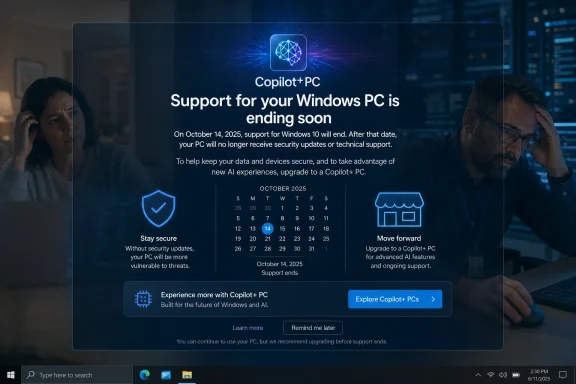
Microsoft showed some Windows 10 users full-screen upgrade prompts in late 2024 urging them to buy Copilot+ PCs and move to Windows 11 before Windows 10’s free support deadline of October 14, 2025. The ads were not a routine notification buried in Settings; they were an operating-system-level intervention that turned a support deadline into a hardware sales pitch. That is the part worth arguing about. Microsoft was right to warn users that an old OS was approaching the end of its supported life, but it chose the most Microsoft way possible to say it: by blurring security advice, Windows 11 migration pressure, and AI PC marketing into the same unavoidable screen.
The basic message was defensible. Windows 10 had a published end-of-support date, and the installed base was enormous. Millions of people were still running the operating system on machines that either could not officially run Windows 11 or had never been moved because the owner saw no reason to change.
A full-screen notice about that reality is not inherently abusive. Operating systems are infrastructure, and infrastructure needs lifecycle warnings. If a user’s PC is going to stop receiving free security updates, a conspicuous alert is better than a quiet knowledge-base article that only sysadmins and tech journalists read.
But Microsoft did not merely say, “Your version of Windows has a deadline.” It bundled that warning with a pitch for Copilot+ PCs, the company’s AI-branded hardware category built around newer processors, neural processing units, and Windows 11 features that older machines often cannot use. That changed the character of the message.
Security warnings are supposed to reduce risk. Ads are supposed to create demand. When the same screen tries to do both, users are left wondering which part is guidance and which part is pressure.
For ordinary users, an end-of-support deadline is already confusing. It does not mean a PC stops booting. It does not mean installed programs vanish. It does not even mean the machine becomes instantly unsafe at midnight. It means the normal stream of free fixes, including security updates, ends unless the device is covered by an extended update option.
That nuance rarely survives a full-screen prompt. The format itself implies alarm: stop what you are doing, read this, act now. When the recommended action is not simply “check your update options” but “level up” to a new class of PC, the deadline becomes a lever.
Microsoft had a legitimate communication problem. It also had a hardware adoption problem. The full-screen Copilot+ message solved the second problem by borrowing the emotional force of the first.
Microsoft’s marketing described Copilot+ PCs as the fastest and most intelligent Windows PCs, but that slogan had to compete with the reality that many Windows 10 machines were still perfectly adequate for browsing, Office, video calls, remote work, and light gaming. For a large slice of the Windows base, the PC replacement cycle had slowed because the hardware was good enough.
That is the real commercial tension underneath the pop-up. Windows 11 adoption depended partly on hardware eligibility, and Copilot+ PC adoption depended on making AI feel like a hardware requirement rather than a software experiment. The Windows 10 deadline gave Microsoft a rare chance to collapse those arguments into one sentence: your old OS is aging out, and our new AI PCs are the future.
The trouble is that the user did not ask to enter a product funnel. They were using a PC they already owned, running an operating system Microsoft had supported for nearly a decade. Turning that desktop into a billboard may have been effective, but it was also revealing.
That line created a strange upgrade landscape. Some people could move to Windows 11 with a few clicks. Some could technically install Windows 11 through unsupported methods but had to accept warnings and possible future friction. Others faced the practical answer Microsoft increasingly preferred: buy a new PC.
This is where the Copilot+ ad landed badly. A user with an older Windows 10 machine might not have been ignoring Windows 11 out of laziness. They might have been blocked by Microsoft’s own compatibility rules. Showing that user a full-screen ad for a new AI PC was therefore not merely informational; it was a reminder that the official upgrade path could involve spending hundreds or thousands of dollars.
For enthusiasts, unsupported installs and registry workarounds became part of the folklore. For regular users and small businesses, they were not a plan. Microsoft’s full-screen messaging treated hardware replacement as a natural next step, but for many households and offices it was a budget decision forced by policy as much as by performance.
Windows has been drifting in this direction for years. The Start menu recommends apps. Settings pages promote subscriptions. Edge campaigns surface inside the OS. Microsoft 365, OneDrive, Game Pass, Copilot, and Windows itself increasingly cross-promote each other because, from Microsoft’s point of view, the PC is no longer merely a local computing environment. It is a distribution surface.
The backlash comes from a different mental model. Users still think of Windows as the thing they bought, licensed, or received with the machine. They may tolerate update prompts and security warnings because those are part of maintenance. They are less forgiving when the OS uses privileged access to sell them something.
This is not about a single screen. It is about whether the desktop belongs primarily to the user or to the platform owner. Microsoft’s answer keeps getting more ambiguous.
That message would still have annoyed some users. No one enjoys being told their operating system is aging out. But it would have preserved a clean boundary between security advice and product promotion.
Instead, the Copilot+ framing encouraged skepticism. If the same warning that says “protect yourself” also says “buy our newest AI PC,” users are more likely to discount the warning as marketing. That is bad for Microsoft and worse for users who need to take lifecycle deadlines seriously.
Security communication depends on trust. The more it resembles a growth campaign, the less persuasive it becomes.
The problem was the consumer-style tone of the campaign. Full-screen prompts make sense in Microsoft’s direct relationship with home users, but they are poison in managed environments if they bypass planning and create help-desk tickets. A user who sees an official Microsoft screen about buying a new PC may reasonably ask why their company has not already replaced their machine.
Even when such prompts are limited to unmanaged or consumer editions, they contribute to a broader administrative anxiety: Microsoft increasingly treats Windows as a service channel it can update, message through, and reframe without much warning. That may be efficient for Redmond. It is less comfortable for organizations that need predictable user experience and change control.
The Windows 10 deadline was always going to be an operational challenge. Marketing it as an AI PC moment did not make that challenge easier.
But the first wave of AI PC marketing asked users to buy into the destination before the road was fully paved. Some marquee features arrived in preview, some were delayed, and some depended on specific processor families or staged rollouts. Recall, the most attention-grabbing Copilot+ feature, became a case study in how quickly an AI showcase can become a security and privacy controversy.
That does not mean Copilot+ PCs are a gimmick. It means the category needed credibility, patience, and clear demonstrations of value. A full-screen Windows 10 ad was a blunt instrument for a subtle adoption problem.
The people most likely to appreciate NPUs and local AI workflows are also the people most likely to resent being hard-sold by the operating system. Enthusiasts do not need a pop-up to know new hardware exists. They need a reason to believe the platform is mature.
Windows 11 improved over time, but it also carried baggage. Interface changes, taskbar limitations at launch, account nudges, default app friction, and more aggressive service integration all gave holdouts reasons to wait. Some objections were emotional, but not all of them were irrational.
The Copilot+ prompt therefore landed in a culture of accumulated annoyance. It was not seen in isolation. It arrived after years of users watching Windows become more cloud-connected, more promotional, and more opinionated about how they should use their PCs.
That is why a lifecycle ad could trigger a broader argument about respect. Windows 10 users were not merely being told to modernize. They were being told, in effect, that the future of Windows was a machine they had not chosen, running features they might not want, sold through a screen they could not easily ignore.
Microsoft also has a reasonable interest in moving the ecosystem forward. Supporting old platforms indefinitely is expensive, fragments developer attention, and slows security improvements. Hardware-backed protections are easier to standardize when the baseline rises.
The issue is not the destination. It is the coercive texture of the journey. Microsoft can be right about the need to move beyond Windows 10 and still wrong about using full-screen advertising to push Copilot+ PCs.
A platform steward has to maintain a higher standard than an app vendor. Windows occupies too central a place in daily work to behave like a shopping mall kiosk.
That makes the ad campaign look less like a one-off annoyance and more like a preview of Microsoft’s post-Windows-10 posture. The company will keep using lifecycle events to accelerate its preferred platform transitions. The next such transition may involve AI features, cloud identity, subscription services, or security baselines that require newer hardware.
Microsoft’s challenge is to avoid teaching users that every urgent message is also a sales pitch. Once that suspicion hardens, even legitimate warnings lose force. The company has spent decades telling users to patch, update, and trust Windows security prompts. It should be careful about spending that trust on hardware marketing.
That difference in perspective explains the controversy. To Microsoft, the prompt was a timely nudge toward a more secure, more modern Windows experience. To many users, it was an ad delivered by software they could not realistically replace without changing their computing life.
Both readings can be true. That is what makes the episode so revealing. The prompt was not a bug in Microsoft’s strategy. It was the strategy, rendered full-screen.
 Microsoft Turned an End-of-Life Warning Into a Storefront
The basic message was defensible. Windows 10 had a published end-of-support date, and the installed base was enormous. Millions of people were still running the operating system on machines that either could not officially run Windows 11 or had never been moved because the owner saw no reason to change.A full-screen notice about that reality is not inherently abusive. Operating systems are infrastructure, and infrastructure needs lifecycle warnings. If a user’s PC is going to stop receiving free security updates, a conspicuous alert is better than a quiet knowledge-base article that only sysadmins and tech journalists read.
But Microsoft did not merely say, “Your version of Windows has a deadline.” It bundled that warning with a pitch for Copilot+ PCs, the company’s AI-branded hardware category built around newer processors, neural processing units, and Windows 11 features that older machines often cannot use. That changed the character of the message.
Security warnings are supposed to reduce risk. Ads are supposed to create demand. When the same screen tries to do both, users are left wondering which part is guidance and which part is pressure.
The Calendar Was Real, but the Urgency Was Manufactured
At the time these prompts began appearing, Windows 10 users still had months before the October 14, 2025 support cutoff. That distinction mattered then, and it matters even more in hindsight. Microsoft was not wrong about the date, but the presentation made the migration feel more immediate than it actually was.For ordinary users, an end-of-support deadline is already confusing. It does not mean a PC stops booting. It does not mean installed programs vanish. It does not even mean the machine becomes instantly unsafe at midnight. It means the normal stream of free fixes, including security updates, ends unless the device is covered by an extended update option.
That nuance rarely survives a full-screen prompt. The format itself implies alarm: stop what you are doing, read this, act now. When the recommended action is not simply “check your update options” but “level up” to a new class of PC, the deadline becomes a lever.
Microsoft had a legitimate communication problem. It also had a hardware adoption problem. The full-screen Copilot+ message solved the second problem by borrowing the emotional force of the first.
Copilot+ PCs Needed a Bigger Story Than AI Tricks
Copilot+ PCs were introduced as the next major Windows hardware wave, but the category arrived with an awkward burden: users needed to be convinced that local AI features justified buying a new computer. Faster processors and better battery life are familiar reasons to upgrade. A neural processing unit is a harder sell.Microsoft’s marketing described Copilot+ PCs as the fastest and most intelligent Windows PCs, but that slogan had to compete with the reality that many Windows 10 machines were still perfectly adequate for browsing, Office, video calls, remote work, and light gaming. For a large slice of the Windows base, the PC replacement cycle had slowed because the hardware was good enough.
That is the real commercial tension underneath the pop-up. Windows 11 adoption depended partly on hardware eligibility, and Copilot+ PC adoption depended on making AI feel like a hardware requirement rather than a software experiment. The Windows 10 deadline gave Microsoft a rare chance to collapse those arguments into one sentence: your old OS is aging out, and our new AI PCs are the future.
The trouble is that the user did not ask to enter a product funnel. They were using a PC they already owned, running an operating system Microsoft had supported for nearly a decade. Turning that desktop into a billboard may have been effective, but it was also revealing.
Windows 11’s Hardware Line Still Haunts the Upgrade Campaign
The Windows 10-to-11 transition was never just another upgrade. Windows 11 introduced stricter hardware requirements, including TPM 2.0 and supported CPU lists that left many otherwise usable PCs outside the official path. Microsoft framed those requirements around security and reliability, but users experienced them as a hard line through the middle of the installed base.That line created a strange upgrade landscape. Some people could move to Windows 11 with a few clicks. Some could technically install Windows 11 through unsupported methods but had to accept warnings and possible future friction. Others faced the practical answer Microsoft increasingly preferred: buy a new PC.
This is where the Copilot+ ad landed badly. A user with an older Windows 10 machine might not have been ignoring Windows 11 out of laziness. They might have been blocked by Microsoft’s own compatibility rules. Showing that user a full-screen ad for a new AI PC was therefore not merely informational; it was a reminder that the official upgrade path could involve spending hundreds or thousands of dollars.
For enthusiasts, unsupported installs and registry workarounds became part of the folklore. For regular users and small businesses, they were not a plan. Microsoft’s full-screen messaging treated hardware replacement as a natural next step, but for many households and offices it was a budget decision forced by policy as much as by performance.
The Adware Complaint Is Really About Control
Calling these prompts “ads” is not just rhetorical excess. A full-screen message promoting a purchasable product category behaves like advertising, even if it is wrapped in lifecycle language. It interrupts the user, occupies the whole display, and advances a commercial objective.Windows has been drifting in this direction for years. The Start menu recommends apps. Settings pages promote subscriptions. Edge campaigns surface inside the OS. Microsoft 365, OneDrive, Game Pass, Copilot, and Windows itself increasingly cross-promote each other because, from Microsoft’s point of view, the PC is no longer merely a local computing environment. It is a distribution surface.
The backlash comes from a different mental model. Users still think of Windows as the thing they bought, licensed, or received with the machine. They may tolerate update prompts and security warnings because those are part of maintenance. They are less forgiving when the OS uses privileged access to sell them something.
This is not about a single screen. It is about whether the desktop belongs primarily to the user or to the platform owner. Microsoft’s answer keeps getting more ambiguous.
Security Messaging Works Best When It Is Boring
There is a better version of this campaign, and it is almost painfully obvious. Microsoft could have shown Windows 10 users a plain-language lifecycle notice explaining their options: upgrade to Windows 11 if eligible, enroll in extended security updates if available, replace unsupported hardware if necessary, or accept the risk of remaining unpatched.That message would still have annoyed some users. No one enjoys being told their operating system is aging out. But it would have preserved a clean boundary between security advice and product promotion.
Instead, the Copilot+ framing encouraged skepticism. If the same warning that says “protect yourself” also says “buy our newest AI PC,” users are more likely to discount the warning as marketing. That is bad for Microsoft and worse for users who need to take lifecycle deadlines seriously.
Security communication depends on trust. The more it resembles a growth campaign, the less persuasive it becomes.
IT Departments Saw a Different Pop-Up Than Consumers Did
For enterprise administrators, the problem was not that Microsoft wanted users off Windows 10. Most IT departments understood that deadline years in advance. They were already dealing with hardware inventories, application compatibility testing, Windows 11 readiness, procurement cycles, and extended security update planning.The problem was the consumer-style tone of the campaign. Full-screen prompts make sense in Microsoft’s direct relationship with home users, but they are poison in managed environments if they bypass planning and create help-desk tickets. A user who sees an official Microsoft screen about buying a new PC may reasonably ask why their company has not already replaced their machine.
Even when such prompts are limited to unmanaged or consumer editions, they contribute to a broader administrative anxiety: Microsoft increasingly treats Windows as a service channel it can update, message through, and reframe without much warning. That may be efficient for Redmond. It is less comfortable for organizations that need predictable user experience and change control.
The Windows 10 deadline was always going to be an operational challenge. Marketing it as an AI PC moment did not make that challenge easier.
The AI PC Pitch Arrived Before the AI PC Case Was Settled
Microsoft’s strategic problem is that Copilot+ PCs are both real and premature. The hardware improvements are meaningful, particularly around battery life and efficient performance on newer silicon. Local AI acceleration is likely to matter more over time as models become more integrated into search, accessibility, media editing, and productivity workflows.But the first wave of AI PC marketing asked users to buy into the destination before the road was fully paved. Some marquee features arrived in preview, some were delayed, and some depended on specific processor families or staged rollouts. Recall, the most attention-grabbing Copilot+ feature, became a case study in how quickly an AI showcase can become a security and privacy controversy.
That does not mean Copilot+ PCs are a gimmick. It means the category needed credibility, patience, and clear demonstrations of value. A full-screen Windows 10 ad was a blunt instrument for a subtle adoption problem.
The people most likely to appreciate NPUs and local AI workflows are also the people most likely to resent being hard-sold by the operating system. Enthusiasts do not need a pop-up to know new hardware exists. They need a reason to believe the platform is mature.
Windows 10 Became the Last Refuge of the Familiar PC
Windows 10’s staying power was not just inertia. It represented a familiar bargain: a desktop-first operating system with broad hardware support, mature application compatibility, and fewer visible experiments than Windows 11. For many users, it worked, and “it works” remains the most powerful argument in computing.Windows 11 improved over time, but it also carried baggage. Interface changes, taskbar limitations at launch, account nudges, default app friction, and more aggressive service integration all gave holdouts reasons to wait. Some objections were emotional, but not all of them were irrational.
The Copilot+ prompt therefore landed in a culture of accumulated annoyance. It was not seen in isolation. It arrived after years of users watching Windows become more cloud-connected, more promotional, and more opinionated about how they should use their PCs.
That is why a lifecycle ad could trigger a broader argument about respect. Windows 10 users were not merely being told to modernize. They were being told, in effect, that the future of Windows was a machine they had not chosen, running features they might not want, sold through a screen they could not easily ignore.
Microsoft’s Position Is Stronger Than Its Tactics
It is important not to flatten the story into “Microsoft bad, users good.” Running an unsupported operating system is risky. Attackers do not retire when mainstream support ends. The longer Windows 10 remains widely deployed without updates, the more attractive it becomes as a target.Microsoft also has a reasonable interest in moving the ecosystem forward. Supporting old platforms indefinitely is expensive, fragments developer attention, and slows security improvements. Hardware-backed protections are easier to standardize when the baseline rises.
The issue is not the destination. It is the coercive texture of the journey. Microsoft can be right about the need to move beyond Windows 10 and still wrong about using full-screen advertising to push Copilot+ PCs.
A platform steward has to maintain a higher standard than an app vendor. Windows occupies too central a place in daily work to behave like a shopping mall kiosk.
The Windows 10 Deadline Is Now a Test of Microsoft’s Restraint
As of May 2026, the original Windows 10 support deadline is no longer a future event. The mainstream cutoff passed on October 14, 2025, and the practical question has shifted from “should users prepare?” to “what did users actually do?” Some upgraded, some replaced hardware, some enrolled in extended update arrangements, and some almost certainly kept running Windows 10 without fully understanding the risk.That makes the ad campaign look less like a one-off annoyance and more like a preview of Microsoft’s post-Windows-10 posture. The company will keep using lifecycle events to accelerate its preferred platform transitions. The next such transition may involve AI features, cloud identity, subscription services, or security baselines that require newer hardware.
Microsoft’s challenge is to avoid teaching users that every urgent message is also a sales pitch. Once that suspicion hardens, even legitimate warnings lose force. The company has spent decades telling users to patch, update, and trust Windows security prompts. It should be careful about spending that trust on hardware marketing.
The Upgrade Screen Said the Quiet Part Out Loud
The full-screen Copilot+ PC prompt distilled Microsoft’s Windows strategy into one awkward moment. Windows is still the operating system on the PC, but it is also a sales channel for Microsoft’s preferred services, hardware partners, AI ambitions, and account ecosystem. The user sees a desktop; Microsoft sees an installed base.That difference in perspective explains the controversy. To Microsoft, the prompt was a timely nudge toward a more secure, more modern Windows experience. To many users, it was an ad delivered by software they could not realistically replace without changing their computing life.
Both readings can be true. That is what makes the episode so revealing. The prompt was not a bug in Microsoft’s strategy. It was the strategy, rendered full-screen.
The Copilot+ Push Leaves Windows Users With a Short List of Hard Truths
The practical lesson is not that every Windows 10 user should have bought a Copilot+ PC the moment Microsoft asked. It is that Windows lifecycle planning can no longer be separated from hardware policy, AI strategy, and Microsoft’s increasingly promotional use of the operating system itself.- Windows 10’s mainstream support deadline was real, and users who remain on it need a deliberate security plan rather than wishful thinking.
- Copilot+ PCs may be excellent machines, but Microsoft’s AI branding does not automatically make them the right upgrade for every Windows 10 holdout.
- Windows 11 compatibility rules turned many otherwise usable PCs into unofficial or replacement-only candidates.
- Full-screen operating-system prompts are a poor vehicle for messages that need user trust and technical nuance.
- IT administrators should assume Microsoft will continue using Windows surfaces to push strategic transitions unless policy controls prevent it.
- The safest upgrade path is the one chosen after checking hardware eligibility, application needs, budget, and update coverage — not the one chosen because a pop-up created urgency.
References
- Primary source: Mashable
Published: 2026-05-19T18:20:08.260005
Microsoft displays full-screen Copilot+ PC ads to Windows 10 users | Mashable
Microsoft is pushing full-screen pop-up ads to encourage users to upgrade to Windows 11 and Copilot+.mashable.com - Related coverage: tomsguide.com
Microsoft admits Windows users 'experienced some challenges' with the forced CoPilot key — now it's finally doing something about it | Tom's Guide
Microsoft has acknowledged the dedicated Copilot key on Windows hasn't been universally loved, and a future Windows 11 update will allow users to remap it.www.tomsguide.com - Official source: blogs.microsoft.com
Introducing Copilot+ PCs - The Official Microsoft Blog
An on-demand recording of our May 20 event is available. Today, at a special event on our new Microsoft campus, we introduced the world to a new category of Windows PCs designed for AI, Copilot+ PCs. Copilot+ PCs are the fastest, most intelligent Windows PCs ever built. With powerful new...blogs.microsoft.com - Official source: microsoft.com
End of support for Windows 10, Windows 8.1, and Windows 7 | Microsoft Windows
Make a smooth transition to Windows 11 from your unsupported operating system with help from Microsoft. Enjoy the benefits of upgrading to a Windows 11 PC.www.microsoft.com - Official source: learn.microsoft.com
Windows 10 - release information | Microsoft Learn
Learn release information for Windows 10 releaseslearn.microsoft.com - Related coverage: windowscentral.com
Windows 10 reaches end of support: Discover how to keep your device secure beyond October 2025 | Windows Central
Windows 10 support ended on Tuesday, October 14. That means Windows 10 PCs will no longer receive security updates automatically, and you must take action to ensure these devices remain secure when connected to the internet.www.windowscentral.com
- Related coverage: arstechnica.com
Microsoft pushes full-screen ads for Copilot+ PCs on Windows 10 users - Ars Technica
Microsoft has frequently used this kind of reminder to encourage upgrades.arstechnica.com - Related coverage: asus.com

Best Copilot+ PC - The fastest, most intelligent Windows PC
Best Copilot+ Laptop– The fastest, most intelligent Windows PCs. Copilot+ ushers in a new era of Windows AI PCs and AI laptops for seamless, intuitive tasks.
www.asus.com
- Official source: blogs.windows.com
Introducing the ultimate Copilot+ PCs – The all-new Surface Pro and Surface Laptop
Today, Microsoft and Surface introduced the fastest, most intelligent Windows PCs ever: Copilot+ PCs. The all-new Surface Pro and Surface Laptop are the ultimate Copilot+ PCs, delivering incredible performance, all-day battery life and brand-new AI eblogs.windows.com - Related coverage: windowslatest.com
Microsoft gives up, extends Windows 10's support for free if you meet the requirements
Windows 10 support is NOT ending on October 14, 2025, if you're ready to link your Microsoft account and sync Settings to the cloud. www.windowslatest.com
- Related coverage: tomshardware.com
Windows 10 support ends today — here's who's affected and what you need to do | Tom's Hardware
Update if you can, upgrade if you can't, or at least get the extended support license.www.tomshardware.com - Related coverage: cincodias.elpais.com
Cómo conseguir el soporte extendido para tu ordenador con Windows 10 | Lifestyle | SmartLife | Cinco Días
Es muy fácilcincodias.elpais.com - Related coverage: as.com
Cómo seguir usando Windows 10 después del fin del soporte en octubre de 2025: así funciona el programa ESU de Microsoft - Meristation
Microsoft continuará ofreciendo una alternativa para los usuarios de Windows 10 tras el cese del soporte oficial. Así funciona el programa ESU de W10.as.com - Official source: news.microsoft.com
</rdf:Alt> </dc:title> <dc:description><rdf:Alt><rdf:li xml:lang="x-default"/> </rdf:Alt> </dc:description> <dc:creator><rdf:Seq><rdf:li>Joseph Galbraith (MBO Partners, Inc.)
</rdf:Alt> </dc:description> <dc:creator><rdf:Seq><rdf:li>Joseph Galbraith (MBO Partners, Inc.)news.microsoft.com
- Related coverage: atomicdata.com
- Related coverage: euroconsumers.org
- Related coverage: transparity.com
