

Microsoft’s rare public concession—that Windows 11 “went off track”—is the wake‑up call the PC gaming community has been demanding, and it comes with a pragmatic but perilous plan: deprioritize some of the OS’s high‑visibility AI work, “swarm” engineering teams onto reliability, and spend 2026 repairing the fundamentals that actually matter to users.
Windows 11 launched with a modernized UI and an explicit roadmap toward deeper AI integration: Copilot, Recall, and a set of agentic features designed to make Windows “helpful” in new ways. For many users that promise sounded compelling; for a growing cohort—power users, IT admins, and gamers—it felt like feature creep layered on top of a fragile foundation.
The backlash crystallized in late 2025. A high‑profile social media exchange about turning Windows into an “agentic OS” produced thousands of negative replies, and Microsoft’s Windows leadership began to hear the same refrain across telemetry, Insider feedback, and forum threads: fix the basics first—performance, update reliability, and predictable behavior—before shipping more agentic features.
The turning point wasn’t just tone or annoyance. A series of high‑impact updates in January 2026 produced regressions—boot failures on some enterprise PCs, explorer.exe crashes that broke the taskbar for certain configurations, and cloud‑sync related crashes that interfered with core workflows. Those incidents prompted emergency out‑of‑band patches and created the perception that Microsoft's release pipeline had abandoned careful gating in favor of faster feature velocity.
Two operational shifts were reported alongside the admission:
But 2024–2025 delivered repeated scenarios where background services, update regressions, or poorly coordinated features impacted frame pacing, introduced CPU spikes, or caused shader compilation stalls. Those incidents aren’t theoretical—they break games in obvious, visible ways, and they erode the trust gamers place in Windows as a primary gaming platform.
The community response has been predictable and vocal:
For gamers, the practical takeaway is straightforward: keep your systems under control, treat major updates like operational events, and test critical workloads before relying on them for important streams or tournament play. For Microsoft, the test is harder: rebuild trust with measurable, sustained wins—not marketing, not glossy demos, but a year of quieter updates that simply leave your games alone when they need to.
The coming months will answer whether “swarming” was a temporary triage response or the start of a culture that once again prioritizes engineering discipline, predictable updates, and the humble reliability that made Windows the default for decades.
Conclusion: Microsoft has finally recognized the problem and sketched a viable path to fix it—but the window to restore trust is narrow. Gamers and system builders aren’t waiting forever; they’re testing alternatives today. If Microsoft turns its words into measurable improvements across update reliability, foreground responsiveness, and transparent AI defaults, Windows can recover. If not, the platform risk is real: a steady, persistent erosion of the “default” position that Windows has held in PC gaming for a generation.
Source: happygamer.com Microsoft Admits Windows 11 Went ‘Off Track,’ Gamers Are Already Moving On | Happy Gamer
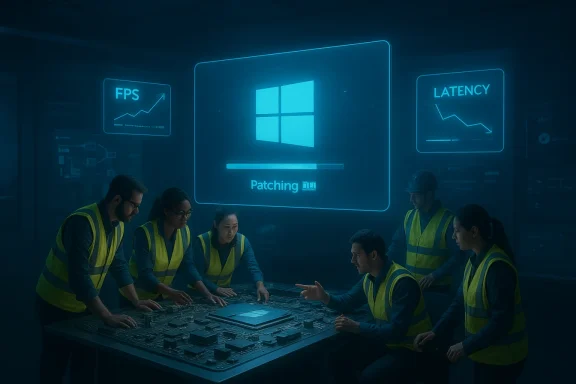 Background: how an AI-first push collided with everyday expectations
Windows 11 launched with a modernized UI and an explicit roadmap toward deeper AI integration: Copilot, Recall, and a set of agentic features designed to make Windows “helpful” in new ways. For many users that promise sounded compelling; for a growing cohort—power users, IT admins, and gamers—it felt like feature creep layered on top of a fragile foundation.The backlash crystallized in late 2025. A high‑profile social media exchange about turning Windows into an “agentic OS” produced thousands of negative replies, and Microsoft’s Windows leadership began to hear the same refrain across telemetry, Insider feedback, and forum threads: fix the basics first—performance, update reliability, and predictable behavior—before shipping more agentic features.
The turning point wasn’t just tone or annoyance. A series of high‑impact updates in January 2026 produced regressions—boot failures on some enterprise PCs, explorer.exe crashes that broke the taskbar for certain configurations, and cloud‑sync related crashes that interfered with core workflows. Those incidents prompted emergency out‑of‑band patches and created the perception that Microsoft's release pipeline had abandoned careful gating in favor of faster feature velocity.
What Microsoft has admitted — and what it really said
Pavan Davuluri, President of Windows and Devices, responded publicly: “The feedback we’re receiving from our community of passionate customers and Windows Insiders has been clear. We need to improve Windows in ways that are meaningful for people. This year, you will see us focus on addressing pain points we hear consistently from customers: improving system performance, reliability, and the overall experience of Windows.” That statement, made to The Verge’s Notepad newsletter, is the most explicit acknowledgment from Windows leadership that the platform’s priorities need to shift.Two operational shifts were reported alongside the admission:
- “Swarming”: temporarily reallocating cross‑discipline engineering teams to triage and fix the highest‑impact regressions rapidly.
- A revaluation of Copilot integrations and Recall: some in‑app Copilot buttons and recall‑style features are being paused or reworked after user backlash and privacy concerns.
How we got here: technical and organizational drivers
Several converging factors explain why an engineering organization as large as Microsoft found itself at this crossroads.- Feature velocity vs. validation overhead: shipping frequent, visible features (Copilot buttons in built‑in apps, updates to Recall) increases surface area for regressions. The harder problems—cross‑stack driver interactions, firmware differences across millions of OEM builds, anti‑cheat interactions for games—require broad testing matrices and careful gating that can conflict with speed. The January 2026 servicing sequence exposed those tensions.
- Telemetry scale and signal complexity: Microsoft operates at huge scale. That’s a strength—big telemetry helps prioritize—but aggregated telemetry can hide edge cases that matter a lot to gamers (e.g., shader compile stalls, intermittent CPU spikes). Fixing those requires deeper, workload‑specific traces and cross‑team coordination with GPU vendors and anti‑cheat providers.
- AI expansion adds new failure domains: agentic components like Recall introduce privacy and complexity trade‑offs. Recall’s original design (periodic screen snapshots for local search) triggered privacy scrutiny and forced redesigns; similar agentic ambitions amplified user anxieties about telemetry, resource usage, and implicit defaults. Those reactions fed back into the trust problem that Microsoft now aims to repair.
The gamer perspective: why this matters more than a marketing blunder
For gamers, the OS is part of the stack an invisible servant: schedule work, prioritize foreground apps, and never inject latency at the exact moments that matter—during a firefight, a speedrun, or a competitive match.But 2024–2025 delivered repeated scenarios where background services, update regressions, or poorly coordinated features impacted frame pacing, introduced CPU spikes, or caused shader compilation stalls. Those incidents aren’t theoretical—they break games in obvious, visible ways, and they erode the trust gamers place in Windows as a primary gaming platform.
The community response has been predictable and vocal:
- Many users publicly described migrating or experimenting with Linux and SteamOS, and communities of PC builders began publishing step‑by‑step migration guides and distro recommendations. Valve’s work on Proton and SteamOS has materially reduced friction for many titles, and Linux’s share in Steam’s hardware survey rose into the low‑single digits in 2025—small in absolute terms but symbolic of real momentum.
- Forum threads and comment sections are filled with posts by gamers who cite forced Copilot integrations, intrusive update prompts, and unexpected performance drops as reasons to evaluate alternatives. Those sentiments are loud enough to be a reputational risk to Microsoft’s More Personal Computing division.
The evidence: real incidents that built the narrative
A quick, non‑exhaustive list of notable incidents that fed the trust crisis:- Copilot removal bug: a March 2025 cumulative update unintentionally uninstalled the Copilot app on many devices, prompting Microsoft to issue an emergency patch and advise users to reinstall. That episode underlined how mandatory updates can interact unpredictably with new feature code paths.
- Auto‑HDR and 24H2 compatibility issues: the 24H2 rollout triggered compatibility holds for several high‑profile titles and produced visible frame‑rate and stability regressions for some GPU/hardware combinations. Game publishers and driver vendors had to coordinate emergency fixes.
- January 2026 Patch fallout: multiple out‑of‑band patches fixed boot and cloud‑sync regressions after a January servicing cycle—an optics problem that suggested a reactive cadence rather than a robust pre‑release gating process.
What Microsoft is promising to do in 2026 — and why it might work
Microsoft’s public playbook for 2026 focuses on three concrete commitments:- Prioritize Performance Fundamentals: reduce UI latency, improve file explorer and search responsiveness, and reduce the CPU/I/O influence of background services during gaming sessions. This includes “game‑session” modes that limit nonessential work and closer coordination with GPU vendors to reduce shader‑compile stalls.
- Swarm on the highest‑impact regressions: form small, cross‑functional squads (kernel, telemetry, drivers, PM) to triage and fix reproducible high‑frequency problems until they’root cause. That approach compresses time‑to‑fix compared with distributed roadmap schedules.
- Reassess Copilot and agentic UI surface area: pause low‑value Copilot buttons and reconsider Recall’s desor to make agentic features less intrusive and more privacy‑friendly. Expect clearer opt‑ins and more transparent telemetry controls.
- Microsoft has unmatched telemetry, deep engineering bench strength, and vendor relationships. If prioritized correctly, these resources can eliminate many of the most painful regressions quickly. But success depends on governance—ensuring swarming doesn’t become a stopgap while systemic test and release process failures remain unaddressed.
Community reaction and the Linux angle — hype or real migration?
The narrative that “gamers are switching to Linux en masse” is exaggerated, butal verifiable trends:- Valve’s Steam Survey and community trackers showed Linux’s share on Steam climb from roughly 2% to above 3% through 2025—real growth, driven largely by Steam Deck and Proton improvements, but still a minority of gamers. The point isn’t scale today; it’s that the friction to move is lower than it was five years ago.
- Community signals matter: posts and threads documenting individual high‑profile migrations (reviewers, streamers, and enthusiasts) amplify perceptions and provide practical migration templates. Those pipelines—dual‑boot, dedicated gaming distros, or SteamOS—have matured significantly.
- Anti‑cheat remains the limiting factor: many large multiplayer titles still rely on Windows‑native kernel features for anti‑cheat, which means Linux adoption will be incremental and title‑dependent rather than wholesale. Until anti‑cheat vendors fully enable Proton/SteamOS pathways at scale, Windows remains the practical default for many competitive titles.
Practical advice for gamers and PC builders today
If you’re a Windows gamer worried about update regressions, resource hogs, or intrusive AI features, here’s a pragmatic checklist:- Defer non‑security Feature Updates until after the immediate patch storm (wait for OOB fixes).
- Use known mitigations: enable Game Mode, ensure GPU drivers come from vendor releases (not always the default MS‑pushed driver), and apply vendor‑recommended hotfixes for shader/precompilation issues when available.
- Control Copilot and background AI: use the app settings and group policies (for Pro/Enterprise) to disable or limit Copilot and recall‑style indexing until you’re comfortable with behavior. Recent Insider toggles and policy settings make granular opt‑outs possible.
- Backup and image your system before major updates. If recovery is critical (competitive ladder play, streamed events), maintain a system image and rollback plan. Microsoft’s recovery tooling is improving, but nothing beats a verified system image.
- Consider a dual‑boot or a separate Linux machine for experimental play. If a title works under Proton and you need rock‑solid reliability for some runs, segduces risk. Proton’s coverage continues to grow, but test your pipeline first.
Risks and open questions: what could go wrong with Microsoft’s plan
- Governance and discipline: “Swarming” can fix acute issues fast, but it risks leaving long‑term structural problems (testing automation, release gating, partner certification) unaddressed if it’s treated as a one‑off emergency tactic. The hard work is process reform, not speed skating around regressions.
- Perception vs. reality: Microsoft must publish measurable progress. Short‑term patches may tamp down noise, but the community will judge success by months of stable updates and fewer emergency OOB releases—not by a single announcement.
- Anti‑cheat and ecosystem compatibility: gaming depends on many third parties; even when Microsoft fixes the OS side, publishers and anti‑cheat vendors must cooperate to prevent regressions. Coordination bottlenecks will persist without stronger partner SLAs.
- Default settings and opt‑in behavior: Microsoft can redesign Copilot and Recall to be more privacy‑forward, but defaults matter. Opt‑in (not opt‑out) defaults for agentic features will be a key trust signal.
Bottom line: a credible course correction — if actions match words
Microsoft’s acknowledgement that Windows 11 “went off track” and its pledge to prioritize reliability and performance in 2026 is a necessary and overdue pivot. The company has the engineering horsepower and ecosystem relationships to make meaningful improvements quickly—if it follows through with sustained process reform, transparent metrics, and caution about where visible AI is surfaced.For gamers, the practical takeaway is straightforward: keep your systems under control, treat major updates like operational events, and test critical workloads before relying on them for important streams or tournament play. For Microsoft, the test is harder: rebuild trust with measurable, sustained wins—not marketing, not glossy demos, but a year of quieter updates that simply leave your games alone when they need to.
The coming months will answer whether “swarming” was a temporary triage response or the start of a culture that once again prioritizes engineering discipline, predictable updates, and the humble reliability that made Windows the default for decades.
Conclusion: Microsoft has finally recognized the problem and sketched a viable path to fix it—but the window to restore trust is narrow. Gamers and system builders aren’t waiting forever; they’re testing alternatives today. If Microsoft turns its words into measurable improvements across update reliability, foreground responsiveness, and transparent AI defaults, Windows can recover. If not, the platform risk is real: a steady, persistent erosion of the “default” position that Windows has held in PC gaming for a generation.
Source: happygamer.com Microsoft Admits Windows 11 Went ‘Off Track,’ Gamers Are Already Moving On | Happy Gamer
