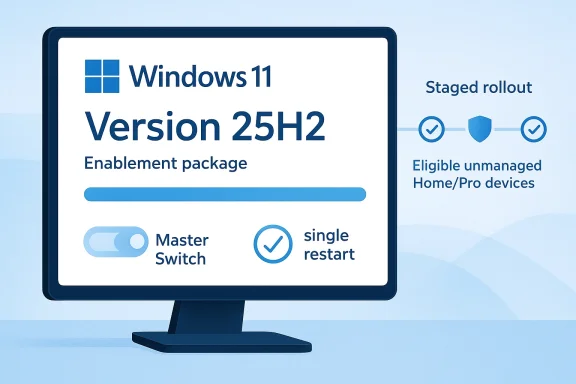
Microsoft’s latest Windows 11 servicing push is less about a dramatic new feature release and more about the company tightening the screws on how upgrades are delivered. The move to steer eligible Windows 11 24H2 Home and Pro systems toward 25H2 is being framed as a smarter, more automated experience, but it also signals something bigger: Microsoft wants fewer stranded PCs, fewer version splits, and less fragmentation in the consumer base. At the same time, the company is asking users to trust an “intelligent” update system without giving much detail about how that intelligence works.
The most important thing to understand is that 25H2 is not being treated like a traditional major refresh for most 24H2 devices. Microsoft’s support documentation says that devices already on Windows 11 Home and Pro, version 24H2 can receive the 25H2 feature update automatically through Windows Update, while managed machines are excluded from that automatic consumer-style rollout. That matters because it shows the company is using different update logic for home users, small-office PCs, and enterprise fleets.
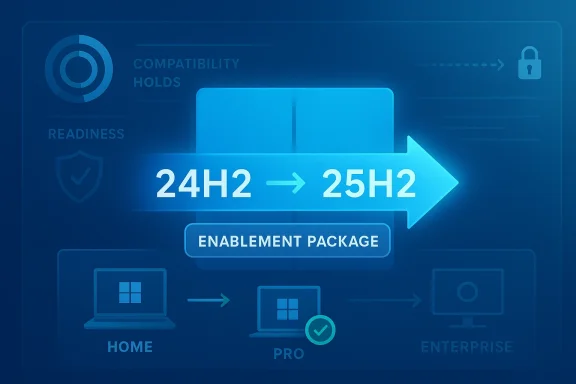
This also fits the modern Windows servicing model, where Microsoft increasingly ships new versions as an enablement package rather than a full operating-system reinstall. In practical terms, the jump from 24H2 to 25H2 is designed to be relatively lightweight, with the update more like a switch being flipped on top of the existing codebase. Microsoft’s own 25H2 support materials say devices on 24H2 that receive updates directly from Windows Update or WSUS can automatically obtain the enablement package and move to 25H2.
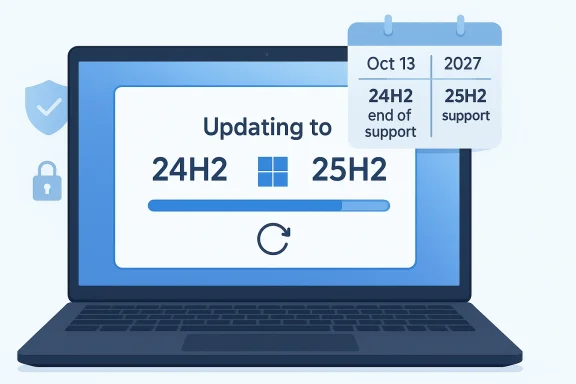
The timing is not accidental. Microsoft’s lifecycle guidance lists October 13, 2026 as the end of support date for Windows 11 Home and Pro, version 24H2, which means the company has a clear incentive to accelerate migrations before that window closes. That gives users almost no reason to stay on an older feature release if the upgrade is broadly compatible and the servicing process is relatively painless.
Yet the language around “intelligent” delivery raises a fair question: intelligent according to what? Microsoft has not publicly disclosed the exact signals used by its machine-learning gating system, and that lack of transparency is likely to irritate users who prefer deterministic control over their operating systems. The company says it can hold back updates if it detects compatibility problems, which is sensible, but the absence of clear criteria leaves room for uncertainty.
The 24H2-to-25H2 transition is especially notable because Microsoft has already positioned 25H2 as a relatively efficient upgrade path for eligible systems. The enablement-package approach means the underlying platform work has largely already been delivered through prior servicing, with 25H2 acting as the activation layer. That reduces install time and lowers the operational cost of adopting the newer version, which is exactly the kind of change Microsoft wants to normalize.
Historically, Windows feature updates were more disruptive. They often looked and felt like complete operating-system swaps, with longer install times, more reboot cycles, and higher odds of breakage. Microsoft’s current approach is meant to make those transitions almost invisible, at least on supported hardware. That is good engineering from a servicing standpoint, but it also means users see fewer visible milestones and less obvious control points.
There is also a strategic reason behind the push. Microsoft has made repeated claims in recent Windows cycles that newer versions deliver better reliability, stronger security posture, and a more consistent baseline for support. A tighter update funnel helps the company limit the number of in-market configurations it must maintain, test, and defend. Fewer versions in the wild means fewer edge cases in the long run, even if the transition period feels forceful.
That model has clear advantages. It cuts install time, lowers the chance of a lengthy outage, and makes it easier for Microsoft to align consumer systems on one predictable release cadence. It also reduces the anxiety many people associate with “big Windows upgrades,” which have traditionally carried the risk of compatibility issues, driver conflicts, or forced reconfiguration.
At the same time, the lighter upgrade path can make Microsoft’s push feel more invasive precisely because it is easier to do. When an update is fast and quiet, users have fewer obvious points at which to intervene. The company can frame the process as frictionless progress, while users may experience it as a gradual erosion of choice.
What Microsoft is likely doing, based on the way modern Windows deployment already works, is combining compatibility telemetry with staged rollout logic and safeguard holds. The company has said that if it detects a problem such as an application or driver incompatibility, it may withhold the update until the issue is resolved. That is a sensible safeguard, but it also means readiness is not a simple yes-or-no state from the user’s perspective.
The criticism is not that Microsoft uses automation. The criticism is that automation without explanation can feel arbitrary, especially when it affects core system behavior. For technically minded users, “the machine learning system decided” may sound less like reassurance and more like a black box. Transparency would not eliminate every concern, but it would go a long way toward making forced updates feel more predictable.
That distinction is important because Windows users are not all the same. Casual home users may prefer the system to handle everything automatically, while power users often want to stage updates around work, travel, or troubleshooting windows. Microsoft’s current model favors the first group and tolerates the second, but it does not really satisfy the second group.
The manual path still exists, of course. Users can go into Settings > Windows Update and check for updates themselves if they want to accelerate the process, provided the machine is eligible. That means Microsoft is not fully removing agency; it is merely narrowing the window in which agency can matter.
That said, the enterprise experience is not isolated from the consumer one. A broader 25H2 adoption wave still influences security baselines, application testing, and support expectations. Even when organizations are excluded from automatic consumer rollouts, the pace of the overall Windows ecosystem shifts around them.
The practical reality is that enterprises usually prefer predictability over novelty. Microsoft’s approach to consumer forced updates helps the company reduce fragmentation, but it also gives IT departments a sharper contrast between managed and unmanaged Windows behavior. That contrast is useful: it lets organizations see clearly why their own controls matter.
This matters because it reminds users that even Microsoft’s own update machinery is not immune to breakage. When the company talks about readiness, machine learning, and intelligent rollout, it is also implicitly acknowledging how fragile update ecosystems can be at scale. A failed preview patch can turn a servicing story into a trust story very quickly.
The good news is that Microsoft responded with a corrective release and made clear that the out-of-band update contains the earlier improvements plus the fix for affected systems. That is exactly how modern Windows servicing is supposed to work: identify the problem, pull the bad update, and replace it with a coherent corrected package. Still, these incidents reinforce why some users remain wary of forced updates in the first place.
The lifecycle angle is even more important. Microsoft’s stated end-of-support date for 24H2 means that a lagging consumer installed base eventually becomes a support burden and a security liability. By nudging devices to 25H2 now, Microsoft is trying to avoid the last-minute cliff where millions of PCs all need to move at once.
There is also a broader platform strategy at work. Microsoft wants Windows to be seen as a secure, continuously updated service, not a patchwork of version islands. That helps with Defender integration, compliance posture, and the company’s wider pitch to consumers and businesses alike. But the more successful that strategy becomes, the less room users have to opt into a slower, more independent model.
At the same time, this strategy helps Microsoft differentiate Windows from more manually curated software environments. The company can promise that devices will remain current without requiring users to track versions, compare packages, or hunt for updates. That is attractive in a market where many buyers simply want their computers to stay out of the way.
But there is a flip side. When updates become increasingly opaque, Microsoft risks alienating the enthusiasts, power users, and IT professionals who influence broader Windows opinion. Those users often become the informal support network for family, friends, and colleagues, which means dissatisfaction can spread well beyond the direct audience.
The larger question is whether Microsoft can pair that automation with enough transparency to keep advanced users onside. People do not necessarily object to smart update systems; they object to feeling managed by something they cannot inspect. If Microsoft wants “intelligent” updates to be seen as a benefit rather than a black box, it will need to explain more clearly what the system is optimizing for and when users still get a meaningful say.
Source: Tom's Hardware Microsoft to force updates to Windows 11 25H2 for PCs with older OS versions — 'intelligent' update system uses machine learning to determine when a device is ready
 Overview
The most important thing to understand is that 25H2 is not being treated like a traditional major refresh for most 24H2 devices. Microsoft’s support documentation says that devices already on Windows 11 Home and Pro, version 24H2 can receive the 25H2 feature update automatically through Windows Update, while managed machines are excluded from that automatic consumer-style rollout. That matters because it shows the company is using different update logic for home users, small-office PCs, and enterprise fleets.This also fits the modern Windows servicing model, where Microsoft increasingly ships new versions as an enablement package rather than a full operating-system reinstall. In practical terms, the jump from 24H2 to 25H2 is designed to be relatively lightweight, with the update more like a switch being flipped on top of the existing codebase. Microsoft’s own 25H2 support materials say devices on 24H2 that receive updates directly from Windows Update or WSUS can automatically obtain the enablement package and move to 25H2.
The timing is not accidental. Microsoft’s lifecycle guidance lists October 13, 2026 as the end of support date for Windows 11 Home and Pro, version 24H2, which means the company has a clear incentive to accelerate migrations before that window closes. That gives users almost no reason to stay on an older feature release if the upgrade is broadly compatible and the servicing process is relatively painless.
Yet the language around “intelligent” delivery raises a fair question: intelligent according to what? Microsoft has not publicly disclosed the exact signals used by its machine-learning gating system, and that lack of transparency is likely to irritate users who prefer deterministic control over their operating systems. The company says it can hold back updates if it detects compatibility problems, which is sensible, but the absence of clear criteria leaves room for uncertainty.
Why this matters now
The update strategy comes at a time when Windows servicing has become more aggressive, more automated, and more tightly integrated with telemetry-driven decision-making. Consumers increasingly experience Windows as a managed service rather than a static product, and Microsoft is clearly comfortable making update choices on their behalf. That may reduce friction for the average user, but it also reinforces a long-running tension between convenience and control.- Home and Pro users get the most automatic treatment.
- Managed devices are deliberately excluded for now.
- Compatibility holds still remain part of the process.
- Support deadlines are being used as a migration pressure point.
Background
Windows versioning used to be relatively easy to explain: install a new release, live with it until the next one arrives. Over time, Microsoft shifted to continuous servicing, staged rollout mechanisms, and update rings that decide who gets what and when. That model is now standard across Windows 11, and 25H2 is another example of Microsoft trying to make upgrades more routine and less dramatic.The 24H2-to-25H2 transition is especially notable because Microsoft has already positioned 25H2 as a relatively efficient upgrade path for eligible systems. The enablement-package approach means the underlying platform work has largely already been delivered through prior servicing, with 25H2 acting as the activation layer. That reduces install time and lowers the operational cost of adopting the newer version, which is exactly the kind of change Microsoft wants to normalize.
Historically, Windows feature updates were more disruptive. They often looked and felt like complete operating-system swaps, with longer install times, more reboot cycles, and higher odds of breakage. Microsoft’s current approach is meant to make those transitions almost invisible, at least on supported hardware. That is good engineering from a servicing standpoint, but it also means users see fewer visible milestones and less obvious control points.
There is also a strategic reason behind the push. Microsoft has made repeated claims in recent Windows cycles that newer versions deliver better reliability, stronger security posture, and a more consistent baseline for support. A tighter update funnel helps the company limit the number of in-market configurations it must maintain, test, and defend. Fewer versions in the wild means fewer edge cases in the long run, even if the transition period feels forceful.
The support clock
The lifecycle entry for Windows 11 Home and Pro version 24H2 is especially important because support deadlines shape upgrade behavior more effectively than marketing ever could. Microsoft does not need to persuade everyone with feature checklists when the expiration date is already on the calendar. Once support ends, staying put becomes a security and compliance liability rather than a preference.- Support deadlines influence enterprise planning.
- Consumer systems are nudged more than they are asked.
- Newer versions become the safest default.
- Upgrade friction is being engineered downward.
The 25H2 Servicing Model
The strongest signal in Microsoft’s documentation is that 25H2 is being delivered as an evolution of the 24H2 servicing baseline, not as a disruptive redo. On devices receiving updates directly from Windows Update, the enablement package can be applied automatically, which makes the transition feel closer to a quality update than a classic feature upgrade. That is a fundamental change in how Windows feature releases behave.That model has clear advantages. It cuts install time, lowers the chance of a lengthy outage, and makes it easier for Microsoft to align consumer systems on one predictable release cadence. It also reduces the anxiety many people associate with “big Windows upgrades,” which have traditionally carried the risk of compatibility issues, driver conflicts, or forced reconfiguration.
At the same time, the lighter upgrade path can make Microsoft’s push feel more invasive precisely because it is easier to do. When an update is fast and quiet, users have fewer obvious points at which to intervene. The company can frame the process as frictionless progress, while users may experience it as a gradual erosion of choice.
Enablement versus full install
The distinction matters technically. An enablement package activates features already sitting in the codebase, while a full OS upgrade typically replaces a much larger portion of the system image. Microsoft’s approach is designed to reduce risk and speed adoption, but it also creates a sense that major version transitions are increasingly administrative rather than transformative. That may be efficient, but it is not always satisfying for users who expect more visible control over when their PC changes.- Smaller update payloads mean less downtime.
- Version jumps become less disruptive.
- Compatibility is managed earlier in the cycle.
- The OS feels more like a service than a release.
The “Intelligent” Rollout
Microsoft’s “intelligent” update language is doing a lot of work here. The company says machine learning helps determine when a device is ready for the update, but it has not provided granular details about the criteria. That omission matters because update readiness is not a trivial concept; it can encompass drivers, hardware configuration, prior update history, telemetry, and known issue signals.What Microsoft is likely doing, based on the way modern Windows deployment already works, is combining compatibility telemetry with staged rollout logic and safeguard holds. The company has said that if it detects a problem such as an application or driver incompatibility, it may withhold the update until the issue is resolved. That is a sensible safeguard, but it also means readiness is not a simple yes-or-no state from the user’s perspective.
The criticism is not that Microsoft uses automation. The criticism is that automation without explanation can feel arbitrary, especially when it affects core system behavior. For technically minded users, “the machine learning system decided” may sound less like reassurance and more like a black box. Transparency would not eliminate every concern, but it would go a long way toward making forced updates feel more predictable.
What “ready” probably means
Microsoft has not published the model, features, or thresholds behind this decision-making, so any interpretation has to remain cautious. Still, the update system likely weighs multiple risk factors before offering 25H2 automatically. Inference is unavoidable here, but it is reasonable to assume the process is designed to minimize failures and support calls.- Hardware and driver compatibility likely matter.
- Known problematic apps may trigger holds.
- Recent update behavior may influence eligibility.
- Telemetry probably helps identify safer cohorts first.
Forced Updates and User Control
The most controversial part of the rollout is not that it exists, but that it is forced for eligible consumer PCs. Microsoft says users can delay installation for a time, but they cannot fully opt out if the device is in scope. For many people that will be acceptable, even welcome; for others, it is another reminder that Windows is increasingly managed from above rather than chosen from below.That distinction is important because Windows users are not all the same. Casual home users may prefer the system to handle everything automatically, while power users often want to stage updates around work, travel, or troubleshooting windows. Microsoft’s current model favors the first group and tolerates the second, but it does not really satisfy the second group.
The manual path still exists, of course. Users can go into Settings > Windows Update and check for updates themselves if they want to accelerate the process, provided the machine is eligible. That means Microsoft is not fully removing agency; it is merely narrowing the window in which agency can matter.
Consumer choice versus platform discipline
This is where Microsoft’s philosophy becomes clearer. The company increasingly behaves as if the healthiest Windows ecosystem is one in which most consumer PCs converge on a common baseline quickly. That simplifies support, improves security consistency, and reduces fragmentation, but it also centralizes power over the pace of change.- Users can postpone, but not permanently refuse.
- Manual install remains an option for the impatient.
- The default path is automatic, not negotiated.
- Microsoft prioritizes platform hygiene over individual preference.
Enterprise Exclusions and IT Reality
The rollout reportedly excludes managed devices, which makes sense because organizations need policy control, pilot rings, compliance checks, and change management. Enterprises do not want consumer-style forced updates because they operate on scheduling, application certification, and business risk. Microsoft knows that, which is why it leaves room for IT administrators to manage upgrades using their own tools and timelines.That said, the enterprise experience is not isolated from the consumer one. A broader 25H2 adoption wave still influences security baselines, application testing, and support expectations. Even when organizations are excluded from automatic consumer rollouts, the pace of the overall Windows ecosystem shifts around them.
The practical reality is that enterprises usually prefer predictability over novelty. Microsoft’s approach to consumer forced updates helps the company reduce fragmentation, but it also gives IT departments a sharper contrast between managed and unmanaged Windows behavior. That contrast is useful: it lets organizations see clearly why their own controls matter.
Why exclusion matters
The exclusion is not a loophole; it is a design choice. Microsoft seems to understand that business devices are not just personal computers with more policy settings. They are part of operational systems that have to survive audits, line-of-business app dependencies, and recovery planning.- Managed systems need deployment rings.
- Admins need deferral and validation.
- Business continuity outweighs speed.
- Standardization still matters, but on enterprise terms.
The KB5079391 and KB5086672 Episode
The rollout story is arriving against the backdrop of Microsoft’s recent update hiccup involving KB5079391 and the follow-up KB5086672. Microsoft’s support page says the March 26, 2026 preview update for Windows 11 25H2 and 24H2 ran into installation trouble on some systems, with error 0x80073712 indicating missing or problematic update files. Microsoft later released an out-of-band update to fix the issue and restore the intended improvements.This matters because it reminds users that even Microsoft’s own update machinery is not immune to breakage. When the company talks about readiness, machine learning, and intelligent rollout, it is also implicitly acknowledging how fragile update ecosystems can be at scale. A failed preview patch can turn a servicing story into a trust story very quickly.
The good news is that Microsoft responded with a corrective release and made clear that the out-of-band update contains the earlier improvements plus the fix for affected systems. That is exactly how modern Windows servicing is supposed to work: identify the problem, pull the bad update, and replace it with a coherent corrected package. Still, these incidents reinforce why some users remain wary of forced updates in the first place.
Why this episode is relevant
The timing of the patch failure may not be directly related to the 25H2 forced rollout, but the association is hard to ignore. Users are being told to trust an ever-more-automated update system at the same moment Microsoft is cleaning up a broken one. That is not fatal to the company’s case, but it does complicate the messaging.- Update trust is built through consistency.
- Patch failures undermine confidence fast.
- Correction speed matters almost as much as prevention.
- Users remember the last bad install.
Security and Lifecycle Implications
From a security standpoint, Microsoft’s policy has obvious logic. Keeping more Home and Pro PCs on the newest supported build reduces exposure to known weaknesses, simplifies mitigation, and narrows the universe of systems that need urgent attention. A forced or strongly guided transition is often more effective than hoping users update on their own.The lifecycle angle is even more important. Microsoft’s stated end-of-support date for 24H2 means that a lagging consumer installed base eventually becomes a support burden and a security liability. By nudging devices to 25H2 now, Microsoft is trying to avoid the last-minute cliff where millions of PCs all need to move at once.
There is also a broader platform strategy at work. Microsoft wants Windows to be seen as a secure, continuously updated service, not a patchwork of version islands. That helps with Defender integration, compliance posture, and the company’s wider pitch to consumers and businesses alike. But the more successful that strategy becomes, the less room users have to opt into a slower, more independent model.
Security versus autonomy
This tradeoff is not unique to Microsoft, but Windows makes it especially visible because the desktop still carries legacy expectations of ownership. Users often feel they should be able to say when and how their OS changes, even if the security case for automatic updates is strong. Microsoft is betting that most people will accept less autonomy in exchange for lower maintenance overhead.- Security benefits from rapid adoption.
- Old versions become harder to justify.
- Automatic rollout reduces exposure windows.
- Autonomy becomes secondary to baseline protection.
Market and Competitive Impact
Microsoft’s update posture also has competitive implications, even if the headlines focus on Windows alone. The more seamless Microsoft can make update transitions, the stronger its case that Windows remains the safest and least annoying choice for the mainstream PC market. Competitors in the broader computing ecosystem—whether that is alternative desktop platforms or cloud-managed endpoints—benefit when Microsoft’s own process looks clumsy.At the same time, this strategy helps Microsoft differentiate Windows from more manually curated software environments. The company can promise that devices will remain current without requiring users to track versions, compare packages, or hunt for updates. That is attractive in a market where many buyers simply want their computers to stay out of the way.
But there is a flip side. When updates become increasingly opaque, Microsoft risks alienating the enthusiasts, power users, and IT professionals who influence broader Windows opinion. Those users often become the informal support network for family, friends, and colleagues, which means dissatisfaction can spread well beyond the direct audience.
What rivals can learn
Even if rivals do not copy Microsoft’s exact approach, they can learn from its strengths and missteps. Better update automation is not just a Microsoft problem; it is a platform trust problem across the industry. The winners will be the vendors that combine reliability, transparency, and meaningful user control.- Seamless servicing is now table stakes.
- Transparency matters as much as automation.
- Power users still shape reputation.
- Update failures become marketing opportunities for rivals.
Strengths and Opportunities
Microsoft’s approach has real merit, and it is easy to see why the company wants to lean harder into automated rollouts. If the process works as intended, consumers get safer devices faster, administrators spend less time chasing stragglers, and the overall Windows ecosystem becomes more consistent. That is a meaningful operational gain, even if it comes with philosophical baggage.- Faster protection against unpatched vulnerabilities.
- Less version fragmentation across the consumer base.
- Shorter installation windows for upgrade transitions.
- Better baseline consistency for app developers.
- Lower support burden for Microsoft and OEMs.
- More predictable lifecycle management before 24H2 retirement.
- Reduced user effort for ordinary home PC owners.
Risks and Concerns
The downsides are just as real, and some are structural rather than temporary. Automatic update systems depend on trust, and trust can be damaged quickly when users feel they are being pushed into changes they did not ask for or cannot fully understand. The recent patch issues around KB5079391 only sharpen that concern.- Opaque machine-learning criteria can feel arbitrary.
- Forced rollout limits user control on consumer PCs.
- Compatibility mistakes can spread faster when automation is aggressive.
- Poor communication can amplify backlash around update policy.
- Update fatigue may push some users to postpone too long.
- Broken patches can undermine faith in the whole servicing model.
- Managed and unmanaged gaps may create confusion about who is in control.
Looking Ahead
Microsoft will likely continue refining its update gates, especially if 25H2 proves to be broadly stable on eligible 24H2 systems. The company has every incentive to make the transition feel routine, because the less dramatic it appears, the easier it is to justify more automation later. If the rollout goes smoothly, expect Microsoft to treat this as validation of a model that combines telemetry, machine learning, and staged deployment into a single delivery pipeline.The larger question is whether Microsoft can pair that automation with enough transparency to keep advanced users onside. People do not necessarily object to smart update systems; they object to feeling managed by something they cannot inspect. If Microsoft wants “intelligent” updates to be seen as a benefit rather than a black box, it will need to explain more clearly what the system is optimizing for and when users still get a meaningful say.
- Watch for broader adoption of 25H2 on eligible Home and Pro PCs.
- Monitor whether Microsoft publishes more detail about readiness signals.
- Track future safeguard holds for hardware and driver problems.
- Pay attention to whether enterprises adopt related servicing guidance.
- Observe whether update failures prompt any policy softening.
Source: Tom's Hardware Microsoft to force updates to Windows 11 25H2 for PCs with older OS versions — 'intelligent' update system uses machine learning to determine when a device is ready
Last edited: