

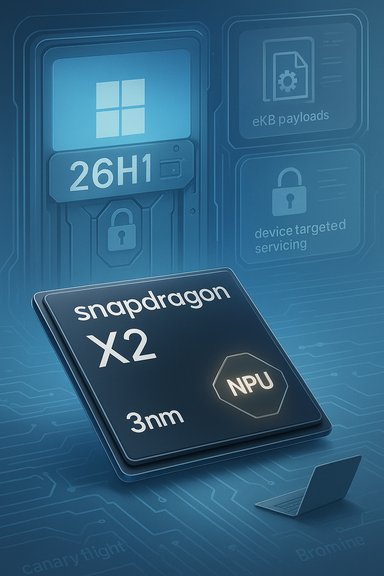
Microsoft’s update cadence for Windows 11 may be quietly shifting again: a Known Issue Rollback (KIR) connected to the October 2025 Windows 10 cumulative update has surfaced internal metadata that appears to reference a Windows 11 build labeled “version 26H1”, and community reporting links that trace to Qualcomm’s upcoming Snapdragon X2 family and a codename in Microsoft’s internal flight branches.
Microsoft moved Windows 11 from a semiannual feature-update cadence to a single major H2 release with continuous servicing, enabling feature binaries to be staged and selectively activated by tiny enablement packages (eKBs) or device-targeted servicing. That architecture makes it straightforward for Microsoft to ship platform-specific images for new hardware while keeping the broader install base on the usual annual H2 cycle. Community and industry signals now suggest the company may use that same pattern again in 2026: a small, device-targeted Windows 11 release labeled in leak reports as 26H1 would arrive in early 2026 for new Windows on Arm machines, while the mainstream 26H2 rollout would still ship in fall 2026. This story hinges on three interlocking threads:
This approach can accelerate real, on‑device AI experiences for capable hardware while protecting the broader Windows install base from early regressions. The tradeoffs are operational complexity and the risk of confusion; both are manageable if Microsoft and OEMs coordinate clear labeling, servicing metadata, and enterprise guidance.
Until Microsoft issues public guidance, readers should treat 26H1 as a likely engineering branch and not a consumer‑visible commitment. Validate any device purchase decisions against OEM documentation, plan pilots if deploying X2 hardware in production, and expect an active period of firmware, driver, and servicing updates through early 2026.
This update illustrates how modern OS servicing models let platform owners precisely control where and when features land—an advantage for complex hardware-driven AI features, and a new coordination challenge for administrators, OEMs and consumers alike.
Source: Windows Report Windows 11 Version 26H1 Quietly Makes Its First Appearance
 Background / Overview
Microsoft moved Windows 11 from a semiannual feature-update cadence to a single major H2 release with continuous servicing, enabling feature binaries to be staged and selectively activated by tiny enablement packages (eKBs) or device-targeted servicing. That architecture makes it straightforward for Microsoft to ship platform-specific images for new hardware while keeping the broader install base on the usual annual H2 cycle. Community and industry signals now suggest the company may use that same pattern again in 2026: a small, device-targeted Windows 11 release labeled in leak reports as 26H1 would arrive in early 2026 for new Windows on Arm machines, while the mainstream 26H2 rollout would still ship in fall 2026. This story hinges on three interlocking threads:- Microsoft’s October 2025 cumulative update for Windows 10 (KB5066791) and its published Known Issue Rollback entries.
- Community captures and reporting showing an internal string that reads like SUPPORTED_Windows_11_0_26H1_Only inside a KIR/MSI artifact tied to KB5066791.
- Qualcomm’s public Snapdragon X2 family announcement—and leak/press coverage that places X2-equipped devices in early 2026—giving Microsoft a plausible hardware window for a device-gated release.
What the KIR evidence actually shows
The KB and the internal tag
Microsoft’s KB article for the October 14, 2025 Windows 10 cumulative update, KB5066791, documents the end-of-support messaging changes and an associated Windows 10 settings UI bug; Microsoft also issued a KIR (Known Issue Rollback) artifact to remediate a mis‑displayed End-of-Support banner on some Windows 10 SKUs. Community observers noticed that a KIR or its MSI payload contains a machine‑readable targeting token that appears to refer to a Windows 11 branch named “26H1.” That internal string—reported as something like SUPPORTED_Windows_11_0_26H1_Only—was first flagged on community sites and picked up by specialist outlets reporting on firmware/servicing artifacts.How to read that artifact responsibly
- The presence of a version token in update machinery is a technical breadcrumb, not an official PR statement. Microsoft uses internal tags for many purposes—test branches, device-targeted servicing, and rollout controls—so the existence of a tag can indicate a planned branch without confirming public naming or distribution details.
- Historically Microsoft has staged binaries and later flipped enablement packages to reveal features; shipping a narrow, device‑validated image while holding broader enablement until the H2 release is logically consistent with previous Copilot+ rollouts.
Why Qualcomm’s Snapdragon X2 matters to the 26H1 hypothesis
Technical drivers for an interim, device-specific release
Qualcomm announced the Snapdragon X2 family at its 2025 Snapdragon Summit to target premium Windows on Arm laptops and mini‑PCs. The new X2 lineup brings:- a 3nm process node on flagship parts,
- multi‑GHz Oryon CPU cores with boost frequencies up to 5.0 GHz on top-tier bins,
- dramatically larger Hexagon NPUs marketed at around 80 TOPS for INT8 workloads, and
- updated Adreno GPUs, higher memory bandwidth and new I/O (Wi‑Fi 7, optional 5G).
The codename—“Bromine”—and flight metadata
Community trackers and flight‑history wikis have been cataloguing insider build lab names; the “br_release” lab and associated build numbers (sometimes labeled Bromine) have appeared in Canary/Beta channel metadata, and community wikis list Bromine as the working name for a 26H1 engineering milestone. That matches the naming pattern Microsoft has used previously (elemental and chemistry-inspired code names in internal branches). While wikis and forum logs are not formal announcements, the convergence of br_release labels across multiple flight manifests strengthens the inference that Microsoft engineers are working in a 26H1/Bromine branch.What 26H1 would likely contain (technical breakdown)
If Microsoft is preparing a narrow, device-targeted Windows 11 26H1 image for Snapdragon X2 devices, engineering work points toward a platform-focused, not feature-bloated, release. Expect the following components:- Device and vendor driver bundles tuned for X2 thermal/power profiles (GPU, NPU, wireless, storage).
- Hexagon NPU runtimes, signed model manifests and attestation hooks for safe on‑device model execution (local Copilot+ experiences).
- Emulation and compatibility patches for Windows on Arm (x64/x86 translation improvements, anticheat and AV support updates).
- Servicing metadata to allow fine-grained KIR/eKB targeting—i.e., a small enablement package to flip user features later for qualified devices or the broader fleet.
Strengths of Microsoft’s potential approach
- Controlled validation: Shipping a validated vendor image with the device reduces regressions at retail and helps OEMs tune drivers and firmware before mass exposure. This reduces costly support incidents across millions of software configurations.
- Privacy-first on-device AI: Early exposure on NPU‑rich hardware lets Microsoft test local model execution and attestation mechanics at scale with hardware that can meet latency and local-processing claims—helpful for privacy guarantees.
- Ecosystem momentum: Coordinating OS image, firmware and driver updates with OEMs and Qualcomm can accelerate software optimization and give Windows on Arm a stronger “Copilot+” story—critical for competing with x86 incumbents and Apple’s silicon.
Risks, user confusion and operational downsides
- Naming and fragmentation confusion: If Microsoft surfaces a “26H1” label publicly while the release is actually device-targeted, consumers and IT teams may misinterpret availability expectations. Headlines referencing a new Windows version will raise questions about upgrade eligibility and timing. The optics matter.
- Early‑ship driver and firmware issues: First-generation device images commonly reveal corner-case regressions (fingerprint readers, docking, anticheat), imposing troubleshooting burdens on OEMs and early adopters. This was visible in prior Copilot+ hardware rollouts.
- Enterprise update complexity: IT administrators depend on predictable update naming and cataloging. A small, targeted 26H1 image complicates WSUS/MDM reporting and patch-tabling unless Microsoft provides clear SKU/target metadata and communication.
- Perception of preferential treatment: Power users and enthusiasts may view device-first rollouts as a two‑tier experience—those who buy new hardware get features earlier, others wait. That is defensible technically, but messaging must be crisp to avoid community backlash.
Practical guidance: what users and IT teams should do now
For consumers and early adopters
- Confirm the OS image on any pre‑release X2 laptop before purchase: check whether the vendor ships a device image with features pre‑enabled or whether those features are gated behind an eKB.
- If your priority is rock‑solid stability, prefer to wait for the broader 26H2 rollout or until the ecosystem has a few weeks of field telemetry.
- If you buy an X2 machine for early AI features, expect frequent firmware/driver updates in the first months and plan for time‑consuming updates/pilot testing.
For IT admins and enterprise teams
- Treat any 26H1‑style release as a vendor‑specific image, not a fleet‑wide feature update. Use a pilot ring for X2 devices and validate security/endpoint agents before broad deployment.
- Coordinate with OEM partners about driver packaging, WHQL/partner testing, and MDM asset mapping—ensure devices report a distinct SKU so WSUS/Intune inventories can distinguish images.
- Update deployment playbooks to include testing of on‑device AI features, data flow (NPU vs cloud), and privacy-attestation logs. Verify vendor-provided attestation and key‑provisioning flows.
Messaging: why Microsoft’s communications will be decisive
Precise, early communication from Microsoft (and OEM partners) will determine whether a device-first 26H1 is perceived as an engineering necessity or a confusing sidestep. If Microsoft keeps to the enablement‑package model and describes 26H1 as a platform image for X2 hardware—while emphasizing that consumer-facing features will arrive broadly in 26H2—it can avoid large-scale confusion. Conversely, muddled naming or inconsistent documentation of which devices are targeted will produce help‑desk load spikes and enterprise pushback. The KIR artifact’s discovery demonstrates internal readiness work; to reduce friction Microsoft will need to publish clear guidance when (or if) it chooses to expose the build name and distribution mechanics publicly.How plausible is this timeline — and what could derail it?
- Plausibility: High. Qualcomm’s roadmap and vendor coverage place X2 devices in early 2026, and Microsoft has precedent for gating hardware‑dependent features to Copilot+ devices first. Multiple independent press outlets reported Snapdragon X2 specs and an early‑2026 device window, which aligns with the servicing metadata spotted in KB artifacts.
- Potential derails:
- OEM integration delays (firmware, signed images) could push device availability and force Microsoft to absorb more platform work into 26H2 instead.
- Unresolved driver regressions during early hardware validation could lead Microsoft to change plans and refrain from shipping a distinct 26H1 image.
- Messaging misalignment across Microsoft, OEMs and retailers could force a delay while communication templates are fixed.
Bottom line — what this means for the Windows ecosystem
The emergence of a 26H1 tag inside servicing artifacts is an important operational signal: Microsoft is actively working on a device‑targeted branch that appears engineered to support Qualcomm’s Snapdragon X2-based Copilot+ hardware. That engineering path makes sense given the scale of change in X2’s NPU and SoC characteristics, and it follows Microsoft’s playbook of staging hardware‑gated features first on certified devices before a broad release.This approach can accelerate real, on‑device AI experiences for capable hardware while protecting the broader Windows install base from early regressions. The tradeoffs are operational complexity and the risk of confusion; both are manageable if Microsoft and OEMs coordinate clear labeling, servicing metadata, and enterprise guidance.
Until Microsoft issues public guidance, readers should treat 26H1 as a likely engineering branch and not a consumer‑visible commitment. Validate any device purchase decisions against OEM documentation, plan pilots if deploying X2 hardware in production, and expect an active period of firmware, driver, and servicing updates through early 2026.
This update illustrates how modern OS servicing models let platform owners precisely control where and when features land—an advantage for complex hardware-driven AI features, and a new coordination challenge for administrators, OEMs and consumers alike.
Source: Windows Report Windows 11 Version 26H1 Quietly Makes Its First Appearance
