

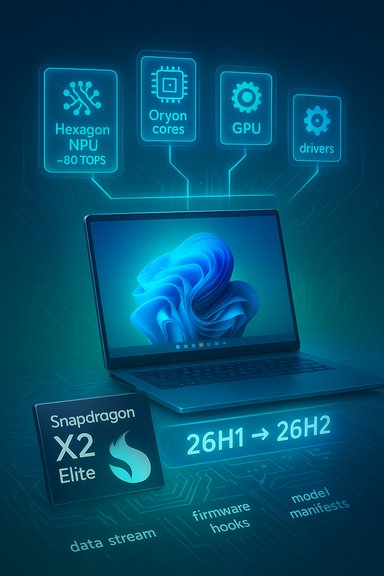
Windows 11 looks set to receive a device-targeted, interim update early next year tied to Qualcomm’s new Snapdragon X2 family — a release that may arrive first on Copilot+ Arm laptops and not on the wider Windows 11 install base. The reported plan: a narrow, hardware‑gated release (referred to in leaks as “26H1” for shorthand) timed to ship with Snapdragon X2 Elite systems so key platform work — drivers, NPU runtimes, firmware hooks and tuned binaries — can arrive with retail devices, while the consumer-facing features will be rolled out broadly later in the year as part of the regular 26H2 release cycle.
Microsoft’s release and servicing model shifted after Windows 11’s debut to a single annual feature update with continuous servicing, paired with targeted feature rollouts. That model gives Microsoft the flexibility to stage heavier, hardware‑dependent features to qualifying devices first — particularly Copilot+ PCs with NPUs capable of local AI inference — while the broader install base receives the same features later through the annual H2 release or enablement packages. The same strategy was visible when Copilot+ hardware quietly received Windows 11 version 24H2 ahead of general availability, a precedent that explains this current approach.
Qualcomm’s Snapdragon X2 Elite family is the likely trigger. The X2 platform escalates performance and on‑device AI muscle — third‑generation Oryon cores, large Hexagon NPUs rated around 80 TOPS, and significant GPU and memory bandwidth improvements — and Qualcomm and industry outlets project first X2 systems will appear in the first half of 2026. Those new silicon characteristics aren’t just faster hardware; they introduce new drivers, runtime dependencies and platform integrations that often require coordinated OS-level support to be safe and performant.
At the same time, the industry must manage perception and execution tightly. Microsoft and OEMs need careful messaging to avoid confusion over naming and availability, developers must accelerate Arm‑native support, and enterprises must treat early X2 images as pilots rather than fleet upgrades. For most Windows 11 users, the practical outcome is this: you’ll probably get the same features eventually, but if you want the earliest on‑device AI and are comfortable with early adopter tradeoffs, an X2 Copilot+ laptop will be the quickest path to those experiences.
Windows’ next big upgrade may arrive in two parts next year: an engineered, device‑specific platform build to match new Arm silicon, and the annual broad release that brings the work to the wider Windows 11 population. The rumor is technically coherent and matches Qualcomm’s X2 rollout timeline, but it remains a rumor until Microsoft or an OEM confirms details — watch official blogs and OEM announcements for the authoritative word.
Source: TechRadar https://www.techradar.com/computing...te-early-in-2026-but-most-people-wont-get-it/
 Background: why Microsoft might ship a device‑specific Windows 11 release
Microsoft’s release and servicing model shifted after Windows 11’s debut to a single annual feature update with continuous servicing, paired with targeted feature rollouts. That model gives Microsoft the flexibility to stage heavier, hardware‑dependent features to qualifying devices first — particularly Copilot+ PCs with NPUs capable of local AI inference — while the broader install base receives the same features later through the annual H2 release or enablement packages. The same strategy was visible when Copilot+ hardware quietly received Windows 11 version 24H2 ahead of general availability, a precedent that explains this current approach.Qualcomm’s Snapdragon X2 Elite family is the likely trigger. The X2 platform escalates performance and on‑device AI muscle — third‑generation Oryon cores, large Hexagon NPUs rated around 80 TOPS, and significant GPU and memory bandwidth improvements — and Qualcomm and industry outlets project first X2 systems will appear in the first half of 2026. Those new silicon characteristics aren’t just faster hardware; they introduce new drivers, runtime dependencies and platform integrations that often require coordinated OS-level support to be safe and performant.
What the rumor actually claims — and what’s verified
- The rumor (originating from community leak signals and repeated by reporting outlets) is that Microsoft will ship a narrowly scoped Windows 11 release timed to Snapdragon X2 Elite systems early in 2026. This release is being called 26H1 in some leak references, but the name is likely a placeholder and Microsoft has not confirmed any naming.
- The purpose of that device‑specific release would be platform enablement: signed DCH drivers for the GPU and NPU, Hexagon runtime libraries and secure model manifests, emulation and compatibility fixes for Windows on Arm, and device‑targeted servicing mechanics. After validation on X2 hardware, the broader Windows 11 install base would receive the user‑facing features in the customary annual H2 release (26H2).
- Qualcomm’s public messaging and independent coverage confirm the Snapdragon X2 family’s headline specs and the H1 2026 device timing window. Those independent reports echo vendor claims of an up to 80 TOPS Hexagon NPU and peak boost clocks on prime cores up to 5.0 GHz on top‑bin parts. Vendors and outlets place device availability in early 2026.
Snapdragon X2: the new hardware that could justify an interim release
Qualcomm’s Snapdragon X2 Elite and X2 Elite Extreme are framed as a generational leap for Windows on Arm: larger NPUs, high single‑core boost clocks, more cores and broader memory bandwidth — all designed to make on‑device AI both powerful and practical. Key vendor claims and independent reporting include:- Hexagon NPU at ~80 TOPS (INT8), aimed at sustained on‑device inference for multitasking AI workloads.
- Third‑generation Oryon CPU architecture with high boost clocks (up to 5.0 GHz on premium bins) and multi‑core configurations that scale to 18 cores in Extreme variants.
- Redesigned Adreno X2 GPUs with substantial perf/W improvements and support for modern graphics APIs.
- Integrated memory/package options and I/O like LPDDR5x support, PCIe Gen 5 storage, Wi‑Fi 7 and optional modem integration.
Why a narrow release could make sense for Microsoft and OEMs
- Controlled rollout reduces the blast radius for regressions. Shipping a vetted image on new devices gives Microsoft and OEMs telemetry from certified hardware and a constrained environment for troubleshooting hardware‑specific bugs like fingerprint sensor regressions, docking station issues, or driver conflicts.
- Privacy and security gating. Some Copilot+ experiences emphasize on‑device processing for privacy (Recall, low‑latency Voice and Vision features). Ensuring NPUs and attestation systems behave correctly across firmware and OS versions is a compliance and security imperative.
- OEM certification and driver readiness. New silicon requires signed drivers, WHQL/partner testing and validated OEM images. Synchronizing an OS image with OEM shipping schedules can deliver a smoother out‑of‑box experience for customers.
- Precedent exists: when Copilot+ hardware first shipped, certain Windows 11 updates and features were initially available only on qualifying devices before being broadly rolled out later in the year. That pattern is functionally identical to the scenario described by the rumor.
The user‑facing picture: who gets features when
- Early adopters who buy Snapdragon X2 Elite laptops will likely see the new platform image preinstalled with the device. Those systems could enable Copilot+ experiences and local AI features with the lowest latency and best privacy posture from day one.
- Existing Windows 11 owners should expect feature parity eventually: Microsoft typically migrates the same user‑facing features to the broader user base via its annual H2 release or through staged enablement packages. In other words, the features are expected to reach everyone — the timing and the execution context (local vs cloud) may differ.
- Enterprises should treat the device‑specific release as a special OEM image: pilot new X2 hardware in a controlled ring, verify MDM drivers and security agents, and validate line‑of‑business apps — particularly those with kernel components, DRM, or anticheat — before rolling out widely.
Strengths: what this strategy could deliver well
- Faster time‑to‑value for on‑device AI. Users of X2 systems may enjoy dramatically improved responsiveness for Copilot tasks, offline or private workflows that run locally on the Hexagon NPU, and lower latency for multimodal tasks like Vision and transcription. That’s an immediate, tangible benefit for creators and knowledge workers.
- Better quality control at launch. Coordinated OEM + Microsoft images cut down on the “works on paper but fails in the wild” stories. Shipped images can include tuned power/thermal profiles, validated drivers and known‑good firmware versions.
- Competitive pressure on x86 vendors. A strong, polished Arm offering with on‑device AI capabilities forces Intel and AMD to accelerate similar capabilities — a dynamic that benefits the entire PC market through improved hardware and software investments.
Risks, confusion and notable downsides
- Fragmentation and consumer confusion. Headlines proclaiming “Windows 26H1” could mislead owners of existing PCs who expect the same update; Microsoft’s naming and messaging must be very explicit to avoid frustration. Early device launches with exclusive features risk creating perceived inequality in the Windows ecosystem.
- App compatibility and emulation gaps. Windows on Arm still relies on emulation for many legacy x64 apps. Although Microsoft keeps improving emulation, first‑wave X2 devices could reveal compatibility edge cases — especially with kernel drivers, anticheat, or older ISV code. Developers should prioritize Arm64 builds and test thoroughly.
- Driver and firmware teething issues. Early OEM images often surface corner‑case bugs. Fingerprint readers, docking behavior, and third‑party endpoint tools are regular trouble spots for initial shipping images. Enterprises must treat X2 images as pilot candidates, not immediate replacements for fleetwide upgrades.
- Privacy nuance. Some features touted as “on‑device” may fall back to the cloud on older or non‑NPU hardware, altering the privacy and latency characteristics. Administrators and privacy teams must read the feature notes carefully when judging compliance and processing locality.
- Uncertainty about naming and timing. The leak’s reference to “26H1” could be internal shorthand only; Microsoft could choose a different naming or delivery model to reduce confusion. The rumor’s details remain unconfirmed until official statements appear.
Practical guidance: what to do now
For consumers who buy new laptops:- Confirm which Windows image ships on the device and whether the vendor has enabled Copilot+ features out of the box.
- Ask the OEM about driver update cadence, NPU SDK maturity and whether the device will receive Microsoft enablement packages.
- If on‑device AI is mission‑critical, prioritize a tested X2 SKU and budget time for early driver updates.
- There’s no technical need to rush — the same features are likely to arrive in 26H2 for the broader install base.
- Keep Windows Update current and join Windows Insider channels (if comfortable) to preview changes sooner.
- If you rely on stability, wait for the broad 26H2 release rather than chasing early, hardware‑focused images.
- Treat X2 devices and any device‑specific release as a packaged OEM image: test in a pilot ring, validate Intune/MDM policies, and confirm ISV support.
- Audit legacy scripts and tooling for PowerShell/WMIC usage and update automation to modern APIs where necessary.
- Coordinate with OEM partners for driver signing plans and work with ISVs to validate client agents and anticheat/DRM components.
- Prioritize Arm64 native builds and test against emulation when Arm builds aren’t possible.
- Validate kernel-mode and signed components on Arm hardware early to avoid post‑launch compatibility work.
- Review Microsoft’s Windows on Arm guidelines and plan for model runtime parity across NPU vendors.
What to watch next (and how to judge the rumor)
- Official Microsoft guidance. The most definitive confirmation will be an official Microsoft roadmap entry or Windows Experience Blog post describing release cadence and device‑targeted servicing plans. Until then, treat the leak as plausible but not final.
- Qualcomm and OEM timelines. Watch Qualcomm press materials and OEM product announcements for device availability windows and which models will ship with final images. Multiple industry outlets reported H1 2026 as the expected device window; independent reviews of shipping devices will be the real proof point.
- Windows Update mechanics. If Microsoft chooses a device‑targeted servicing branch or an enablement‑KB approach, documentation and KB notes will explain how and when broader rollouts will occur. Administrators should monitor update catalogs and the Release Health dashboard closely.
Final analysis: cautious optimism, with a clear checklist
Shipping a narrow, hardware‑gated Windows 11 update alongside Snapdragon X2 Elite laptops is a sensible engineering choice that balances early access to on‑device AI with the need for quality, privacy and OEM coordination. The precedent exists, the hardware claims are consistent across vendor and independent reporting, and the motivations (validated drivers, NPU runtimes, attestation) align with how modern OS ecosystems manage new silicon.At the same time, the industry must manage perception and execution tightly. Microsoft and OEMs need careful messaging to avoid confusion over naming and availability, developers must accelerate Arm‑native support, and enterprises must treat early X2 images as pilots rather than fleet upgrades. For most Windows 11 users, the practical outcome is this: you’ll probably get the same features eventually, but if you want the earliest on‑device AI and are comfortable with early adopter tradeoffs, an X2 Copilot+ laptop will be the quickest path to those experiences.
Windows’ next big upgrade may arrive in two parts next year: an engineered, device‑specific platform build to match new Arm silicon, and the annual broad release that brings the work to the wider Windows 11 population. The rumor is technically coherent and matches Qualcomm’s X2 rollout timeline, but it remains a rumor until Microsoft or an OEM confirms details — watch official blogs and OEM announcements for the authoritative word.
Source: TechRadar https://www.techradar.com/computing...te-early-in-2026-but-most-people-wont-get-it/
