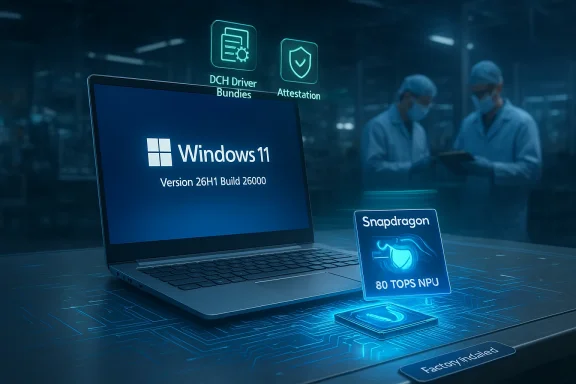
Microsoft’s plan to ship Windows 11 version 26H1 as a hardware‑gated, factory‑installed platform image marks a clear break from the company’s familiar annual feature cadence — the release will arrive primarily on new Snapdragon X2‑powered PCs, run on a distinct internal platform codenamed Bromine, and will not be offered as an in‑place Windows Update to existing Intel, AMD, or earlier Arm devices.
Microsoft’s public documentation and partner briefings make the essentials plain: 26H1 is a platform enablement release, not a consumer feature wave. It packages deep, low‑level changes — kernel, scheduler, driver stacks, NPU/runtime hooks, and firmware/attestation adjustments — needed to properly support next‑generation Arm system‑on‑chips such as Qualcomm’s Snapdragon X2 family. The company has signalled this version will be preinstalled on qualifying new devered as a broad feature update via Windows Update to the existing installed base.
Why the split? Chipmakers and OEMs often ship silicon on timelines that don’t align with Microsoft’s H2 (second‑half) update cycle. Microsoft’s choice to produce a targeted platform image allows OEMs to factory‑flash a validated OS tailored to the hardware’s firmware and driver expectations, reducing day‑one instability and enabling features — most notably on‑device AI — that depend on specialized NPU and runtime integration. The upshot for consumers: if your PC is already running Windows 11 24H2 or 25H2, you will not see 26H1 in Windows Update; your device remains on the mainstream servicing lane and will receive the normal quality and security patches until the broader 26H2 feature release.
Industry reporting also suggests other Arm vendors are at least exploring compatibility paths — independent outlets have discussed NVial future partner in the Bromine story — but as of Microsoft’s initial disclosures, Qualcomm’s Snapdragon X2 is the only publicly confirmed chip family shers and IT teams should treat speculation about additional silicon partners as provisional until formal announcements arrive.
For Qualcomm and other Arm proponents, a Microsoft‑validated factory image is a crucial enabling element: it lowers the barrier SoCs by ensuring the OS and drivers arrive matched to firmware and NPU ru targeted images allow the company to shepherd on‑device AI and new security primitives witost and risk of immediately merging those changes into the universal servicing branch. The balance is delicate: done well, it accelerateorly, it fragments the ecosystem.
For readers looking to act: don’t panic, but don’t assume everything will “just work.” Validate SKUs, insist on written update policies for procurement, pilot thoroughly, and treat 26H1 X2 devices as distinct SKUs during their Bromine servicing lifetime. The promise is real — thinner, longer‑lasting, AI‑capable laptops — but the operational and support implications require discipline from Microsoft, Qualcomm, OEMs, and enterprise customers alike.
In short: Windows 11 26H1 is not the next big consumer feature update; it is a targeted platform release designed to unlock a new class of Arm PCs, beginning with Qualcomm’s Snapdragon X2 family. Its technical rationale is sound, but the industry must manage communication, support, and tooling carefully to ensure this pivot advances Windows on Arm without imposing undue complexity on the broader ecosystem.
Source: Techgenyz Microsoft’s Bold Windows 11 Version 26H1 Launch Elevates Snapdragon X2 PCs
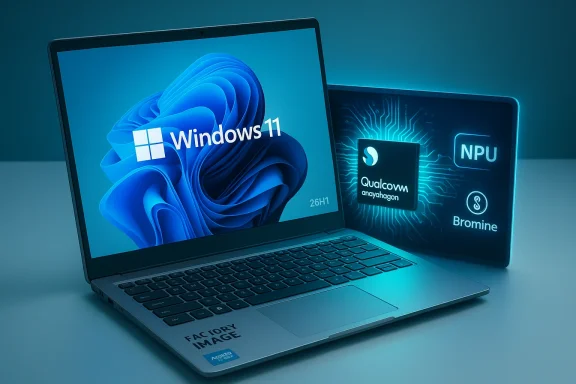 Background / Overview
Microsoft’s public documentation and partner briefings make the essentials plain: 26H1 is a platform enablement release, not a consumer feature wave. It packages deep, low‑level changes — kernel, scheduler, driver stacks, NPU/runtime hooks, and firmware/attestation adjustments — needed to properly support next‑generation Arm system‑on‑chips such as Qualcomm’s Snapdragon X2 family. The company has signalled this version will be preinstalled on qualifying new devered as a broad feature update via Windows Update to the existing installed base. Why the split? Chipmakers and OEMs often ship silicon on timelines that don’t align with Microsoft’s H2 (second‑half) update cycle. Microsoft’s choice to produce a targeted platform image allows OEMs to factory‑flash a validated OS tailored to the hardware’s firmware and driver expectations, reducing day‑one instability and enabling features — most notably on‑device AI — that depend on specialized NPU and runtime integration. The upshot for consumers: if your PC is already running Windows 11 24H2 or 25H2, you will not see 26H1 in Windows Update; your device remains on the mainstream servicing lane and will receive the normal quality and security patches until the broader 26H2 feature release.
What 26H1 actually is (technical breakdown)
A platform baseline, not a UI-driven feature pack
At a high level, 26H1 (Bromine) focuses on the plumbing beneath Windows rather than new visible experiences. Microsoft’s release notes and Canary builds identify this as a release that “only includes platform changes to support specific silicon,” which is why the company restricts it to factory images for qualifying ma consumer‑facing UI differences compared with 25H2; the value proposition is improved hardware integration, performance tuning, and secure NPU/runtime support.://www.pcworld.com/article/2965923/its-official-windows-11-26h1-isnt-for-you.html)Core technical areas addressed
- Kernel and scheduler updates toeneous CPU topologies typical of modern Arm designs, improving responsiveness across mixed‑core configurations.
- Power and thermal policies tuned to new SoC power envelopes so thin, fanless laptops can hit realistic nder sustained workloads.
- Validated DCH driver bundles for GPUs, ISPs, and connectivity components, shipped as part of the factory OS imageware mismatches at first boot.
- NPU/runtime hooks and attestation that enable secure on‑device AI and model execution (local inference, model manifests, and attested execution), which are increasingly central to Copilot+ and other AI experiences.
- Firmware/pre‑boot and attestation changes affecting BitLocker, WinRE, and device identity flows to match new platform security primitives.
Distribution and servicing: how Microsoft will manage 26H1 devices
Factory image first
Microsoft expects OEMs to ship qualifying SKUs preinstalled with 26H1. In practice this means identical product names may ship with distinct OS images depending on silicon — for example, a ZenBook model with Snapdragon X2 will arrive with 26H1, while the same chassis with Intel or AMD silicon will ship with 25H2. Buyers must check the factory image and OEM disclosure at purchase if 26H1 is a deciding factor.Separate servicing lane
Devices that ship with 26H1 will have their own monthly quality and security update cadence on the Bromine servicing lane. Microsoft has been explicit: 26H1 devices will not be offered 26H2 in the fall of 2026 because 26H1 is built on a different internal platform core. Microsoft alsoe “a path to update in a future Windows release” for 26H1 devices, but that route will not be the immediate 26H2 mainstream channel. Expect divergence in build strings and update metadata until convergence occurs at a future release.What’s not supported
Some servicing features that enterprises have come to rely on may differ or be unavailable on the initial Bromine lane; for example, third‑party reporting noted the early 26H1 servicing lane does not support hotpatching in the same way as mainstream branches — a detail IT teams should verify in OEM and Microsoft release notes before wide deployment. If hotpatch behavior is critical to your environment, demand clarity from vendors.The Snapdragon X2 anchor — why Qualcomm matters here
Qualcomm’s Snapdragon X2 is the first confirmed SoC partner for 26H1 devices. The X2 family introduces larger on‑die NPUs, updated core architectures, and different memory/I/O behaviors that require OS-level integration to realize promised performance and efficiency. OEMs are already committed to bringing X2 devices to market in early 2026, which aligned timelines forced Microsoft’s hand: provide a Bromine image for factory provisioning rather than delay device launches until the autumn 26H2 cycle.Industry reporting also suggests other Arm vendors are at least exploring compatibility paths — independent outlets have discussed NVial future partner in the Bromine story — but as of Microsoft’s initial disclosures, Qualcomm’s Snapdragon X2 is the only publicly confirmed chip family shers and IT teams should treat speculation about additional silicon partners as provisional until formal announcements arrive.
Who should care — and what to do
Consumers
If you have an existing Intel or AMD laptop or desktop running Windows 11 24H2/25H2, this change mostly means “business as usual.” Regular monthly security and quality updates continue, and the mainstream 26H2 feature release will be the cross‑platform consumer milestone luld not feel pressured to buy new hardware just to obtain Bromine‑specific optimizations. ([techraechradar.com/computing/windows/microsoft-confirms-windows-11-26h1-update-wont-be-coming-to-your-current-pc-heres-why-thats-actually-great-news?utm_source=opehe market for a new Arm64 ultraportable and a Snapdragon X2 SKU interests you because of battery life or on‑device AI, factor in the following before purchase:- Verify the device’s factory OS image and whether it ships with 26H1.
- Ask the OEM about the update policy and expected timeline for migration from Bromine to the mainstream branch (or oth releases).
- Confirm driver and management tooling compatibility for your workload (e.g., VPN clients, disk encryp and virtualization agents).
Enterprises and IT teams
This is material. A device arriving with 26H1 is, for management purposes, effectively a distinct SKU with its own servicing expectations and pohavior from similarly named Intel/AMD SKUs. Recommendations:- Pilot X2 devices in a controlled deployment ring and test endpoint management, bity agents, and domain join behavior.
- Demand OEM documentation and SLAs about driver support, telemetry, and rollback procedures.
- Validate that your enterprise tooling (MDM, security suites, zero‑touch provisioning) supports Arm64 builds and that vendors commit to parity testing.
Developers and ISVs
If your software targets Windows broadly, this is a renewed call to prioritize Arm64 testing. The Bromine lane will exposeaths and runtime differences that can cause subtle behavior changes in native and JIT‑compiled code. Action items:- Prioritize Arm64 build artifacts and CI testing on real hardware.
- Validate grac‑accelerated code and ensure model manifest and attestation flows are robust.
Risks, tradeoffs, and the fragmentation debate
Benefits Microsoft and partners highlight
- Day‑one stability: Factory‑validated images reduce driver/firmware mismatch risk on first boot.
- Optimized battery and AI: Tailored kernel and NPU integrations should enable the power/performance claims OEMs advertise for X2 devices.
- ast radius: Containing risky changes to a controlled hardware set lowers cross‑platform instability risk for the wider Windows population.
Real risks to watch
- Short‑term fragmentation: Multiple platform cores (Bromine vs Germanium) create parallel servicing lanes. That fragmentation raises complexity for IT management, driver certification, and third‑party tooling compatibility.
- Update confusion at point of sale: Identically named SKUs with different silicon may confuse consumers and business procurement teams unless OEMs provide clear labelling and OS image details.
- Support and lifecycle uncertainty: Microsoft’s statement that 26H1 devices have a “path” to future updates is intentionally vague. Enterprises should demand concrete timelines and rollback options in SLAs.
- Ecosystem readiness: Some legacy drivers, kernel‑level agents, or security tools may not be immediately available for Arm64/Bromine; enterprises may face delays in certifying their stacks.
Strategic implications — why Microsoft is leaning into hardware‑gated releases
This move indicates a broader shift: Microsoft is increasingly willing to produce device‑first platform releases to enable specific silicon trends — particularly on‑device AI and efficient Arm performance — without destabilizing the general Windows install base. The Bromine model echoes earlier targeted launches (for example, the Copilot+ enabling builds that shipped on select devices), but it likely signals a more permanent pattern: when silicon shifts introduce deep OS changes, Microsoft will consider hardware‑gated lanes rather than delaying OEM product cycles or risking regressions on mass updates.For Qualcomm and other Arm proponents, a Microsoft‑validated factory image is a crucial enabling element: it lowers the barrier SoCs by ensuring the OS and drivers arrive matched to firmware and NPU ru targeted images allow the company to shepherd on‑device AI and new security primitives witost and risk of immediately merging those changes into the universal servicing branch. The balance is delicate: done well, it accelerateorly, it fragments the ecosystem.
Timeline and what to expect next
- Spring 2026: First Snapdragon X2 devices shipping with Windows 11 version 26H1 (Bromine) factory images.
- Fall 2026: Mainstream 26H2 feature update for devices on the existing Germanium branch (24H2/25H2 users). 26H1 devices are not expected to upgrade to 26H2.
- 2027 (expected): A future convergence release (reports indicate a likely 2027 update such as 27H2) will be where Microsoft reconciles the Bromine and Germanium lines and provides a unified servicing baseline. This schedule remains contingent on partner roadmaps and Microsoft’s internal planning. Treat any specific dates beyond Microsoft’s official notices as provisional.
Practical buying and deployment checklist
- For consumers:
- Confirm whether the SKU ships with 26H1 or 25H2 before purchase.
- If you need broad software compatibility today, prefer Intel/AMD SKUs or wait for mainstream 26H2 parity.
- For IT decision‑makers:
- Test X2 devices in a pilot ring before wide deployment.
- Require OEM update and support policies in procurement documents.
- Verify endpoint management tools and security agents support Arm64/Bromine builds.
- For developers:
- Add real X2 hardware to CI, validate Arm64 builds, and test NPU‑accelerated code paths with graceful fallbacks.
Final analysis: a cautious, engineering‑first move that needs careful stewersion 26H1 is a pragmatic engineering response to mismatched hardware and OS release cadences. By delivering a hardware‑gated Bromine image to Snapdragon X2 devices, Microsoft allows OEMs to ship polished, AI‑capable Arm laptops without forcing deep platform changes onto the entire Windows ecosystem at once. That is a technically defensible choice: it reduces the risk of widespread regressions and enables new capabilities tied to NPUs and firmware attestation.
But the model raises nontrivial tradeoffs. Short‑term fragmentation, possible confusion at purchase, and lifecycle uncertainty for enterprises and software vendors are real and material. Success depends on three things: precise and transparent messaging at point of sale, solid OEM update and support commitments, and rapid ecosystem readiness (drivers, management tooling, and key third‑party agents) for Arm64. If those conditions hold, Bromine can be an effective bridge to a future unified platform; if not, it risks creating avoidable complexity during a sensitive shift toward on‑device AI and Arm silicon.For readers looking to act: don’t panic, but don’t assume everything will “just work.” Validate SKUs, insist on written update policies for procurement, pilot thoroughly, and treat 26H1 X2 devices as distinct SKUs during their Bromine servicing lifetime. The promise is real — thinner, longer‑lasting, AI‑capable laptops — but the operational and support implications require discipline from Microsoft, Qualcomm, OEMs, and enterprise customers alike.
In short: Windows 11 26H1 is not the next big consumer feature update; it is a targeted platform release designed to unlock a new class of Arm PCs, beginning with Qualcomm’s Snapdragon X2 family. Its technical rationale is sound, but the industry must manage communication, support, and tooling carefully to ensure this pivot advances Windows on Arm without imposing undue complexity on the broader ecosystem.
Source: Techgenyz Microsoft’s Bold Windows 11 Version 26H1 Launch Elevates Snapdragon X2 PCs