Windows 11 26H1 Bromine: Platform Image for Snapdragon X2 Arm Laptops

  • Thread Author
Microsoft’s latest Windows 11 release, version 26H1, is not a conventional feature update for existing PCs — it’s a narrow, device‑first platform image designed to enable next‑generation Arm silicon and will ship only on select new devices (notably those built on Qualcomm’s Snapdragon X2 family).

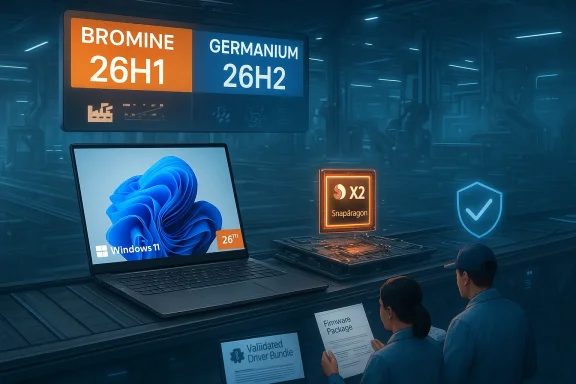
High-tech lab: a Windows 11 laptop, Snapdragon X2 chip, and engineers reviewing firmware packages.Background / Overview​

Microsoft’s 26H1 departure from the familiar H2 feature‑update model is deliberate. Rather than pushing a single feature update to the entire installed base, the company produced a platform‑focused release — internally observed in the industry as the Bromine baseline — to give OEMs a validated factory image that matches the firmware, drivers and security attestation expectations of new Arm SoCs.
The practical result: devices that ship with Windows 11, version 26H1 will receive monthly quality and security updates on their own servicing lane, but existing Intel, AMD and earlier Arm Windows 11 PCs will not be offered 26H1 as an in‑place upgrade via Windows Update. Those machines remain on the mainstream servicing path toward the broader 26H2 feature update expected later in 2026.

What Windows 11 26H1 actually is​

A platform enablement release, not a consumer feature drop​

At its core, 26H1 is about plumbing: kernel and scheduler changes, power management and thermal tuning, validated DCH driver bundles, NPU/runtime hooks for on‑device AI, and firmware/attestation adaptations required by modern Arm SoCs. Consumer‑facing UI or productivity features are minimal; the update’s value is in ensuring new hardware delivers expected battery life, performance and secure local AI behavior out of the box.

The rationale: silicon timing and safety​

Chipmakers and OEMs often ship hardware on timelines that don’t align with Microsoft’s autumn H2 releases. With the Snapdragon X2 family arriving in early 2026, Microsoft faced a choice: delay partner device launches or provide a validated OS image for factories. The company chose the latter to avoid merging deep platform changes into the broad servicing branch — a move that reduces widespread regression risk but produces a short‑term servicing split.

The Bromine vs Germanium distinction​

Industry reporting and Microsoft’s documentation point to two coexisting platform cores in 2026: Bromine (26H1) for the targeted device lane and Germanium for the established H2 cycles (24H2, 25H2, and future 26H2). That difference explains why some cumulative updates and build strings are specific to the 26H1 lane.

Compatibility and distribution: who gets 26H1 (and who doesn’t)​

  • 26H1 will be preinstalled only on qualifying new devices — the primary targets being Copilot+ and Arm64 laptops that use Qualcomm’s Snapdragon X2 processors.
  • Existing Windows 11 PCs (Intel, AMD, earlier Arm) will not receive 26H1 through Windows Update and will remain on their current servicing baseline until they receive the mainstream 26H2 feature update.
  • OEM product SKUs can be confusing: identical product names with different silicon may ship with different Windows images (e.g., a ZenBook X2 SKU with 26H1 versus the same shell with Intel/AMD and 25H2). Always verify the factory OS image for a given SKU with the vendor.
This distribution model is factory‑image first — Microsoft expects OEMs to flash devices with the correct image and driver bundle during manufacturing, which reduces day‑one issues tied to driver/firmware mismatches.

Technical snapshot: what’s under the hood​

26H1’s engineering focus includes several deep platform areas:
  • Kernel and scheduler updates to manage heterogeneous core topologies common in modern Arm SoCs, ensuring correct affinity and performance balancing.
  • Power and thermal governors tuned to new SoC envelopes to preserve battery life and sustained performance characteristics OEMs advertise.
  • NPU/runtime and attestation hooks for on‑device AI tasks, tying hardware‑accelerated inference to secure attestation and runtime manifests.
  • Bundled, validated DCH drivers and signed firmware packages shipped with the factory image, rather than relying on post‑sale driver matching that can fail when silicon changes the device’s runtime expectations.
  • Pre‑boot and recovery interactions (BitLocker, WinRE) validated for new attestation flows introduced by some Arm designs.
Two concrete traces of the platform split were visible in early builds and Patch Tuesday metadata: Canary‑channel builds in the 28000 family and cumulative update metadata (for example, a February 2026 cumulative identified as KB5077179 / OS Build 28000.1575) that target the 26H1 servicing lane. These identifiers confirm that 26H1 follows a distinct build and servicing string.

The Snapdragon X2 story: what the hardware vendors are promising​

Qualcomm and partner OEM materials positioned Snapdragon X2 as a generational leap focused on on‑device AI and energy efficiency. Vendor claims for high‑end X2 SKUs include:
  • CPU configurations with large Oryon‑based core counts in flagship variants.
  • NPU performance claims in the ballpark of ~80 TOPS (with some partner‑tuned SKUs listing higher figures).
  • Higher memory bandwidth and modern process nodes to reduce bottlenecks between CPU, NPU and memory subsystems.
Those vendor‑supplied metrics are useful signals of architectural change, but they remain vendor claims until independent benchmarks validate them. Nevertheless, such claims illustrate why Microsoft treated 26H1 as a platform requirement rather than a routine update.
OEMs have already signaled that X2‑based SKUs will ship with 26H1 preinstalled in early 2026, while identically named Intel/AMD variants ship with the standard 25H2 image — a concrete illustration of the factory image model in action.

Practical implications for consumers​

If you run a current Intel/AMD Windows 11 PC, the short version is simple: do nothing. Your device will continue to receive security and monthly quality updates on the existing servicing branch and will be eligible for the broad 26H2 feature update when Microsoft ships it to the mainstream installed base.
If you plan to buy a brand‑new Arm‑based Copilot+ laptop (Snapdragon X2), expect the device to ship with Windows 11 26H1 preinstalled. When shopping:
  • Confirm the exact SKU and whether the factory image is 26H1.
  • Ask the vendor how firmware and driver updates will be delivered post‑purchase (OEM channel vs Windows Update).
  • Be aware that feature claims tied to Bromine‑only capabilities (e.g., a specific on‑device AI runtime) may not be available on identically named Intel/AMD SKUs.
Enthusiasts and tinkerers should heed a clear warning: manual installation of 26H1 onto unsupported hardware is risky. Driver mismatches, firmware assumptions and attestation differences can break features or force recovery scenarios; Microsoft discourages forcing 26H1 onto unsupported devices.

Practical implications for IT, procurement and enterprise​

For IT teams, 26H1 introduces an operational wrinkle: a small subset of devices on an organization’s fleet may arrive on a different platform baseline with its own servicing expectations.
Recommended immediate actions:
  • Inventory and SKU validation — Confirm whether any planned purchases include Snapdragon X2 SKUs and the factory OS image associated with those SKUs.
  • Pilot early — Before rolling Bromine devices into general deployment, pilot them in a controlled ring to validate MDM, endpoint protection, VPNs and backup tooling.
  • Require OEM documentation — Ask vendors to provide explicit update channels for firmware and drivers and to document how attestation/BitLocker interplay is handled on 26H1 images.
  • Treat 26H1 devices as distinct SKUs — Don’t assume they will match lifecycle behavior of 25H2/26H2 devices. Plan for a slightly different support path until Microsoft publicly converges the servicing lanes.
These steps will minimize surprises and reduce the chance of breakage when a mixed fleet (Bromine and Germanium devices) coexists.

Benefits and trade‑offs: why Microsoft chose this route​

Benefits
  • Faster OEM time‑to‑ship: OEMs don’t need to delay hardware launches waiting for the H2 feature update.
  • Validated factory image: Devices ship with a known‑good combination of OS, drivers and firmware, reducing early field failures.
  • Optimized platform behavior: Tight integration between OS scheduler, power management and NPU runtimes can unlock the advertised battery and AI benefits without risk to the wider installed base.
Trade‑offs and risks
  • Servicing fragmentation: Two servicing baselines increase complexity for users, enterprises and developers.
  • Customer confusion: Buyers may not understand why a capable existing PC won’t receive 26H1, especially when OEM marketing highlights new on‑device AI features.
  • Compatibility risk: Low‑level differences can expose driver or app incompatibilities that require revalidation.
Microsoft’s history with prior rollouts — where platform changes introduced visible instability on some devices — helps explain the cautious, device‑scoped approach this time. The trade‑off favors safer launches for new silicon at the cost of short‑term fragmentation.

How the servicing split is visible today​

  • Canary and Insider builds showed a new build family around 28xxx (notably Build 28000) for the Bromine baseline.
  • Patch metadata published on the February 2026 Patch Tuesday included a cumulative associated with 26H1 (for example KB5077179 / OS Build 28000.1575), showing Microsoft’s operational separation of security/quality updates for the platform.
Those identifiers are practical evidence that Bromine has a separate servicing stream, not just marketing language. Enterprises and technical teams should track build strings and KB IDs when validating device images or troubleshooting update behavior.

Recommendations — what sensible buyers and administrators should do now​

For consumers:
  • If you own an Intel/AMD PC: continue normal updates; there’s no need to chase 26H1.
  • If you’re buying a new Arm device for on‑device AI: verify the SKU, factory image and the OEM’s update policy before purchase. Demand clarity about post‑sale driver and firmware channels.
For IT and procurement:
  • Add a line item for Bromine/26H1 SKUs in procurement specs and require OEM documentation on servicing and driver delivery.
  • Pilot devices in a controlled ring with your standard security agents and management tooling. Validate endpoint protection, VPNs and BitLocker interaction.
  • Maintain separate images and patch plans for Bromine devices until Microsoft explicitly publishes a convergence path.
For developers:
  • Test apps on both Germanium (25H2/26H2) and Bromine (26H1) images if you target Arm devices. Watch for scheduler, threading and NPU runtime differences that may influence performance or compatibility.

What to expect next: 26H2 and convergence​

Microsoft has signaled that mainstream feature development continues on the H2 cadence; Windows 11 26H2 is expected to deliver broad user‑facing features to the entire installed base later in 2026. Microsoft also says there will be a future convergence that aligns the Bromine and Germanium update paths, but the company has not published a definitive migration timetable for when 26H1 devices will be moved onto the broad 26H2 servicing lane. That means Bromine devices will remain on their separate servicing lane for a period until Microsoft publishes a clear unification plan.
Until then, expect:
  • OEMs to push device‑specific firmware/driver updates through their channels.
  • Microsoft to publish platform KBs and security updates tied to the 28000 build string for Bromine devices.

Final analysis: pragmatic engineering that raises policy questions​

Windows 11 26H1 is a pragmatic engineering solution to a difficult timing problem: enable new silicon on schedule without risking the larger installed base. The choice reduces day‑one churn for OEMs and end users who buy X2‑based devices, and it ensures the deep kernel and runtime work required for modern NPUs and heterogeneous cores is validated in a narrow blast radius.
That pragmatism comes with costs. The split servicing lanes increase the complexity of lifecycle management for enterprises and blur expectations for consumers who expect a unified Windows Update experience. Microsoft and OEMs will need crisp communication, clear SKU labeling and straightforward update roadmaps to prevent confusion and support overhead. Without that clarity, the Bromine experiment could be remembered as either a smart enabler for Arm laptops or as the start of an annoyingly fragmented chapter in Windows servicing.

In short: Windows 11, version 26H1 exists to make sure Snapdragon X2 and similar next‑gen Arm devices work as advertised out of the box. If you have an existing Intel or AMD PC, nothing changes — your device will remain on the mainstream servicing path and receive the broader features when 26H2 ships later in the year. If you’re buying new X2‑based hardware, confirm the SKU’s factory image and OEM update policy, pilot thoroughly in managed environments, and treat 26H1 devices as distinct SKUs with their own servicing expectations while Microsoft and partners work toward a future convergence.

Source: FilmoGaz PCs Miss Out on Windows 11 26H1 Update
 

Microsoft has shipped an unusual, purpose‑built Windows 11 release — version 26H1 — not as a general feature update for existing PCs but as a factory‑installed platform image engineered to enable specific next‑generation silicon, starting with Qualcomm’s Snapdragon X2 family. This is a conscious architecture- and partner-driven move: 26H1 (internally associated with the Bromine platform and the 28000 build series) contains primarily low‑level kernel, scheduler, power, driver and NPU/runtime plumbing — the changes necessary to make modern Arm SoCs deliver promised performance and battery life — and Microsoft is distributing it only on qualifying new devices rather than via Windows Update to the installed base.

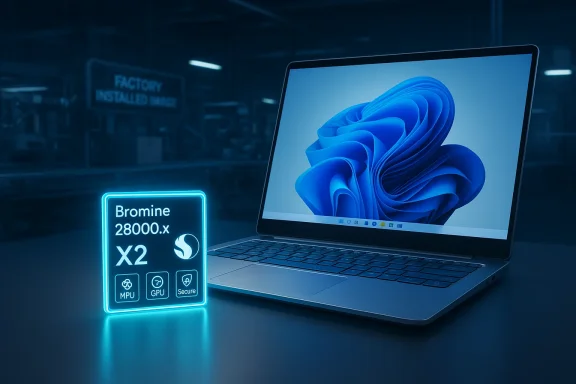
Neon sign reads Bromine 28000.x X2 beside a laptop on a factory floor.Background / Overview​

Microsoft’s Windows update model has long centered on a broadly distributed annual H2 feature release, supplemented by monthly cumulative updates. In early 2026 the company introduced a parallel, device‑first track: Windows 11, version 26H1, a springtime platform release intended solely to support the engineering realities of new system‑on‑chip designs. Rather than backporting deep platform work into the servicing baseline for hundreds of millions of existing devices, Microsoft created a separate branch — known publicly in community reporting as Bromine — and tied it to high‑level build strings beginning in the 28000 range.
The practical implication is simple: manufacturers launching laptops built around qualifying Arm silicon can ship devices factory‑flashed with an OS image that already includes validated drivers, power policies, NPU runtime integration and firmware interactions. Consumers with current Intel/AMD or earlier Arm PCs should continue on the existing servicing lanes (24H2 / 25H2) and will receive mainstream feature updates later in the year through 26H2, which remains Microsoft’s broadly distributed H2 release.

What Windows 11 26H1 actually is (and what it isn’t)​

What it is​

  • A platform enablement release designed to support specific next‑generation silicon, notably Qualcomm’s Snapdragon X2 Series on first wave devices.
  • An OEM / factory‑installed image: 26H1 will appear preinstalled on qualifying new devices starting early 2026 rather than arriving as an in‑place Windows Update to existing PCs.
  • A different platform core: Community reporting and Microsoft documentation reference a distinct underlying platform (Bromine) and build family (28000.x), separate from the Germanium core used by recent H2 updates. This divergence explains update and servicing differences.
  • Serviced independently: Devices shipped with 26H1 will receive monthly security and quality updates on a 26H1 servicing lane (for example, February 10, 2026 cumulative KB5077179 / OS Build 28000.1575).

What it is not​

  • Not a consumer feature wave: 26H1 contains few visible UI features; the value is under‑the‑hood platform readiness rather than headline consumer functionality.
  • Not an in‑place upgrade for existing devices: Microsoft explicitly states that devices running earlier versions of Windows 11 will not be offered 26H1 through Windows Update and cannot do an in‑place install to move onto it.

Under the hood: the technical changes that justified a separate branch​

The rationale for a platform‑specific release is engineering-first. Modern Arm SoCs — with heterogeneous CPU clusters, on‑device NPUs for AI acceleration, novel GPU/IPU/ISP subsystems and new firmware/attestation flows — can require deep OS changes that introduce unacceptable regression risk if merged into the servicing stream used by tens or hundreds of millions of devices.
Key platform areas 26H1 addresses:
  • Kernel / HAL and scheduler updates to respect heterogeneous core topology, ensuring fairness and predictable thermal behavior when mixing big and little cores.
  • Power and thermal governors tuned to new SoC power domains so sustained performance and battery life match vendor claims.
  • Validated DCH driver stacks (GPU, ISP, radios) and updated firmware/WinRE/BitLocker interactions tailored for the new platforms.
  • NPU runtime and attestation hooks enabling secure on‑device AI model execution and efficient runtime handoff to dedicated accelerators.
  • Servicing and SSU coordination so factory images and subsequent monthly cumulative rollups remain dependable for OEM manufacturing timelines.
These are plumbing changes: most users won’t notice new menus or widgets, but the hardware-dependent differences are material for device reliability and performance.

The KB and build evidence: what Microsoft has published​

Microsoft’s Patch Tuesday of February 10, 2026 included cumulative update metadata tied to the 26H1 lane. The most salient public artifacts:
  • KB5077179 — OS Build 28000.1575: the February 2026 cumulative for Windows 11, version 26H1. It lists fixes for a dxgmms2.sys kernel error, WPA3 connectivity, servicing stack improvements, AI component updates and more.
  • Windows 11, version 26H1 support page (KB ID 5079944): Microsoft’s page explicitly states 26H1 “enables the next generation of silicon,” names Qualcomm Snapdragon X2 Series as the first devices, clarifies it’s not a general in‑place update and notes devices shipped on 26H1 won’t be able to update to the next annual feature update in H2 2026.
  • Safe OS Dynamic Update KB5077178: includes WinRE improvements and highlights Secure Boot certificate expiry considerations — a reminder that low‑level platform bits are part of this servicing lane.
These published KB and support entries are the hard proof: 26H1 is live as a servicing lane and is bound to a specific build family (28000.x).

Which hardware gets 26H1 — Snapdragon X2 and industry context​

Microsoft’s support documentation names Qualcomm’s Snapdragon X2 Series as the first silicon family shipping devices preinstalled with 26H1. Industry reporting and Insider Canary previews have tied the Bromine/28000 branch to Arm laptop SoCs such as Snapdragon X2 and, in some speculative reporting, to other upcoming accelerators like NVIDIA’s N1X. The NVIDIA connection remains industry reporting/speculation rather than firm Microsoft confirmation; Qualcomm X2 is explicitly cited by Microsoft.
What to expect on day one with X2‑based devices:
  • Preinstalled 26H1 images with vendor‑validated drivers and power profiles.
  • On‑device AI capabilities using integrated NPUs with runtime support and attestation baked into the platform.
  • Monthly cumulative servicing specific to the Bromine/26H1 lane, keeping the device up to date without tying it to the mainstream servicing baseline.

Enterprise and OEM considerations — what IT teams must know​

This is not just a consumer story. Enterprises, OEMs, ISVs and IT professionals face concrete implications when a major OS vendor splits platform branches.
Key enterprise takeaways:
  • Do not treat 26H1 as a mandatory servicing lane for your existing fleet. Microsoft’s guidance is explicit: continue to use 24H2/25H2 as your baseline unless you are purchasing qualifying new hardware.
  • Vendor‑sold 26H1 devices are separate SKUs: they require their own validation, driver checks, imaging and security posture assessments before you deploy in production.
  • Mixed fleets demand test plans: if you have a mix of Intel/AMD and new Arm devices, plan pilot testing for any management, imaging, security tools, VPN/SSO/MDM integrations and vendor drivers. 26H1 devices will not have the same upgrade path to 26H2 later in 2026.
  • Licensing and image management: ensure OEM documentation clarifies which images will be factory‑installed and whether your provisioning processes or update servers can service the 26H1 lane. Expect device‑bound KBs and servicing rollups that are not applicable to standard Intel/AMD images.
Practical deployment checklist for IT (numbered for clarity):
  • Inventory devices you plan to purchase; validate which ones ship with 26H1.
  • Establish a pilot group and test driver stacks, MDM policies, and app compatibility.
  • Confirm update behavior with each OEM — how will monthly updates be delivered, and what is the documented update path toward future convergence?
  • Validate security features (BitLocker, WinRE interactions, Secure Boot CA updates) on the 26H1 images.
  • Avoid broad rollouts until you’ve verified firmware, management and remediation workflows.

Upgrade cadence, migration path and how 26H1 fits the annual rhythm​

Microsoft reaffirmed its annual H2 feature cadence: 26H2 remains the planned fall 2026 consumer and enterprise feature update. 26H1 does not replace that rhythm; rather, it runs in parallel as a device‑specific platform lane. Microsoft’s support pages state devices shipped with 26H1 will not be able to update to the next annual feature update (26H2) later in 2026 because 26H1 is built on a different Windows core; a future migration path will be provided at a later date. In short: expect parallel servicing lanes for the near term and a future convergence plan that Microsoft will publish when ready.
This model is not wholly new: Microsoft has previously created early platform releases for ARM hardware when silicon schedules and platform work demanded it. The difference now is the explicit, documented divergence and the formal servicing lane for a platform that may be used on an expanding set of Arm devices.

Risks, fragmentation and the potential downsides​

Microsoft’s approach is pragmatic, but it is not without risk. These are the areas readers — both consumers and IT pros — should watch carefully.
  • Customer and enterprise confusion: multiple simultaneous baselines increase the chance that buyers or frontline IT staff misidentify the servicing lane for a device, applying incorrect update policies or trying to install incompatible KBs. The KB pages make the device bound model explicit, but real‑world confusion is likely.
  • Fragmentation of feature delivery: if Bromine‑specific platform work remains distinct for too long, user‑facing features may be delivered unevenly, and apps or management tools may require platform‑specific adjustments.
  • Support overhead for mixed fleets: enterprises that adopt 26H1 hardware early will have to maintain a separate test, imaging and support pipeline for those devices until Microsoft provides a comfortable migration path.
  • Security boot and certificate timelines: the February Safe OS dynamic update called out Secure Boot certificate expiration considerations, a reminder that platform divergence carries cryptographic and firmware maintenance requirements that IT must track proactively.
  • Risk of regressions or rushed rollouts: historically, deep platform work carries the risk of unexpected regressions; shipping Bromine as a factory image reduces exposure to the mainstream servicing lane but concentrates risk in OEM validation and driver stacks. Recent patch history in 2026 demonstrates the real operational complexity of servicing Windows at scale.
Where Microsoft’s approach mitigates risk:
  • By not pushing 26H1 as a mass in‑place update, Microsoft avoids exposing millions of existing PCs to deep kernel or HAL changes that might cause regressions.
  • OEM factory‑images let manufacturers test devices end‑to‑end with silicon, firmware and drivers before shipping.

Recommendations for different audiences​

Consumers and enthusiasts​

  • If you are an average user with an existing Windows PC, do nothing. Your device will continue receiving the normal monthly security and quality updates on its servicing lane; 26H1 is not arriving via Windows Update for your machine.
  • If you are buying a new Arm laptop advertised with Snapdragon X2 and 26H1, read the spec sheet carefully: confirm the OS version shipped, vendor support policies for updates and whether the device meets your app compatibility needs.

IT administrators and enterprise purchasers​

  • Treat 26H1 devices as separate SKUs — require OEM documentation about servicing and migration paths before purchase.
  • Run a pilot: verify driver compatibility, BitLocker and WinRE behavior, MDM enrollment, VPN, enterprise line‑of‑business apps and image provisioning.
  • Avoid wide production rollouts until you’ve validated update behavior and verified the OEM’s plan for future convergence to the mainstream H2 branch.

OEMs and ISVs​

  • Provide clear messaging: disclose which devices ship with 26H1 and how servicing will be handled. Offer offline images and guidance for IT to integrate devices in pipelines. Ensure driver stacks and vendor support channels are ready for enterprise validation.

SEO‑friendly technical summary (quick facts)​

  • Product: Windows 11, version 26H1 (platform enablement release).
  • Platform codename / build family: Bromine / 28000.x (example OS Build 28000.1575).
  • First silicon pairing: Qualcomm Snapdragon X2 Series devices will ship with 26H1 preinstalled.
  • Distribution: Factory‑installed on new devices only; not an in‑place Windows Update for existing PCs.
  • Servicing: Monthly cumulative updates specific to the 26H1 lane (e.g., KB5077179).
  • Mainline feature update: 26H2 remains the H2 2026 broad feature release for the general installed base.

Final analysis: pragmatic engineering or risky fragmentation?​

Windows 11 26H1 is a textbook engineering compromise. Microsoft faced a choice: delay highly publicized new Arm hardware until the mainstream H2 release, or deliver a validated platform lane so OEMs can ship on time. By creating Bromine/26H1 as an OEM‑installed image, Microsoft prioritized device correctness, driver validation and OEM timelines while preserving the mainstream H2 feature cadence for the installed base.
That approach is pragmatic: it reduces the systemic risk of inflicting deep kernel and HAL changes on the broad population. It lets silicon partners show off power-efficiency and on‑device AI features at launch with a tested platform. It also preserves the predictable annual cadence for general feature delivery.
But the model introduces real operational overhead and potential confusion. Mixed fleets, separate servicing lanes, and different migration mechanics are the precise risks the industry has historically sought to avoid. The success of 26H1 will depend on clear OEM documentation, robust OEM + Microsoft servicing discipline, and a timely migration story so 26H1 devices can converge back to the mainstream feature lane without leaving customers in a perpetual special‑case servicing silo.
For most users and IT teams the sensible posture is patience: continue with existing purchasing and deployment strategies, pilot any 26H1 devices carefully, and wait for Microsoft’s formal migration guidance. For early adopters and enthusiasts who value the latest Arm silicon and on‑device AI, 26H1 unlocks hardware that would otherwise be delayed — provided you accept the separate servicing lane tradeoffs.

Windows 11 26H1 is less a new consumer-facing Windows and more an industry enabler: a platform‑first release that acknowledges the changing landscape of silicon, NPUs and hardware‑accelerated AI. Microsoft has published the KBs and support notes that make the mechanics explicit; the coming months will show whether this dual‑lane approach becomes a one‑off pragmatism or a recurring pattern whenever Windows must keep pace with radical shifts in device architecture.
Conclusion: if you manage Windows devices, read the device spec sheets, insist on OEM servicing and migration clarity, and treat 26H1 hardware as a strategic choice — not a drop‑in replacement — for now.

Source: FilmoGaz Microsoft Unveils Windows 11 26H1 for Select and Future CPUs
 

Back
Top