

Microsoft’s latest Insider activity shows a deliberate, low‑level rework of Windows 11’s foundations — not a cosmetic update — and that engineering pivot is being staged as a device‑targeted platform branch (26H1) to support a new generation of Arm and hybrid SoCs, on‑device AI, and Copilot‑centric hardware.
Microsoft’s public messaging has emphasized steady feature updates within the Windows 11 umbrella, but recent Canary and Dev channel builds reveal a different tactical choice: isolate platform plumbing in preview channels so OEMs and silicon partners can validate drivers, firmware, and runtime components without destabilizing the wider Windows 11 population.
This is not a marketing rebrand or a consumer feature pack. The Canary code now reports Windows 11, version 26H1 and includes early build strings such as Build 28000 and later Build 28020.1362 (KB5073095) — explicit engineering signposts that the work is platform‑focused. Microsoft’s own notes emphasize that 26H1 “only includes platform changes to support specific silicon,” a sharp distinction from mainstream servicing and feature updates.
At the same time, Microsoft moved parts of the Dev channel forward (the 26300 series) and warned subscribers that these builds “may have different known issues,” signaling that the company expects preview instability as it reworks deep OS layers.
Key technical vectors prompting the split:
Microsoft’s channel moves — notably advancing the Dev channel to the 26300 series and warning of atypical known issues — confirm the company is deliberately staging risky platform plumbing inside preview lanes while preserving Beta/Release Preview channels for broader feature stabilization.
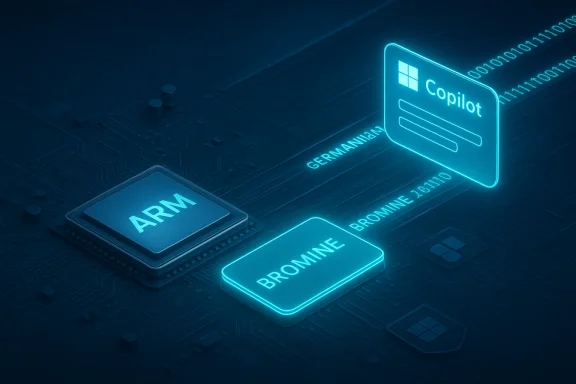
Insider commentary and reporting also identify internal platform labels and baselines — names such as Germanium (the current mainstream baseline) and Bromine (associated with early 26H1 work for next‑gen Arm silicon) — that indicate Microsoft is maintaining parallel platform tracks to reduce cross‑population disruption.
Benefits for OEMs:
However, there are practical caveats:
Operational implications:
This business logic reduces enterprise migration friction, allows Microsoft to gate premium local AI behind hardware tiers, and keeps the servicing model consistent for the mainstream audience. The trade‑off is greater complexity for hardware enablement and the risk that users perceive fragmentation if device experiences diverge too much.
That strategy has clear strengths: it reduces day‑one device risk, enables Copilot+ hardware value propositions, and prevents a disruptive forced upgrade for the mainstream installed base. But it also raises real concerns about fragmentation, enterprise validation costs, and recovery complexity that customers and IT teams must plan for now.
For Windows enthusiasts and IT managers, the immediate sober advice is simple: treat early 2026 Insider channel activity as a signal, not a mandate. Update procurement checklists, intensify recovery and validation testing for any Copilot+/26H1 devices, and keep mainstream production fleets on validated servicing baselines until platform stability is proven in your environment. Microsoft is preparing the foundation for an AI‑first PC era — the quality of that foundation will determine whether the promise of on‑device intelligence becomes a reliable everyday experience or a source of fragmentation and support overhead.
Source: Windows Report https://windowsreport.com/microsoft-prepares-major-platform-shift-for-windows-11/
 Background
Microsoft’s public messaging has emphasized steady feature updates within the Windows 11 umbrella, but recent Canary and Dev channel builds reveal a different tactical choice: isolate platform plumbing in preview channels so OEMs and silicon partners can validate drivers, firmware, and runtime components without destabilizing the wider Windows 11 population.This is not a marketing rebrand or a consumer feature pack. The Canary code now reports Windows 11, version 26H1 and includes early build strings such as Build 28000 and later Build 28020.1362 (KB5073095) — explicit engineering signposts that the work is platform‑focused. Microsoft’s own notes emphasize that 26H1 “only includes platform changes to support specific silicon,” a sharp distinction from mainstream servicing and feature updates.
At the same time, Microsoft moved parts of the Dev channel forward (the 26300 series) and warned subscribers that these builds “may have different known issues,” signaling that the company expects preview instability as it reworks deep OS layers.
What this platform shift actually is — and what it is not
What it is
- A platform‑only engineering branch designed to enable new silicon features (NPUs, heterogeneous CPU clusters, new memory and IO topologies) without forcing a universal servicing baseline change.
- A narrow, device‑targeted baseline intended primarily for factory images on qualifying Arm64 or hybrid devices rather than a mass Windows Update rollout.
- A Canary/Dev channel engineering stream where OEMs and silicon partners validate drivers, firmware, and runtime integrations ahead of commercial availability.
What it is not
- A broad consumer feature update for the current installed base of Intel/AMD x64 PCs.
- A replacement for the normal annual Windows 11 feature cadence that most end users will experience.
- A marketing deck for a “Windows 12” consumer launch — Microsoft is deliberately evolving Windows 11 as the umbrella for this architectural change.
Why Microsoft is doing this: the technical drivers
Silicon is changing the rules. Modern client‑class SoCs are introducing features that touch the OS at its foundations: high‑performance NPUs for local AI workloads, heterogeneous CPU clusters (big + little cores), and revised platform security primitives (Pluton, secure attestation). These require kernel scheduler tweaks, new driver models, revised firmware initialization, and tighter boot/attestation integration — changes that are risky to graft onto the existing servicing baseline without a separate platform branch.Key technical vectors prompting the split:
- On‑device AI and large NPUs: local neural accelerators shift compute off the CPU and into silicon that demands runtime orchestration and new APIs. OEMs require stable, validated platform support for these NPUs.
- Heterogeneous core topologies: scheduler and telemetry tuning is necessary when chips combine high‑performance cores with dramatically more efficient cores; the OS must be aware and tuned for heat, power, and latency characteristics.
- Firmware and boot contracts: vendor‑specific firmware flows can affect WinRE, BitLocker, and pre‑boot security unless handled carefully — another reason to validate platform changes on device images rather than as a blanket update.
Evidence in the Insider stream: builds, channels, and code names
Multiple Insider artifacts together paint a consistent picture. Canary builds reporting 26H1 and higher build numbers (Build 28000 and incremental builds such as 28020.1362) are the clearest public indicators that Microsoft has separated platform work into a distinct branch.Microsoft’s channel moves — notably advancing the Dev channel to the 26300 series and warning of atypical known issues — confirm the company is deliberately staging risky platform plumbing inside preview lanes while preserving Beta/Release Preview channels for broader feature stabilization.
Insider commentary and reporting also identify internal platform labels and baselines — names such as Germanium (the current mainstream baseline) and Bromine (associated with early 26H1 work for next‑gen Arm silicon) — that indicate Microsoft is maintaining parallel platform tracks to reduce cross‑population disruption.
What this means for hardware partners and OEMs
OEMs and silicon partners are the immediate audience for this platform rework. The primary commercial outcome is that qualifying devices can be factory‑imaged with the new platform baseline and validated against the device’s firmware, drivers, and on‑device accelerators before shipping. That approach reduces day‑one driver failures, mitigates BitLocker/WinRE anomalies in the field, and gives OEMs a validated stack for marketing Copilot+ and AI‑accelerated experiences.Benefits for OEMs:
- Controlled validation windows with Microsoft’s engineering teams.
- Reduced field support and RMA risk for devices with novel silicon.
- Ability to position devices with hardware‑gated AI experiences (Copilot+ tier) without destabilizing the general Windows population.
- Fragmentation risk if device images diverge substantially from the mainstream servicing baseline.
- Increased validation and certification work for each hardware SKU tied to the Bromine/26H1 baseline.
Impact on consumers and enterprises
For consumers
Most consumer desktops and laptops will not be forced onto the 26H1 baseline. Microsoft’s messaging and the current distribution strategy indicate that 26H1 is intended for a subset of devices — primarily new Arm‑based and hybrid SoC systems sold with factory images targeting on‑device AI. Everyday Windows 11 users should therefore expect continued annual feature updates on the mainstream servicing branch.However, there are practical caveats:
- If you buy a Copilot+ certified PC with an on‑device NPU, that device may ship with the Bromine/26H1 baseline and will expect firmware and drivers built against that platform. Consumer recovery and driver substitution scenarios should be tested before performing low‑level repairs or clean installs.
- Enthusiast Insiders who flash Canary or Dev images should expect instability and more complicated channel switching if their device takes a platform‑only build.
For enterprises
Enterprises face a classic platform management tradeoff: validate and adopt new hardware to gain on‑device AI and performance benefits, or maintain a more conservative fleet strategy to preserve stability and reduce validation overhead.Operational implications:
- Device procurement: IT teams must decide whether to standardize on mainstream Germanium‑based images or to pilot select Copilot+/Bromine devices for AI workloads.
- Imaging and deployment: factory‑imaged devices using the 26H1 baseline may complicate in‑place upgrades and cross‑image compatibility, requiring updated imaging workflows and driver distribution plans.
- Security and recovery: platform changes that touch firmware and boot flows increase the need for validated recovery procedures (WinRE/BitLocker), making enterprise testing suites and rollback plans essential.
Strategic analysis: strengths and potential risks
Strengths of Microsoft’s approach
- Risk isolation: By compartmentalizing platform work into a device‑targeted branch, Microsoft reduces the blast radius of deep kernel and firmware changes. This approach is sensible where silicon innovations require invasive platform adjustments.
- Faster silicon enablement: OEMs and silicon partners can ship on time with validated OS support for NPUs and hybrid cores, making the PC ecosystem more competitive with mobile/embedded platforms that already gate features by hardware.
- Preserves mainstream stability: Users who do not require Copilot+ or NPU features remain on the familiar servicing baseline, preserving the annual feature cadence and reducing forced migration.
Risks and open questions
- Fragmentation and complexity: Multiple platform baselines increase the support surface for Microsoft, OEMs, and ISVs. Application compatibility, driver availability, and imaging hygiene are all harder to maintain across parallel baselines.
- Recovery and security pitfalls: Vendor firmware idiosyncrasies can break preboot security flows (e.g., BitLocker, WinRE) if not fully validated across baselines, raising potential customer support and security oversight issues.
- Enterprise validation burden: Large organizations must update their test matrices and extended pilot programs to evaluate Copilot+/26H1 devices, increasing time‑to‑adoption for AI‑enabled hardware.
- Market perception: If consumer experiences of Windows 11 remain uneven while Microsoft pushes Copilot and AI experience marketing, momentum could stall. Some telemetry indicated Windows 11 adoption slowed toward the end of 2025, a signal Microsoft will want to reverse with a stable, reliable platform.
Practical guidance: what to do now
Below are concise, actionable steps for different stakeholders.For consumers and power users
- Do not install Canary or Dev builds on any production machine unless you are prepared to troubleshoot deep system issues.
- If you buy a new Copilot+ or NPU‑enabled PC, check the OEM’s documentation about factory images and recovery media; prefer OEM tools for driver and firmware updates.
- Maintain full backups and know how to use your device’s recovery environment; platform‑level changes can complicate recovery scenarios.
For IT administrators and enterprise procurement
- Update procurement specs to include platform baseline and firmware support details — ask OEMs whether devices are factory‑imaged to Bromine/26H1 and what that implies for your management tools.
- Create a pilot program that includes recovery‑scenario testing: BitLocker key escrow, WinRE recovery, driver rollback, and image redeployment.
- Keep a segregated validation lab for Bromine/26H1 devices and maintain a parallel imaging pipeline until the platform proves stable in your environment.
For OEMs and ISVs
- Coordinate closely with Microsoft’s partner engineering teams during platform validation windows, prioritize firmware–OS contracts early, and publish explicit guidance for enterprise customers about device baselines and recovery.
The broader product strategy: Copilot, Copilot+ and the “AI‑first” OS
Microsoft’s commercialization strategy is clear: rather than waiting for a boxed new major release, the company is building an AI‑native operating model inside Windows 11. Copilot is being embedded more deeply into Windows and Microsoft 365, and Copilot+ PCs — devices certified for on‑device AI with hardware security primitives like Microsoft Pluton — are the preferred runway for richer, low‑latency AI experiences. That strategy explains why Microsoft is comfortable evolving the platform under the Windows 11 name rather than launching a distinct “Windows 12.”This business logic reduces enterprise migration friction, allows Microsoft to gate premium local AI behind hardware tiers, and keeps the servicing model consistent for the mainstream audience. The trade‑off is greater complexity for hardware enablement and the risk that users perceive fragmentation if device experiences diverge too much.
What to watch next
- Canary/Dev build cadence and further platform build numbers (watch for follow‑up builds beyond 28020).
- OEM announcements of Copilot+ certified laptops and their declared baselines (Bromine vs Germanium).
- Microsoft documentation updates that clarify migration and recovery paths for devices factory‑imaged with the 26H1 baseline.
- Enterprise telemetry and adoption metrics — particularly whether Windows 11 share loss observed in late 2025 rebounds as platform stability improves.
Final assessment
Microsoft’s platform pivot for Windows 11 — exposing a 26H1/Bromine path in the Insider stream and moving Dev channel builds forward — is a pragmatic engineering choice that recognizes the realities of modern silicon and on‑device AI. By isolating platform plumbing into device‑targeted baselines, Microsoft aims to accelerate silicon enablement while protecting the larger Windows population from destabilizing low‑level changes.That strategy has clear strengths: it reduces day‑one device risk, enables Copilot+ hardware value propositions, and prevents a disruptive forced upgrade for the mainstream installed base. But it also raises real concerns about fragmentation, enterprise validation costs, and recovery complexity that customers and IT teams must plan for now.
For Windows enthusiasts and IT managers, the immediate sober advice is simple: treat early 2026 Insider channel activity as a signal, not a mandate. Update procurement checklists, intensify recovery and validation testing for any Copilot+/26H1 devices, and keep mainstream production fleets on validated servicing baselines until platform stability is proven in your environment. Microsoft is preparing the foundation for an AI‑first PC era — the quality of that foundation will determine whether the promise of on‑device intelligence becomes a reliable everyday experience or a source of fragmentation and support overhead.
Source: Windows Report https://windowsreport.com/microsoft-prepares-major-platform-shift-for-windows-11/
