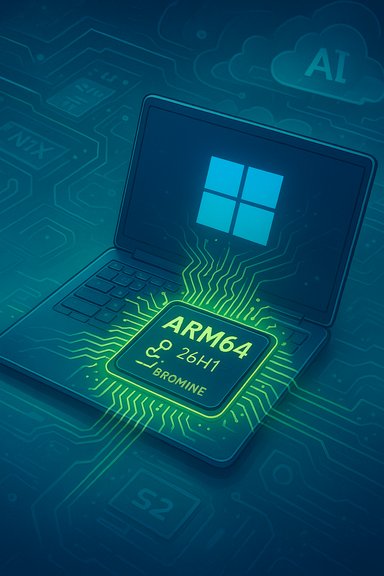
Microsoft has quietly pushed a Canary‑channel build that relabels Windows 11 as version 26H1 (build 28000) — but Microsoft is explicit: this is not the next broad feature update. Instead, 26H1 is a platform‑only, device‑targeted branch intended to enable support for “specific silicon,” and it will only be used on a narrow set of PCs at launch rather than rolled out to the entire Windows 11 installed base.
Microsoft’s Windows 11 update model has, since launch, centered on an annual H2 feature cadence with continuous servicing improvements. The company has used the Windows Insider channels — Canary, Dev, Beta, Release Preview — to experiment with different engineering streams. In late Canary testing Microsoft surfaced an Insider Preview that sets the visible OS version to Windows 11, version 26H1 (Build 28000). The key line from Microsoft’s Canary notes reads: “26H1 is not a feature update for version 25H2 and only includes platform changes to support specific silicon.” That message reframes the 26H1 label as an engineering baseline for new hardware rather than a conventional consumer feature release.
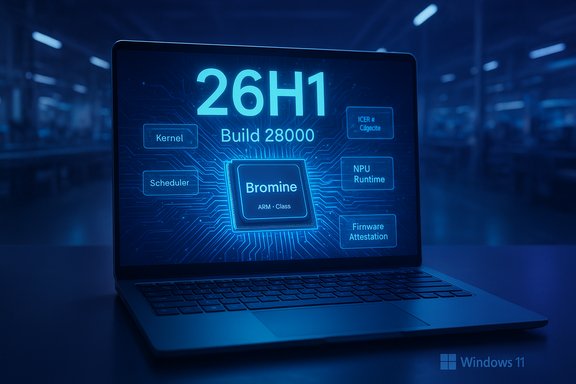
Industry reporting and community tracking have attached internal codenames (commonly reported as Bromine) and engineering reasoning to this work: Build 28000 represents a platform branch where deep, low‑level changes — kernel tweaks, scheduler updates, driver stacks and firmware attestation hooks — can be co‑validated with silicon vendors and OEMs without disturbing the mainstream 25H2 servicing branch. That separation reduces risk to the billions of existing Windows machines while letting OEM partners ship new devices that depend on OS plumbing not present in the current baseline.
Qualcomm’s next‑generation Snapdragon family (commonly reported as Snapdragon X2 Elite / X2 Elite Extreme) has been widely mentioned as the proximate trigger: press materials and reporting tied to the chip announced a generational jump in CPU microarchitecture, 3nm process claims, and substantial NPU throughput figures (reported in community coverage as high as ~45–80 TOPS for different SKUs). Qualcomm and partners indicated first‑wave devices could appear in early 2026, which aligns timewise with a platform branch created in late 2025 to allow co‑validation. Microsoft itself did not name Qualcomm in the Canary notes, but independent reporting has drawn the connection. Treat the vendor linkage as highly likely but not formally confirmed by Microsoft.
Arguments for optimism:
For end users and IT teams the sensible posture is simple: no urgent action. Continue to rely on the established 25H2/26H2 feature cadence for mainstream updates. If evaluating a first‑wave Arm laptop for early AI experiences, ask OEMs for explicit documentation about the shipped image, enabled features, and the servicing path. For the wider ecosystem, 26H1 is a pragmatic engineering tradeoff — one that can accelerate on‑device AI adoption when executed transparently, but one that demands careful coordination to avoid fragmentation and frustration.
Source: How-To Geek Windows 11 26H1 is coming, but only for some PCs
 Background / Overview
Microsoft’s Windows 11 update model has, since launch, centered on an annual H2 feature cadence with continuous servicing improvements. The company has used the Windows Insider channels — Canary, Dev, Beta, Release Preview — to experiment with different engineering streams. In late Canary testing Microsoft surfaced an Insider Preview that sets the visible OS version to Windows 11, version 26H1 (Build 28000). The key line from Microsoft’s Canary notes reads: “26H1 is not a feature update for version 25H2 and only includes platform changes to support specific silicon.” That message reframes the 26H1 label as an engineering baseline for new hardware rather than a conventional consumer feature release.Industry reporting and community tracking have attached internal codenames (commonly reported as Bromine) and engineering reasoning to this work: Build 28000 represents a platform branch where deep, low‑level changes — kernel tweaks, scheduler updates, driver stacks and firmware attestation hooks — can be co‑validated with silicon vendors and OEMs without disturbing the mainstream 25H2 servicing branch. That separation reduces risk to the billions of existing Windows machines while letting OEM partners ship new devices that depend on OS plumbing not present in the current baseline.
What exactly is Windows 11 26H1 (Build 28000)?
A platform branch, not a consumer feature pack
- Platform‑only: 26H1 has a deliberately lean public changelog — a handful of stability fixes — and Microsoft’s public position is clear: this flight’s purpose is platform enablement for particular hardware families rather than introducing broad UI or productivity features for all users.
- Canary channel staging: The build surfaced in the Canary channel, which Microsoft uses as the earliest testbed for platform plumbing (kernel, drivers, low‑level subsystems). Canary builds often never make it beyond the early testing rings into broad distribution.
- Build number signal: The new build number series (28000) and internal branch naming (reported as Bromine) signal a parallel engineering track — a snapshot OS image that OEMs and partners can use for co‑validation. The number indicates a platform milestone rather than an end‑user RTM feature release.
What it likely contains (under the hood)
Platform branches of this type typically include:- Kernel and scheduler updates tuned to heterogeneous CPU topologies (big/little or mixed microarchitectures).
- Power and thermal policy adjustments for new SoC power envelopes.
- New DCH driver bundles for GPUs, media pipelines, wireless stacks and camera ISPs.
- NPU/accelerator runtime integrations, attestation hooks, and secure‑enclave or firmware changes to support on‑device AI workloads.
- Servicing metadata and device catalog entries enabling targeted rollout or rollback for qualifying hardware.
Why is Microsoft doing a device‑targeted 26H1 now?
The silicon timing problem
The engineering reason for a targeted platform branch is straightforward: when new SoCs introduce meaningful architectural changes — large NPUs, revised memory subsystems, novel firmware semantics, or heterogenous core arrangements — those changes often require coordinated OS‑level work that’s difficult to graft safely onto the servicing baseline used by hundreds of millions of existing PCs.Qualcomm’s next‑generation Snapdragon family (commonly reported as Snapdragon X2 Elite / X2 Elite Extreme) has been widely mentioned as the proximate trigger: press materials and reporting tied to the chip announced a generational jump in CPU microarchitecture, 3nm process claims, and substantial NPU throughput figures (reported in community coverage as high as ~45–80 TOPS for different SKUs). Qualcomm and partners indicated first‑wave devices could appear in early 2026, which aligns timewise with a platform branch created in late 2025 to allow co‑validation. Microsoft itself did not name Qualcomm in the Canary notes, but independent reporting has drawn the connection. Treat the vendor linkage as highly likely but not formally confirmed by Microsoft.
Device launch reliability and OEM coordination
Shipping an OEM image that’s been co‑engineered and validated against the exact firmware and drivers the device will ship with reduces day‑one risk. By providing a Bromine/26H1 image to partners, Microsoft can:- Let OEMs flash a known‑good image at the factory.
- Coordinate driver signing, WHQL/partner testing, and image creation without disrupting the broader servicing stream.
- Reduce the blast radius of kernel‑level regressions to a narrow hardware set rather than the entire Windows install base.
Who will (and won’t) get 26H1 at launch?
Who will likely receive 26H1
- First‑wave devices built around the new silicon families (industry reporting points most strongly at Snapdragon X2‑class notebooks) and OEM images that require platform changes not present in 25H2. These systems may ship with a 26H1‑based factory image so day‑one drivers, attestations and on‑device AI features work correctly.
Who will not receive it (initially)
- The vast majority of existing Windows 11 PCs — especially Intel and AMD machines — are not expected to be pushed to 26H1 as a broad feature update. Microsoft has reiterated that 25H2 remains the primary place for new features and that a standard annual H2 feature release (26H2) will still be the main consumer update later in 2026. In short: ordinary users and enterprise fleets should expect the usual H2 release cadence.
Insiders and channel implications
- Canary insiders may see the version bump and can test platform plumbing, but Canary builds can require a clean reinstall to leave, and platform branches can include setup or firmware requirements incompatible with other channels. Dev and Beta continue to be the channels where feature‑first work is validated.
Technical implications: what Microsoft might change to enable these SoCs
Kernel, scheduler and heterogenous cores
New Arm laptop SoCs introduce mixed microarchitectures and higher core counts. OS schedulers and policies may need updates to take full advantage of new performance cores and efficiency clusters while keeping battery life and thermals in check. Bromine/26H1 likely contains scheduler tuning and kernel fixes targeted to these topologies.NPU runtimes, attestation, and secure model execution
Large on‑die NPUs require runtime stacks, signed manifests and firmware attestation to ensure models run securely on device. Microsoft has previously gated heavy AI features to qualifying Copilot+ devices that meet NPU and firmware attestation expectations; 26H1 can surface runtime hooks and secure‑enclave integrations required to deliver those experiences at launch.Driver model and DCH bundles
New GPUs, media IP, and ISP pipelines bring DCH driver stacks and vendor‑specific packaging needs. Platform branches let OEMs and vendors ship a validated driver stack as part of the factory image while Microsoft keeps broad Windows Update servicing stable for the rest of the ecosystem.Power/thermal governance and platform telemetry
SoC vendors often tune power domains and telemetry differently. Microsoft’s platform work may include new power governors, battery/power reporting changes, and updated telemetry hooks to let OEMs fine‑tune performance‑vs‑efficiency behavior on a per‑device basis.Strengths of Microsoft’s approach
- Reduced day‑one risk for OEMs and users: Ship a validated image to partners and minimize shipping devices with a measured, tested OS baseline.
- Preserves mainstream stability: By keeping the broad feature stream on 25H2/26H2, Microsoft avoids destabilizing the large existing user base with low‑level changes.
- Faster time‑to‑market for new silicon: OEMs can launch hardware earlier with full OS support, giving consumers access to new on‑device AI experiences sooner.
- Controlled testing and telemetry: Targeted Canary validation limits regressions to a constrained population, enabling more rapid iteration with partner telemetry and focused fixes.
Risks, unknowns and potential downsides
Fragmentation and consumer confusion
Shipping a release labeled “26H1” only to a subset of devices risks confusion: mainstream customers reading headlines may expect their PC to get the update. Microsoft must execute clear messaging and OEM point‑of‑sale labeling to avoid frustration. This naming decision — using an H‑style version string for a device‑targeted branch — raises communication risks.Driver/firmware teething problems
First factory images often uncover corner‑case regressions: fingerprint readers, docking station behavior, or third‑party agents can break in ways that are hard to predict. Enterprises must treat any 26H1 device as a unique SKU and validate management tooling aggressively before broad deployment.Potential for perceived or real exclusivity
If 26H1 ships with on‑device AI capabilities that are materially better on qualifying hardware, consumers may perceive a two‑tier Windows experience. Microsoft’s messaging states those features will reach the broader Windows ecosystem (likely via 26H2), but fidelity and performance parity could vary — particularly for features that rely on high‑end NPUs. Claims about permanent exclusivity should be treated cautiously until Microsoft and OEMs publish exact servcing commitments.Enterprise servicing complexity
Device‑targeted branches create servicing track complexity for IT: how will Intune, WSUS and other management systems identify Bromine devices? Microsoft and OEMs must publish clear servicing metadata and known‑issue rollback procedures; otherwise admin workflows risk being disrupted.Is 26H1 a step toward true Windows on ARM parity with macOS?
Short answer: not by itself. 26H1 appears to be a platform enablement snapshot — an engineering baseline that lets OEMs ship hardware and get low‑level integrations right. Parity with macOS for x86 app compatibility involves more than platform plumbing; it requires mature emulation layers, broad ISV native support, and sustained optimization across compiler and runtime ecosystems.Arguments for optimism:
- A well‑engineered platform baseline with deep NPU and runtime integrations is a necessary step for delivering local AI experiences that can compete with device‑centric macOS features.
- By co‑validating with silicon vendors and OEMs, Microsoft can achieve higher quality on ARM devices at launch, narrowing experience gaps.
- Emulation and ISV readiness remain core challenges. Windows on ARM historically relied on emulation layers (and translation layers) for x64/x86 apps. Achieving the seamless experience macOS enjoys with Rosetta required sustained ISV porting and an emulation story baked into the OS and toolchains.
- A single device‑targeted platform image does not by itself solve app compatibility, ecosystem inertia, or developer priorities — especially for niche or legacy enterprise apps.
- Microsoft’s own messaging emphasizes the platform nature of 26H1 and insists mainstream features remain on the H2 cadence; that suggests this is not a permanent branching of Windows into multiple feature streams but a practical engineering accommodation.
Practical advice: what different audiences should do now
Consumers shopping for a new laptop
- Confirm the device’s advertised Windows image: ask whether the laptop ships with a 26H1/Bromine image or standard 25H2.
- If you want early on‑device AI features (Copilot+ experiences), expect those to be hardware‑gated and potentially pre‑enabled only on specific devices at launch.
- If broad compatibility and predictable updates matter more than bleeding‑edge AI features, prefer mainstream 25H2/26H2 devices and wait for the H2 2026 feature release.
IT admins and enterprise buyers
- Treat any 26H1 device as a specialized SKU. Validate drivers, management tooling, security agents and peripherals in a pilot ring before wide deployment. Coordinate with OEMs on servicing and driver update mechanisms.
- Assume mainstream updates and feature parity will arrive on the 26H2 H2 2026 release; plan migrations and testing around that schedule rather than expecting 26H1 for fleet upgrades.
Developers and ISVs
- Expand Arm64 testing and implement graceful fallback strategies for NPU‑dependent features so experiences degrade gracefully when hardware acceleration is absent.
- If targeting on‑device AI experiences, collaborate early with OEMs or leverage Microsoft’s developer guidance for model runtime and attestation integration.
OEMs and silicon partners
- Use the Bromine/26H1 baseline to validate day‑one images, driver stacks and firmware attestation. Communicate clearly at point of sale which features require the new platform and how servicing will be handled post‑purchase.
Clear signals, but still some open questions
- Microsoft has made the most crucial point explicit: 26H1 is a targeted platform branch, not a mainstream feature update, and 25H2 remains the primary place for new features. That clarity prevents mass confusion about forced migrations.
- Independent reporting strongly links the branch to next‑gen Arm silicon (notably Qualcomm’s Snapdragon X2 family) and to OEM launch timing in early 2026, but Microsoft did not explicitly name vendors in the Canary notes. Treat vendor linkage as plausible and well‑supported by industry timelines, but technically unconfirmed until Microsoft or an OEM states specifics.
- The broader questions remain: Will Microsoft standardize this device‑first platform approach for future silicon waves? Will consumers see permanent functional gating for some features, and how will servicing metadata be exposed to enterprise management tools? The answer will depend on Microsoft’s coordination with OEMs and how the company balances time‑to‑market with clarity and minimal fragmentation.
Conclusion
Windows 11 version 26H1 (Build 28000) is an important engineering signal from Microsoft: the company is preparing a constrained, platform‑only branch to enable new silicon and reduce day‑one device risk. This approach preserves Microsoft’s broader annual H2 feature cadence while allowing OEMs and chip vendors to ship validated images for devices that require deeper OS plumbing. That’s good for hardware launch reliability — but it also raises practical challenges around messaging, potential user confusion, driver/firmware regressions and enterprise servicing complexity.For end users and IT teams the sensible posture is simple: no urgent action. Continue to rely on the established 25H2/26H2 feature cadence for mainstream updates. If evaluating a first‑wave Arm laptop for early AI experiences, ask OEMs for explicit documentation about the shipped image, enabled features, and the servicing path. For the wider ecosystem, 26H1 is a pragmatic engineering tradeoff — one that can accelerate on‑device AI adoption when executed transparently, but one that demands careful coordination to avoid fragmentation and frustration.
Source: How-To Geek Windows 11 26H1 is coming, but only for some PCs