Windows 11 26H1 Canary Build 28000: Platform Update for Snapdragon X2 PCs

  • Thread Author
Microsoft has quietly confirmed a new, unconventional Windows 11 release: Windows 11, version 26H1, now appearing in the Canary Channel as Build 28000 and labeled by Microsoft as a platform-only update intended to support specific new silicon. Insiders running the Canary Channel will see the version string change in Settings and winver, and Microsoft says this release is not a conventional feature update for version 25H2 — instead it contains targeted platform changes to enable upcoming hardware.

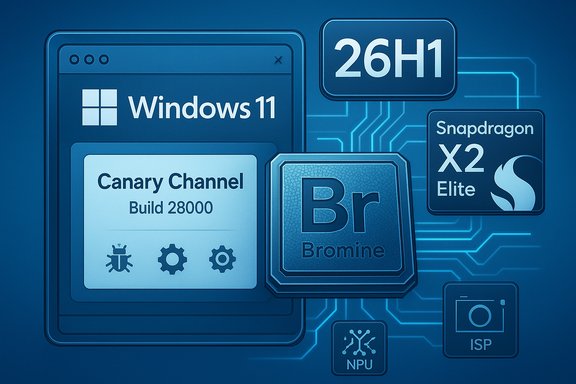
Blue tech collage featuring Windows 11 Canary Channel, Br Bromine, Snapdragon X2 Elite, and 26H1.Background​

Over the past three years Microsoft shifted Windows 11 development away from the twice-yearly “H1/H2” feature cadence used early in the Windows 10 era and toward a single, annual feature update. Microsoft’s recent behavior — shipping an earlier, platform-focused update exclusively to new ARM-based Copilot+ devices and then following with a broader rollout later — established a precedent with version 24H2. The version being surfaced now, 26H1, appears to be the next iteration of that approach: a platform release intended to enable next-generation Arm silicon rather than to deliver consumer-facing feature changes to all PCs. This split-path model is important to understand: Microsoft can sign off a new platform baseline (internally codenamed Bromine in reporting) and ship that baseline on devices that require it — notably the first wave of Snapdragon X2-based Copilot+ laptops — while continuing to develop and distribute feature work through the existing 25H2 track for the broader hardware base. The strategy reduces the risk of blocking new hardware launches while retaining the company’s stated annual feature-update rhythm.

What Microsoft released: Build 28000 in the Canary Channel​

The initial Canary release for Insiders is Build 28000. Microsoft’s release notes for this flight describe the update as containing a “small set of general improvements and fixes” plus a short list of bug fixes. The update also explicitly sets the reported version to Windows 11, version 26H1 for Canary testers. Microsoft stresses that 26H1 is not a feature update for 25H2 and “only includes platform changes to support specific silicon.” The announcement also repeats that 25H2 remains the primary place for new features, and that Dev and Beta channels will continue to be the primary venues for early feature previews while Canary is used mainly for platform-level changes. Key fixes called out in the initial build include:
  • Fixes for Live Captions crashes experienced in earlier flights.
  • A fix for credentials window accessibility when logging into Outlook in recent flights.
Known issues listed in the Canary notes include:
  • The redesigned Start menu unexpectedly scrolling to the top for some Insiders.
  • Reports that sleep and shutdown may not be working correctly in recent Canary builds.
These are small-scope items in a Canary flight, but they’re telling in two ways: Microsoft is validating low-level platform stability across a small group of testers, and it is doing so before any broad consumer rollout.

Why 26H1 exists: enabling the next wave of Arm silicon​

Microsoft’s wording — “platform changes to support specific silicon” — leaves one clear question: what silicon? Multiple industry outlets and consistent signals from OEM and silicon vendors point to Qualcomm’s Snapdragon X2 family (announced for Copilot+ PCs) as the most likely target for this platform release. The Snapdragon X2 Elite family delivers substantial improvements in CPU architecture, GPU, and on-device NPU performance (vendors quote up to 80 TOPS for the Hexagon NPU on some X2 parts), and those gains are accompanied by new memory, I/O, and power management expectations that commonly require kernel, driver, and firmware integration work at the OS platform level. Qualcomm’s X2 platform increases complexity and capability:
  • Up to 18 CPU cores in some X2 configurations (hybrid Prime + Performance cores).
  • Significantly larger NPUs and expanded AI throughput targets (tens of TOPS).
  • Support for higher memory bandwidth, new display and GPU features, and additional system services intended to accelerate on-device AI workloads.
When silicon departs substantially from existing platform expectations, operating systems — and especially Windows, with its long history of device-driver boundaries and power/firmware interactions — often require a new platform baseline to guarantee stability, correct power management, and full access to on-die acceleration (NPUs, ISPs, etc.. That’s the practical rationale behind a release like 26H1. Caveat: Microsoft’s release does not explicitly name Qualcomm or the Snapdragon X2 family in the Canary announcement. Public reporting and registration of references to 26H1 in Microsoft internal files make the Snapdragon X2 hypothesis the most credible explanation, but the vendor-specific linkage remains an informed interpretation rather than a direct Microsoft quote. This uncertainty should guide any vendor- or enterprise-level planning.

How this affects Windows release channels and the Windows Insider Program​

Windows Insiders will see familiar rules: Dev and Beta remain the hunting grounds for new features and UX experiments, while Canary — at least in the short term — is a staging area for low-level platform work that could be device-limited. Microsoft’s public notes call out one notable constraint: switching out of Canary back to a channel that receives lower build numbers generally requires a clean install of Windows. That’s a standard but significant technical limitation; Canary’s role as a platform sandbox carries friction for testers who later want to return to mainstream channels. From a broader release-planning view, this announcement reinforces a two-track outcome for 2026:
  • A device-limited, early-2026 platform release (26H1/Bromine) that brings support for new Arm silicon and the first wave of Copilot+ features on those devices.
  • A later, broader 26H2 release that will carry feature parity and arrive across the existing PC ecosystem later in the year on Microsoft’s normal annual cadence.
This model reduces the operational risk of blocking OEMs that depend on new silicon launches, but it also increases the complexity of communicating timelines and features to consumers, enterprises, and ISVs.

Developer and ISV implications: driver, app, and AI optimization​

For developers and independent software vendors, a platform release like 26H1 has two immediate technical consequences:
  • Drivers and low-level system components that touch CPU power states, memory controllers, firmware interfaces, NPUs, or proprietary accelerators may need updates to align with the new platform ABI and firmware expectations. This can force early coordination between Microsoft, OEMs, and silicon partners to get validated drivers ready before device launch.
  • Apps that rely on local AI acceleration — from image processing to personal assistants — may be able to take advantage of X2-class NPUs for accelerated workflows. However, fragmentation in availability (X2 devices first; broader rollout later) means vendors may need bifurcated testing and packaging strategies — an X2-optimized binary path and a fallback path for legacy hardware.
The PRISM/x86 emulation story matters here as well. Microsoft has been investing in emulation and translation layers (including prism/prism-emulation updates) to reduce the friction of running legacy x86/AVX2 workloads on Arm-based PCs. Those emulation improvements are evolving in parallel with native ports and platform updates; they are an important compatibility bridge but not a full substitute for native NPU/SoC optimizations.

Consumer impact: who gets 26H1 and when?​

The short answer for most users: not immediately, and possibly not at all on your existing PC. Early reporting and Microsoft’s framing indicate that 26H1 will be targeted at the devices that truly require it — the first wave of Copilot+ PCs equipped with Snapdragon X2-class chips. Wider distribution of the same or similar capabilities will come later in 26H2, which is the general feature update expected on Microsoft’s annual schedule. That raises two practical outcomes:
  • Buyers seeking the earliest access to the newest on-device AI experiences and optimized performance for X2 hardware will be channeled toward Copilot+ devices and the specific OEMs that ship them.
  • Enterprises and consumers with existing Intel/AMD hardware will continue to receive feature updates through the standard path and may need to wait for 26H2 for parity.
This staggered rollout can be interpreted positively — it accelerates the launch of important new hardware — or negatively — it creates a perception of fragmentation where some experiences arrive first on hardware from a narrow set of partners.

Risks and downsides: fragmentation, testing burden, and upgrade complexity​

A platform-only release targeted at a subset of hardware is an efficient engineering solution, but it introduces risks that deserve critical analysis:
  • Fragmentation risk: Shipping different platform baselines for device subsets increases the number of supported combinations Microsoft must validate across drivers, firmware, and cloud services. For enterprises and ISVs, this raises the coordination cost to ensure feature parity and compatibility across fleets.
  • Testing burden: OEMs and driver vendors must ramp QA for X2-specific paths and for the fallback 25H2/26H2 world. That can stretch validation teams and slow down broader rollouts if regressions are discovered late.
  • Upgrade complexity: Canary is not easily reversible to other channels without reinstalling Windows. Consumers who opt-in for early testing on Canary should understand the force of that decision. For organizations, device management must account for the fact that platform-only updates may not be meaningful for older hardware yet still require planning if mixed fleets are in use.
Finally, there’s a market-perception risk: early platform exclusivity for Copilot+ experiences may be interpreted as favoritism toward specific hardware vendors, even if Microsoft’s technical justification is sound. Messaging and transparency will be essential to mitigate frustration among users who feel left behind.

Benefits: faster time-to-market, optimized AI experiences, and power-efficiency gains​

Despite the risks, the approach has defensible benefits:
  • Faster time-to-market: OEMs can ship devices using the validated platform baseline that matches the new SoC, letting hardware and software debut together rather than waiting for a monolithic Windows release.
  • Better on-device AI: Snapdragon X2’s larger NPU capabilities and upgraded ISPs enable local AI scenarios that are more responsive and private than cloud-first approaches. Platform-level support helps ensure that these features are deeply integrated with power, thermal, and security subsystems.
  • Efficiency: Platform-level improvements often include low-level power-management and scheduler fixes that allow SoCs to meet their promised power/performance envelopes, improving battery life and sustained workload performance on thin-and-light designs. Qualcomm’s X2 documentation emphasizes gains in power efficiency and AI throughput that would be wasted without appropriate OS integration.

What testers and IT administrators should do now​

For Windows Insiders interested in evaluating this early platform baseline, a cautious and methodical approach is prudent:
  • Join the Windows Insider Program and enroll specifically in the Canary Channel if you want to see build 28000 and the 26H1 version string. Understand that Canary builds are experimental and may have regressions.
  • Back up all important data before installing Canary builds; consider testing on secondary hardware or in a controlled VM/guest environment where possible.
  • Report bugs via Feedback Hub — platform regressions (sleep/shutdown, drivers, thermal/power) benefit most from diagnostic telemetry and replicable repro steps.
  • For IT administrators: avoid deploying Canary builds in production. Use the Dev and Beta Channels for feature testing that aligns with your update schedule, and wait for general availability before planning fleet-wide rollouts.

Industry context: Copilot+, PRISM emulation, and the broader Arm momentum​

Microsoft and its hardware partners have been building the infrastructure for a more Arm-driven PC ecosystem for several years. Two parallel trends are relevant here:
  • Copilot+ PCs and on-device AI: OEM and silicon vendors (notably Qualcomm) aim to deliver AI workloads on-device for responsiveness and privacy. The Snapdragon X2 family is designed to expand those capabilities dramatically, but OS-level integration is a prerequisite for delivering consistent user experiences.
  • Emulation and compatibility (PRISM): Microsoft’s investments in emulation and translation (including support for AVX/AVX2 through PRISM-style engines) have reduced the friction of running legacy x64 workloads on Arm hardware. Emulation improvements and native ports will coexist; platform-level changes like those in 26H1 are orthogonal but complementary to compatibility efforts.
Taken together, these trends explain why Microsoft might prefer a platform-first release on a limited set of devices: the hardware leap is large enough that the supporting software stack must be tested and tuned in the field before broad deployment.

Verdict: pragmatic engineering or user segmentation?​

Microsoft’s confirmation of Windows 11, version 26H1 in Canary is a clear signal that the company is preparing a platform release timed to launch-new-software-with-new-hardware realities. The advantages are tangible: faster device launches, optimized on-device AI, and targeted validation for radically different SoCs.
Yet the approach carries communication and policy challenges. Consumers and enterprises must be clearly informed about which devices will receive which updates and when. Developers and ISVs need predictable timelines for driver and app updates, and organizations must be prepared for mixed-fleet complexity where some devices run a different platform baseline than others.
The prudent interpretation is that Microsoft is balancing competing priorities: enabling a significant hardware transition without disrupting the overall Windows roadmap. For users who want to be at the frontier of Windows on Arm and on-device AI, 26H1 represents an important milestone. For the broader Windows ecosystem, the real test will be how quickly Microsoft and its partners translate that early platform work into a seamless, broadly available 26H2 that brings parity to the rest of the PC world.

Closing thoughts and what to watch next​

The immediate items to watch are straightforward:
  • Canary telemetry and early Insider feedback on Build 28000, particularly around sleep/shutdown and Start menu regressions reported in the flight notes.
  • OEM device announcements and shipping windows for Snapdragon X2-based Copilot+ laptops, which will determine how rapidly 26H1 moves from Canary to device rollouts. Qualcomm and partners have signaled early-2026 availability for X2 devices.
  • Microsoft’s public messaging about whether 26H1 will ever be broadly distributed to non-X2 devices, or whether all customers will wait for a consolidated 26H2 later in the year. Until Microsoft clarifies that roadmap point, businesses should assume a staged, hardware-first approach.
Windows 11 version 26H1 is not a typical feature update: it’s a targeted, platform-level step designed to bridge Windows with a new class of Arm silicon. For Insiders and early adopters the Canary release is a chance to test and report on that bridge; for the larger Windows ecosystem, the release is a reminder that the platform continues to evolve in lockstep with advances in silicon and that Microsoft is willing to use non-traditional release patterns to support new hardware.
Source: Neowin Microsoft announces Windows 11 version 26H1, now available for testing
 

Microsoft has quietly opened the door to a new Windows 11 platform branch: Insider Preview Build 28000 has landed in the Canary Channel and updates the visible version string to Windows 11, version 26H1, but Microsoft stresses this is a platform-focused flight for specific silicon and not the next consumer feature release for 25H2.

A bright yellow canary perches on a blue CPU chip amid Windows 11 branding.Background / Overview​

Microsoft’s Insider channels serve different engineering goals, and the Canary Channel is the earliest place Microsoft tests low‑level platform plumbing and experimental kernel or driver changes. The Build 28000 Canary drop is a classic example of that model: the build changes the reported Windows version to 26H1 while containing only a “small set of general improvements and fixes” in its public notes — and an explicit clarification that 26H1 is not a feature update for 25H2 and “only includes platform changes to support specific silicon.” That short, careful messaging matters: a version label jump (26H1) can easily be misread as the next broad feature release. Microsoft’s announcement avoids that confusion by positioning this Canary release as an engineering baseline for hardware enablement rather than a consumer-facing feature push. Windows 11 will continue its annual feature cadence — major feature updates are still expected to arrive in the second half of the calendar year — while this 26H1 branch appears to be a targeted platform branch to validate new silicon.

What Build 28000 actually contains​

Summary of the public notes​

The brief public changelog for Build 28000 lists two fix highlights and a small set of known issues:
  • Fixes
  • Live Captions crashes experienced in earlier Canary flights were fixed.
  • The credentials/login dialog for Outlook that had become inaccessible in recent flights was corrected.
  • Known issues
  • Users with the redesigned Start menu may see the Start UI unexpectedly jump or scroll to the top.
  • Reports exist that sleep and shutdown behavior may not work correctly on some devices after recent Canary builds; Microsoft is investigating.
These are the kind of Canary‑scale items — targeted, high‑visibility regressions and low-level stability concerns — you expect to see while platform plumbing stabilizes. The notes explicitly avoid promising any broad feature additions for the mainstream 25H2 stream.

What’s not in the build​

There are no consumer-facing feature rollouts in this flight: no major UI overhauls, no new system apps, and no feature-first changes being previewed for general availability. The decision to label the Canary build 26H1 is a platform/versioning move, not an announcement that everyday Windows 11 users will see new features immediately. Microsoft has framed 25H2 as the primary feature development branch and reiterated the annual H2 cadence for broadly distributed feature updates.

Why Microsoft is doing this: platform enablement for next‑gen silicon​

The hardware angle: Snapdragon X2 and a new generation of Arm PCs​

Public reporting and community telemetry strongly point toward Microsoft using this platform branch to validate support for new Arm‑based silicon — most notably Qualcomm’s Snapdragon X2 family (marketed for high‑end Copilot+ PCs). Snapdragon X2 — and other next‑gen Arm SoCs under discussion in the ecosystem — introduce larger NPUs, new CPU core topologies, higher memory bandwidth, and firmware semantics that often require kernel, scheduler, and driver-level changes in Windows. That combination of new hardware features makes a separate platform baseline pragmatic. Qualcomm and industry outlets have signaled early‑to‑mid 2026 as the likely shipping window for X2‑based systems, which aligns with a device‑targeted platform release appearing in Canary now. Microsoft and OEM partners typically prefer to receive a validated OS image that contains tuned drivers and firmware hooks so devices can ship with a known‑good software baseline on day one. Using a platform branch for that engineering work is a well‑worn pattern.

Copilot+ devices and on‑device AI: why a platform branch helps​

The Copilot+ hardware program and the broader push for on‑device AI place new requirements on the OS: signed NPUs runtimes, secure attestations for models, scheduling policies for on‑die accelerators, and tighter integration between firmware and kernel. Validating those layers in a targeted branch reduces the risk of regressions across the billions of existing Windows installations while letting OEMs ship devices that depend on the new capabilities. Microsoft’s public Canary note uses the phrase “platform changes to support specific silicon,” signaling this precise intent.

Technical expectations: what to expect under the hood​

Likely components of a platform branch like Bromine/26H1​

If Build 28000 (the community-reported “Bromine” platform) is the foundation for new Arm devices, the engineering contents you can reasonably expect include:
  • Kernel and scheduler updates to support heterogeneous core arrangements and large core counts.
  • Power‑management and thermal policy updates tuned for new SoC power envelopes.
  • DCH driver bundles for new Adreno GPU variants, updated wireless/FastConnect stacks, and camera/ISP integrations.
  • Hexagon/NPUs runtime libraries and attestation mechanisms for local model execution.
  • Servicing metadata and device catalog entries that enable targeted enablement and rollback mechanics for qualifying hardware.
These items are the kind of plumbing that doesn’t look exciting in a feature checklist but is essential for stable device launches where media, AI, and performance expectations are high.

Emulation and compatibility implications for Windows on Arm​

Windows on Arm continues to depend on emulation layers (Prism/emulator) for x64/x86 compatibility. Improvements in those areas — such as expanded AVX/AVX2 support in the emulator — are orthogonal to the platform baseline but will matter for app compatibility on Arm machines. Recent work across the ecosystem is making Arm laptops more viable for a wider set of workloads, but emulation remains an architectural cost and a compatibility risk vector for some legacy drivers and kernel components.

Risks, fragmentation, and enterprise implications​

Fragmentation and update communication risks​

A platform branch that is device‑targeted introduces operational questions:
  • Will devices that ship on 26H1/Bromine follow a separate servicing path? If so, how will enterprises track and manage security updates and feature parity?
  • Could OEMs ship devices with a Bromine baseline while the broader installed base remains on 25H2, creating subtle behavioral differences between device classes?
  • How will Microsoft communicate which devices receive the Bromine baseline and which remain on the main servicing track?
Microsoft’s public messaging attempts to minimize these concerns by calling the Canary release platform‑only and not a general feature update, but the potential for confusion remains. Administrators should not assume parity between Bromine‑based devices and the wider Windows 11 fleet until Microsoft and OEMs publish clear servicing and support policies.

Compatibility and third‑party driver risk​

Platform-level changes can expose incompatibilities in kernel-mode drivers, antivirus/endpoint agents, virtualization stacks (Hyper‑V, WSL), and other deep components. Canary builds — by their nature — will surface some of these regressions early. Enterprises must keep testing matrices updated and coordinate with ISV vendors to validate mission‑critical drivers and security tooling on any Bromine-based images before procurement or rollouts.

Security and policy considerations​

On-device AI and Copilot+ features typically require new runtime and attestation hooks that dovetail with device security boundaries. Devices shipping on a Bromine baseline could include new secure‑enclave integrations or signing requirements that affect how device identity and local AI workloads are managed. Security teams should assess whether Bromine devices require different update, attestation, or key‑management processes and whether those processes align with enterprise policies.

What the known issues tell us (and what to watch)​

The immediate practical regressions​

The Build 28000 notes list two classes of issues that are illuminating:
  • Start menu scrolling/Jumping: The redesigned Start menu may unexpectedly scroll to the top for some Insiders. UI regressions like this indicate that layout and input handling behaviors are still being validated in the new branch.
  • Sleep and shutdown anomalies: Multiple Canary flights recently have shown problems with sleep and shutdown, and Insiders report power transitions not behaving as expected. These are serious for everyday usability and point to low‑level power-management or firmware interactions still under test.
Both items are typical of early platform testing: high‑visibility but fixable issues that are precisely what Canary is designed to capture.

Telemetry and community feedback will drive fixes​

Because Canary telemetry is smaller and more targeted than Dev/Beta, the signals Microsoft receives will tend to be early indicators rather than broad fault statistics. Expect Microsoft to iterate quickly, shipping fixes across multiple Canary flights before the platform baseline is finalized with OEMs. Insiders who participate should file detailed Feedback Hub traces if they reproduce regressions; the right diagnostic artifacts help Microsoft investigate kernel and firmware interactions faster.

Practical guidance: what Insiders, OEMs and IT should do now​

For enthusiasts and Insiders​

  • Install Canary builds only on spare or test devices. Canary can contain low‑level changes that require a clean install to revert.
  • Create full backups and recovery media before installing. Canary builds can introduce boot or driver issues that necessitate a recovery.
  • Use Feedback Hub and include diagnostic traces for any regressions you encounter. Detailed repro steps increase the chance of quick fixes.

For OEMs and silicon partners​

  • Prioritize coordinated driver and firmware testing with Microsoft: kernel changes, NPU runtimes, power management, and latest DCH bundles should be validated against the Bromine branch to reduce day‑one support load.
  • Prepare device catalog and enablement mechanics for targeted servicing and Known Issue Rollback (KIR) scenarios.

For enterprises and IT departments​

  • Treat Bromine/26H1 devices as a separate product class until Microsoft issues clear servicing guidance. Expect to pilot devices under real management conditions (imaging, Intune/MDM, WSUS/WUfB) before broad procurement.
  • Validate backup/recovery workflows and test WinRE/Quick Machine Recovery behavior against your incident response playbooks — platform branches can change recovery defaults.
  • Keep security and endpoint teams in the loop: verify that any Bromine‑specific runtime or attestation hooks fit enterprise security policies and that EDR/AV vendors have validated their kernels/drivers on the new platform.

What remains unverified or speculative​

Several community and industry claims circulating around 26H1 should be treated cautiously:
  • The explicit statement that 26H1/Bromine will be exclusive to Copilot+ or Snapdragon X2 devices is plausible given past patterns, but Microsoft has not publicly committed to a permanent exclusivity policy. Treat claims of permanent gating as probable but not confirmed until Microsoft or OEMs publish official program rules.
  • Links to non‑Qualcomm silicon (for example, NVIDIA N1x) appearing in community threads are possible but remain speculative. Industry rumors surface early; until Microsoft or the silicon vendor confirm, the association is an informed hypothesis rather than a finished plan.
  • The exact final RTM build number and whether the Bromine baseline will be folded into the general 26H2 release later in the year are engineering details that can change. Community captures indicate build 28000 as a likely sign‑off target, but Microsoft’s engineering pipeline can adjust build numbers before finalization. Treat the round number as a credible signal, not a binding commitment.

Strategic takeaways​

  • Microsoft’s use of a Canary 26H1 build demonstrates a pragmatic, device‑first approach to enabling new silicon: validate the plumbing in a controlled channel, then ship hardware with a tuned image, and finally merge user‑facing features into the broader annual release cadence. That approach minimizes day‑one risk for OEMs and improves the shipping experience for early buyers.
  • For most Windows users and administrators, there is no immediate action required. The mainstream feature track remains 25H2 for now, and Microsoft has reiterated the H2 schedule for general feature rollouts. Only Insiders and device makers need to engage with 26H1 now.
  • The approach introduces communication and servicing transparency risks. Enterprises should insist on clear Microsoft and OEM guidance about servicing, security patching, and device catalog entries for any Bromine/26H1 hardware they plan to purchase.

Conclusion​

Build 28000’s appearance in the Canary Channel and the visible version bump to Windows 11, version 26H1 is an engineering signal: Microsoft is preparing a platform baseline to support a new wave of silicon and device scenarios, not launching a general consumer feature update for all Windows 11 PCs. The Canary notes confirm a small set of fixes, a handful of known issues to be resolved in the coming flights, and a company emphasis that 25H2 remains the primary feature track while Windows continues its annual H2 cadence. For Insiders, OEMs, and IT teams, the next weeks and months will reveal whether 26H1/Bromine becomes the foundation for Snapdragon X2 Copilot+ launches and how Microsoft will manage servicing and communications for a split‑path device ecosystem. Until those policy and servicing details are explicit, cautious testing, clear procurement pilots, and close coordination with vendors remain the best paths forward.
Source: Windows Report Microsoft Starts Testing Windows 11 26H1 With Canary Build 28000
 

Back
Top