

Microsoft has confirmed that Windows 11, version 26H1 will ship as a narrowly scoped, hardware‑gated release — available only on new PCs built around Qualcomm’s Snapdragon X2 family — and not as a general update for the existing Windows installed base.
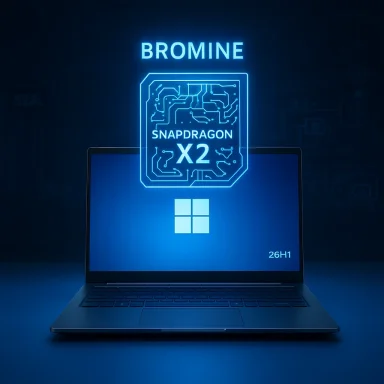
Microsoft’s announcement of Windows 11 version 26H1 marks a significant operational shift in how the company will deliver platform updates going forward. Rather than a universal feature update pushed through Windows Update, 26H1 is a factory‑installed, OEM‑flashed platform image intended to support specific next‑generation Arm silicon. The internal engineering platform for this release is commonly referred to as Bromine, and the Canary‑channel test builds for the release use the 28xxx build series (commonly cited as Build 28000).
This release strategy is intentional: Microsoft is shipping a Windows image tailored to the low‑level kernel, driver stacks, power management and NPU/accelerator plumbing that new Arm chips require from day one. In practice that means 26H1 will appear preinstalled on qualifying Snapdragon X2 laptops and similar devices, and it will not be offered as an in‑place update to the broad population of Windows 11 devices currently on versions 24H2 or 25H2.
Microsoft’s lifecycle documentation lists February 10, 2026 as the start date for version 26H1 and gives consumer SKUs (Home and Pro) a support window that runs through March 14, 2028. Enterprise and Education SKUs for 26H1 show a longer support window, running into 2029. Those concrete dates matter: they define the servicing lane for any device shipped with 26H1 and set expectations for security update timelines across manufacturers and IT departments.
Benefits for the ecosystem:
The core message for everyone in the Windows ecosystem is simple: read the label on the device. If it ships with Windows 11, version 26H1, expect device‑specific servicing, a different upgrade cadence, and the potential for new capabilities — but also new planning requirements. Microsoft, Qualcomm and OEM partners have created a pathway aimed at accelerating next‑generation Arm devices; the wider success of that path will depend on clear communication, robust certification and predictable migration mechanics in the months ahead.
Source: Mix Vale Microsoft confirms Windows 11 26H1 exclusive to Qualcomm’s new Snapdragon X2 processors
 Background / Overview
Microsoft’s announcement of Windows 11 version 26H1 marks a significant operational shift in how the company will deliver platform updates going forward. Rather than a universal feature update pushed through Windows Update, 26H1 is a factory‑installed, OEM‑flashed platform image intended to support specific next‑generation Arm silicon. The internal engineering platform for this release is commonly referred to as Bromine, and the Canary‑channel test builds for the release use the 28xxx build series (commonly cited as Build 28000).This release strategy is intentional: Microsoft is shipping a Windows image tailored to the low‑level kernel, driver stacks, power management and NPU/accelerator plumbing that new Arm chips require from day one. In practice that means 26H1 will appear preinstalled on qualifying Snapdragon X2 laptops and similar devices, and it will not be offered as an in‑place update to the broad population of Windows 11 devices currently on versions 24H2 or 25H2.
Microsoft’s lifecycle documentation lists February 10, 2026 as the start date for version 26H1 and gives consumer SKUs (Home and Pro) a support window that runs through March 14, 2028. Enterprise and Education SKUs for 26H1 show a longer support window, running into 2029. Those concrete dates matter: they define the servicing lane for any device shipped with 26H1 and set expectations for security update timelines across manufacturers and IT departments.
What Microsoft actually confirmed — the essentials
- Platform target: 26H1 is intended for ARM‑based devices built around next‑generation silicon, with Qualcomm’s Snapdragon X2 family explicitly named as the initial hardware platform.
- Distribution model: 26H1 will be preinstalled by OEMs on qualifying devices rather than pushed broadly through Windows Update.
- No in‑place update: Existing Windows 11 PCs on 24H2/25H2 will not be upgraded to 26H1 through normal channels.
- Separate servicing lane: Devices that ship with 26H1 will be serviced on their own lane; Microsoft has confirmed they will not receive the mainstream 26H2 feature upgrade in fall 2026.
- Lifecycle dates: Version 26H1’s consumer support window begins February 10, 2026 and ends March 14, 2028 (Enterprise/ Education timelines extend further).
- Engineering baseline: The release is built on a new core (Bromine) and uses build numbers in the 28000 series.
Why Microsoft took this route: technical rationale
Moving Windows onto a new core for a subset of hardware is unusual but not without engineering precedent. Here’s the concise rationale:- Modern Arm SoCs increasingly rely on deep integration between firmware, microcontrollers, NPUs, DSPs and the OS kernel to deliver both performance and efficiency. Ship‑time optimizations — power‑state tuning, GPU/NPU drivers, scheduling and IO path adjustments — require a tight alignment between OS, firmware and silicon.
- Delivering a generic Windows image that attempts to be one‑size‑fits‑all risks delaying hardware releases or shipping devices with suboptimal battery life or feature support. A preinstalled, device‑specific image lets OEMs and silicon partners tune the platform together.
- Microsoft’s Bromine platform appears to introduce engineering changes that are not trivially backward compatible with the existing Germanium‑based servicing lane, hence the decision to isolate 26H1 devices until a future convergence release.
What’s in 26H1: the reality versus expectations
For end users scanning for shiny new features, the headline should be: 26H1 is not primarily a consumer feature update. Reports and early release notes indicate the visible user experience will largely preserve parity with contemporary Windows 11 releases; the substantive changes are under the hood:- Kernel and scheduler adjustments optimized for Arm cores and heterogeneous CPUs.
- New driver and firmware interfaces to support the Snapdragon X2 families’ NPU, GPU and power domains.
- Power management and thermal policies tuned for the new silicon to deliver the claimed battery improvements.
- Revised platform runtime for on‑device AI features and Copilot+ workloads leveraging large local NPU throughput.
- Changes to legacy components and servicing behaviors — some deprecated elements have been reported, which could affect older compatibility scenarios.
The Snapdragon X2 angle: what Qualcomm gains — and what this means for OEMs
Qualcomm’s Snapdragon X2 family is the hook that explains the timing. The X2 chips were designed to push Windows on Arm into wider markets, promising stronger single‑thread CPU performance and dramatically beefed‑up NPU capacity for on‑device AI.Benefits for the ecosystem:
- OEM differentiation: Manufacturers can advertise devices that ship with a platform image tuned for the X2 family — better out‑of‑box AI experiences, longer battery life, and platform‑level features that would be hard to retrofit.
- Faster hardware time‑to‑market: OEMs and Qualcomm can ship devices simultaneously with an OS baseline certified to support key silicon features.
- Copilot+ readiness: Devices with large on‑device NPUs and dedicated acceleration can enable new classes of offline/low-latency AI features Microsoft is pushing in its Copilot ecosystem.
- OEMs must coordinate imaging, driver signing and certification with Microsoft earlier and more tightly than for a normal Windows release.
- Support contracts and servicing obligations must reflect the device‑specific servicing lane for 26H1, with explicit communication to enterprise customers about feature update cadence and lifecycle end dates.
Who should care — and who probably shouldn’t
- Consumers who want the absolute latest Windows‑on‑Arm hardware — especially if they prioritize on‑device AI or battery life — will find 26H1 devices compelling. If the Snapdragon X2 delivers on Qualcomm’s promises, early adopters will enjoy class‑leading efficiency and NPU power.
- Developers pushing native Arm64 builds, or integrating on‑device inference, must test on 26H1 images to validate performance and driver interactions for the new hardware.
- Enterprises and IT admins: for production deployments, the guidance is conservatively simple — do not treat 26H1 as the mainstream update. Microsoft continues to recommend 24H2 or 25H2 for enterprise rollouts in 2026. The separate servicing lane and the fact that 26H1 devices will skip 26H2 in fall 2026 complicate lifecycle planning and image management.
- Casual users of existing Intel/AMD or older Arm machines need not act. 26H1 will not be pushed to them, and mainstream feature efforts will continue in the 26H2 branch later in 2026.
Risks and downsides: platform fragmentation, enterprise headaches, and compatibility pitfalls
This move raises several immediate and medium‑term risks:- Perception of fragmentation. To consumers and IT staff, the idea that “Windows 11” now comes in multiple incompatible plumbing variants increases confusion. Messaging must be clear: 26H1 is for new Arm silicon and appears only on qualifying OEM images.
- Enterprise procurement complexity. Buying a fleet of 26H1 devices today requires understanding their separate servicing lane, update cadence, and how OEM support will operate when feature parity with the broader Windows branch is required.
- App compatibility and legacy support. Differences in runtime glue or removed legacy components could catch poorly tested line‑of‑business applications by surprise. This is especially relevant where apps rely on older frameworks, virtual drivers, or kernel‑mode components that may not be carried forward unchanged.
- Developer burden. If hardware‑specific behavior becomes common, developers will need to expand testing matrices to include the Bromine platform and Arm‑first devices like Snapdragon X2 systems.
- Migration ambiguity. Microsoft has promised a migration path to bring 26H1 devices back onto the mainstream servicing lane in a future release, but precise timing and mechanics remain unclear. That uncertainty can complicate long‑term IT planning.
Benefits: performance, battery life, and a path for on‑device AI
Despite the risks, there are clear technical advantages that justify Microsoft’s engineering decision:- Optimized performance per watt. Early engineering notes and device briefings claim better real‑world battery life and more consistent peak performance on X2 hardware when run on a tuned platform image.
- Enablement of advanced on‑device AI. Larger NPUs mean richer offline AI features with lower latency—important for privacy, reliability, and responsiveness in Copilot+ scenarios.
- Fewer last‑minute silicon workarounds. By shipping a platform that is designed with the SoC’s needs in mind, OEMs avoid the less desirable option of bolting on fixes after devices are already in market.
Practical guidance for buyers, admins and developers
If you are deciding whether to buy, deploy, or develop for a 26H1 device, here’s a concise checklist:- For consumers:
- Buy a 26H1 device if you prioritize on‑device AI and battery life, and you accept that the device will follow a slightly different feature cadence.
- Verify the OEM’s warranty and support policy for updates and driver delivery for the specific model you plan to purchase.
- For IT admins and enterprise buyers:
- Do not adopt 26H1 for wide enterprise rollouts at launch. Stick with 24H2 or 25H2 for predictable servicing and compatibility.
- If considering a pilot, confirm the OEM’s SLAs and Microsoft’s servicing commitments for security patches vs. feature updates.
- Map the application inventory against Arm compatibility and test critical LOB applications on 26H1 hardware before approving any production use.
- For developers:
- Add 26H1 images to your test matrix if your app targets on‑device AI or is performance‑sensitive on Arm64.
- Prioritize building native Arm64 binaries where possible and validate emulation (Prism) behavior for x86 applications.
- Prepare to diagnose driver or user‑mode behavior that may be different on the Bromine platform.
- For OEMs and partners:
- Document the device’s update path and lifecycle commitments clearly and ensure channel partners understand servicing implications.
- Work with Microsoft to certify imaging, driver signing and update mechanisms carefully to avoid field problems.
How this shapes the Windows ecosystem: short and mid‑term impacts
Short term (0–12 months):- A small, visible split in the Windows 11 family will appear in market messaging and device SKU tables.
- Tech press and buyers will focus on early Snapdragon X2 systems as the showcase hardware for on‑device AI.
- OEMs shipping 26H1 will be doing so with targeted marketing about AI, battery life and Copilot features.
- Microsoft will need to deliver a convergence release to realign the Bromine and Germanium branches; that roadmap and timeline will be watched closely by enterprises.
- Developers and ISVs will expand Arm64 support coverage; the mainstream software ecosystem will increasingly treat Arm as a first‑class platform.
- The market dynamic between Arm‑based Windows devices, Apple silicon, and x86 PCs will accelerate competition around battery life and local AI capabilities.
Open questions and what to watch next
- When will Microsoft publish the concrete mechanics and timing of the migration path from 26H1 back to the mainstream servicing lane? The company has promised a pathway but not a release number or schedule.
- Will more silicon vendors (for example, NVIDIA’s rumored N1X) require 26H1‑class platform support at launch, and how quickly will Microsoft broaden 26H1 availability to additional Arm vendors?
- How will OEMs handle driver updates and optional feature rollouts for 26H1 devices outside of Microsoft’s regular feature cadence?
- Which legacy components will Microsoft deprecate or remove in Bromine, and how will that affect niche enterprise or industry software?
- How will pricing and value propositions evolve if Snapdragon X2 devices succeed in delivering the promised performance and battery benefits?
Reading the tea leaves: strategic implications for Microsoft and the industry
Microsoft’s decision to ship 26H1 as a device‑specific release signals a few broader strategic priorities:- The company is doubling down on enabling on‑device AI and tighter hardware‑software co‑design for Arm platforms, likely because customer value in AI responsiveness and privacy is increasingly tied to local (not cloud) processing.
- Microsoft is pragmatically accepting short‑term servicing divergence in exchange for faster, more stable hardware launches — a tradeoff that shifts some update complexity to OEMs and enterprise customers.
- This move could accelerate third‑party software vendors’ commitment to Arm, making Windows on Arm a more credible competitor to the established x86 base and Apple’s M‑series on the performance‑and‑efficiency front.
Conclusion — a measured call to action
Windows 11 version 26H1 is a deliberate, engineering‑driven, hardware‑gated release designed to get cutting‑edge Arm silicon into customers’ hands with the appropriate OS plumbing. If you are an early adopter who values on‑device AI and the promise of Snapdragon X2 performance and efficiency, 26H1 systems will be compelling devices to evaluate. If you manage enterprise fleets or depend on strict lifecycle predictability, treat 26H1 as a niche platform for pilots only and continue deploying the mainstream 24H2/25H2 branches for production.The core message for everyone in the Windows ecosystem is simple: read the label on the device. If it ships with Windows 11, version 26H1, expect device‑specific servicing, a different upgrade cadence, and the potential for new capabilities — but also new planning requirements. Microsoft, Qualcomm and OEM partners have created a pathway aimed at accelerating next‑generation Arm devices; the wider success of that path will depend on clear communication, robust certification and predictable migration mechanics in the months ahead.
Source: Mix Vale Microsoft confirms Windows 11 26H1 exclusive to Qualcomm’s new Snapdragon X2 processors
