

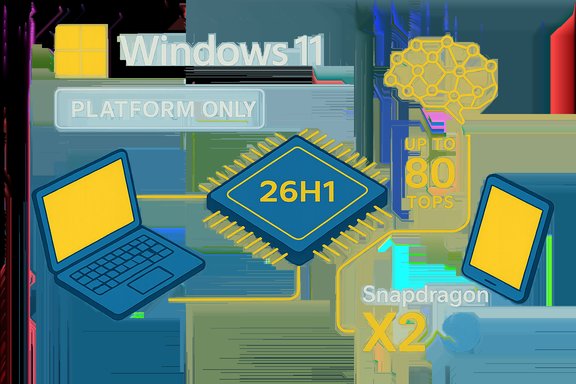
Microsoft’s Canary-channel build has made one thing abundantly clear: Windows 11 version 26H1 is a platform branch, not the next mass‑market feature update, and most users—home consumers and enterprise fleets alike—do not need to change course today. The Windows Insider team pushed Build 28000 to the Canary Channel and explicitly updated the visible version to “Windows 11, version 26H1,” while adding a short but decisive clarification: “26H1 is not a feature update for version 25H2 and only includes platform changes to support specific silicon. There is no action required from customers.” This move confirms what industry reporting and community investigation had been suggesting for weeks: 26H1 exists primarily to enable new silicon, not to deliver a broad set of consumer-facing features.
Microsoft’s Windows Insider channels have long been used to separate different kinds of development work: Canary for early platform plumbing, Dev for longer‑lead engineering experiments, Beta for more polished feature previews, and Release Preview for near‑shipping candidates. The Canary Channel is deliberately experimental; builds there frequently contain low‑level kernel, driver, scheduler, and firmware integration changes that are intended for validation rather than consumer production. The Build 28000 release updates the Windows version string to 26H1 in Settings and winver, but the changelog is minimal and the emphasis is on platform changes—not new user features. Community research and prior reporting tied this platform work to the arrival of new Arm‑centric and AI‑focused silicon, most prominently Qualcomm’s Snapdragon X2 family. Qualcomm’s public materials and independent press coverage describe X2 chips with dramatically larger NPUs (Hexagon NPU up to ~80 TOPS) and high performance CPU/GPU claims, and they place first‑wave devices in the first half of 2026—precisely the window where a device‑targeted platform branch would be useful. Independent outlets summarized Qualcomm’s announcement and the projected device timing, supporting the rationale behind a platform‑first Windows image. At the same time, leaks and servicing artifacts discovered by community investigators suggested Microsoft had internal tokens referencing a 26H1 branch; those engineering breadcrumbs were the first signals that Microsoft was preparing a distinct platform line internally. Microsoft’s Canary build and its explicit messaging now make that internal work visible to Insiders.
A mature path forward demands three things:
If anything changes—if Microsoft pivots the distribution model, or if OEMs announce their X2 device plans with unexpected gating—those will be material developments worth watching in the coming months. For now, the message from the Windows Insider team is simple: 26H1 is not for everyone, and you don’t need to do anything.
Source: PCWorld It's official: Windows 11 26H1 isn't for you
 Background / Overview
Microsoft’s Windows Insider channels have long been used to separate different kinds of development work: Canary for early platform plumbing, Dev for longer‑lead engineering experiments, Beta for more polished feature previews, and Release Preview for near‑shipping candidates. The Canary Channel is deliberately experimental; builds there frequently contain low‑level kernel, driver, scheduler, and firmware integration changes that are intended for validation rather than consumer production. The Build 28000 release updates the Windows version string to 26H1 in Settings and winver, but the changelog is minimal and the emphasis is on platform changes—not new user features. Community research and prior reporting tied this platform work to the arrival of new Arm‑centric and AI‑focused silicon, most prominently Qualcomm’s Snapdragon X2 family. Qualcomm’s public materials and independent press coverage describe X2 chips with dramatically larger NPUs (Hexagon NPU up to ~80 TOPS) and high performance CPU/GPU claims, and they place first‑wave devices in the first half of 2026—precisely the window where a device‑targeted platform branch would be useful. Independent outlets summarized Qualcomm’s announcement and the projected device timing, supporting the rationale behind a platform‑first Windows image. At the same time, leaks and servicing artifacts discovered by community investigators suggested Microsoft had internal tokens referencing a 26H1 branch; those engineering breadcrumbs were the first signals that Microsoft was preparing a distinct platform line internally. Microsoft’s Canary build and its explicit messaging now make that internal work visible to Insiders.What Microsoft shipped in Build 28000 — the essentials
- Version string updated to Windows 11, version 26H1 (visible in Settings > System > About and winver).
- Changelog is deliberately light: small fixes and quality improvements rather than new consumer features.
- Microsoft’s explicit positioning: 26H1 is a platform-only branch intended to support specific silicon; 25H2 remains the main feature track and Windows will continue an annual H2 feature cadence.
- The Canary Channel remains the experimental testbed; builds there may contain concepts that never ship beyond Insiders.
Why a device‑targeted platform branch makes engineering sense
- Coordinated drivers and firmware. New SoCs bring new GPU, NPU, ISP, and power-management behaviors that require DCH driver stacks, signed firmware blobs, and tuned power profiles. Packaging a validated OS image with those drivers reduces out‑of‑box breakage.
- On‑device AI attestation and runtime testing. Copilot+ experiences and other local AI features rely on NPUs and attestation flows to ensure local processing and privacy guarantees. Validating those pieces on a limited set of certified devices lowers the risk of privacy, performance, or security regressions on day one.
- Controlled rollout and telemetry. A device‑validated image gives Microsoft and OEMs targeted telemetry from homogeneous hardware, making it faster to diagnose and remediate device‑specific issues such as docking, camera ISP regressions, or unexpected thermal behavior.
- Practical OEM logistics. OEMs prefer shipping tested images that match their firmware and driver bundles. A dedicated platform image simplifies certification and retail readiness for first‑wave hardware.
The Qualcomm connection: Snapdragon X2 basics and why it matters
Qualcomm’s Snapdragon X2 family (announced at its Snapdragon Summit) is explicitly positioned for premium Windows laptops and claims substantial improvements in CPU, GPU, and NPU capabilities. Key public claims from Qualcomm and independent reporting include:- Hexagon NPU rated at approximately 80 TOPS for INT8 workloads—an order‑of‑magnitude step for on‑device inference that is central to low‑latency AI experiences.
- Up to 18-core configurations on flagship X2 Extreme parts, with high single‑thread boost clocks and large caches.
- Vendors and Qualcomm place first X2‑based devices in H1 2026, creating a practical launch window where coordinated OS support is valuable.
What this means for different audiences
For typical consumers (Home / Pro)
- No action required. If you run Windows 11 today on Intel or AMD hardware, you will not be forced onto a separate 26H1 track. Microsoft explicitly positioned 25H2 as the main feature branch and reassured customers that 26H1 is not a general feature update.
- If you buy a future Copilot+ laptop claimed to use Snapdragon X2, expect OEM images to be validated and potentially include features that are gated to certified hardware at launch. Those features should broaden to the general Windows population later—likely in the H2 feature release—though their runtime characteristics may differ on non‑NPU hardware.
For enterprise IT
- Treat early X2 devices as pilots, not mass‑deployments. Use a confined validation ring in Intune or WSUS before wide rollout. Test management agents, anticheat/DRM, VPNs, and security stacks thoroughly on vendor images before approving broad deployment.
- Ask OEMs for SKU-level documentation that maps device models to servicing targets (so that targeted eKB flips or KIR entries can be traced in your inventory).
For OEMs and silicon partners
- Co‑engineering with Microsoft is essential for device launch success. Coordinate driver signing, firmware timelines, and certification so first‑ship images are stable and well‑documented.
For developers and ISVs
- Prioritize Arm64 CI coverage and validate kernel‑mode and DRM/anticheat components on Arm environments. Consider graceful NPU fallback strategies for models so features do not catastrophically fail on systems without the required NPU.
Strengths of Microsoft’s approach
- Reduced launch risk. Shipping a device‑validated OS image with tuned drivers, runtimes, and firmware reduces the typical “day one” support storm for OEMs and retailers.
- Privacy and performance guarantees. Constraining on‑device AI to devices with certified NPUs and attestation logic helps Microsoft and partners meet privacy commitments while ensuring performance claims hold up in real usage.
- Operational flexibility. Microsoft’s servicing model—shipping binaries in servicing and using small enablement packages (eKBs) or targeted Known Issue Rollback (KIR) tokens—lets the company stage features without breaking the mainline for everyone. This is a mature, documented pattern in Microsoft’s modern update strategy.
Risks, tradeoffs, and areas of concern
- Potential for perceived fragmentation. If certain AI features debut on a constrained set of Copilot+ devices, users and enterprise admins may perceive that Microsoft is intentionally fragmenting Windows. Messaging must be crystal clear to avoid confusion. Microsoft’s Canary note helps, but broad consumer communications will still be necessary.
- Support complexity for IT. Device‑targeted branches complicate inventory and update management. IT teams must map servicing targets to devices and anticipate different timelines for feature parity across hardware classes.
- Uncertainty around eventual parity. Features that debut on NPU‑enabled hardware may later arrive for more devices, but the quality of those experiences (latency, privacy posture, local vs cloud execution) could differ materially. Enterprises and users should not expect identical behavior after feature parity is delivered.
- Public trust and transparency. When features are hardware‑gated, clear OEM labeling at purchase and plain‑language documentation about what runs locally vs in the cloud are required. Without these, early adopters may feel misled.
- Reliability of community leaks. While engineering artifacts and service tokens provided strong signals for a 26H1 branch, those are not formal product commitments. Microsoft’s public Canary post corrects the narrative in part; still, any reports about prolonged exclusivity or permanent feature locks should be treated as unverified until Microsoft or an OEM confirms them.
Practical checklist: what to do now
- Confirm your current Windows version if you’re curious: check Settings > System > About or run winver. Insiders can also inspect channel settings; ordinary users on Windows 11 should remain on 25H2 for mainstream features.
- If evaluating X2‑based Copilot+ hardware, request explicit OEM documentation about pre‑enabled features, servicing targets, and update mechanics before purchase.
- For IT admins: create a pilot ring in Intune/WSUS for first‑wave X2 devices and validate critical management, security, and productivity workflows on vendor images.
- For ISVs: expand Arm64 testing and implement NPU fallback strategies so experiences degrade gracefully where hardware isn’t present.
What’s confirmed vs. what remains unverified
- Confirmed: Microsoft released Build 28000 to Canary and updated the visible version to 26H1 with explicit language that it is not a feature update for 25H2 and is focused on platform changes for specific silicon.
- Confirmed: Qualcomm publicly announced the Snapdragon X2 series with headline claims such as ~80 TOPS Hexagon NPU and projected H1 2026 device availability—details corroborated by multiple outlets.
- Probable but unverified: Some community leaks (known‑issue rollback tokens, Canary metadata and tipster reports) suggested 26H1 was being prepared specifically as a device‑targeted release for Snapdragon X2 systems. Those engineering breadcrumbs are credible signals but were not a public Microsoft commitment until the Canary posting and still do not establish final consumer distribution mechanics or permanent exclusivity. Treat rumors about long‑term feature gating as tentative until formally documented by Microsoft or OEMs.
The bigger picture: platform branches, staged enablement, and the future of Windows updates
Microsoft’s modern servicing model separates the presence of a feature binary from its activation. By staging binaries into the servicing pipeline and enabling them with small eKBs or device‑targeted flips, Microsoft can deliver capabilities first on validated hardware and later to the broader install base. That pattern accelerates time‑to‑market for new silicon while helping the company protect privacy and performance claims. However, repeated use of device‑first branches risks confusing consumers and enterprise buyers if naming and SKU messaging are inconsistent.A mature path forward demands three things:
- Clear OEM labeling at point of sale about which features are hardware‑gated and which are broadly available.
- Transparent documentation from Microsoft on how device‑targeted servicing will be identified in Intune, WSUS, and other management systems.
- Measured public messaging to set expectations: day‑one features on Copilot+ PCs should be presented as early, hardware‑validated experiences with feature parity timelines for the broader fleet.
Conclusion
The Canary‑channel release of Build 28000 and the visible 26H1 label do not signal a mass Windows upgrade for ordinary users. Microsoft explicitly described 26H1 as a platform‑only branch intended to support specific silicon, and independent industry reporting connects that work to Qualcomm’s Snapdragon X2 family and the practical need to validate new NPU, CPU, and driver behaviors ahead of device launches. For most users and IT administrators the sensible posture is unchanged: continue to rely on the mainstream 25H2 release for new features and treat any 26H1 messaging as a targeted engineering branch used to enable new hardware at launch. For OEMs, partners, and developers, the Canary work is a signpost—prepare testing, document SKU servicing, and ensure graceful fallbacks for NPU‑dependent features. Microsoft’s approach reduces launch risk and primes Windows for an era of powerful on‑device AI, but it also raises a communication and management challenge that the company and its partners must solve if the rollout is to be judged a success rather than a source of fragmentation and frustration.If anything changes—if Microsoft pivots the distribution model, or if OEMs announce their X2 device plans with unexpected gating—those will be material developments worth watching in the coming months. For now, the message from the Windows Insider team is simple: 26H1 is not for everyone, and you don’t need to do anything.
Source: PCWorld It's official: Windows 11 26H1 isn't for you
