

Microsoft’s Ignite keynote pushed Windows 11 unmistakably into an AI-first direction, recasting the operating system as a platform for autonomous agents — but the applause has been mixed, and the rollout has exposed real tensions between visionary automation and the day‑to‑day demands of stability, security, and predictable developer tooling. Microsoft’s message at Ignite emphasized new agent infrastructure, direct connectors, and a surfaced Copilot experience woven into the taskbar and desktop, yet community reaction ranged from excitement about productivity gains to sharp alarm about privacy, performance, and the erosion of fundamentals that many users still prize.
Windows has historically balanced platform evolution with backward compatibility and enterprise reliability. The most recent pivot — described publicly by Windows leadership as an operating system that is “evolving into an agentic OS” — accelerates that balance into a risk/benefit inflection point: agents promise automation across apps and cloud services, but they also expand the OS attack surface and add continual background workloads that could affect responsiveness on many machines. The social reaction was immediate and vocal; the Windows lead acknowledged that “we have work to do” after developer and power‑user backlash. Two contextual anchors matter for any evaluation:
But the roadmap presents clear trade‑offs:
The next year will be decisive. If Microsoft backs its agentic vision with measurable improvements in reliability, clear governance primitives, and conservative defaults, the platform could deliver tangible gains without alienating the people who keep Windows running at scale. If not, the community backlash that followed Ignite will harden into migration risk and long‑term reputation damage. The practical question for enterprises and users is simple: pilot cautiously, require auditable controls, and do not accept agentic convenience in exchange for diminished control or a brittle upgrade path.
Source: The Hindu Microsoft Ignite 2025: Windows 11 push sparks debate over AI ambitions and OS stability
 Background
Windows has historically balanced platform evolution with backward compatibility and enterprise reliability. The most recent pivot — described publicly by Windows leadership as an operating system that is “evolving into an agentic OS” — accelerates that balance into a risk/benefit inflection point: agents promise automation across apps and cloud services, but they also expand the OS attack surface and add continual background workloads that could affect responsiveness on many machines. The social reaction was immediate and vocal; the Windows lead acknowledged that “we have work to do” after developer and power‑user backlash. Two contextual anchors matter for any evaluation:- Windows 10 reached the end of its standard support window late in 2025, forcing migrations and amplifying sensitivity to upgrade friction.
- Microsoft’s Copilot strategy — spanning cloud, Copilot Studio, and the new Copilot+ hardware tier — is now the connective tissue for agent capabilities that act across local apps and cloud services.
What Microsoft announced at Ignite 2025
Microsoft’s Ignite messaging and technical blog posts outlined several concrete moves that turn the agent concept into product features and APIs:- Taskbar‑centric discoverability: an “Ask Copilot” experience in the taskbar, plus taskbar‑resident agents showing progress and status. This is designed to reduce context switches and normalize agents as always‑available collaborators.
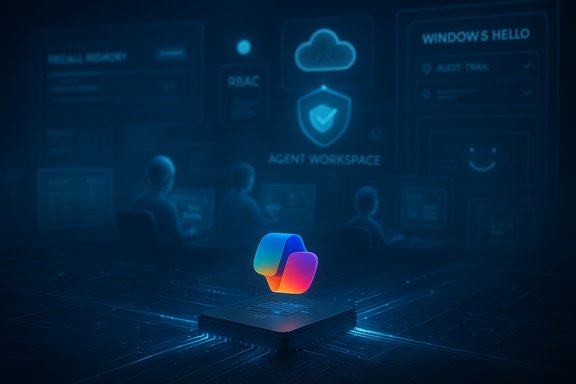
- Agent Workspace: a constrained runtime where agents run under isolated agent identities, with scoped permissions and audit trails intended to make actions traceable and manageable by admins. Microsoft emphasized a human‑in‑the‑loop model with visible session boundaries.
- Model Context Protocol (MCP) support and connectors: Windows will expose MCP and built‑in connectors to let agents discover capability providers (apps, services, local files) and execute multi‑step workflows. MCP is positioned as the interoperability layer for agents and tools.
- Copilot+ hardware and on‑device AI: Microsoft certified a Copilot+ class of PCs with dedicated NPUs (Neural Processing Units) to run stronger on‑device models; OEM spec pages and Microsoft materials cite an NPU performance target in the ballpark of 40 TOPS for richer local experiences.
- Recall and Click‑to‑Do: a privacy‑guarded, opt‑in “Recall” preview that can snapshot screen activity for local search and actions, subject to Windows Hello gating and TPM‑backed encryption. Microsoft explicitly reworked Recall’s privacy controls after earlier reviews.
The technical architecture in practice
Agent Workspace and identity separation
The Agent Workspace is a runtime sandbox that attempts to balance interactivity (agents that click, type, and manipulate UIs) with isolation. Agents run under separate agent accounts and are meant to be auditable in telemetry and logs — a design intended to let admins apply ACLs, Intune policies, and revocation semantics to agent identities. This identity-first approach is a key engineering choice: it treats agents like principals in the OS rather than unprivileged helper threads.MCP and connectors
MCP provides a standardized way for agents to call tools and services, removing the N×M integration problem between models and endpoints. In Windows, MCP servers are expected to be hosted by apps or services that expose a controlled API surface to agents. This model enables powerful workflows but increases the importance of robust authentication, RBAC, and DLP — weaknesses here can allow agents to overreach or exfiltrate data. Microsoft and independent outlets have warned about prompt injection and tool‑poisoning risks in MCP scenarios.On‑device AI, NPUs, and Copilot+
Microsoft’s Copilot+ certification targets devices with NPUs capable of roughly 40 TOPS of inference throughput to enable local small‑model reasoning for voice, vision, and some planning tasks. OEM spec sheets and product listings for Copilot+ machines confirm this baseline in shipped hardware. Devices that lack that NPU capacity will fall back to cloud execution for heavier reasoning tasks. This distinction creates a new two‑tier experience across the Windows ecosystem.Security and privacy: threat models get more complicated
Introducing agents that can act on behalf of users — open files, interact with apps, call cloud services — fundamentally changes the security calculus. Microsoft’s security teams are upfront about new threats, and the company has published guidance, tooling, and mitigations, but the risks remain material.- Cross‑prompt injection (XPIA): attackers can embed adversarial instructions inside documents, websites, or UI elements that an agent will parse and act upon. Microsoft specifically flagged XPIA as a high‑risk scenario, and recent platform tooling (Prompt Shields, Spotlighting in Azure AI Foundry) focuses on detection and real‑time blocking.
- Compromised MCP servers and tool poisoning: because MCP servers can expose tool access, an unvetted or malicious connector could escalate agent privileges or direct agents to perform harmful actions. The model‑to‑tool binding requires robust authentication and whitelisting.
- Credential and token leakage: agents acting under user‑level or delegated privileges can accidentally or maliciously exfiltrate tokens, secrets, or files unless DLP and sensitivity checks are enforced at the platform boundary. Microsoft recommends inline DLP, RBAC, and auditable logs integrated with SIEM.
- Recall and persistent context: features that retain snapshots or agent memory increase the surface for privacy mistakes. Microsoft’s public docs insist Recall is opt‑in, protected by Windows Hello and TPM encryption, and limited via admin controls — but any persistent, searchable local memory requires ironclad access control and clear retention policies to avoid surprises.
Performance and stability concerns
A central complaint from developers and power users is that agentic features arrive at a moment when many still perceive Windows 11 as suffering regressions, inconsistent UI behavior, and periodic performance hits after updates. Several incidents have hardened that perception:- In October 2025, a cumulative update (KB5066835) disrupted the Windows Recovery Environment (WinRE) on many devices by disabling USB keyboard and mouse input; Microsoft issued an out‑of‑band fix (KB5070773) to restore functionality. The incident highlighted the danger of a high‑frequency update model introducing regressions into recovery paths.
- Preview testing and community reports show that agent workspaces and always‑on helper processes can consume CPU, memory, and NPU cycles, and that heavy agent tasks (large model inference, batch media processing) will impact foreground responsiveness on constrained systems. Microsoft claims idle agents are light, but real‑world variability means many users — particularly those on older hardware — will feel the difference.
- Beyond raw CPU or memory use, the platform expansion increases the number of moving parts: more services, connectors, and policies that can fail or interact unexpectedly — a classic reliability multiplier. Frequent small updates that touch kernel subsystems or the shell increase the chance that a regression will affect developer workflows (local web servers, debugging, WinRE).
Developer and community backlash — why it matters
Developers are not merely vocal; they shape the future of platform ecosystems. The reaction to the agentic framing and to visible regressions was swift and multi‑pronged:- Many developers argued Microsoft is prioritizing an agentic vision over the determinism and tooling that make Windows an effective development platform. Public criticism included high‑profile voices warning that Windows risks pushing builders toward macOS or Linux if compatibility and predictable APIs are not prioritized.
- The Davuluri post that described Windows as “evolving into an agentic OS” drew large volumes of negative replies; Microsoft leadership later acknowledged user concerns and promised renewed focus on reliability and developer experience. The acknowledgement is necessary but not sufficient without a transparent remediation roadmap.
- Practical grievances about the taskbar, context menus, and missing power‑user affordances have become emblematic; these UX regressions are often cited as evidence that polish and small‑scale usability are being deprioritized. For a platform that lives on muscle memory and automation scripts, such regressions have outsized impact.
Enterprise impact and governance
For IT leaders, the agentic shift requires explicit governance and a new operational playbook:- Inventory and policy: catalog agents and connectors, apply allowlists, and integrate agent permissions with device management (Intune) and Entra identities. Microsoft’s docs already provide admin controls to block or allow Recall and agent features on managed devices.
- Logging and SIEM: ensure agent actions flow into existing telemetry pipelines, build SOC playbooks for agent‑centric threats (XPIA, tool poisoning), and enable tamper‑evident auditing for high‑sensitivity operations. Microsoft has prioritized integrations with Sentinel and Security Copilot for agent detection and response.
- Pilot and hardware planning: treat agentic features as experimental in production fleets. For offline/on‑device guarantees, plan refreshes to Copilot+ certified hardware selectively where the business case demands it, and measure CPU/NPU/battery impact under representative workloads.
- Regulatory and privacy posture: where regulated data is involved, restrict or disable agentic memory features and require explicit user‑level consent plus strict retention policies. Recall, for example, is opt‑in and removable for managed devices — but the operational footprint must be tested and documented before wide adoption.
Practical recommendations (for users, admins and developers)
- Treat agentic features as preview-grade until your org has audited agent logs, permissions and recovery paths. Use Insider channels for validation, not for production rollout.
- Require signed agents and use allowlists for MCP connectors; integrate agent lifecycle into identity governance.
- Monitor resource consumption: baseline CPU, memory and battery before enabling agents; run capacity tests on representative hardware (including non‑Copilot+ machines).
- Harden DLP and SIEM for agent telemetry; extend existing incident playbooks to include prompt‑injection and automated action rollbacks.
- If privacy or compliance is a concern, maintain Recall disabled on managed devices and require explicit opt‑in for users who need it. Validate the Windows Hello gating and TPM protections in your environment before permitting use.
Strengths, trade‑offs and where Microsoft can regain trust
The architecture carries material promise: properly implemented agents can automate time‑consuming multi‑app tasks, improve accessibility with voice/vision input, and unlock new developer ecosystems around MCP and agent connectors. Microsoft’s platform control, end‑to‑end developer tooling, and enterprise relationships give it a rare capability to ship a cohesive agentic OS at scale — and Copilot+ hardware plus local NPUs may deliver meaningful latency and privacy benefits when done correctly.But the roadmap presents clear trade‑offs:
- Trust vs. convenience: agents that operate on files and screens by default risk eroding user trust unless opt‑in, transparent defaults, and granular revocation are strictly enforced. Microsoft’s rework of Recall’s privacy features and the requirement of Windows Hello are positive examples — but perception matters as much as policy.
- Performance vs. universality: Copilot+ hardware can offload heavy inference to NPUs, but the two‑tier experience invites fragmentation. Users on older hardware will rely on cloud fallbacks that add latency and cost. OEM adoption and clear upgrade paths will determine how inclusive the agentic experience becomes.
- Innovation vs. reliability: the cadence of previews, staged feature flags, and continuous updates can accelerate innovation — but only if quality assurance and recovery tooling keep pace. The WinRE incident in October 2025 underlines how costly regression in recovery paths can be.
Conclusion
Microsoft Ignite 2025 made an important strategic bet: treat Windows as a platform where AI agents are first‑class citizens. The technical stack — Agent Workspace, MCP, Copilot+ hardware, and Recall — is coherent and capable of delivering new productivity models. At the same time, the rollout has illuminated the discipline required to introduce autonomy into a mass‑market OS: security and privacy engineering must outrun feature marketing, performance must be demonstrably acceptable across a heterogeneous device landscape, and the developer and admin communities must see predictable APIs and reliable recovery behavior.The next year will be decisive. If Microsoft backs its agentic vision with measurable improvements in reliability, clear governance primitives, and conservative defaults, the platform could deliver tangible gains without alienating the people who keep Windows running at scale. If not, the community backlash that followed Ignite will harden into migration risk and long‑term reputation damage. The practical question for enterprises and users is simple: pilot cautiously, require auditable controls, and do not accept agentic convenience in exchange for diminished control or a brittle upgrade path.
Source: The Hindu Microsoft Ignite 2025: Windows 11 push sparks debate over AI ambitions and OS stability
