

Microsoft’s decision to split the Canary channel and seed a new 29500-series of builds is more than a rebranding trick — it’s the first publicly visible sign of a deliberate, early-stage “platform lift” that could determine whether Windows 11 evolves into a truly modern, maintainable OS or becomes another brittle patchwork of legacy compatibility and rushed features.
Microsoft announced an optional Canary update — Windows 11 Insider Preview Build 29531.1000 — on February 18, 2026, and described it as the start of a new 29500-series platform stream focused on foundational, low-level work rather than user-facing feature previews. Insiders must opt in via Settings > Windows Update > Advanced options > Optional updates; the company warns that this path intentionally focuses on platform plumbing and that some features may be temporarily missing while those under‑the‑hood changes are validated.
Independent coverage and community reporting picked up the change immediately: Windows Central and TechRadar framed the split as the beginning of a long, cross‑team effort to prepare Windows for its next major platform baseline (widely expected to feed into what’s being discussed as the 27H2 cadence), and noted that Microsoft will keep the existing 28000-series builds in Canary for feature-focused testing. Community discussion captured the practical consequences and clarifications from Microsoft, including the fact that the migration to 29500 builds is opt‑in and that returning to the old path may require a clean OS reinstall in many cases.
This split is important because it separates two engineering goals that have long been entangled: the rapid delivery of visible features (UI tweaks, app improvements, Copilot integrations) and deep platform plumbing (kernel changes, driver interfaces, hardware enablement). By splitting Canary, Microsoft can iterate on both concurrently without one blocking the other — at least in theory. The real question is how well this will manage risk for users, OEMs, and ISVs that depend on Windows’ backward compatibility.
From an engineering perspective this is sensible. Surface features are cheap to iterate on: they can be disabled, toggled by server flags, or shipped gradually. Kernel and driver changes, by contrast, are high‑risk because they touch third‑party drivers, firmware, and deeply embedded enterprise software. Testing those changes in a narrower, opt‑in population reduces blast radius while giving Microsoft the chance to iterate earlier.
There is a real chance this becomes the long-awaited “platform lift” — a disciplined engineering campaign that removes decades of cruft and makes the OS easier to secure, test, and evolve. But success is not guaranteed. The transition’s outcome will depend on Microsoft’s discipline: how transparent it is with partners, how comprehensive its compatibility tooling is, and how patient it is with ecosystem stakeholders who must update drivers and software.
For Insiders: treat 29531 and the 29500 stream as a lab, not a preview of new consumer features. For enterprises: begin inventory and vendor outreach now. For Microsoft: deliver the communication, tooling, and timelines the ecosystem will need to avoid repeating past mistakes.
The surface changes — a movable taskbar or a resurrected Start layout — make headlines, but the real battle is under the hood. If Microsoft gets the under‑the‑hood work right, 27H2 could finally be the technical reset Windows has needed for years. If not, the platform lift could become a long, painful stretch of compromised compatibility and frustrated partners. The next 18 months will tell which path the company chooses.
Source: igor´sLAB Windows 11 27H2: Microsoft splits the Canary channel – Is the big overhaul finally coming? | igor´sLAB
 Background / Overview
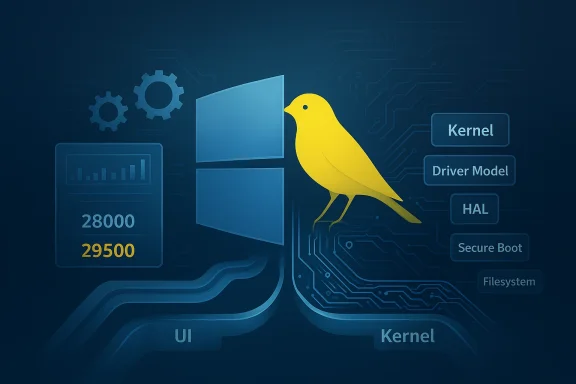
Microsoft announced an optional Canary update — Windows 11 Insider Preview Build 29531.1000 — on February 18, 2026, and described it as the start of a new 29500-series platform stream focused on foundational, low-level work rather than user-facing feature previews. Insiders must opt in via Settings > Windows Update > Advanced options > Optional updates; the company warns that this path intentionally focuses on platform plumbing and that some features may be temporarily missing while those under‑the‑hood changes are validated.Independent coverage and community reporting picked up the change immediately: Windows Central and TechRadar framed the split as the beginning of a long, cross‑team effort to prepare Windows for its next major platform baseline (widely expected to feed into what’s being discussed as the 27H2 cadence), and noted that Microsoft will keep the existing 28000-series builds in Canary for feature-focused testing. Community discussion captured the practical consequences and clarifications from Microsoft, including the fact that the migration to 29500 builds is opt‑in and that returning to the old path may require a clean OS reinstall in many cases.
This split is important because it separates two engineering goals that have long been entangled: the rapid delivery of visible features (UI tweaks, app improvements, Copilot integrations) and deep platform plumbing (kernel changes, driver interfaces, hardware enablement). By splitting Canary, Microsoft can iterate on both concurrently without one blocking the other — at least in theory. The real question is how well this will manage risk for users, OEMs, and ISVs that depend on Windows’ backward compatibility.
What the 29500-series actually represents
Platform work, not bells and whistles
Microsoft’s blog post and subsequent reporting emphasize that the 29500-series is dedicated to platform development. That phrase is intentionally broad: platform work can include kernel and scheduler experiments, driver model adjustments, HAL (Hardware Abstraction Layer) refinements, changes to boot and secure boot flows, filesystem and storage plumbing, and other low-level subsystems. The company explicitly warned Insiders that some features may be temporarily absent while the underlying platform baseline is rebuilt and validated.From an engineering perspective this is sensible. Surface features are cheap to iterate on: they can be disabled, toggled by server flags, or shipped gradually. Kernel and driver changes, by contrast, are high‑risk because they touch third‑party drivers, firmware, and deeply embedded enterprise software. Testing those changes in a narrower, opt‑in population reduces blast radius while giving Microsoft the chance to iterate earlier.
Build numbers as signals
The jump from the 28000 series to the 29500 series is meaningful to people who read build numbers for a living. Historically, large jumps in build numbers have accompanied platform or servicing model changes — the visible string is shorthand for an internal change in baseline or servicing model. Microsoft’s blog and the community threads make that explicit: 29531 is the anchor for a new family of platform flights.What’s confirmed versus what’s speculation
Confirmed removals and deprecations
- VBScript: Microsoft has been publicly deprecating VBScript for some time and published guidance for developers to prepare for VBScript removal and the migration of dependent code paths. The deprecation timeline has been public for months, and Microsoft states VBScript will transition to a Feature on Demand and then be removed/disabled by default in coming releases. That makes VBScript’s eventual absence from newer, platform‑first builds a planned action rather than a leak.
- WordPad: Microsoft documentation already lists WordPad as removed starting with Windows 11, version 24H2 (and Windows Server 2025). That removal is public and has operational consequences — certain tools and scripts that call the WordPad binary will break and administrators should plan alternatives.
Plausible platform changes that are not yet confirmed
Several claims being circulated in the enthusiast press and among Insiders (including suggestions in recent analysis pieces) go further than Microsoft’s public statements:- That the new 29500 baseline will include deliberate kernel and HAL refactors.
- That Microsoft will drop support for ancient printer driver architectures and remove support for specific legacy file systems.
- That the company is moving aggressively toward a “core OS” model, where legacy components live in containers or are functionalized as optional packages.
Why Microsoft might be doing this now
Engineering debt, AI, and new silicon
Microsoft has signaled for years that Windows needs to be ready for new classes of hardware — from Arm‑first AI silicon to specialized NPUs for on‑device inference — and that much of the OS still carries compatibility layers dating back decades. The Canary split lets platform engineers iterate on the plumbing required for NPU scheduling, modern power management, and new driver models without re‑introducing user‑visible regressions into the feature flight. Multiple outlets note Microsoft is treating the 29500 series as groundwork for the Windows 11 27H2 cadence in 2027; internally this work is being referred to in different ways across teams and may carry codenames in partner communications.Avoiding a “Windows 12” fragmentation
There was chatter about a separate major release (Windows 12) in previous rumor cycles. Microsoft’s approach — keep the Windows 11 brand but rebuild the platform underneath — reduces market fragmentation and the customer confusion that comes with a new product brand. It’s a tactical move: deliver a modernized technical foundation while avoiding the branding costs and migration hurdles of a separate Windows 12 launch.The upside: what this could fix
- Cleaner technical foundations. If Microsoft can safely move legacy policy into optional containers or reimplement old behavior via compatibility layers, the base OS becomes easier to maintain and test.
- Performance gains. Removing legacy subsystems that wake drivers unnecessarily or require complex compatibility bridges can reduce CPU and memory overhead — especially important when on‑device AI and NPUs compete for those same resources.
- Faster innovation on modern silicon. A platform baseline that embraces Arm variants and NPU scheduling could make Windows a better host for next‑generation client hardware and hybrid cloud/AI workflows.
- Safer surface for security. Eliminating known historical attack vectors such as default VBScript support reduces long‑tail risk exposure.
The risks: what keeps me up at night
Driver and ISV compatibility headaches
The single biggest operational risk is device and driver compatibility. Kernel or HAL changes cascade into signed drivers, firmware interfaces, and deeply embedded software in industrial and medical devices. Those systems often depend on vendor drivers that haven’t been updated in years. A platform‑level change that drops or modifies driver interfaces will force an ecosystem update that is costly and time‑consuming.Rollback friction and one‑way migrations
Microsoft’s opt‑in model for the 29500-series comes with a real operational cost: migrating a device onto a platform-development baseline is effectively a one‑way trip unless you are prepared to perform a clean installation of Windows to return to a lower build family. That friction matters for testers and for any organization that accidentally migrates a production device and then faces downtime. Microsoft and the community have already called out that Insiders need to plan backups and reimaging strategies.The Vista specter
History matters. The Windows Vista transition is still a cautionary tale: driver and compatibility breakage produced a reputational hit that took years to recover. Microsoft can’t afford the same scale of disruption today — both because the ecosystem is even more diverse and because enterprises expect longer lifecycles of stability. Any platform lift must be accompanied by a robust, vendor-driven testing program, explicit compatibility shims, and extended support windows where necessary.Incomplete communications and tooling gaps
Right now, Microsoft’s public message is intentionally high level. Without deep, authoritative technical notes and with limited signaling to OEMs and enterprise customers, partner planning is difficult. magnitude, comprehensive compatibility matrices, driver test harnesses, and preview images for ISVs and OEM partners are essential.Timeline and codenames — what to expect
Public reporting and community investigation suggest that the 29500 path is intended to feed into a 27H2 release in 2027, with interim 26H1/26H2 work continuing on the 28000 baseline. Coverage has referenced internal codenames and multi‑path testing strategies; Microsoft’s official blog emphasizes separate announcements for each Canary build so testers know exactly which stream they are on. Expect the next 12–18 months to be about iterative platform validation, close partner engagement, and gradual reintroduction of features that were temporarily deferred.Practical guidance for Insiders, IT pros and OEMs
If you are an Insider tester
- Don’t opt in casually. Only migrate a non‑critical test device you can wipe easily if you later need to revert.
- Image before you opt. Create a full system image and securely store BitLocker recovery keys and product information.
- Report with context. When filing Feedback Hub bugs, include the build series and exact build number — 28000 vs 29500 matters for triage.
If you are an enterprise IT professional
- Hold off on production migrations. Treat 29500 as a preview platform; do not roll it into managed fleets.
- Inventory drivers and legacy dependencies. Identify drivers, legacy apps, and tooling that rely on VBScript, WordPad, or undocumented driver behavior.
- Engage vendors early. Ask OEMs and ISVs for compatibility statements and pre‑release testing windows.
If you build drivers or hardware
- Test on both flight families. If possible, keep test infrastructure for 28000 and 29500 streams.
- Prioritize signing and driver certification. Signing and WHQL/partner certification workflows can reveal problems early.
- Provide UEFI/firmware updates proactively. Firmware mismatches are common sources of instability when platform baselines change.
How Microsoft could reduce the risk and help the ecosystem
- Publish clear compatibility and removal matrices well before the change is forced into production channels.
- Provide vendor‑oriented preview ISOs and detailed test plans (driver test harnesses, recommended fuzzing suites).
- Offer a robust fallback/compatibility layer that can be shipped as a supported optional package.
- Coordinate extended support or bridge releases for sectors with long‑tail devices (manufacturing, healthcare, aviation).
- Fund or facilitate partner updates for small vendors who lack resources to do large reworks quickly.
Bottom line: a cautious optimism
The Canary split is a clear signal: Microsoft is preparing to rebase Windows’ technical foundation rather than merely bolting on more features. That is a necessary step for an operating system that needs to be both modern and maintainable in a landscape dominated by specialized silicon and AI workloads.There is a real chance this becomes the long-awaited “platform lift” — a disciplined engineering campaign that removes decades of cruft and makes the OS easier to secure, test, and evolve. But success is not guaranteed. The transition’s outcome will depend on Microsoft’s discipline: how transparent it is with partners, how comprehensive its compatibility tooling is, and how patient it is with ecosystem stakeholders who must update drivers and software.
For Insiders: treat 29531 and the 29500 stream as a lab, not a preview of new consumer features. For enterprises: begin inventory and vendor outreach now. For Microsoft: deliver the communication, tooling, and timelines the ecosystem will need to avoid repeating past mistakes.
The surface changes — a movable taskbar or a resurrected Start layout — make headlines, but the real battle is under the hood. If Microsoft gets the under‑the‑hood work right, 27H2 could finally be the technical reset Windows has needed for years. If not, the platform lift could become a long, painful stretch of compromised compatibility and frustrated partners. The next 18 months will tell which path the company chooses.
Source: igor´sLAB Windows 11 27H2: Microsoft splits the Canary channel – Is the big overhaul finally coming? | igor´sLAB
