

Microsoft’s latest Windows 11 test is stirring up a familiar fight: how far should a platform owner go when promoting its own browser? A new beta feature appears to make Microsoft Edge launch automatically at sign-in unless users actively opt out, a move that critics say crosses the line from product improvement into behavioral steering. Microsoft has not broadly released the change yet, but the optics are already bad because the company has spent years trying to keep Edge relevant in a market still dominated by Chrome. The result is another policy and UX controversy that reaches well beyond one browser setting.
The modern Edge-versus-Chrome story is really a story about Windows, distribution, and default behavior. Microsoft replaced Internet Explorer with Edge in the Windows 10 era because the old browser had become a liability, both technically and reputationally. The company then spent years trying to make Edge not just viable, but sticky, by integrating it more deeply into Windows and by nudging users toward it at key moments.
That strategy has always triggered pushback because browsers are not just apps. They are the primary gateways to search, identity, cloud services, extensions, payments, and work software, which means even small UI decisions can have outsized economic effects. When a platform vendor already controls the operating system, the concern is that defaults can become de facto mandates, even if users technically can change them.
Microsoft has repeatedly argued that its browser choices are about security, productivity, and a better Windows experience. Critics hear something else: a company using operating-system leverage to defend a weak share position in a market led by Google Chrome. The tension is especially sharp on Windows 11, where users increasingly expect cleaner setup flows and fewer promotional prompts, not more.
The browser debate has also been shaped by regulation, particularly in Europe, where Microsoft has had to make more explicit choices around defaults and uninstallability. That regulatory pressure has already changed parts of the Windows experience, and it has trained rivals and advocacy groups to scrutinize every new Edge-related experiment for signs of renewed steering. In that sense, this startup-launch test is not an isolated tweak; it is a continuation of a long-running contest over user agency.
For Microsoft, the challenge is simple to describe and difficult to solve. Edge needs growth, but growth that depends on friction, prompts, or auto-launch behavior can quickly start looking like coercion. For users, the issue is equally clear: if you picked Chrome, Firefox, Opera, Vivaldi, or another browser, why should Windows keep trying to second-guess that choice?
The key controversy is the opt-out design. In product terms, opt-out is often defended as a convenience feature because it reduces the number of steps for users who want a browser ready immediately at login. In public-policy terms, however, opt-out can be viewed as a dark-pattern-adjacent nudge because it places the burden on users to actively refuse a behavior they did not request.
It also matters because Windows startup already has a long history of being crowded by background tasks, sync tools, and vendor services. A browser auto-launch that feels optional in isolation can feel very different when it appears alongside everything else competing for memory, bandwidth, and attention. The result is not just a UX change; it is a statement about who gets to occupy the user’s first click.
That history is important because users do not judge each feature in a vacuum. When the same company repeatedly nudges people toward the same product, even a modest new change looks like part of a larger pattern. The Browser Choice Alliance has explicitly framed Microsoft’s behavior in those terms, arguing that the company uses “dark patterns” and shifting tactics that hinder reliable browser choice.
That makes every Windows-integrated promotion feel loaded. If a Windows user already has Chrome as the default browser, auto-launching Edge at login can look less like helpful preloading and more like a deliberate attempt to insert Microsoft into the browsing path anyway. The sharper the behavior feels, the more it reinforces the old narrative that Edge survives by riding Windows rather than winning on merits alone.
That response is predictable, but it is not merely rhetorical. The alliance’s broader position is that Microsoft has repeatedly used interface tactics that distort consumer choice and hinder competing browsers from competing on even terms. Its public messaging has consistently emphasized fair access rather than special treatment, which gives it a credible argument whenever Microsoft introduces another Edge-first default.
The group’s criticism also has emotional force because it uses plain-language framing that many users instantly understand: if you chose a browser, Microsoft should not keep trying to override that choice. That argument does not require technical sophistication, which makes it potent in public debate. It also sets a high bar for Microsoft, because any explanation that leans too heavily on product telemetry or engagement goals will sound defensive.
Microsoft likely sees startup exposure as a low-friction way to improve awareness and retention. If the browser opens at login, users may be more likely to use it for quick tasks, especially when it is already signed in, synced, and ready. In a market where even small changes in retention matter, that sort of passive exposure can be attractive to a product team chasing incremental gains.
For Google, the issue is especially awkward because Chrome’s success depends on being the browser users reach for by habit. For smaller browsers, the stakes are even higher because they rely on word of mouth, advocacy, and deliberate installation choices to maintain share. Any Microsoft move that makes switching feel harder or less intuitive can therefore have a disproportionate effect on the long tail of browser competition.
In enterprise settings, the logic can look different. Microsoft already markets Edge for Business as a standardized, managed browser for organizations that want security controls, policy enforcement, and integration with Microsoft identity. In that context, auto-launch behavior may be less controversial if IT enables it as part of a managed desktop experience.
Enterprise users are used to policy. Consumers are used to choice. Microsoft can justify automatic behavior when a company’s IT department controls the rollout, but it has a much harder time justifying the same behavior on a personal PC where the user already selected a different default browser. That distinction matters more than Microsoft’s marketing language often suggests.
Microsoft may also believe this is a soft-power play rather than a hard lock-in. The company can say the browser is simply available, not forced into the default browser slot, and that users can dismiss or disable the behavior in settings. In product terms, that looks like a reasonable way to test engagement without fully overriding browser choice. In political terms, however, the distinction is much less persuasive.
That is a rational business objective, but it does not automatically make the implementation user-friendly. The difficulty for Microsoft is that every “convenience” feature can also function as a retention mechanism. The company is trying to optimize for seamlessness, yet the public reads the move as another attempt to preload loyalty.
That matters because regulators do not need to view this particular test as illegal to consider it relevant. They care about pattern, intent, and cumulative impact. A feature that appears small on its face can become evidence in a broader narrative about whether Microsoft is genuinely respecting user choice or simply adapting its pressure tactics to the latest policy environment.
It also creates a messaging problem. Microsoft can say it is being responsive to users, but the visible design of the test says the company is still willing to nudge heavily in its own direction. In regulated markets, those signals are not just cosmetic; they help determine whether watchdogs view the company as cooperative or combative.
The key is to distinguish choice from inertia. An opt-out setting is not the same as a user decision made in advance, because it assumes the default behavior is acceptable until refused. That may be efficient for Microsoft, but it is not always respectful of user expectation.
A sensible way to assess it is to ask three questions:
Microsoft should also be watching whether critics can turn this into a broader narrative about Windows update creep. The company has already had to deal with complaints about promotions, app preloads, and default nudges, so even a minor change can become a symbol. In that environment, perception can move faster than product intent.
Microsoft still has room to back away from the sharpest version of this experiment, and it should use that room carefully. The company can absolutely make Edge more capable, faster, more secure, and more integrated with Windows without making users feel trapped inside its ecosystem. If it wants people to choose Edge, it will need to win more often on trust and less often on defaults. Until then, every new push will feel like another reminder that Windows remains the world’s most influential browser distribution channel, and that is exactly why the controversy will keep coming back.
Source: forbes.com https://www.forbes.com/sites/zakdof...ndows-update-1-billion-users-must-now-decide/
 Background
The modern Edge-versus-Chrome story is really a story about Windows, distribution, and default behavior. Microsoft replaced Internet Explorer with Edge in the Windows 10 era because the old browser had become a liability, both technically and reputationally. The company then spent years trying to make Edge not just viable, but sticky, by integrating it more deeply into Windows and by nudging users toward it at key moments.That strategy has always triggered pushback because browsers are not just apps. They are the primary gateways to search, identity, cloud services, extensions, payments, and work software, which means even small UI decisions can have outsized economic effects. When a platform vendor already controls the operating system, the concern is that defaults can become de facto mandates, even if users technically can change them.
Microsoft has repeatedly argued that its browser choices are about security, productivity, and a better Windows experience. Critics hear something else: a company using operating-system leverage to defend a weak share position in a market led by Google Chrome. The tension is especially sharp on Windows 11, where users increasingly expect cleaner setup flows and fewer promotional prompts, not more.
The browser debate has also been shaped by regulation, particularly in Europe, where Microsoft has had to make more explicit choices around defaults and uninstallability. That regulatory pressure has already changed parts of the Windows experience, and it has trained rivals and advocacy groups to scrutinize every new Edge-related experiment for signs of renewed steering. In that sense, this startup-launch test is not an isolated tweak; it is a continuation of a long-running contest over user agency.
For Microsoft, the challenge is simple to describe and difficult to solve. Edge needs growth, but growth that depends on friction, prompts, or auto-launch behavior can quickly start looking like coercion. For users, the issue is equally clear: if you picked Chrome, Firefox, Opera, Vivaldi, or another browser, why should Windows keep trying to second-guess that choice?
What Microsoft Is Testing
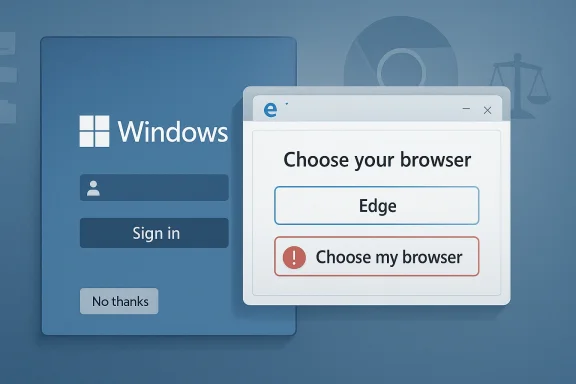
The immediate issue is a beta-tested behavior in which Edge can launch automatically when a user signs in to Windows 11. Windows Central reports that a banner appears in Edge telling users the app “now launches when you sign into Windows,” with a visible No thanks option if they want to disable it. That means the behavior is not yet a default everywhere, but it is being presented as something Microsoft is seriously evaluating for broader rollout.The key controversy is the opt-out design. In product terms, opt-out is often defended as a convenience feature because it reduces the number of steps for users who want a browser ready immediately at login. In public-policy terms, however, opt-out can be viewed as a dark-pattern-adjacent nudge because it places the burden on users to actively refuse a behavior they did not request.
Why the startup moment matters
Startup is one of the most sensitive moments in desktop software because it is the first point at which a platform can impose attention. If the browser opens immediately after sign-in, Microsoft gains a prime placement before the user has launched anything else. That matters because the first app on screen often becomes the path of least resistance, especially for casual users or those who simply resume their work without thinking.It also matters because Windows startup already has a long history of being crowded by background tasks, sync tools, and vendor services. A browser auto-launch that feels optional in isolation can feel very different when it appears alongside everything else competing for memory, bandwidth, and attention. The result is not just a UX change; it is a statement about who gets to occupy the user’s first click.
- Startup placement is high-value real estate.
- Opt-out design shifts the burden to the user.
- Browser choice becomes a first-run policy issue, not a preference.
- The feature can be framed as convenience or coercion depending on implementation.
Why This Feels Familiar
This controversy lands in an already crowded historical context. Microsoft has spent years adjusting Edge’s appearance, startup behavior, web-link handling, search integration, and browser-migration prompts in order to improve retention. Some of those changes have been genuine product work, but many have also been perceived as attempts to slow down browser switching or make competing defaults less natural.That history is important because users do not judge each feature in a vacuum. When the same company repeatedly nudges people toward the same product, even a modest new change looks like part of a larger pattern. The Browser Choice Alliance has explicitly framed Microsoft’s behavior in those terms, arguing that the company uses “dark patterns” and shifting tactics that hinder reliable browser choice.
The long tail of default battles
The browser wars were once about rendering engines and standards support. Today they are about distribution, attention, and ecosystem gravity. Chrome’s dominance means Microsoft is not fighting a normal feature gap; it is fighting inertia, habit, and Google’s cross-platform footprint.That makes every Windows-integrated promotion feel loaded. If a Windows user already has Chrome as the default browser, auto-launching Edge at login can look less like helpful preloading and more like a deliberate attempt to insert Microsoft into the browsing path anyway. The sharper the behavior feels, the more it reinforces the old narrative that Edge survives by riding Windows rather than winning on merits alone.
- Microsoft has a long record of Edge promotion inside Windows.
- Rivals interpret those moves through the lens of platform leverage.
- Users increasingly expect explicit consent for startup behavior.
- “Convenience” and “pressure” can look identical from the outside.
The Browser Choice Alliance Response
The strongest immediate criticism has come from the Browser Choice Alliance, a coalition that includes rival browser interests and claims to advocate for genuine browser choice on Windows. In the reporting around this test, the group argued that Microsoft should prioritize user choice over a feature that pushes Edge onto Windows 11 users regardless of their chosen browser.That response is predictable, but it is not merely rhetorical. The alliance’s broader position is that Microsoft has repeatedly used interface tactics that distort consumer choice and hinder competing browsers from competing on even terms. Its public messaging has consistently emphasized fair access rather than special treatment, which gives it a credible argument whenever Microsoft introduces another Edge-first default.
Why the coalition has leverage
The Browser Choice Alliance matters because it translates annoyance into a policy narrative. A lone user complaint can be dismissed as preference; a coalition complaint can be framed as an industry-wide pattern. That distinction is especially powerful when the complaint maps onto broader antitrust and regulatory concerns already circulating in the market.The group’s criticism also has emotional force because it uses plain-language framing that many users instantly understand: if you chose a browser, Microsoft should not keep trying to override that choice. That argument does not require technical sophistication, which makes it potent in public debate. It also sets a high bar for Microsoft, because any explanation that leans too heavily on product telemetry or engagement goals will sound defensive.
- The alliance frames the issue as consumer rights, not product rivalry.
- Its messaging resonates with users who dislike defaults changing behind the scenes.
- It gives regulators and journalists a concise narrative to work with.
- It forces Microsoft to justify the experience in user-centric terms.
The Competitive Stakes
At a market level, the new test reflects the reality that browser competition is no longer fought primarily through technology alone. Chrome remains the dominant consumer browser on desktop, and Microsoft’s Edge continues to trail by a wide margin. That means Edge’s path to growth depends heavily on ecosystem placement, enterprise familiarity, and tight Windows integration.Microsoft likely sees startup exposure as a low-friction way to improve awareness and retention. If the browser opens at login, users may be more likely to use it for quick tasks, especially when it is already signed in, synced, and ready. In a market where even small changes in retention matter, that sort of passive exposure can be attractive to a product team chasing incremental gains.
Why rivals object
Competitors object because platform-driven exposure is not neutral. If Microsoft can place Edge in front of users at Windows sign-in, rivals must fight not just feature parity but also operating-system primacy. That creates a structural imbalance that no browser vendor can fully match on equal terms.For Google, the issue is especially awkward because Chrome’s success depends on being the browser users reach for by habit. For smaller browsers, the stakes are even higher because they rely on word of mouth, advocacy, and deliberate installation choices to maintain share. Any Microsoft move that makes switching feel harder or less intuitive can therefore have a disproportionate effect on the long tail of browser competition.
- Chrome is still the main competitive threat Microsoft cares about.
- Smaller browsers suffer more when default friction rises.
- Startup exposure can materially affect retention.
- Platform vendors can out-distribute rivals even when features are similar.
Consumer Versus Enterprise Impact
Consumer impact and enterprise impact will not be identical, and Microsoft knows it. In consumer settings, a login-time browser launch can feel invasive because it interrupts a personal workflow and appears to override the user’s preferred browser without asking first. The home PC is where people are most sensitive to the feeling that software is making decisions for them.In enterprise settings, the logic can look different. Microsoft already markets Edge for Business as a standardized, managed browser for organizations that want security controls, policy enforcement, and integration with Microsoft identity. In that context, auto-launch behavior may be less controversial if IT enables it as part of a managed desktop experience.
The split personality of Edge
This is where Microsoft’s story becomes more complex. The company wants Edge to serve two masters: an enterprise-managed work browser and a consumer-facing browser that can be inserted into Windows without much friction. Those goals are related, but they are not the same, and a feature that helps one audience can alienate the other.Enterprise users are used to policy. Consumers are used to choice. Microsoft can justify automatic behavior when a company’s IT department controls the rollout, but it has a much harder time justifying the same behavior on a personal PC where the user already selected a different default browser. That distinction matters more than Microsoft’s marketing language often suggests.
- Enterprises may accept managed defaults more readily.
- Consumers are more likely to see startup launch as intrusive.
- Admin-controlled behavior is easier to defend than forced UX changes.
- Mixed-use devices blur the line and increase confusion.
Microsoft’s Likely Rationale
It is worth acknowledging why Microsoft might think this is a smart experiment. Product teams often argue that modern users want apps to be ready immediately, especially if they sync state from the cloud and restore quickly at login. If Edge launches in the background or appears instantly, users who rely on Microsoft services may perceive a smoother, more integrated session.Microsoft may also believe this is a soft-power play rather than a hard lock-in. The company can say the browser is simply available, not forced into the default browser slot, and that users can dismiss or disable the behavior in settings. In product terms, that looks like a reasonable way to test engagement without fully overriding browser choice. In political terms, however, the distinction is much less persuasive.
What Microsoft is optimizing for
Microsoft rarely promotes Edge in a vacuum. The browser is linked to Copilot, Microsoft 365, account sign-in, security tooling, and Windows-native services. If users open Edge more often, the company can collect more behavioral signals, encourage more Microsoft-account attachment, and deepen familiarity with its broader stack.That is a rational business objective, but it does not automatically make the implementation user-friendly. The difficulty for Microsoft is that every “convenience” feature can also function as a retention mechanism. The company is trying to optimize for seamlessness, yet the public reads the move as another attempt to preload loyalty.
- Faster browser availability can reduce friction for some users.
- Microsoft gains more engagement with its own ecosystem.
- The company can frame the feature as optional and reversible.
- Public trust depends on whether the opt-out feels truly obvious.
The Regulatory Shadow
No discussion of Edge promotion in 2026 is complete without the regulatory context. Microsoft has already faced pressure over default settings, uninstallation, and browser choice, especially in markets shaped by the Digital Markets Act and related competition concerns. The company has made changes that made Windows more compliant in some areas, but critics argue those changes have often been partial or uneven.That matters because regulators do not need to view this particular test as illegal to consider it relevant. They care about pattern, intent, and cumulative impact. A feature that appears small on its face can become evidence in a broader narrative about whether Microsoft is genuinely respecting user choice or simply adapting its pressure tactics to the latest policy environment.
Why the timing is awkward
The timing is awkward because the browser market remains a symbolically important arena for platform fairness. If Microsoft rolls out a new opt-out startup launch while public debate still centers on browser choice, it hands critics an easy example of why platform vendors should not be left to police themselves. That may not create a legal problem immediately, but it does create a reputational one.It also creates a messaging problem. Microsoft can say it is being responsive to users, but the visible design of the test says the company is still willing to nudge heavily in its own direction. In regulated markets, those signals are not just cosmetic; they help determine whether watchdogs view the company as cooperative or combative.
- Regulators watch cumulative behavior, not just one feature.
- Opt-out defaults can attract policy scrutiny.
- Browser choice is a high-visibility competition issue.
- Microsoft’s compliance history shapes how new tests are interpreted.
How Users Should Read the Change
For everyday Windows users, the important thing is not the rhetoric around browser wars. It is the practical question of whether the feature improves their experience. If someone likes opening the browser immediately on sign-in, the change may be convenient. If someone uses a different browser or prefers a cleaner desktop, it may be an annoyance worth disabling.The key is to distinguish choice from inertia. An opt-out setting is not the same as a user decision made in advance, because it assumes the default behavior is acceptable until refused. That may be efficient for Microsoft, but it is not always respectful of user expectation.
A practical decision framework
Users evaluating the feature should think in terms of workflow, not brand loyalty. If Edge is already your browser and you want fast startup, leaving it enabled may save a few clicks. If you use Chrome or another browser as your daily driver, the startup launch probably adds clutter without delivering much value.A sensible way to assess it is to ask three questions:
- Do I want a browser open before I ask for one?
- Is Edge actually my preferred browser, or just Microsoft’s preferred browser?
- Will this improve my workflow enough to justify the extra startup activity?
- Users who prefer Edge may not mind the change.
- Users who prefer Chrome may see it as one more prompt to dismiss.
- Performance-sensitive systems may benefit from fewer startup extras.
- Privacy-conscious users may object to any feature that increases automatic activity.
Strengths and Opportunities
Microsoft does have a plausible product argument here, and it is not unfair to say that a startup-ready browser can help some users who want speed and continuity. The company also has an opportunity to present Edge as a genuinely helpful Windows companion rather than just a browser it is trying to force into relevance. If it handles the rollout carefully, the feature could become a small but defensible quality-of-life improvement.- Faster access to the browser immediately after sign-in.
- Better continuity for users who rely on Microsoft accounts and sync.
- A chance to reinforce Edge for Business messaging for managed devices.
- A way to test whether users actually value browser readiness at startup.
- Potential improvement in user retention if the experience feels helpful, not pushy.
- An opportunity to differentiate on security and integration rather than pure market share.
- A chance to show that Microsoft can still ship convenience features without heavy-handed defaults.
Risks and Concerns
The downside risk is substantial because the feature sits at the intersection of user trust, competition policy, and Windows UX. Even if the implementation is technically reversible, it may still feel like one more example of Microsoft using its platform advantage to get Edge in front of users who did not ask for it. That perception is hard to shake once it takes hold.- User backlash from people who already chose another browser.
- Reputational damage from looking like an opt-out dark pattern.
- Regulatory scrutiny if the feature expands beyond a narrow test.
- Support burden from confused users who do not understand why Edge is opening.
- Performance overhead from another startup activity on busy systems.
- Competitive harm to smaller browsers that rely on deliberate installs.
- Trust erosion if users feel Windows updates keep adding unwanted behavior.
What to Watch Next
The next few weeks will matter because Microsoft may adjust the feature before it reaches a broader audience. If the company narrows the rollout, ties it only to Edge-default users, or makes the control much more explicit, it could defuse some of the controversy. If it does none of those things, the backlash will likely intensify as more testers notice the behavior.Microsoft should also be watching whether critics can turn this into a broader narrative about Windows update creep. The company has already had to deal with complaints about promotions, app preloads, and default nudges, so even a minor change can become a symbol. In that environment, perception can move faster than product intent.
Signals to monitor
- Whether Microsoft limits the test to users who already prefer Edge.
- Whether the No thanks option remains prominent and clear.
- Whether the feature appears in stable builds or stays in beta.
- Whether the Browser Choice Alliance escalates the complaint.
- Whether Microsoft publishes clearer documentation about the purpose and scope.
- Whether enterprise administrators get meaningful control over the behavior.
- Whether the startup launch affects performance or login smoothness in practice.
Microsoft still has room to back away from the sharpest version of this experiment, and it should use that room carefully. The company can absolutely make Edge more capable, faster, more secure, and more integrated with Windows without making users feel trapped inside its ecosystem. If it wants people to choose Edge, it will need to win more often on trust and less often on defaults. Until then, every new push will feel like another reminder that Windows remains the world’s most influential browser distribution channel, and that is exactly why the controversy will keep coming back.
Source: forbes.com https://www.forbes.com/sites/zakdof...ndows-update-1-billion-users-must-now-decide/
Last edited:
