

Microsoft’s latest Windows 11 gaming guidance, reported on May 1–3, 2026, now treats 16GB of RAM as the practical floor for a gaming PC and frames 32GB as the “no worries” configuration for players who game while running chat, browsers, launchers, recording, or streaming tools. The recommendation is technically sensible and commercially awkward. It lands just as memory prices are being squeezed by AI-server demand, turning what recently felt like a cheap, obvious upgrade into another budget fight. The real story is not that Microsoft discovered games need RAM; it is that the Windows gaming stack has quietly normalized a level of background consumption that makes yesterday’s mainstream PC feel newly provisional.
For years, 16GB occupied the comfortable middle of PC gaming advice. Eight gigabytes was the compromise, 16GB was the recommendation, and 32GB was what you bought because RAM was cheap, you kept too many tabs open, or you wanted the machine to age gracefully. Microsoft’s new framing does not formally rewrite Windows 11’s minimum requirements, which remain far below any credible gaming build, but it does redraw the psychological line.
That distinction matters. A system requirement is a gate: below it, the software may not install or may be unsupported. A gaming recommendation is a social signal: below it, the machine may work, but the owner is being told to expect compromises. Microsoft has shifted 16GB from the place where anxiety ended to the place where anxiety begins.
The company’s argument is not hard to follow. A modern gaming session is rarely just a game. It is Discord, a browser with a wiki and YouTube guide open, a launcher or three, RGB utilities, capture software, overlay tools, anti-cheat services, cloud sync clients, GPU control panels, and whatever Windows itself is doing in the background. In that world, 32GB is not extravagance; it is slack.
But slack has become political in PC hardware. When memory was cheap, telling users to buy more of it sounded like common-sense future-proofing. In 2026, after a sharp DRAM price shock, the same advice sounds like a large platform owner externalizing the cost of modern software bloat onto the people least able to absorb it.
What has changed is the amount of forgiveness built into that configuration. A 16GB PC in 2020 often had enough memory to absorb user messiness. A 16GB PC in 2026 has to share that same capacity with heavier games, heavier browsers, heavier launchers, heavier chat clients, and a version of Windows increasingly designed around services that presume persistent connectivity and background intelligence.
That is why Microsoft’s recommendation feels both obvious and revealing. It is not saying every game needs 32GB. It is saying the gaming environment increasingly benefits from 32GB. The target has moved from “can this game launch?” to “can this PC feel smooth while behaving like people actually use PCs?”
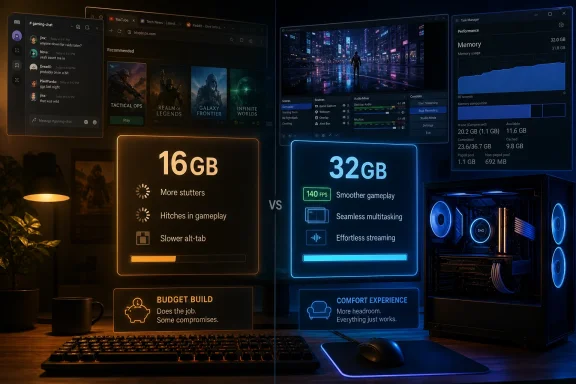
Gamers have always understood the difference between average frame rate and experience. Memory pressure often shows up not as a clean benchmark loss but as stutter, hitching, long alt-tab delays, texture streaming pauses, or the slow degradation of responsiveness after a few hours. Those are the failures that make a computer feel tired even when the GPU is strong.
The old advice treated RAM as a secondary upgrade after GPU and CPU. That hierarchy still makes sense for raw frame rates, but it is less persuasive for quality of life. The machine that benchmarks well in a clean test environment can still feel worse in a real room, with Discord open, a browser leaking memory, and Windows indexing or syncing at exactly the wrong moment.
This is where the argument becomes uncomfortable for Microsoft. If the company tells users that 32GB is the safer gaming target because of the reality of background applications, it is implicitly admitting that the baseline PC experience has become heavier. Windows is not solely responsible for that. Electron apps, Chromium browsers, live-service launchers, anti-cheat systems, peripheral utilities, and game engines all contribute to the pile. But Windows is the platform that hosts and blesses the pile.
The modern Windows desktop is a place where many applications behave less like compact native utilities and more like bundled browser runtimes. Chat clients, launchers, productivity tools, and control panels can each reserve hundreds of megabytes before a game even starts. Once that pattern becomes normal, the OS vendor can either fight it with platform discipline or recommend more RAM.
Microsoft appears to be doing both, but the timing makes the latter more visible. Project K2 and other efforts to reduce idle resource usage may eventually matter, particularly if Microsoft can make Windows less tolerant of pointless resident processes and background excess. Yet those improvements are future promises. The buyer choosing parts this weekend sees prices, not roadmaps.
There is also a messaging problem in Microsoft’s broader PC strategy. The company has spent the last few years pushing Copilot+ PCs, AI features, and a new hardware baseline that already includes 16GB as a common floor. That may be appropriate for local AI workloads and premium laptops, but it blurs into the gaming conversation in a way that makes users suspicious. When the platform owner, the AI evangelist, and the hardware recommender are the same company, every new baseline starts to look like a sales funnel.
Reports from the component market describe a sharp 2026 memory crunch driven by data-center demand, especially AI infrastructure that consumes high-bandwidth memory and related DRAM capacity at enormous scale. Conventional DRAM pricing has reportedly seen record quarter-over-quarter increases, with further pressure expected as cloud providers and server customers reserve supply. The result is familiar to anyone who lived through GPU shortages: the consumer DIY market discovers it is not the priority customer.
That changes the upgrade calculus. A 32GB kit that used to be an easy add-on now competes with a better GPU tier, a larger SSD, a stronger power supply, or simply the ability to build the machine at all. The enthusiast advice remains rational in the abstract, but budget builders do not buy in the abstract. They buy from a cart with a total at the bottom.
This is also where the PC’s modular virtue becomes a little cruel. Yes, a desktop owner can often buy 16GB now and upgrade later. But “later” assumes prices normalize, the motherboard has free slots, the user can match speeds and timings without headaches, and the system was not a prebuilt or small-form-factor design with awkward constraints. Upgradability is real, but it is not a magic eraser for bad timing.
For laptop buyers, the situation is worse. Soldered memory has become common, and 16GB versus 32GB is often a decision made once, at purchase, through the manufacturer’s price ladder. Microsoft’s “no worries” recommendation is most useful precisely where it is least flexible: on machines that cannot be upgraded after the fact.
Those users are also most likely to run messy, real-world workloads. A teenager with 16GB is not closing every tab before launching a game. A student is not clean-booting into a benchmark state. A streamer trying to start small is not treating OBS as an optional luxury. Microsoft’s recommendation reflects their usage patterns, but it also tells them the solution is to spend more money during a shortage.
That is the heart of the backlash. “Buy 32GB” is not bad advice. “Buy 32GB now” can be bad advice if the price is punitive and the user’s actual games still run acceptably on 16GB. A platform recommendation should help buyers prioritize, not panic them into overspending.
The smarter reading is tiered. If you are building a new desktop intended to last several years, and the price difference is tolerable, 32GB is the right target. If you already own a 16GB system and your games are smooth, there is no reason to treat Microsoft’s language as an emergency. If you are buying a soldered-memory laptop, 32GB deserves more serious consideration because you may never get a second chance.
That nuance is often lost when vendor guidance gets compressed into headlines. The danger is that “no worries” becomes “anything less is wrong.” That would be a bad conclusion for a market in which many players are already navigating inflated costs across GPUs, SSDs, displays, and subscriptions.
The result is uneven. Some engines scale gracefully. Others use available memory aggressively, stumble on 8GB GPUs, or assume an SSD and plenty of system RAM as part of the streaming pipeline. A game that technically lists 16GB as a requirement may still benefit from 32GB once high-resolution textures, large open worlds, mods, shader compilation, and background applications enter the scene.
This is why Microsoft’s recommendation resonates with people who troubleshoot PCs rather than just benchmark them. The memory shortage may make 32GB harder to swallow, but the direction of software demand is not imaginary. Players increasingly expect to alt-tab instantly, run overlays, stream to friends, keep guides open, and leave launchers resident. Developers increasingly build for machines with more headroom because enough of the market has it.
Mods add another layer. A vanilla game may be fine at 16GB, but a heavily modded Bethesda title, city builder, simulation game, or high-resolution texture pack can turn spare memory into a stability feature. PC gaming’s greatest strength — its openness — is also one reason baseline recommendations creep upward.
The complication is that “gaming PC” now describes too many machines. A compact e-sports box for Counter-Strike and Fortnite is not the same thing as a 4K open-world rig. A handheld gaming PC is not a tower. A laptop with shared thermal constraints is not a desktop with four DIMM slots. Microsoft’s broad recommendation is directionally correct, but PC buyers still need workload-specific judgment.
That makes the 2026 moment especially strange. The natural upgrade curve was already moving toward 32GB. If prices had remained low, Microsoft’s guidance would have been received as mildly belated common sense. Instead, the market snapped in the opposite direction, making the obvious next step feel newly expensive.
Hardware adoption curves are not driven only by technical need. They are driven by component pricing, OEM defaults, laptop configurations, regional availability, and what people can justify to themselves. A recommendation can be right on the engineering merits and still poorly matched to the economic moment.
This is where PC gaming differs from consoles. A console generation hides the memory decision inside a fixed platform. PC gaming exposes every tradeoff to the buyer. That flexibility is empowering when prices are sane and punishing when supply chains are distorted by a larger industry.
The AI buildout has made that distortion more visible. Gamers are used to competing with miners, scalpers, and workstation buyers. Now they are competing with hyperscalers and AI infrastructure plans measured in billions. That is not a fair fight, and it makes every “recommended spec” feel like a reminder that consumer PCs are downstream from bigger money.
The more interesting baseline is experiential. How much memory does a Windows 11 gaming PC need before the user stops thinking about memory? That is the question Microsoft is answering with 32GB. Not “will it run,” but “will I have to care?”
That is a useful distinction because PC maintenance has become a hobby inside the hobby. Users with 16GB can often make their systems behave well by pruning startup apps, using lighter alternatives, closing browsers, managing overlays, disabling unnecessary launchers, and watching memory use. But requiring that discipline is itself a cost. Some buyers pay for 32GB to avoid becoming the system administrator of their own leisure time.
Sysadmins will recognize the pattern. Enterprises do not buy only for minimum application launch. They buy for support burden, user behavior, browser growth, endpoint security agents, collaboration tools, and the fact that a machine that is adequate on day one can become a ticket generator by year three. Microsoft is applying a similar logic to gaming PCs, even if the audience hears it through the more emotional language of upgrades.
The problem is that “no worries” is a luxury phrase. It assumes the buyer can pay to remove friction. In a healthy component market, that is fine. In a shortage, it sounds like advice from someone standing outside the checkout line.
Task Manager has improved over the years, but Windows still does too little to explain memory pressure in human terms. Users see numbers, processes, and vague categories. They need plain-language answers: which startup apps are persistently resident, which background processes spiked during gameplay, which overlays are duplicating functionality, and which applications are consuming memory after their windows appear closed.
Game Mode could also become more assertive. Rather than functioning mostly as a scheduler and notification-tuning feature, it could offer a reversible “session clean-up” mode that pauses nonessential launchers, quiets update checks, trims background tasks, and warns users when a chat client or browser is unusually heavy. Microsoft has to be careful not to break workflows, but a gaming PC should not require third-party folklore to behave like one.
There is a privacy and control dimension here as well. Users are more likely to accept higher hardware recommendations when they believe the OS is respecting their resources. They are less forgiving when the desktop feels like an advertising surface, a telemetry platform, or a staging area for features they did not ask for. Memory pressure becomes symbolic: every extra process looks like evidence that the user is subsidizing someone else’s strategy.
A leaner Windows would not eliminate the case for 32GB. Games and multitasking will keep growing. But it would make the recommendation feel like an investment in capability rather than a tax on bloat.
For current 16GB owners, the upgrade trigger should be evidence, not anxiety. If games stutter when alt-tabbing, if memory use is pinned near capacity, if the page file is working hard, if Discord and a browser meaningfully degrade play, or if newer titles produce hitching that GPU settings do not solve, then more RAM is likely to help. If none of that is happening, inflated 2026 pricing is a good reason to wait.
For laptop buyers, the recommendation carries more weight. Soldered RAM turns a spec choice into a lifespan decision. A 16GB laptop can still be the right purchase at the right price, but a 32GB model is more defensible if the machine is meant to serve as a gaming, school, work, and content device through the end of the decade.
Desktop builders have more room to compromise. A sensible plan may be to buy a motherboard with upgrade capacity, start with 16GB only if the budget demands it, and move to 32GB when pricing improves. But that plan works best when the initial configuration uses two slots thoughtfully rather than filling every slot with small modules that become e-waste at upgrade time.
That is not a scandal. It is how computing has always moved. The scandal, if there is one, is that the move arrived while DRAM pricing is being pulled upward by forces far outside the gaming market. The future got more expensive right when the platform started calling it normal.
Source: TweakTown Microsoft recommends 16GB RAM as baseline, 32GB as a 'no worries' upgrade for gaming PCs running Windows 11
 Microsoft Moves the Goalposts Without Calling It a Mandate
For years, 16GB occupied the comfortable middle of PC gaming advice. Eight gigabytes was the compromise, 16GB was the recommendation, and 32GB was what you bought because RAM was cheap, you kept too many tabs open, or you wanted the machine to age gracefully. Microsoft’s new framing does not formally rewrite Windows 11’s minimum requirements, which remain far below any credible gaming build, but it does redraw the psychological line.That distinction matters. A system requirement is a gate: below it, the software may not install or may be unsupported. A gaming recommendation is a social signal: below it, the machine may work, but the owner is being told to expect compromises. Microsoft has shifted 16GB from the place where anxiety ended to the place where anxiety begins.
The company’s argument is not hard to follow. A modern gaming session is rarely just a game. It is Discord, a browser with a wiki and YouTube guide open, a launcher or three, RGB utilities, capture software, overlay tools, anti-cheat services, cloud sync clients, GPU control panels, and whatever Windows itself is doing in the background. In that world, 32GB is not extravagance; it is slack.
But slack has become political in PC hardware. When memory was cheap, telling users to buy more of it sounded like common-sense future-proofing. In 2026, after a sharp DRAM price shock, the same advice sounds like a large platform owner externalizing the cost of modern software bloat onto the people least able to absorb it.
The 16GB PC Is Not Dead, But It Has Lost Its Margin
The most important thing to say plainly is that 16GB is not suddenly unusable for gaming. Many titles still run acceptably on 16GB, especially if the user is disciplined about background apps, plays at mainstream settings, and does not expect to stream, record, browse, and chat simultaneously on the same box. For a budget system, 16GB remains a legitimate configuration rather than e-waste waiting to happen.What has changed is the amount of forgiveness built into that configuration. A 16GB PC in 2020 often had enough memory to absorb user messiness. A 16GB PC in 2026 has to share that same capacity with heavier games, heavier browsers, heavier launchers, heavier chat clients, and a version of Windows increasingly designed around services that presume persistent connectivity and background intelligence.
That is why Microsoft’s recommendation feels both obvious and revealing. It is not saying every game needs 32GB. It is saying the gaming environment increasingly benefits from 32GB. The target has moved from “can this game launch?” to “can this PC feel smooth while behaving like people actually use PCs?”
Gamers have always understood the difference between average frame rate and experience. Memory pressure often shows up not as a clean benchmark loss but as stutter, hitching, long alt-tab delays, texture streaming pauses, or the slow degradation of responsiveness after a few hours. Those are the failures that make a computer feel tired even when the GPU is strong.
The old advice treated RAM as a secondary upgrade after GPU and CPU. That hierarchy still makes sense for raw frame rates, but it is less persuasive for quality of life. The machine that benchmarks well in a clean test environment can still feel worse in a real room, with Discord open, a browser leaking memory, and Windows indexing or syncing at exactly the wrong moment.
Windows 11 Is Carrying More of the Gaming Session Than It Used To
Microsoft’s recommendation also exposes a broader truth about Windows 11: the operating system is no longer merely the neutral floor beneath a game. It is an ecosystem of services, accounts, widgets, sync layers, security components, gaming overlays, store infrastructure, AI-adjacent features, and web-backed experiences. Some of that is useful. Some of it is tolerated. All of it has a resource cost.This is where the argument becomes uncomfortable for Microsoft. If the company tells users that 32GB is the safer gaming target because of the reality of background applications, it is implicitly admitting that the baseline PC experience has become heavier. Windows is not solely responsible for that. Electron apps, Chromium browsers, live-service launchers, anti-cheat systems, peripheral utilities, and game engines all contribute to the pile. But Windows is the platform that hosts and blesses the pile.
The modern Windows desktop is a place where many applications behave less like compact native utilities and more like bundled browser runtimes. Chat clients, launchers, productivity tools, and control panels can each reserve hundreds of megabytes before a game even starts. Once that pattern becomes normal, the OS vendor can either fight it with platform discipline or recommend more RAM.
Microsoft appears to be doing both, but the timing makes the latter more visible. Project K2 and other efforts to reduce idle resource usage may eventually matter, particularly if Microsoft can make Windows less tolerant of pointless resident processes and background excess. Yet those improvements are future promises. The buyer choosing parts this weekend sees prices, not roadmaps.
There is also a messaging problem in Microsoft’s broader PC strategy. The company has spent the last few years pushing Copilot+ PCs, AI features, and a new hardware baseline that already includes 16GB as a common floor. That may be appropriate for local AI workloads and premium laptops, but it blurs into the gaming conversation in a way that makes users suspicious. When the platform owner, the AI evangelist, and the hardware recommender are the same company, every new baseline starts to look like a sales funnel.
The DRAM Market Turns Good Advice Into Bad Timing
The reason this story has traveled is not that 32GB is an outrageous recommendation. In enthusiast circles, 32GB has been the comfortable answer for years. The reason it bites now is that memory has stopped feeling like the cheap part of the build.Reports from the component market describe a sharp 2026 memory crunch driven by data-center demand, especially AI infrastructure that consumes high-bandwidth memory and related DRAM capacity at enormous scale. Conventional DRAM pricing has reportedly seen record quarter-over-quarter increases, with further pressure expected as cloud providers and server customers reserve supply. The result is familiar to anyone who lived through GPU shortages: the consumer DIY market discovers it is not the priority customer.
That changes the upgrade calculus. A 32GB kit that used to be an easy add-on now competes with a better GPU tier, a larger SSD, a stronger power supply, or simply the ability to build the machine at all. The enthusiast advice remains rational in the abstract, but budget builders do not buy in the abstract. They buy from a cart with a total at the bottom.
This is also where the PC’s modular virtue becomes a little cruel. Yes, a desktop owner can often buy 16GB now and upgrade later. But “later” assumes prices normalize, the motherboard has free slots, the user can match speeds and timings without headaches, and the system was not a prebuilt or small-form-factor design with awkward constraints. Upgradability is real, but it is not a magic eraser for bad timing.
For laptop buyers, the situation is worse. Soldered memory has become common, and 16GB versus 32GB is often a decision made once, at purchase, through the manufacturer’s price ladder. Microsoft’s “no worries” recommendation is most useful precisely where it is least flexible: on machines that cannot be upgraded after the fact.
Budget Gamers Are Being Asked to Pay for Everyone Else’s Multitasking
The class dimension of this advice should not be ignored. High-end buyers already moved to 32GB or 64GB because the incremental cost once felt modest inside a premium build. The people affected by a new baseline are the buyers assembling entry-level and midrange systems, the families buying a first gaming laptop, and the students trying to stretch a machine across schoolwork, gaming, and content creation.Those users are also most likely to run messy, real-world workloads. A teenager with 16GB is not closing every tab before launching a game. A student is not clean-booting into a benchmark state. A streamer trying to start small is not treating OBS as an optional luxury. Microsoft’s recommendation reflects their usage patterns, but it also tells them the solution is to spend more money during a shortage.
That is the heart of the backlash. “Buy 32GB” is not bad advice. “Buy 32GB now” can be bad advice if the price is punitive and the user’s actual games still run acceptably on 16GB. A platform recommendation should help buyers prioritize, not panic them into overspending.
The smarter reading is tiered. If you are building a new desktop intended to last several years, and the price difference is tolerable, 32GB is the right target. If you already own a 16GB system and your games are smooth, there is no reason to treat Microsoft’s language as an emergency. If you are buying a soldered-memory laptop, 32GB deserves more serious consideration because you may never get a second chance.
That nuance is often lost when vendor guidance gets compressed into headlines. The danger is that “no worries” becomes “anything less is wrong.” That would be a bad conclusion for a market in which many players are already navigating inflated costs across GPUs, SSDs, displays, and subscriptions.
Game Developers Have Been Spending the Headroom Consoles Gave Them
This shift is not only about Windows. Game development has also moved into a new memory era. Current-generation consoles established a broad target around unified memory pools, fast SSD streaming, and asset-heavy worlds. PC ports then arrive in an ecosystem with wildly different memory configurations, GPU VRAM capacities, storage speeds, and background loads.The result is uneven. Some engines scale gracefully. Others use available memory aggressively, stumble on 8GB GPUs, or assume an SSD and plenty of system RAM as part of the streaming pipeline. A game that technically lists 16GB as a requirement may still benefit from 32GB once high-resolution textures, large open worlds, mods, shader compilation, and background applications enter the scene.
This is why Microsoft’s recommendation resonates with people who troubleshoot PCs rather than just benchmark them. The memory shortage may make 32GB harder to swallow, but the direction of software demand is not imaginary. Players increasingly expect to alt-tab instantly, run overlays, stream to friends, keep guides open, and leave launchers resident. Developers increasingly build for machines with more headroom because enough of the market has it.
Mods add another layer. A vanilla game may be fine at 16GB, but a heavily modded Bethesda title, city builder, simulation game, or high-resolution texture pack can turn spare memory into a stability feature. PC gaming’s greatest strength — its openness — is also one reason baseline recommendations creep upward.
The complication is that “gaming PC” now describes too many machines. A compact e-sports box for Counter-Strike and Fortnite is not the same thing as a 4K open-world rig. A handheld gaming PC is not a tower. A laptop with shared thermal constraints is not a desktop with four DIMM slots. Microsoft’s broad recommendation is directionally correct, but PC buyers still need workload-specific judgment.
Steam’s Numbers Show a Market Caught Between Desire and Price
The Steam Hardware Survey, imperfect as it is, remains useful because it captures the messy middle of the PC gaming population. Recent survey reporting has shown 16GB and 32GB configurations trading places in ways that reflect both adoption and affordability. The important signal is not a single month’s percentage; it is that 32GB had become mainstream enough to challenge 16GB before the memory market turned hostile.That makes the 2026 moment especially strange. The natural upgrade curve was already moving toward 32GB. If prices had remained low, Microsoft’s guidance would have been received as mildly belated common sense. Instead, the market snapped in the opposite direction, making the obvious next step feel newly expensive.
Hardware adoption curves are not driven only by technical need. They are driven by component pricing, OEM defaults, laptop configurations, regional availability, and what people can justify to themselves. A recommendation can be right on the engineering merits and still poorly matched to the economic moment.
This is where PC gaming differs from consoles. A console generation hides the memory decision inside a fixed platform. PC gaming exposes every tradeoff to the buyer. That flexibility is empowering when prices are sane and punishing when supply chains are distorted by a larger industry.
The AI buildout has made that distortion more visible. Gamers are used to competing with miners, scalpers, and workstation buyers. Now they are competing with hyperscalers and AI infrastructure plans measured in billions. That is not a fair fight, and it makes every “recommended spec” feel like a reminder that consumer PCs are downstream from bigger money.
The Real Baseline Is No Longer the OS Minimum
Windows 11’s official minimum memory requirement has long been irrelevant to gaming. A 4GB Windows 11 PC is a survival exercise, not a gaming platform. Even 8GB increasingly belongs to office machines, thin clients, and very constrained gaming use. Microsoft’s gaming guidance simply acknowledges the spec ladder users already understand.The more interesting baseline is experiential. How much memory does a Windows 11 gaming PC need before the user stops thinking about memory? That is the question Microsoft is answering with 32GB. Not “will it run,” but “will I have to care?”
That is a useful distinction because PC maintenance has become a hobby inside the hobby. Users with 16GB can often make their systems behave well by pruning startup apps, using lighter alternatives, closing browsers, managing overlays, disabling unnecessary launchers, and watching memory use. But requiring that discipline is itself a cost. Some buyers pay for 32GB to avoid becoming the system administrator of their own leisure time.
Sysadmins will recognize the pattern. Enterprises do not buy only for minimum application launch. They buy for support burden, user behavior, browser growth, endpoint security agents, collaboration tools, and the fact that a machine that is adequate on day one can become a ticket generator by year three. Microsoft is applying a similar logic to gaming PCs, even if the audience hears it through the more emotional language of upgrades.
The problem is that “no worries” is a luxury phrase. It assumes the buyer can pay to remove friction. In a healthy component market, that is fine. In a shortage, it sounds like advice from someone standing outside the checkout line.
Microsoft Should Pair Bigger Recommendations With a Leaner Windows
If Microsoft wants to normalize 32GB for gaming, it owes users more than a parts-list nudge. It should also make Windows less wasteful, more transparent, and more aggressive about helping gamers understand what is consuming memory. The platform vendor cannot control every Electron app or launcher, but it can set expectations and build tools that make bad behavior visible.Task Manager has improved over the years, but Windows still does too little to explain memory pressure in human terms. Users see numbers, processes, and vague categories. They need plain-language answers: which startup apps are persistently resident, which background processes spiked during gameplay, which overlays are duplicating functionality, and which applications are consuming memory after their windows appear closed.
Game Mode could also become more assertive. Rather than functioning mostly as a scheduler and notification-tuning feature, it could offer a reversible “session clean-up” mode that pauses nonessential launchers, quiets update checks, trims background tasks, and warns users when a chat client or browser is unusually heavy. Microsoft has to be careful not to break workflows, but a gaming PC should not require third-party folklore to behave like one.
There is a privacy and control dimension here as well. Users are more likely to accept higher hardware recommendations when they believe the OS is respecting their resources. They are less forgiving when the desktop feels like an advertising surface, a telemetry platform, or a staging area for features they did not ask for. Memory pressure becomes symbolic: every extra process looks like evidence that the user is subsidizing someone else’s strategy.
A leaner Windows would not eliminate the case for 32GB. Games and multitasking will keep growing. But it would make the recommendation feel like an investment in capability rather than a tax on bloat.
The Sensible Buyer Now Has to Think Like a Scheduler
The practical advice is not glamorous, but it is clearer than the outrage cycle suggests. Buyers should treat 32GB as the preferred configuration for a new Windows 11 gaming PC when the budget allows, especially for systems expected to last several years or run streaming, creation, heavy browsing, or demanding open-world games. They should not treat 16GB as obsolete overnight.For current 16GB owners, the upgrade trigger should be evidence, not anxiety. If games stutter when alt-tabbing, if memory use is pinned near capacity, if the page file is working hard, if Discord and a browser meaningfully degrade play, or if newer titles produce hitching that GPU settings do not solve, then more RAM is likely to help. If none of that is happening, inflated 2026 pricing is a good reason to wait.
For laptop buyers, the recommendation carries more weight. Soldered RAM turns a spec choice into a lifespan decision. A 16GB laptop can still be the right purchase at the right price, but a 32GB model is more defensible if the machine is meant to serve as a gaming, school, work, and content device through the end of the decade.
Desktop builders have more room to compromise. A sensible plan may be to buy a motherboard with upgrade capacity, start with 16GB only if the budget demands it, and move to 32GB when pricing improves. But that plan works best when the initial configuration uses two slots thoughtfully rather than filling every slot with small modules that become e-waste at upgrade time.
A New Memory Rule Written in an Old PC Language
The cleanest way to read Microsoft’s guidance is as a new version of an old PC truth: minimum specs tell you where pain begins, not where comfort lives. In 2026, 16GB is increasingly the place where a Windows 11 gaming PC can still be good but has to be managed. 32GB is the place where the user can be less careful.That is not a scandal. It is how computing has always moved. The scandal, if there is one, is that the move arrived while DRAM pricing is being pulled upward by forces far outside the gaming market. The future got more expensive right when the platform started calling it normal.
The 32GB Advice Is Right, But the Receipt Is the Story
Microsoft’s recommendation should push buyers toward a more realistic view of Windows 11 gaming, not toward panic. The concrete lessons are narrower, and more useful, than the headline version.- A new Windows 11 gaming desktop should target 32GB of RAM if the budget allows and the system is expected to last several years.
- A 16GB gaming PC remains viable, but users should expect less headroom for browsers, Discord, streaming tools, overlays, mods, and newer large games.
- Laptop buyers should treat 32GB as more important than desktop buyers because soldered memory can make the original purchase decision permanent.
- Budget builders should not sacrifice a major GPU or CPU tier solely to satisfy a “no worries” label if their actual games and habits fit within 16GB.
- Microsoft needs to match higher hardware guidance with visible work to reduce Windows background overhead and make memory pressure easier to diagnose.
Source: TweakTown Microsoft recommends 16GB RAM as baseline, 32GB as a 'no worries' upgrade for gaming PCs running Windows 11
