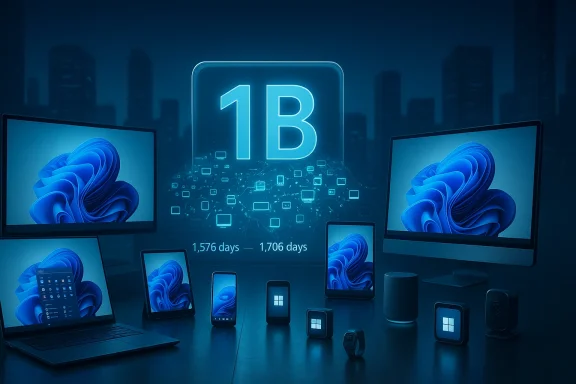
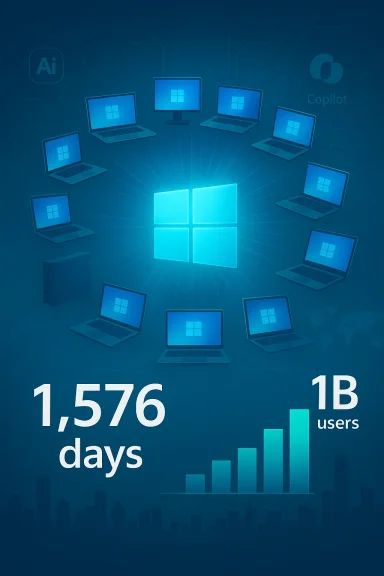
Microsoft’s announcement that Windows 11 has passed the 1 billion‑user mark landed as both milestone and mirror: a headline achievement that confirms broad platform reach, and a prompt to scrutinize what “1 billion users” actually measures and why it matters now. The company revealed the figure during its fiscal Q2 FY2026 earnings commentary, saying Windows 11 reached the milestone in roughly 1,576 days from public availability — about 130 days faster than Windows 10’s comparable climb of 1,706 days. That arithmetic checks out on the calendar, but the bigger story is how Microsoft measured the tally, what accelerated adoption in late 2024–2025, and the practical consequences for IT teams, OEMs, developers, and everyday users.
Microsoft released Windows 11 to the public on October 5, 2021, beginning a phased rollout that prioritized OEM preloads and staged upgrades for eligible Windows 10 machines. The company used that public availability date as the natural anchor for the new milestone and counted forward to the time it disclosed the number during its Q2 FY2026 earnings call. On that basis Microsoft reported Windows 11’s climb to 1 billion devices took approximately 1,576 days, and compared that with the historical figure for Windows 10 — 1,706 days — producing the message that Windows 11 “got there faster.”
That comparison is directionally accurate and useful as a high‑level metric: the calendar math is reproducible when you line up launch and announcement dates. But as with any corporate telemetry headline, the meaningful questions are tactical and technical: what telemetry sources are included; are counts device‑centric or human‑centric; and how much of the growth is organic versus calendar‑driven by policy events such as Windows 10’s end of mainstream support? Multiple outlets reproduced Microsoft’s headline and emphasized these important caveats.
However, the announcement is not the final word. The critical caveats remain: Microsoft’s telemetry definitions for the 1‑billion count are not public, the growth mix includes OEM preloads that may not represent active daily users, and a large residual population of Windows 10 devices will continue to require special handling. For IT leaders the announcement is a useful planning signal; for consumers it’s confirmation that Windows 11 is mainstream; for policy makers it’s a reminder that platform scale requires responsible stewardship.
For readers who want to dig deeper, the original reporting and investor commentary are worth reviewing alongside migration guidance from enterprise practitioners. The milestone matters — but how Microsoft supports the installed base going forward will determine whether 1 billion devices translates into long‑term platform health and user trust, or a transient PR headline.
Conclusion: celebrate the scale, but plan like a professional. The billion‑device number is a strategic lever — now the operational work to make the Windows 11 era stable, secure, and sustainable begins in earnest.
Source: Ars Technica People complaining about Windows 11 hasn't stopped it from hitting 1 billion users
Source: filmogaz.com Windows 11 Surpasses 1 Billion Users, Outpacing Windows 10 Milestone
 Background / Overview
Microsoft released Windows 11 to the public on October 5, 2021, beginning a phased rollout that prioritized OEM preloads and staged upgrades for eligible Windows 10 machines. The company used that public availability date as the natural anchor for the new milestone and counted forward to the time it disclosed the number during its Q2 FY2026 earnings call. On that basis Microsoft reported Windows 11’s climb to 1 billion devices took approximately 1,576 days, and compared that with the historical figure for Windows 10 — 1,706 days — producing the message that Windows 11 “got there faster.” That comparison is directionally accurate and useful as a high‑level metric: the calendar math is reproducible when you line up launch and announcement dates. But as with any corporate telemetry headline, the meaningful questions are tactical and technical: what telemetry sources are included; are counts device‑centric or human‑centric; and how much of the growth is organic versus calendar‑driven by policy events such as Windows 10’s end of mainstream support? Multiple outlets reproduced Microsoft’s headline and emphasized these important caveats.
What Microsoft actually announced
The headline facts
- Microsoft stated Windows 11 is now active on more than 1 billion devices and that platform usage was up over 45% year‑over‑year in the quarter.
- The company framed the adoption interval as 1,576 days from Windows 11’s public availability to the earnings‑call window, and contrasted that with Windows 10’s 1,706 days to the same threshold.
Where the claim appeared
Microsoft delivered the milestone figure during its fiscal Q2 FY2026 investor commentary — a standard venue for large, headline‑friendly metrics that shape investor and partner narratives. The claim was quickly picked up and discussed across technology press and analyst feeds, with consensus that the number is a corporate telemetry metric rather than an independently audited census.What to take at face value — and what to treat cautiously
- Take the calendar math at face value: counting from October 5, 2021 to late January 2026 yields an interval consistent with 1,576 days. That part is verifiable.
- Treat the composition of “1 billion users” with caution: Microsoft did not publish a forensic breakdown of the telemetry buckets used (for example, how many were OEM preloads, monthly active devices, enterprise enrollments, or virtual/managed instances). That omission matters when you move from headline to operational planning.
How Microsoft likely counts “users” — the measurement mechanics
Microsoft’s large‑number statements historically compress multiple internal signals into a single headline. The likely components of the Windows 11 “1 billion” figure include:- Monthly active devices reported through Windows telemetry and Microsoft services.
- OEM preloads and new‑device activations that come out of the channel.
- Devices that call home via enterprise management services or Microsoft account sign‑ins.
- Some combination of thin‑client, virtual machines, and other Windows‑based endpoints that report into Microsoft services.
Why the measurement method matters
- Device‑centric counts favor Microsoft’s platform narrative (one Windows instance = one counted unit), which is useful for platform economics and partner discussions.
- Human‑centric metrics (unique users, daily active users) would tell a different story about real engagement and cross‑device usage.
- OEM preload counts can spike after a refresh cycle (holiday season, back‑to‑school), creating lumpy growth that’s meaningful commercially but not equivalent to steady organic migration.
Why Windows 11 reached 1 billion faster than Windows 10 — the key drivers
The faster climb is real in Microsoft’s chosen day‑count framing, and several concrete market forces explain why.1) Windows 10 end‑of‑support created a hard deadline
Microsoft formally ended mainstream support for many Windows 10 SKUs on October 14, 2025. That created an explicit upgrade impetus: enterprises and consumers faced the option of migrating to Windows 11, buying Extended Security Updates (ESU), or running unsupported systems. The deadline functioned as a major economic nudge that accelerated upgrade planning and OEM purchasing cycles over the months leading into and following the cutoff. Multiple reports tied the late‑2025 surge in Windows 11 adoption to precisely this dynamic.2) OEM refresh cycles and new hardware shipments
PC purchases are the primary vehicle by which incompatible or end‑of‑life devices exit the installed base. OEMs increasingly shipped new systems with Windows 11 preinstalled and positioned modern silicon, TPM, and AI‑enabled features as selling points. Holiday quarter sales and commercial fleet refresh programs contributed significant preload volume — a baked‑in source of counted growth. Microsoft also cited stronger Windows OEM revenue tied to that demand.3) Product bundling and the AI narrative
Microsoft’s push to integrate AI across Windows — particularly Copilot and other productivity‑adjacent services — helped to frame Windows 11 as the platform for next‑generation PC experiences. For organizations investing in AI productivity projects, the promise of integrated device‑to‑cloud AI features made migration more compelling beyond pure security arguments. That value narrative shortened the runway for some upgrade decisions.4) Commercial incentives and channel dynamics
Enterprises balancing ESU costs, compliance risks, and procurement timelines often concluded that migration or device replacement was the better long‑term choice. OEMs and channel partners ran campaigns and programs to convert that momentum into sales, amplifying Windows 11 activations during the critical period. Analysts and press coverage consistently linked these commercial levers to the faster headline time to 1 billion.Practical implications for enterprises and IT administrators
The headline is a strategic signal: Windows 11 is now the mainstream platform Microsoft will prioritize with new features, security updates, and developer APIs. For IT teams, the immediate task is operational:- Inventory and prioritize: confirm which devices in your fleet are eligible for Windows 11, which need hardware refreshes, and where application compatibility is a blocker.
- Secure the short term: for devices that cannot upgrade immediately, implement compensating controls — network segmentation, strong endpoint detection & response, stricter patch policies, and monitoring. Extended Security Updates remain an option for critical systems.
- Pilot and stage: don’t rush full production rollouts. Run compatibility pilots for critical ap tooling, and test device drivers and imaging before mass deployment.
- Budget and cadence: expect OEM supply timing to influence replacement cycles; work procurement into a predictable refresh cadence that balances cost, security, and sustainability considerations.
Consumer perspective and controversial tradeoffs
For individual users and enthusiasts, the milestone means Windows 11 is firmly mainstream, but it also highlights recurring friction points.- Hardware requirements: Windows 11’s baseline (TPM 2.0, UEFI Secure Boot, and a curated supported CPU list) left many functioning PCs ineligible for an in‑place upgrade when Windows 11 launched. OEM replacement partly solved this, but hundreds of millions of devices remained on Windows 10 well into late 2025, prompting a split market of upgrade‑capable and upgrade‑blocked machines.
- Bypass and unsupported paths: the existence of third‑party workarounds and registry hacks to install Windows 11 on “unsupported” hardware has created a risky informal ecosystem. For hobbyists the tradeoff may be acceptable; for regulated or corporate contexts, bypasses undermine security guarantees and supportability. The safer path is hardware that meets Microsoft’s baseline or managed virtualized endpoints.
- Update quality and trust: Windows 11 has had high‑profile update issues during its lifecycle, and trust in the update pipeline is lower among some segments. That reputational risk can slow voluntary migration and complicate enterprise rollouts unless Microsoft maintains hiline and clearer communications. Industry coverage flagged quality and trust as ongoing risks even as adoption metrics rose.
Strengths highlighted by the milestone
Microsoft’s 1‑billion figure underscores several real strengths:- Platform scale: one billion devices is a powerful argument for developers and ISVs to invest in Windows 11‑specific experiences, APIs, and tooling.
- Commercial leverage: stronger OEM demand and channel momentum give Microsoft and partners a stable runway to monetize new services and integrations.
- Security baseline: the enforced hardware trust model (TPM, Secure Boot) raises security foundations for many Windows 11 devices when properly implemented, improving resilience against firmware and boot‑level attacks for eligible hardware.
Risks, unanswered questions, and recommendations for scrutiny
While the headline is defensible, several risks and opaque elements deserve attention.Measurement opacity
Microsoft did not publish a detailed breakdown of the telemetry that produced the 1‑billion figure. Without an itemized decomposition (OEM preloads vs monthly active devices vs enterprise managed devices), the figure remains a corporate metric rather than a replicable audit. External trackers (web‑traffic panels, ad networks) measure different things and cannot definitively corroborate Microsoft’s internal counts. In short: the arithmetic is real; the composition is not fully transparent. Flag this as a caution when using the number for contractual or procurement decisions.Privacy and telemetry concerns
Counting devices at scale requires telemetry. Enterprises and privacy advocates will reasonably ask what data is being collected, how it’s used, and whether opt‑out or aggregation controls are sufficient. Microsoft’s telemetry posture has improved over the years, but scale intensifies scrutiny. IT departments should validate telemetry settings and ensure compliance with local data protection rules when enabling feature‑telemetry for managed fleets.Fragmentation and e‑waste risk
A portion of the installed base will never be able to meet Windows 11’s hardware requirements. That creates a long tail of unsupported devices and a parallel market of replacement hardware — a sustainability challenge. Microsoft, OEMs, and policy makers should consider programs to mitigate e‑waste and preserve affordability for lower‑income users.Competitive and regulatory questions
Platform scale is commercial leverage. As Windows 11 becomes the dominant client runtime, regulators and competitors may intensify scrutiny around default apps, monetization levers, and developer access to platform features. Microsoft will need to balance platform economics with openness and fair play, or face regulatory examination similar to previous high‑profile platform debates.A practical checklist — what to do next (for admins and power users)
- Inventory: run device inventories now and tag machines by Windows 11 eligibility, critical app compatibility, and end‑of‑life risk.
- Pilot: choose a representative subset of devices and deploy Windows 11 builds with production apps to catch driver and app issues early.
- Secure: apply compensating controls to devices that will remain on Windows 10 temporarily; evaluate ESU costs vs replacement.
- Communicate: prepare a stakeholder plan (help desk, procurement, finance, security) with timelines and expected impact on licensing and headcount.
- Optimize: evaluate cloud‑first or virtualization alternatives (Azure Virtual Desktop, Windows 365) for legacy workloads that cannot be migrated affordably.
- Sustain: build a refres with sustainability targets and total cost of ownership rather than one‑off emergency purchases.
Reading the milestone with nuance: a final assessment
Windows 11 joining the billion‑user club is a meaningful milestone for Microsoft and the broader PC ecosystem. It confirms that the company’s migration narrative — a mix of security pressure, OEM refresh cycles, and a product story centered on AI and Copilot integration — produced measurable results in a compressed timeframe. The calendar math that produced 1,576 days is verifiable and the comparison to Windows 10’s 1,706 days is directionally accurate. Industry reporting repeated and contextualized Microsoft’s claims, and the practical effects — migration urgency, OEM channel dynamics, and developer prioritization — are real and immediate.However, the announcement is not the final word. The critical caveats remain: Microsoft’s telemetry definitions for the 1‑billion count are not public, the growth mix includes OEM preloads that may not represent active daily users, and a large residual population of Windows 10 devices will continue to require special handling. For IT leaders the announcement is a useful planning signal; for consumers it’s confirmation that Windows 11 is mainstream; for policy makers it’s a reminder that platform scale requires responsible stewardship.
For readers who want to dig deeper, the original reporting and investor commentary are worth reviewing alongside migration guidance from enterprise practitioners. The milestone matters — but how Microsoft supports the installed base going forward will determine whether 1 billion devices translates into long‑term platform health and user trust, or a transient PR headline.
Conclusion: celebrate the scale, but plan like a professional. The billion‑device number is a strategic lever — now the operational work to make the Windows 11 era stable, secure, and sustainable begins in earnest.
Source: Ars Technica People complaining about Windows 11 hasn't stopped it from hitting 1 billion users
Source: filmogaz.com Windows 11 Surpasses 1 Billion Users, Outpacing Windows 10 Milestone