

Microsoft’s reported internal push to relax Windows 11’s mandatory Microsoft account requirement is a small headline with outsized consequences. If the company really is reconsidering the forced sign-in flow at setup, it would mark a meaningful reversal in how Windows balances convenience, identity, and control. It would also place Microsoft on a more consumer-friendly path at a moment when the company is already trying to soften other rough edges in Windows 11, from update friction to AI clutter. The catch is that this is still discussion, not policy: there is no public commitment yet, only signs that influential people inside Microsoft want the rule changed. of its life in a tension-filled middle ground between modernization and control. Microsoft launched it with a cleaner visual language, a centered taskbar, and a more cloud-connected identity model, but many users quickly felt the trade-offs: fewer customization options, more recommendations, more prompts, and a setup experience that increasingly nudged people toward online services. Over time, that friction became one of the platform’s defining stories rather than a one-time complaint.
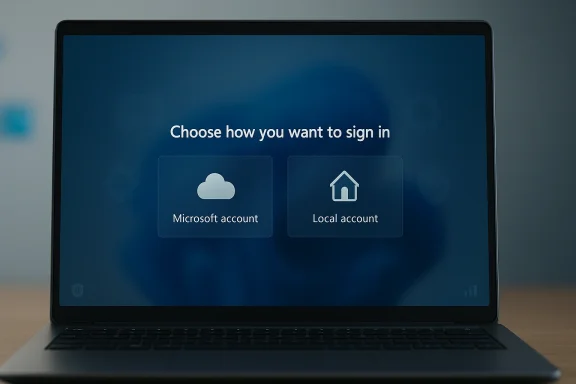
The Microsoft account issue is especially nt a user meets the operating system. During out-of-box experience, Windows 11 Home in particular has long pushed users toward internet connectivity and a Microsoft account, and Microsoft has steadily tightened the path around local-account workarounds in Insider builds. In October 2025, Microsoft’s Dev Channel notes explicitly said it was removing known mechanisms for creating a local account in OOBE and requiring internet plus a Microsoft account to complete setup.
That hardening has created predictable backlash. For some users, a Microsoft account is useful and even welcome because it syncs settings, benefits, OneDrive, and Store access. For others, it feels like an unnecessary subscription to an ecosystem they never asked to join. The divide is not just ideological; it is practical. Enterprise administrators, schools, and privacy-conscious home users often want local or domain-based identities, not consumer cloud identity at first boot.
At the same time, Microsoft has been signaling that it understands Windows 11 needs to feel less aggressive overall. Recent Insider and release-preview changes have focused on reliability, update behavior, and trimming unnecessary Copilot entry points rather than piling on more UI surfaces. That broader context matters because it suggests the account requiret of a much larger debate over whether Windows 11 is a user-first desktop or a Microsoft-services onboarding funnel.
Scott Hanselman’s “Ya I hate that. Working on it.” response is therefore notable less because it is dramatic and more because it confirms the existence of internal discomfort. Hanselman is not a policy engine by himself, but he is a highly visible Microsoft vice president with enough credibility to make that kind of answer meaningful. When someone like that says he dislikes the requirement and isignal is that the complaint has moved from user forums into the company’s internal conversation.
The most important thing to say here is what Microsoft has not said. It has not announced a reversal, it has not updated any official Windows setup guidance, and it has not publicly committed to a local-account-first setup flow for Windows 11 Home. What exists right now is an internal sentiment window, not a finished roadmap. That distinction matters because W slow, negotiated, and staged across multiple teams.
Hanselman’s reaction is still valuable because it suggests there is real appetite inside the company to revisit the issue. The way he framed it implies he sees the forced Microsoft account requirement as something worth changing rather than a permanent strategic pillar. In a company the size of Microsoft, that matters. A policy can survive technical objections if enough business teams like it, and it can die if enough respected internal voixperience has become too costly.
There is also the optics problem. For years, Microsoft has been telling users that Windows 11 is more secure, more integrated, and more modern. Requiring a Microsoft account helps support that story. Relaxing the requirement, by contrast, could look like a retreat unless Microsoft explains the change as an expansion of choice rather than a downgrade in protection. That is a communications challenge as much as a product one.
So the internal debate likely revolves around three questions:
That split is one reason the issue has become symbolic. Home users often interpret the account requirement as proof that Microsoft wants Windows to behave more like a managed service than a general-purpose operating system. Enterprises, meanwhile, mostly care that the setup flow does not break provisioning or policy compliance. The same policy creates two very different kinds of irritation.
The criticism is also tied to a broader “Windows 11 feels pushier” narrative. Over the last two years, users have complained about recommendations-heavy surfaces, Copilot prompts, update interruptions, and setup flows that seem designed to maximize service attachment. In that context, the Microsoft account requirement is not a single irritation; it is one more sign that the OS is being optimized for Microsoft’s ecosystem gr
The practical complaint list is pretty consistent:
There is also a workflow angle. Local accounts are still useful in offline labs, test environments, secondary machines, kiosk-like deployments, and situations where users simply do not want cloud identity tied to every device. For those scenarios, the Microsoft account requirement is not an inconvenience; it is a hindrance.
There is also a strategic reason Microsoft likes account-first setup: it helps the company build a stable relationship with the user from day one. If the first login is a Microsoft account, the rest of the ecosystem becomes easier to present as a natural extension of that relationship. That includes cloud backup, security recovery, app purchase history, and increasingly AI-related services.
The strongest version of Microsoft’s argument is this: if Windows is expected to be a modern consumer platform, then identity, synchronization, and cloud recovery should be built in by default. That is a coherent product philosophy. The weaker version is that forcing an account onto everyone is necessary to keep the platform coherent. That claim is much less persuasive, especially for users who never asked for the cloud layer at all.
But that same logic can become seer experience feels manipulative. The more Windows feels like a funnel, the more users search for bypasses, workarounds, and alternate setup media. In other words, overreach creates avoidance behavior.
The company seems aware of that danger, which is why recent Windows messaging has emphasized reliability, craft, and user control. A Microsoft account requirement is one of the clearest places where that rhetoric and the product reality can clash.
That said, enterprises still care. Every extra assumption built into setup is another thing to document, explain, and support. If a device first boots into an OOBE flow that assumes consumer account behavior, IT teams may have to spend extra time steering the process back to the managed path. In bulk deployments, that is real time and real cost.
In mixed environments, the account issue gets messier still. Employees may sign into personal services on corporate devices, or they may need to use consumer Microsoft products alongside work-managed identities. The more Microsoft simplifies that boundary, the easier support becomes. The more it blurs the boundary, the more account issues can spill into help desks.
That approach would let Microsoft preserve its enterprise story while giving consumers more freedom. It would also be much easier to defend publicly. A “choice for home users, consistency for managed fleets” framework is far more credible than a blanket retreat from account-based setup.
That compromise would also reflect the direction Microsoft appears to be takis: more control, fewer surprises, and a stronger sense that the system should adapt to the user rather than the other way around.
That is particularly important now that Windows 10 support has ended. Microsoft has more leverage over holdouts, but leverage is not the same thing as goodwill. If users are being asked to move to Windows 11, they are going to scrutinize the experience more carefully, not less. Annoyances that might have been tolerated on Windows 10 become reasons to reconsider the platform’s direction.
The irony is that Microsoft has recently been trying to sell Windows 11 as more user-centered, not less. The company has been scaling back some Copilot exposure, improving update controls, and emphasizing reliability work. Relaxing the account requirement would fit that broader narrative much better than continuing to defend a setup screen people already resent.
That is why the account issue is larger than a single toggle. It is part of the much broader battle over s the default general-purpose desktop or becomes just another service endpoint with a familiar brand.
That matters because it suggests a shift in tone, not just feature selection. A year or two ago, Microsoft often sounded like it was trying to justify every new surface in Windows, especially AI surfaces. Now the company seems more willing to say that not every app needs a Copilot button and not every moment needs to be an upsell. That is a healthier place to be.
It would also reduce the number of workarounds users seek. One of the recurring signs that a product policy has gone too far is that users begin documenting hacks just to get past the official flow. Windows has been there for years on account setup. Moving away from that pattern would signal confidence rather than coercion.
If the company gets this right, a local-account-friendly setup won’t weaken Windows 11. It will make the OS feel more trustworthy, which is a far more valuable asset in the long run.
Another risk is that Microsoft changes the flow in a confusing way, leaving users unsure when a Microsoft account is optional and when it is not. A poorly explained compromise could create more support confusion than the current hard rule. Clarity will matter as much as policy.
It is also possible the company narrows the change to specific editions or regions, which would be politically easier and technically safer. That would let Microsoft defend the benefits of its ecosystem while acknowledging that not every user should be forced into it. In practical terms, that may be the most realistic path.
Source: Windows Central https://www.windowscentral.com/micr...-microsoft-account-requirements-during-setup/
The Microsoft account issue is especially nt a user meets the operating system. During out-of-box experience, Windows 11 Home in particular has long pushed users toward internet connectivity and a Microsoft account, and Microsoft has steadily tightened the path around local-account workarounds in Insider builds. In October 2025, Microsoft’s Dev Channel notes explicitly said it was removing known mechanisms for creating a local account in OOBE and requiring internet plus a Microsoft account to complete setup.
That hardening has created predictable backlash. For some users, a Microsoft account is useful and even welcome because it syncs settings, benefits, OneDrive, and Store access. For others, it feels like an unnecessary subscription to an ecosystem they never asked to join. The divide is not just ideological; it is practical. Enterprise administrators, schools, and privacy-conscious home users often want local or domain-based identities, not consumer cloud identity at first boot.
At the same time, Microsoft has been signaling that it understands Windows 11 needs to feel less aggressive overall. Recent Insider and release-preview changes have focused on reliability, update behavior, and trimming unnecessary Copilot entry points rather than piling on more UI surfaces. That broader context matters because it suggests the account requiret of a much larger debate over whether Windows 11 is a user-first desktop or a Microsoft-services onboarding funnel.
Scott Hanselman’s “Ya I hate that. Working on it.” response is therefore notable less because it is dramatic and more because it confirms the existence of internal discomfort. Hanselman is not a policy engine by himself, but he is a highly visible Microsoft vice president with enough credibility to make that kind of answer meaningful. When someone like that says he dislikes the requirement and isignal is that the complaint has moved from user forums into the company’s internal conversation.
 What Microsoft Has Actually Said
The most important thing to say here is what Microsoft has not said. It has not announced a reversal, it has not updated any official Windows setup guidance, and it has not publicly committed to a local-account-first setup flow for Windows 11 Home. What exists right now is an internal sentiment window, not a finished roadmap. That distinction matters because W slow, negotiated, and staged across multiple teams.Hanselman’s reaction is still valuable because it suggests there is real appetite inside the company to revisit the issue. The way he framed it implies he sees the forced Microsoft account requirement as something worth changing rather than a permanent strategic pillar. In a company the size of Microsoft, that matters. A policy can survive technical objections if enough business teams like it, and it can die if enough respected internal voixperience has become too costly.
Why this is a policy fight, not a coding problem
The Windows setup flow could be altered technically without much mystery. The harder part is agreeing that the change should happen. Microsoft has a long list of reasons to prefer account-based setup: account recovery, device sync, OneDrive onboarding, Store access, and clearer service attachment. But the existence of those benefits does not automatically mean the forced requirement is the right default for every edition and every customer.There is also the optics problem. For years, Microsoft has been telling users that Windows 11 is more secure, more integrated, and more modern. Requiring a Microsoft account helps support that story. Relaxing the requirement, by contrast, could look like a retreat unless Microsoft explains the change as an expansion of choice rather than a downgrade in protection. That is a communications challenge as much as a product one.
So the internal debate likely revolves around three questions:
- Which editions should still require online identity at setup?
- What core security or recovery features depend on a Microsoft account?
- How much user freedom can Microsoft restore without weakening its cloud strategy?
The difference between consumer and enterprise
Enterprise Windows environments are already more layered than consumer installs. Devices may be joined to Entra ID, managed by Intune, or deployed through Autopilot, which means the account story is not the same as it is on a retail laptop in a bedroom or classroom. Microsoft has to keep that world working, and it likely will. The real friction is on the consumer side, where the account requirement is felt most sharply and where the company has the least flexibility in how it is perceived.That split is one reason the issue has become symbolic. Home users often interpret the account requirement as proof that Microsoft wants Windows to behave more like a managed service than a general-purpose operating system. Enterprises, meanwhile, mostly care that the setup flow does not break provisioning or policy compliance. The same policy creates two very different kinds of irritation.
Why Users Push Back So Hard
The user backlash is not really about typing an email address. It is about ownership, privacy, and control. A lot of people do not object to Microsoft accounts in principle; they object to being forced into one before they have even reached the desktop. That first-contact impression matters more than Microsoft sometimes seems to acknowledge. It tells users the compain is the default answer to every problem.The criticism is also tied to a broader “Windows 11 feels pushier” narrative. Over the last two years, users have complained about recommendations-heavy surfaces, Copilot prompts, update interruptions, and setup flows that seem designed to maximize service attachment. In that context, the Microsoft account requirement is not a single irritation; it is one more sign that the OS is being optimized for Microsoft’s ecosystem gr
What home users are really asking for
Most home users are not asking Microsoft to abolish Microsoft accounts. They are asking for a real choice at setup. That distinction matters because it means the company could potentially preserve account-based defaults while making local accounts easier and more honest to select. It would be a concession, yes, but not necessarily a surrender.The practical complaint list is pretty consistent:
- Forced sign-in feels like a trap during first setup.
- Some users want offline installation for privacy or convenience.
- Others need local accounts for family PCs, labs, or travel machines.
- Power users dislike having to work around setup just to reach a basic desktop.
- People resent being pushed into cloud services before they have context.
Why power users care disproportionately
Power users care because they are the people most likely to notice policy drift. They are also the people most likely to advise others, write guides, and shape public perception. If enthusiasts decide Windows 11 is too constrained, that opinion ripples outward into businesses,eneral consumer chatter. Microsoft may not always love that dynamic, but it has always mattered.There is also a workflow angle. Local accounts are still useful in offline labs, test environments, secondary machines, kiosk-like deployments, and situations where users simply do not want cloud identity tied to every device. For those scenarios, the Microsoft account requirement is not an inconvenience; it is a hindrance.
Microsoft’s Incentives to Keep the Requirement
Microsoft’s case for the requirement is not irrational. The company can point to syncing, recovery, OneDrive, Microsoft Store access, and simpler cross-device continuity as benefits of identity-linked setup. For many consumers, that package really is useful. It reduces friction later, even if it adds friction at the beginning.There is also a strategic reason Microsoft likes account-first setup: it helps the company build a stable relationship with the user from day one. If the first login is a Microsoft account, the rest of the ecosystem becomes easier to present as a natural extension of that relationship. That includes cloud backup, security recovery, app purchase history, and increasingly AI-related services.
Security and recovery as the official rationale
Microsoft and its support channels often justify account linkage through device recovery, BitLocker-related benefits, and easier access to services. Those arguments are not fabricated. They are genuine reasons many mainstream users might benefit from account sign-in. The issue is that a feature with value does not automatically justify making it mandatory.The strongest version of Microsoft’s argument is this: if Windows is expected to be a modern consumer platform, then identity, synchronization, and cloud recovery should be built in by default. That is a coherent product philosophy. The weaker version is that forcing an account onto everyone is necessary to keep the platform coherent. That claim is much less persuasive, especially for users who never asked for the cloud layer at all.
The business case underneath the UX case
Microsoft also benefits commercially when users sign in. A signed-in Windows device increases the odds that people will use OneDrive, Microsoft 365, Microsoft Store, Xbox services, and other attached offerings. It also helps Microsoft maintain continuity across subscription tiers and account-based entitlements. From a platform strategy perspective, that makes sense.But that same logic can become seer experience feels manipulative. The more Windows feels like a funnel, the more users search for bypasses, workarounds, and alternate setup media. In other words, overreach creates avoidance behavior.
A subtle brand risk
There is a branding risk here that is bigger than the account screen itself. If Microsoft keeps tying basic OS access to account attachment, it reinforces the impression that Windows is becoming less of a general-purpose desktop and more of a service front end. That would be a bad trade for a platform whose strength has always been breadth and flexibility.The company seems aware of that danger, which is why recent Windows messaging has emphasized reliability, craft, and user control. A Microsoft account requirement is one of the clearest places where that rhetoric and the product reality can clash.
The Enterprise Angle
For enterprises, the forced Microsoft account requirement is less existential than it is awkward. Most organizations do not deploy Windows 11 the same way a consumer buys a laptop from a retailer. They have policy frameworks, managed identities, provisioning tools, and security controls that reduce dependence on the consumer sign-in model.That said, enterprises still care. Every extra assumption built into setup is another thing to document, explain, and support. If a device first boots into an OOBE flow that assumes consumer account behavior, IT teams may have to spend extra time steering the process back to the managed path. In bulk deployments, that is real time and real cost.
Why IT teams value flexibility
The ideal enterprise setup is predictable, scriptable, and boring. Anything that adds a consumer-oriented gate into that flow is a nuisance, even if it is not a blocker. That is why IT departments often prefer local-control or domain-first logic and why they are often skeptical of consumer defaults being treated as universal norms.In mixed environments, the account issue gets messier still. Employees may sign into personal services on corporate devices, or they may need to use consumer Microsoft products alongside work-managed identities. The more Microsoft simplifies that boundary, the easier support becomes. The more it blurs the boundary, the more account issues can spill into help desks.
The provisioning perspective
Microsoft has spent years making Windows deployment more cloud-aware, not less. That includes modern provisioning, Autopilot-style management, and account-linked services that fit enterprise workflows. It would be unusual for the company to throw all of that away. More likely, if change comes, it will be edition-aware and scenario-specific rather than universal.That approach would let Microsoft preserve its enterprise story while giving consumers more freedom. It would also be much easier to defend publicly. A “choice for home users, consistency for managed fleets” framework is far more credible than a blanket retreat from account-based setup.
The strategic compromise Microsoft may prefer
If Microsoft moves, the likeliest outcome is not a dramatic abolition of account sign-in. It is a more nuanced setup experience with better clarity about nt is optional, when it is recommended, and when it is actually necessary. That would solve a lot of the anger without undermining the company’s cloud strategy.That compromise would also reflect the direction Microsoft appears to be takis: more control, fewer surprises, and a stronger sense that the system should adapt to the user rather than the other way around.
The Competitive Context
This issue matters because Windows does not exist in a vacuum. Users who feel pushed around by Windows 11 have alternatives, even if those alternatives are imperfect. macOS offers a different kind of ecosystem integration. Linux offers more control and less vendor lock-in. ChromeOS offers a cloud-first model without pretending it is anything else. Windows has always won by being the most adaptable mainstream desktop, and any move that weakens that perception affects its competitive position.That is particularly important now that Windows 10 support has ended. Microsoft has more leverage over holdouts, but leverage is not the same thing as goodwill. If users are being asked to move to Windows 11, they are going to scrutinize the experience more carefully, not less. Annoyances that might have been tolerated on Windows 10 become reasons to reconsider the platform’s direction.
Why small setup choices have big market effects
An operating system’s first-run experience is not a minor detail. It is a brand statement. If the first thing a user sees is a hard requirement to sign into a Microsoft account, the message is that the computer is entering Microsoft’s ecosystem before it is truly theirs. That feeling can persist long after setup is over.The irony is that Microsoft has recently been trying to sell Windows 11 as more user-centered, not less. The company has been scaling back some Copilot exposure, improving update controls, and emphasizing reliability work. Relaxing the account requirement would fit that broader narrative much better than continuing to defend a setup screen people already resent.
What rivals gain when Windows gets pushy
When Windows feels overly prescriptive, rivals gain a rhetorical advantage. Apple can point to ecosystem consistency without the same level of overt setup friction. Linux distributions can point to user choice. Even Chromebook-style devices can claim a cleaner cloud-first honesty. Microsoft’s challenge is that it can’t simply be “more flexible than everybody” if its most visible setup flow feels less flexible than before.That is why the account issue is larger than a single toggle. It is part of the much broader battle over s the default general-purpose desktop or becomes just another service endpoint with a familiar brand.
Signs of a Broader Reset
The account debate would be easier to dismiss if it were happening in isolation. It is not. Microsoft has recently been making a series of Windows 11 changes that all point in the same direction: fewer needless prompts, more sensible defaults, and a gentler relationship with the user. The company has been trimming unnecessary Copilot entry points, adjusting update behavior, and listening more visibly to longstanding complaints about clutter and control.That matters because it suggests a shift in tone, not just feature selection. A year or two ago, Microsoft often sounded like it was trying to justify every new surface in Windows, especially AI surfaces. Now the company seems more willing to say that not every app needs a Copilot button and not every moment needs to be an upsell. That is a healthier place to be.
Account control as part of the same philosophy
If Microsoft decides to soften the account requirement, it would fit the same philosophy. The logic would be simple: Windows should be capable of richer integration, but it should not force every user into that integration on the first screen. That is a more mature stance than assuming cloud attachment is always a win.It would also reduce the number of workarounds users seek. One of the recurring signs that a product policy has gone too far is that users begin documenting hacks just to get past the official flow. Windows has been there for years on account setup. Moving away from that pattern would signal confidence rather than coercion.
A better message for the next phase of Windows
Microsoft’s challenge is not only technical. It is narrative. The company needs Windows 11 to feel like an operating system that respects time, privacy, and workflow. The more the product looks like a platform you can shape, the easier it becomes to sell its cloud services as helpful rather than compulsory. That is the sweet spot.If the company gets this right, a local-account-friendly setup won’t weaken Windows 11. It will make the OS feel more trustworthy, which is a far more valuable asset in the long run.
Strengths and Opportunities
Microsoft has a real opportunity to turn a persistent complaint into a goodwill win. The company can preserve account-based convenience for people who want it while easing setup for those who do not. That would align Windows with the broader, more user-sensitive direction visible in recent Insider changes.- It would reduce one of the loudest Windows 11 complaints.
- It would make first-run setup feel less of Windows as a flexible desktop.
- It would align with Microsoft’s recent focus on reliability and control.
- It would likely lower the need for workarounds and unofficial bypasses.
- It could help Microsoft sell cloud services as an option, not a mandate.
- It would strengthen trust with enthusiasts, enterprises, and privacy-minded users.
Risks and Concerns
The biggest risk is that Microsoft talks around the issue without changing anything meaningful. That would make the company look responsive in public while preserving the same setup friction in practice. Users notice that sort of thing immediately, and skepticism would harden fast.Another risk is that Microsoft changes the flow in a confusing way, leaving users unsure when a Microsoft account is optional and when it is not. A poorly explained compromise could create more support confusion than the current hard rule. Clarity will matter as much as policy.
- Half-measures could frustrate users without pleasing anyone.
- A confusing setup matrix could increase support burden.
- Microsoft may worry about weakening cloud-service attachment.
- Security messaging could be muddled if the company softens too abruptly.
- Enterprise and consumer needs may be treated too similarly.
- Any change could trigger renewed debate over Windows’ direction.
- If the company backs away publicly but not functionally, trust will erode.
Looking Ahead
The next few months will show whether this is just internal grumbling or the beginning of an actual policy shift. If Microsoft follows the same pattern it has been using elsewhere in Windows 11, the account issue may reappear first in Insider builds, then in official support guidance, and only later in stable consumer releases. That would be the classic Microsoft playbook: test, refine, then normalize.It is also possible the company narrows the change to specific editions or regions, which would be politically easier and technically safer. That would let Microsoft defend the benefits of its ecosystem while acknowledging that not every user should be forced into it. In practical terms, that may be the most realistic path.
Things to watch
- Insider build notes for any OOBE account-flow changes.
- Microsoft support documentation for updated setup language.
- Whether Home and Pro editions diverge more clearly.
- Whether local account workarounds stop being blocked so aggressively.
- Whether Microsoft frames the change as optionality rather than reversal.
- Whether enterprise deployment guidance remains untouched.
Source: Windows Central https://www.windowscentral.com/micr...-microsoft-account-requirements-during-setup/
