

CS Technologies Plus is reporting a pronounced uptick in customers choosing to move to Windows 11, a pattern the local Business Review in The Derrick highlights as part of a broader, late‑stage migration wave tied to Windows 10’s support calendar, hardware refresh cycles, and renewed demand for modern security and management features. This piece unpacks that report, verifies the technical and market facts underpinning the claim, and analyzes what the surge means for small‑town IT shops, their business customers, and regional IT procurement decisions.
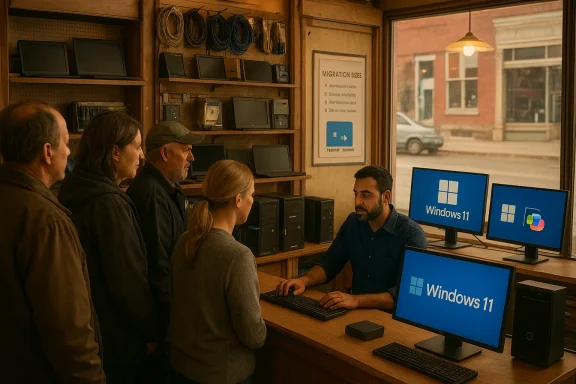
The Business Review in The Derrick frames the story as a local manifestation of a national migration trend: small businesses, schools, and consumers are increasingly asking for Windows 11 installations, new Copilot‑ready or Windows 11‑preloaded PCs, and managed migration services. While The Derrick’s local reporting provides the anecdotal moment — a busy queue of customers at a Seneca IT shop asking for upgrades — the drivers behind the shift are systemic. At the center are (1) Microsoft’s formal end of mainstream support for Windows 10, (2) Windows 11’s higher hardware security baseline, and (3) an active OEM channel supplying new Windows 11 devices and refresh incentives.
I attempted to retrieve the full text of The Derrick article through the linked URL; because the page is paywalled or otherwise inaccessible to automated retrieval, this review treats the local quotes and claims in the Business Review as reported by the newspaper and places them into context using independently verifiable sources from Microsoft, the company itself, and national technology reporting. Where claims in the local report cannot be independently confirmed, I flag them and indicate what can be verified.
The effect of that deadline has been durable. Industry commentary and analysis — from consumer tech outlets to enterprise trackers — show a measurable uplift in migration planning and device refresh cycles in the months immediately before and after the end‑of‑support date. In short: the calendar moved many previously dithering buyers into action.
Industry reporting has repeatedly emphasized this bifurcation: a sizeable cohort of devices is immediately eligible and ready to upgrade, while another large cohort is effectively blocked by hardware. Data points from OEM commentary reinforce the point: Dell, for example, has publicly estimated hundreds of millions of devices as either upgrade‑capable but remaining on Windows 10 or too old to be upgraded at all. That split creates a multi‑tiered market for IT resellers and managed service providers.
For small IT resellers and MSPs, this moment is a mixed gift: significant short‑term revenue from upgrades and device sales, matched by operational complexity, testing burdens, and capacity demands. For buyers, the migration is an opportune time to revisit IT hygiene — inventory, backups, identity posture, and security monitoring — not merely a cosmetic OS swap.
If you run a small business or manage endpoints in a regional setting, act intentionally: inventory first, test applications, stage your rollout, and budget for post‑migration support. Local providers like CS Technologies Plus can be strong partners in this work — but ask for documented plans, fallback options, and clear SLAs before buying into a fast migration.
Note on sources and verification: the technical points about Windows 11 system requirements and Windows 10 end‑of‑support are documented by Microsoft’s lifecycle and Windows 11 requirements pages. Industry context and adoption commentary were verified against multiple independent outlets and vendor statements. Where the local news article quoted specific local figures, those claims are flagged in this review as reported by The Derrick and should be confirmed with the company for precise accounting.
Source: The Derrick BUSINESS REVIEW: CS Technologies Plus sees surge of customers moving to Windows 11
 Overview
The Business Review in The Derrick frames the story as a local manifestation of a national migration trend: small businesses, schools, and consumers are increasingly asking for Windows 11 installations, new Copilot‑ready or Windows 11‑preloaded PCs, and managed migration services. While The Derrick’s local reporting provides the anecdotal moment — a busy queue of customers at a Seneca IT shop asking for upgrades — the drivers behind the shift are systemic. At the center are (1) Microsoft’s formal end of mainstream support for Windows 10, (2) Windows 11’s higher hardware security baseline, and (3) an active OEM channel supplying new Windows 11 devices and refresh incentives.I attempted to retrieve the full text of The Derrick article through the linked URL; because the page is paywalled or otherwise inaccessible to automated retrieval, this review treats the local quotes and claims in the Business Review as reported by the newspaper and places them into context using independently verifiable sources from Microsoft, the company itself, and national technology reporting. Where claims in the local report cannot be independently confirmed, I flag them and indicate what can be verified.
Background: why the timing matters
Windows 10 end‑of‑support created a calendar-driven push
Microsoft formally ended mainstream support for Windows 10 on October 14, 2025. After that date, routine security and feature updates ceased for most Windows 10 editions; Microsoft recommended upgrading eligible devices to Windows 11 or enrolling in the Extended Security Updates (ESU) program as a temporary bridge. This deadline converted what had been a optional upgrade into a practical imperative for many organizations that care about ongoing security and compliance.The effect of that deadline has been durable. Industry commentary and analysis — from consumer tech outlets to enterprise trackers — show a measurable uplift in migration planning and device refresh cycles in the months immediately before and after the end‑of‑support date. In short: the calendar moved many previously dithering buyers into action.
Hardware and compatibility are gatekeepers
Windows 11’s minimum system requirements include a baseline of hardware‑backed security: TPM 2.0, UEFI with Secure Boot, a 64‑bit processor on Microsoft’s supported list, at least 4 GB of RAM, and 64 GB of storage. Those hardware requirements are real constraints — they mean that some older machines cannot be upgraded without hardware swaps or outright replacement, which in turn drives demand for new or refurbished Windows 11‑capable systems.Industry reporting has repeatedly emphasized this bifurcation: a sizeable cohort of devices is immediately eligible and ready to upgrade, while another large cohort is effectively blocked by hardware. Data points from OEM commentary reinforce the point: Dell, for example, has publicly estimated hundreds of millions of devices as either upgrade‑capable but remaining on Windows 10 or too old to be upgraded at all. That split creates a multi‑tiered market for IT resellers and managed service providers.
What The Derrick reported — summary and verification
Local claim
- The Derrick’s Business Review reports that CS Technologies Plus, an established Seneca, PA IT shop, is experiencing a “surge” of customers moving to Windows 11 — manifesting as increased inquiries for upgrades, higher foot traffic for new and refurbished Windows 11 PCs, and demand for migration services.
What we can independently verify
- CS Technologies Plus is a long‑standing regional IT company offering PC sales, repairs, networking, training, internet services, and device refurbishing. Their public site and local chamber listings confirm these service lines and the firm’s capacity to sell and install new and refurbished Windows‑capable hardware. These offerings make CS Technologies Plus a realistic and plausible local supplier for Windows 11 migrations.
- It is consistent with national patterns that small IT shops serving SMBs and K‑12 customers would see increased demand around a major OS lifecycle inflection point such as the Windows 10 end‑of‑support date. Coverage across multiple technology outlets reports a broad uplift in migration activity and OEM refresh activity around the same timeframe.
What is not independently verifiable from public sources
- Exact local figures cited in the paper (for example: specific counts of customers served in a week, percentage increases at CS Technologies Plus, or precise revenue impacts) could not be confirmed because the raw article content was not fetchable by automated tools. Those figures should be treated as the newspaper’s reporting and, if important, verified directly with the company. I flag those numbers as reported but not independently confirmed.
Why customers are moving to Windows 11 now — the drivers
- Support and security obligation. With Windows 10’s support over, organizations that must remain protected and compliant have a natural incentive to migrate or to buy ESU coverage if they stay on older hardware. The risk calculus for continuing on an unsupported OS changes materially after a support end date.
- Hardware refresh cycles. Many businesses have aging fleets and were already planning refreshes. When a device is nearing replacement, choosing a Windows 11‑ready machine becomes the default decision. Local shops that stock both new and refurbished Windows 11 devices are natural beneficiaries. CS Technologies Plus’s inventory and refurbishment services make them a logical local nexus for these transactions.
- Security baseline and management. Windows 11’s TPM‑enabled features (BitLocker, Windows Hello security improvements, virtualization‑based security) and improved management integrations with Microsoft 365/Intune make migrations attractive for organizations prioritizing ransomware resilience and credential protection. These are not abstract features: auditors, insurers, and procurement teams increasingly score them in vendor assessments.
- Bundled incentives. OEMs and retailers have been actively shipping Windows 11 preinstalled on new devices and sometimes bundling trade‑ins, financing, or services — all forces that reduce the effective cost of upgrading for small buyers. Microsoft and PC OEM messaging tied to Copilot, Copilot+ PCs, and AI features also nudged some buyers to prefer Windows 11 hardware.
What this surge means for CS Technologies Plus and similar SMB resellers
Immediate commercial benefits
- Higher foot traffic and service revenue. Upgrades are not just device sales — they generate labor hours for imaging, data migration, driver support, and on‑site troubleshooting. For a community provider like CS Technologies Plus, those service margins are often a core profit generator.
- Inventory turnover and refurb opportunities. Many SMBs and households seek cost‑effective upgrades rather than brand‑new machines. Companies that refurbish donor hardware into Windows 11‑capable devices (or clearly communicate when a device is not upgradeable) can capture that mid‑market. CS Technologies Plus advertises both new and refurbished PCs, which positions it to monetize both segments.
- Cross‑sell windows: networking, backup, and security. Migration projects are inflection points where customers are receptive to related purchases: cloud backups, anti‑ransomware controls, managed antivirus, and improved networking. Local MSPs that present bundled, practical upgrade plans will win more business.
Operational and strategic strains
- Testing and compatibility burden. Even in small environments, SMBs run specialized accounting, point‑of‑sale or industry‑specific applications. Resellers must test these apps on Windows 11 or provide mitigation plans (compatibility modes, containerization, or thin‑client alternatives). This adds labor and complicates scheduling.
- Supply variability. While OEM supply improved in recent years, the specific SKUs that perfectly match a small business’s needs (battery life, docking compatibility, expansion) can be in short supply — particularly if buyers must replace many devices quickly. Retailers need flexible sourcing and clear customer expectations.
- Pricing pressure and customer education. Not every older device needs replacement; in‑place upgrades may suffice. Resellers face the twin tasks of educating customers about when a replacement is necessary and avoiding the appearance of opportunistic upselling.
Practical migration checklist for small businesses (actionable steps)
- Inventory and eligibility audit.
- Run a hardware compatibility check (PC Health Check or manufacturer tools) to separate devices that can upgrade in place from those that must be replaced. Document TPM, Secure Boot, CPU family, RAM and disk availability.
- Application compatibility testing.
- Identify mission‑critical applications and run smoke tests on Windows 11 in a lab or VM. Flag anything requiring vendor updates or special drivers.
- Backup and business continuity plan.
- Implement full image backups (and verify restores) before any migration. Consider rollback images and a staged pilot of representative user profiles.
- User communication and training.
- Prepare short, role‑based guidance: key UI changes, Snap Layouts, and any corporate policies (Single Sign‑On, credential changes, passkeys). Small training sessions reduce help‑desk calls post‑migration.
- Phased rollout.
- Upgrade pilot users first, then departmental groups. Stagger device replacements to avoid service interruptions.
- Post‑migration support package.
- Offer a 30–90 day support window for issues, reconfiguration, or performance tuning — this is a monetizable service and builds trust.
Financial and market implications beyond the local shop
- For small MSPs and resellers: the migration is a revenue opportunity in three categories — hardware sales, migration services, and recurring security/management subscriptions — but it demands careful pricing and predictable delivery models.
- For SMB buyers: the choices are nuanced. Replacing a non‑upgradeable device can be expensive up front but reduces long‑term security risk; in‑place upgrades may be cheaper but can complicate future support and patching.
- For OEMs and distributors: the bifurcated installed base (many eligible but still on Windows 10, many too old to upgrade) drives segmented product offers: trade‑in discounts and low‑end refurbished SKUs for price‑conscious buyers, and premium Copilot+ or AI‑optimized devices for higher‑value customers. Commentary from large vendors shows they are tuning their offerings accordingly.
Risks and caveats — what to watch for
- Compatibility surprises. Legacy printers, line‑of‑business USB dongles, or aged device drivers are the usual time‑stealers in small rollouts. Always budget time for driver hunts and firmware updates.
- Security posture deception. Upgrading to Windows 11 is not a complete security solution by itself. Misconfigured defaults, weak identity controls, and missing endpoint protection still leave organizations vulnerable. Treat the OS as an enabling baseline that must be paired with proper hardening and monitoring.
- Unsupported bypasses and their cost. Some people choose registry hacks or third‑party tools to bypass Windows 11 hardware checks. That creates unsupported configurations that may miss updates or break later, especially firmware‑tied protections — not a recommended path for commercial customers.
- Vendor messaging versus operational reality. Headlines about Windows 11 hitting a milestone (for example, public announcements or OEM statements about adoption rates) can overstate how straightforward migrations are for any given organization. The migration milestone does not mean the work is done — many devices and dozens of special cases remain. Analysts have repeatedly urged nuance when interpreting vendor adoption claims.
Strengths of CS Technologies Plus’s position (why the local surge is credible)
- Established local presence, multi‑service capability. CS Technologies Plus advertises sales, repair, wireless internet, training and refurbishing — a broad stack that matches the needs of community customers making OS transitions. That makes them a logical beneficiary of a regional migration wave.
- Service orientation. Small shops with on‑site repair and training capacity can deliver better customer experiences than large, remote support channels for the “last mile” issues that follow an OS migration.
- Refurb and trade‑in economics. For price‑sensitive buyers, a trusted local seller that can refurbish donor machines or offer tested refurbished Windows 11 systems is highly valuable.
Weaknesses and potential risks for CS Technologies Plus and similar shops
- Capacity limits. A sudden surge can outstrip local labor capacity; if turnaround slips, customer satisfaction could decline.
- Margin pressure. Competitive pressures on hardware pricing and the expectation of low‑cost upgrades can compress margins on device sales; high‑value services (consulting, testing, post‑migration support) will likely carry the sustainable margin.
- Liability exposure. If migrations introduce downtime or data loss, small vendors can face reputational or contractual liability; strict pre‑migration agreements and documented backups are essential.
How to turn this surge into lasting advantage
- Position migration offerings as projects, not ad‑hoc upgrades. Create packaged bundles with clear deliverables: inventory audit, pilot migration, full rollout, and a post‑migration support window.
- Introduce subscription services tied to the migration: managed patching, 24/7 monitoring, and backup as a service. Those recurring revenues reduce dependence on one‑time device sales.
- Build partnerships with regional OEM distributors to guarantee stock and time‑to‑delivery for common form factors used by local customers.
- Offer targeted training and short user guides to reduce support tickets post‑migration — training is a high‑perceived‑value service for SMBs.
Conclusion
The Derrick’s Business Review that CS Technologies Plus is seeing a surge in customers moving to Windows 11 tracks with what national reporting and platform timelines indicate: Microsoft’s end of support for Windows 10, Windows 11’s hardware and security baseline, and OEM refresh incentives combined to create a measurable uptick in migrations. The claim is plausible and consistent with the company’s publicly listed services and the broader market context. However, local numerical details quoted by the newspaper should be regarded as the paper’s reporting unless confirmed directly by CS Technologies Plus.For small IT resellers and MSPs, this moment is a mixed gift: significant short‑term revenue from upgrades and device sales, matched by operational complexity, testing burdens, and capacity demands. For buyers, the migration is an opportune time to revisit IT hygiene — inventory, backups, identity posture, and security monitoring — not merely a cosmetic OS swap.
If you run a small business or manage endpoints in a regional setting, act intentionally: inventory first, test applications, stage your rollout, and budget for post‑migration support. Local providers like CS Technologies Plus can be strong partners in this work — but ask for documented plans, fallback options, and clear SLAs before buying into a fast migration.
Note on sources and verification: the technical points about Windows 11 system requirements and Windows 10 end‑of‑support are documented by Microsoft’s lifecycle and Windows 11 requirements pages. Industry context and adoption commentary were verified against multiple independent outlets and vendor statements. Where the local news article quoted specific local figures, those claims are flagged in this review as reported by The Derrick and should be confirmed with the company for precise accounting.
Source: The Derrick BUSINESS REVIEW: CS Technologies Plus sees surge of customers moving to Windows 11
