
Microsoft’s October cumulative for Windows 11 (KB5066835) promised security hardening and quality fixes — but instead delivered a trio of high-impact regressions that forced an emergency out‑of‑band response and left local web services and recovery workflows in limbo for many users and administrators. One of the two headline problems — USB input loss inside the Windows Recovery Environment (WinRE) — was patched quickly with an out‑of‑band update, KB5070773, but a deeper kernel‑level regression in HTTP.sys remains a live issue for apps that depend on the OS kernel HTTP stack, leaving IIS sites, developer toolchains, and embedded local web servers prone to connection resets and HTTP/2 negotiation failures.
Microsoft shipped the October 2025 Patch Tuesday cumulative update identified as KB5066835 on October 14, 2025. The package bundled security fixes with servicing‑stack changes and delivered the expected monthly hardenings for Windows 11, but within days multiple, distinct regressions were reported across consumer and enterprise environments. Affected scenarios included:
Microsoft issued an emergency out‑of‑band cumulative patch, KB5070773, on October 20, 2025 that explicitly lists restoration of WinRE USB input as a remediation item. Administrators were advised to check Windows Update and install KB5070773 where offered.
However, the incident surfaces lingering risks:
Administrators must respond tactically — deploying KB5070773 where WinRE is affected, pausing mass installs of KB5066835 in sensitive rings, and applying validated HTTP.sys mitigations in test environments — while also adopting longer‑term safeguards: validated recovery images, staged update rings, and explicit WinRE checks in deployment pipelines. The incident underscores that security and recoverability must be balanced, tested, and operationalized as inseparable priorities for Windows platform stewardship.
Source: htxt.co.za Microsoft still needs to fix one major update introduced by October patch - Hypertext
 Background
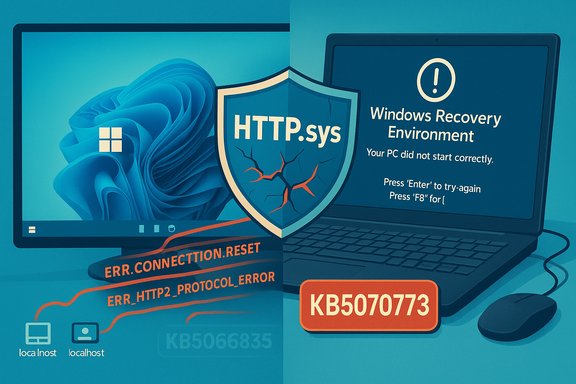
Microsoft shipped the October 2025 Patch Tuesday cumulative update identified as KB5066835 on October 14, 2025. The package bundled security fixes with servicing‑stack changes and delivered the expected monthly hardenings for Windows 11, but within days multiple, distinct regressions were reported across consumer and enterprise environments. Affected scenarios included:- USB keyboards and mice becoming unresponsive inside WinRE, rendering recovery menus unusable.
- A kernel‑mode HTTP listener regression (HTTP.sys) that broke localhost and other IIS‑hosted sites with errors such as ERR_CONNECTION_RESET and ERR_HTTP2_PROTOCOL_ERROR.
- Additional compatibility regressions tied to cryptographic hardenings and File Explorer preview handling.
What broke, in practical terms
WinRE: the recovery environment went silent
The most immediately alarming failure was that USB input devices — keyboards and mice — stopped working inside the Windows Recovery Environment after installing KB5066835. Systems would boot into WinRE normally and display recovery tiles, but neither keystrokes nor mouse clicks were accepted, leaving Safe Mode, Startup Repair, Reset this PC, and other built‑in remediations inaccessible on affected machines. This is not merely inconvenient: for many modern laptops and compact systems that lack PS/2 ports, WinRE is the primary on‑device recovery path.Microsoft issued an emergency out‑of‑band cumulative patch, KB5070773, on October 20, 2025 that explicitly lists restoration of WinRE USB input as a remediation item. Administrators were advised to check Windows Update and install KB5070773 where offered.
HTTP.sys regression: local servers and IIS sites failing
A separate but arguably larger operational issue is a regression in HTTP.sys, the kernel‑mode HTTP listener that underpins IIS, IIS Express, HttpListener, and many embedded local web servers. After KB5066835, numerous users reported that incoming connections handled by HTTP.sys would fail during HTTP/2 or TLS negotiation, terminating with browser errors like ERR_CONNECTION_RESET or ERR_HTTP2_PROTOCOL_ERROR. The practical consequences include:- Local web development and debugging stopped working in Visual Studio when projects used IIS or IIS Express.
- Vendor tools and desktop appliances that embed a local management web UI became unreachable.
- Some production scenarios that rely on kernel‑listener endpoints saw service interruption, especially when hosted on devices that had received the October update.
Timeline and Microsoft’s response
- October 14, 2025 — Microsoft releases the October cumulative update (KB5066835) as part of Patch Tuesday, targeting Windows 11 24H2 and 25H2 lines.
- October 15–18, 2025 — Field reports and enterprise telemetry surface the WinRE USB input regression, HTTP.sys/localhost failures, and related compatibility issues; Microsoft marks some items as Confirmed on the Release Health dashboard.
- October 20, 2025 — Microsoft ships an out‑of‑band cumulative update, KB5070773, to remediate WinRE input problems and deploys Known Issue Rollback and dynamic SafeOS refreshes in some channels. The WinRE USB symptom is explicitly addressed in KB5070773’s updates.
- Post‑October 20 — The HTTP.sys regression remains under active investigation and mitigation; Microsoft publishes guidance, mitigations, and KIR where applicable. Administrators and developers are advised to avoid broad installations of KB5066835 until the HTTP.sys regression is fully resolved.
Technical analysis: why did this happen?
The fragility of Safe OS (WinRE) and combined packages
WinRE runs as a trimmed “Safe OS” image (winre.wim) with a deliberately reduced driver and service set. That minimalism is a feature for reliability but makes the environment sensitive to changes in the Safe OS image or the drivers packaged into it. The October cumulative bundled the servicing stack (SSU) with the latest cumulative update (LCU), and that combined packaging can complicate rollback semantics and testing coverage. A mismatched USB host controller / HID driver variant in the Safe OS image was the proximate cause of WinRE input loss. Microsoft’s out‑of‑band patch repaired the Safe OS image delivered to affected devices.Kernel HTTP stack: the danger of low‑level regressions
HTTP.sys operates in kernel space and mediates incoming HTTP connections for IIS, HttpListener, and related stacks. A regression in HTTP.sys — particularly during HTTP/2 or TLS negotiation — can close sessions before control ever reaches user‑mode servers, producing connection resets and hard‑to‑diagnose failures for applications that rely on localhost or URL ACLs. Because kernel‑level changes have broad reach, a single protocol‑handling regression rapidly cascades into many toolchains (IIS Express, Visual Studio, vendor UIs). Field reports point to HTTP/2/TLS negotiation and post‑handshake semantics as probable interaction points. The fact that fresh installs sometimes do not reproduce the issue suggests additional state factors such as existing registry settings, third‑party drivers, or previous update sequences that interact unpredictably with the kernel stack.Mitigations and recommended actions
For home users, developers, and IT administrators, the incident requires a mix of urgent patching where appropriate and cautious rollout hygiene elsewhere. Key guidance:- If your machine is affected by the WinRE USB input regression, check Windows Update and install KB5070773 when available; validate WinRE input after installation.
- For environments where local IIS, IIS Express, Visual Studio debugging, or embedded local web UIs are critical, do not mass‑deploy KB5066835 until the HTTP.sys regression is resolved or adequate mitigations are validated in a test ring.
- Short‑term mitigations for HTTP.sys failures reported by community responders included:
- Updating Microsoft Defender security intelligence definitions (a non-invasive attempt that fixed some reports).
- Forcing HTTP/1.1 for local loopback endpoints via registry tweaks to disable HTTP/2 at the OS HTTP stack level — this sacrifices protocol benefits but often restores compatibility for debugging and management scenarios.
- Rolling back the offending KBs where risk‑appropriate (with the caveat that combined SSU+LCU packages change uninstall behavior and may not fully rollback via standard wusa/uninstall semantics).
- Inventory: Identify devices that installed KB5066835 and prioritize critical endpoints (kiosks, servers with local web UIs, developer workstations).
- Pause: Halt further automatic rollout of KB5066835 across sensitive rings until mitigations are validated.
- Deploy: Install KB5070773 to restore WinRE functionality where necessary and pilot any HTTP.sys mitigations in a controlled test group.
- Prepare: Create bootable Windows 11 USB media and verify BitLocker recovery key availability to reduce the operational impact if WinRE is not responsive.
Risks, trade‑offs and enterprise impact
This servicing incident illuminates several systemic risks and trade‑offs:- Security vs. recoverability: Rapid, mandatory security updates close vulnerabilities but can — as in this case — inadvertently damage recovery pathways, elevating operational risk from unpatched vulnerabilities to unrecoverable devices. The cryptographic hardening in the October rollup (moving RSA smart‑card operations to KSP) illustrates this trade‑off, where improved security semantics produced application compatibility fallout for legacy CSP‑dependent apps.
- Cumulative packaging and rollback complexity: Combining the SSU and LCU into a single cumulative package reduces management steps but makes rollbacks and partial uninstalls harder, complicating remediation in emergencies. Administrators must factor these semantics into patching runbooks.
- Blast radius of kernel regressions: Changes in kernel components like HTTP.sys have outsized blast radii. A single protocol negotiation regression can break developers’ productivity, CI pipelines, and embedded admin consoles across many products.
What this means for Windows 11 adoption and patch policy
The timing of these regressions — arriving during a period of elevated Windows 11 adoption after Windows 10 support changes — intensified their visibility. Organizations and end users facing hardware refreshes or mandatory migration to Windows 11 are now forced to weigh patch urgency against the risk of regressions that can affect recoverability and developer productivity. Operational recommendations:- Treat recovery validation as a first‑class test: Every update ring should include a WinRE test on representative hardware before broad deployment. Keep golden winre.wim images for each hardware baseline in your imaging pipeline so you can restore a validated Safe OS quickly.
- Separate critical tooling from platform rollouts: Developer and management workstation rings that run local IIS or embedded servers should be staged separately and given extra validation for HTTP.sys behavior.
- Maintain external recovery media and clear runbooks: Have validated bootable USB installers and a well‑drilled recovery playbook that includes reagentc checks, driver inventory, and BitLocker key management.
Strengths in Microsoft’s response — and where risks remain
Microsoft’s response demonstrated several positive practices: prompt public acknowledgement on Release Health, publication of Known Issue Rollback guidance, and rapid issuance of an out‑of‑band cumulative update (KB5070773) that fixed the most immediate recoverability issue for many users. Those are the correct operational steps when a patch harms recoverability at scale.However, the incident surfaces lingering risks:
- Partial fixes and KIRs can mask the underlying root cause if they only address symptoms; the HTTP.sys regression persisted beyond the initial patch window and required deeper kernel analysis.
- The variability of repro — fresh installs vs. upgrades behaving differently — complicates diagnostics and suggests the update sequencing and local state interactions were under‑tested across the hardware and software matrix.
Recommended long‑term measures for organizations
- Institutionalize recovery testing: Include WinRE validation in daily or weekly update validation tests across representative hardware models.
- Harden patch windows with staged rings: Use separate rings for security‑critical updates and for developer/management workstations with local web dependencies. Validate HTTP.sys behavior explicitly.
- Keep fallback artifacts current: Maintain bootable installers, golden winre.wim images, and off‑device BitLocker recovery keys.
- Engage vendor forums early: For commercial products that embed local web UIs (for example, vendor management appliances), maintain vendor contacts and test those products immediately after cumulative updates.
Conclusion
The October servicing wave — KB5066835 — exposed a harsh truth about modern platform servicing: when a single cumulative package touches multiple low‑level subsystems, the blast radius of regressions grows quickly. Microsoft’s emergency update (KB5070773) demonstrates that rapid remediation is possible and that recovery should be prioritized. Yet the lingering HTTP.sys regression remains a cautionary tale: kernel‑level protocol changes can silently cripple developer toolchains and embedded management consoles, and rollback semantics for combined packages complicate remediation.Administrators must respond tactically — deploying KB5070773 where WinRE is affected, pausing mass installs of KB5066835 in sensitive rings, and applying validated HTTP.sys mitigations in test environments — while also adopting longer‑term safeguards: validated recovery images, staged update rings, and explicit WinRE checks in deployment pipelines. The incident underscores that security and recoverability must be balanced, tested, and operationalized as inseparable priorities for Windows platform stewardship.
Source: htxt.co.za Microsoft still needs to fix one major update introduced by October patch - Hypertext
