

Windows 11’s October servicing update has been tied to dramatic frame‑rate collapses in modern PC games, with independent tests showing Assassin’s Creed: Shadows dropping by roughly a third to a half in demanding scenes after installing KB5066835 — a regression substantial enough that NVIDIA shipped an out‑of‑cycle hotfix driver to blunt the damage.
Microsoft released the October cumulative update for Windows 11 (catalogued as KB5066835) as part of its normal servicing wave. Within days and weeks of rollout, a pattern of unrelated regressions emerged across the ecosystem — from problems in the Windows Recovery Environment to unexpected networking anomalies — and a separate cluster of reports identified measurable gaming performance regressions on a subset of systems.
What makes this episode notable is the convergence of three independent signals: (1) community reports and forum telemetry from affected players, (2) editorial bench testing that reproduced severe FPS declines in at least one high‑profile title, and (3) vendor action in the form of an emergency NVIDIA hotfix explicitly referencing the Windows update. Those three threads together form a credible chain linking the Windows update to the observed gaming slowdowns.
Key context and caveats for these figures:
What we can say with reasonable confidence:
For gamers and administrators the pragmatic path is clear: baseline your systems, apply vendor‑recommended mitigations if you’re affected (with backups and caution), and prefer staged rollouts for critical fleets. For vendors, the episode is a call to improve cross‑stack validation and collaborative transparency so that when regressions occur, users see expedient mitigations plus a durable technical explanation.
Until a formal, joint post‑mortem is published by the vendors involved, treat the visible facts — the KB number, the test numbers in affected configurations, and NVIDIA’s hotfix — as the clearest, verifiable anchors in an ongoing investigation.
Source: Club386 Latest Windows 11 update slashes Assassin's Creed Shadows performance in half | Club386
 Background / Overview
Microsoft released the October cumulative update for Windows 11 (catalogued as KB5066835) as part of its normal servicing wave. Within days and weeks of rollout, a pattern of unrelated regressions emerged across the ecosystem — from problems in the Windows Recovery Environment to unexpected networking anomalies — and a separate cluster of reports identified measurable gaming performance regressions on a subset of systems.What makes this episode notable is the convergence of three independent signals: (1) community reports and forum telemetry from affected players, (2) editorial bench testing that reproduced severe FPS declines in at least one high‑profile title, and (3) vendor action in the form of an emergency NVIDIA hotfix explicitly referencing the Windows update. Those three threads together form a credible chain linking the Windows update to the observed gaming slowdowns.
What happened (timeline and verified facts)
- October 14, 2025 — Microsoft distributed the cumulative Windows 11 update catalogued as KB5066835, applied to relevant 24H2 and 25H2 builds. The update included a mix of security hardenings, fixes, and behavioural changes across kernel and system components.
- Mid‑October → November 2025 — Gamers began reporting sudden, sustained performance drops and increased stutter in certain modern titles after installing the update; the effect varied by configuration and title.
- November 19, 2025 — NVIDIA released GeForce Hotfix Display Driver 581.94, an out‑of‑cycle mitigation stating it “addresses: Lower performance may be observed in some games after updating to Windows 11 October 2025 KB5066835.” The vendor positioned the package as a rapid mitigation built on a prior Game Ready driver baseline.
- Late November 2025 — Independent outlets and benchmarking teams reproduced significant performance drops in specific test points and reported that the NVIDIA hotfix restored performance in many affected configurations.
Independent testing: the numbers and what they mean
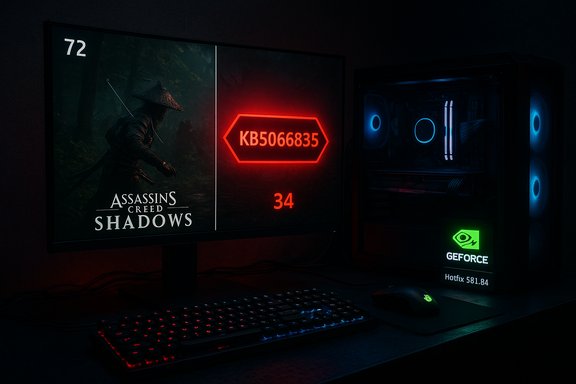
Multiple hands‑on benches focused on Assassin’s Creed: Shadows as the most visible canary for the regression, because the title stresses modern GPU and driver interactions (heavy draw calls, frequent present patterns, and advanced upscalers like DLSS). The clearest reproduced example used a high‑end testbed (an AMD Ryzen 7 9800X3D CPU paired with an NVIDIA GeForce RTX 5090), where identical scene captures dropped from roughly 72 fps to ~34 fps after KB5066835 — a decline in the neighborhood of 33–50% for that scene. Installing NVIDIA’s hotfix (581.94) in those tests returned the scene to near its pre‑update performance.Key context and caveats for these figures:
- The most dramatic numbers are scene‑specific and configuration‑dependent. They reflect precise test points on particular hardware and are not a universal measurement across all PCs.
- Reported deltas varied across games and systems; other titles showed milder effects or none at all. Counter‑Strike 2 was also called out in some tests and community reports as showing a measurable but smaller regression.
- Community posts often circulate single‑system snapshots that are valid for those exact conditions; extrapolating them to the entire installed base risks overstating the scope. That said, the combination of independent reproductions and vendor mitigation strengthens the conclusion that a real, observable interaction exists for a subset of configurations.
Why an OS update can slay frame rates: technical analysis
Modern PC gaming is a millisecond dance between multiple layers: the game engine, the graphics runtime (DirectX/Vulkan), GPU drivers, kernel scheduling, power and thermal controls, firmware (BIOS) features like Resizable BAR, overlays and compositors, and anti‑cheat hooks. Small changes in timing, interrupt routing, system scheduler heuristics, or display composition semantics can change how frames are batched, submitted and presented — with outsized impact on perceptual smoothness.What we can say with reasonable confidence:
- The regression correlates with KB5066835 and produces symptoms consistent with timing/interaction fragility: lower average GPU utilization, worsened 1% lows, and increased micro‑stutter.
- NVIDIA’s decision to ship a targeted hotfix driver that explicitly references the KB update suggests the company identified a driver‑level mitigation that restored expected behaviour for affected games; in effect, NVIDIA adjusted or reverted a driver behaviour to avoid the pathological interaction.
- The precise kernel call, scheduler tweak, or DWM/composition change in KB5066835 that triggered the regression has not been publicly disclosed by Microsoft. Any statement that pins the blame on a single kernel API or user‑mode component would be speculative until vendors publish a joint post‑mortem.
- Community‑reported BIOS workarounds (for example, toggling Resizable BAR) are anecdotal: they help some configurations but do not explain the underlying code path that produced the bug. These are pragmatic mitigations, not root‑cause explanations.
Vendor responses: mitigation vs. root cause
Two important vendor actions framed the public response:- NVIDIA’s hotfix (GeForce Hotfix Display Driver 581.94) arrived quickly as a targeted mitigation and restored performance in many reported cases. NVIDIA described it as a hotfix — intentionally abbreviated QA compared with a full WHQL Game Ready release — and advised users who experienced degraded performance to install it while a longer‑term fix was developed.
- Microsoft issued out‑of‑band follow‑ups for several regressions discovered after KB5066835 and has the enterprise‑level toolset (Known Issue Rollback, KIR) to manage problematic changes for large deployments. However, a detailed, technical root‑cause writeup tying specific KB changes to observed game‑level symptoms was not publicly available at the time the original reporting circulated. That absence leaves room for conjecture and increases the importance of vendor coordination.
- Hotfix drivers are effective at restoring functionality quickly but carry higher risk because their abbreviated QA timelines can introduce edge‑case regressions elsewhere. For users who cannot tolerate driver instability (production rigs or enterprise fleets), the conservative course is to wait for the fix to be folded into a fully validated Game Ready/WHQL release.
Immediate, actionable guidance (for gamers and admins)
If you suspect your system was affected after mid‑October, follow a prioritized, careful checklist:- Check whether KB5066835 (or a later rollup containing the same changes) is installed on your machine. If you’re not on that build, your issue likely has a different cause.
- If you have an NVIDIA GPU and experienced degraded gaming performance, test with GeForce Hotfix Driver 581.94 (manual hotfix channel) and evaluate whether it restores your frame rates. Create a system restore point or full image first.
- If you cannot or prefer not to use a hotfix driver, wait for the next full Game Ready driver that folds the mitigation into a broadly‑tested release. For critical systems, prefer the conservative path.
- For enterprise environments: use Microsoft’s Known Issue Rollback (KIR) and staged deployment controls to avoid broad outages; coordinate with vendor support for managed driver updates.
- Document symptoms and baseline performance (FPS, 1%/0.1% lows, CPU/GPU telemetry) and, if you experiment with BIOS toggles such as Resizable BAR, record the exact configuration before changes — those toggles are anecdotal mitigations and can have wider impact on performance elsewhere.
- Update to NVIDIA 581.94 if affected (test first).
- If the hotfix helps, decide whether to keep it until the next certified driver.
- If it does not help, revert driver changes and collect logs for vendor support; consider rolling back the KB only with caution (and preferably under guidance for enterprise systems).
Critical assessment: strengths, gaps, and the state of evidence
Strengths of the current evidence:- Multiple independent benches reproduced large deltas in controlled test points and documented the hotfix restoring performance — that combination is strong circumstantial proof of an interaction between the Windows update and vendor drivers.
- NVIDIA’s hotfix explicitly naming KB5066835 as the trigger is an unusually clear vendor acknowledgement of a cross‑stack regression; vendors rarely single out OS updates in release notes without good cause.
- The most dramatic performance drops come from a small number of high‑end test configurations. While these are valid and important cases, they do not automatically indicate a mass market failure across all systems. Broad telemetry would help quantify the true prevalence.
- There was no immediate, jointly published technical root‑cause analysis from Microsoft and GPU vendors at the time of the hotfix. That leaves the community dependent on vendor statements, forum lore, and limited benches until a formal post‑mortem appears. Treat causal claims beyond the observed correlation as provisional.
- Hotfix drivers are stopgaps. They work quickly but are not substitutes for full QA processes; administrators and cautious users must weigh the trade‑offs before deploying them broadly.
Broader implications for the Windows gaming ecosystem
This incident is a cautionary tale about the fragility of the modern PC stack. Three enduring lessons emerge:- Integration testing must cover partner stacks: OS vendors should expand test matrices to include diverse driver versions, firmware configurations (Resizable BAR, UEFI variants), and popular high‑frequency workloads like modern game engines. Small timing changes can have outsized perceptual impacts.
- Faster coordination, clearer comms: When regressions cross vendor boundaries, a jointly authored advisory or post‑mortem not only helps sysadmins triage but also preserves user trust. The combination of independent benches and vendor mitigations is useful, but a transparent technical explanation would close the loop.
- User empowerment matters: Enthusiast communities frequently discover mitigations and create practical guides. Vendors and enterprise IT should provide accessible controls (KIR, easier driver rollbacks) to prevent broad disruption.
The “Linux as rescue” argument — realistic or rhetorical?
Some commentators have used this moment to argue that SteamOS / Linux gaming is a credible escape hatch for frustrated gamers. There is merit in the observation: Linux gaming stacks — Proton, Mesa, driver improvements — have matured rapidly, and Valve’s push with SteamOS has increased the viability of the platform for many single‑player and Proton‑compatible titles. However, the reality is nuanced:- Linux is increasingly competitive for many titles, especially with AMD GPUs, but anti‑cheat and certain multiplayer ecosystems remain blockers for large swathes of the gaming library.
- Transitioning an existing library, peripherals, or social multiplayer habits to Linux still involves friction for many users. For those comfortable with tinkering and whose titles work well under Proton, Linux is an attractive alternative; for others, Windows remains the pragmatic choice.
Conclusion
The KB5066835 episode underlines a hard truth: in the modern PC ecosystem, software — not silicon — often defines the user experience. A widely deployed cumulative update that touches core subsystems can ripple across drivers and workloads, producing visible failures in performance‑sensitive apps like modern games. In this instance, independent benches reproduced severe FPS drops in Assassin’s Creed: Shadows, NVIDIA issued a targeted hotfix (581.94) that restored performance in many cases, and the broader pattern of reports suggests a real but configuration‑dependent regression tied to the October Windows servicing wave.For gamers and administrators the pragmatic path is clear: baseline your systems, apply vendor‑recommended mitigations if you’re affected (with backups and caution), and prefer staged rollouts for critical fleets. For vendors, the episode is a call to improve cross‑stack validation and collaborative transparency so that when regressions occur, users see expedient mitigations plus a durable technical explanation.
Until a formal, joint post‑mortem is published by the vendors involved, treat the visible facts — the KB number, the test numbers in affected configurations, and NVIDIA’s hotfix — as the clearest, verifiable anchors in an ongoing investigation.
Source: Club386 Latest Windows 11 update slashes Assassin's Creed Shadows performance in half | Club386
