

A Santo André BIZ listing describes a single cyan Windows 11 Pro logo decal measuring 16mm by 23mm, marketed as an unbranded peel-and-stick accessory for laptops, desktops, tablets, notebooks, and other smooth surfaces. The product is cheap, tiny, and almost comically low-stakes, but it lands in a market where Windows branding has long carried more weight than ordinary decoration. A logo sticker can be harmless personalization; it can also blur, for less careful buyers, the line between showing affinity for Windows and implying that a machine is licensed, certified, or officially supplied. That distinction matters more than the sticker does.
The Santo André BIZ product pitch is straightforward: one cyan Windows 11 Pro logo sticker, 16mm by 23mm, no manufacturer part number, no OEM affiliation, and no claim that it contains a product key or license. On its face, this is not a Windows license, not a Certificate of Authenticity, and not a device certification label. It is a cosmetic decal.
That simplicity is exactly why the listing is interesting. Windows users have spent decades reading stickers as signals: “Designed for Windows,” “Windows Vista Capable,” OEM badges, edition labels, COA labels, service tags, serial-number labels, asset tags, and refurbisher marks. A little rectangle on the palm rest has never been just a little rectangle.
For enthusiasts, a replacement badge can be fun. For IT departments, repair shops, resellers, and buyers of used machines, the same object can become another small piece of visual ambiguity. Windows licensing is already abstract enough in the digital-license era; adding unofficial edition branding to hardware that may or may not actually run Windows 11 Pro does not make the picture cleaner.
The decal market is therefore a tiny mirror of a bigger Windows reality. Microsoft has moved licensing, activation, and entitlement increasingly into software and account infrastructure, while users still reach for physical signs to explain what a machine is. The sticker survives because people still want the device to look like what they believe it is.
That era has not vanished entirely, but Windows 10 and Windows 11 changed the center of gravity. Activation is now commonly tied to a digital entitlement associated with the device’s hardware profile, a Microsoft account, or a product key entered through the activation system. The machine can be properly licensed even if its case has no meaningful Windows badge at all.
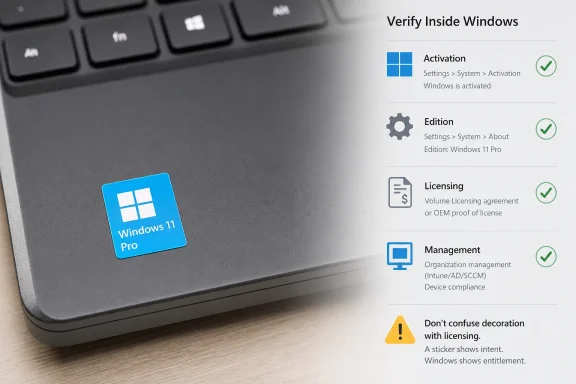
That makes decorative stickers both less important and more potentially misleading. A Windows 11 Pro decal on a laptop does not prove that Windows 11 Pro is installed. It does not prove that the edition is activated. It does not prove that the license is transferable, genuine, retail, OEM, volume, or compliant with anyone’s procurement policy.
The old visual shorthand still has power, though. People glance at a palm rest or tower and make assumptions. That is why a 16mm-by-23mm logo is not just a trinket in the Windows ecosystem; it sits on top of decades of habits around trust, resale, refurbishing, and device identity.
Microsoft’s trademark rules are built around preventing exactly the kind of confusion that turns a logo into an implied endorsement. The Windows name and logo are not just design elements; they are brand assets used to signal Microsoft products, compatibility, certification, and ecosystem trust. That does not mean every fan-made sticker is destined for a courtroom, but it does mean a seller should be careful about how it presents such an item.
The practical question for buyers is not whether the decal is pretty. It is whether the decal could be mistaken for something official. A tiny logo on a water bottle is one thing. A Windows 11 Pro badge placed on a refurbished laptop for resale is another.
That distinction is where enthusiast culture and commerce part ways. A collector customizing a personal rig is expressing taste. A reseller applying edition-specific Windows branding to a device is making a representation, even if unintentionally, about what that device is.
A decorative Windows 11 Pro sticker does not upgrade Windows 11 Home to Pro. It does not activate anything. It does not repair a failed activation state. It does not replace a lost OEM proof-of-license label. It does not make an unsupported PC supported. It does not turn a home-built desktop into a Microsoft-certified commercial device.
This sounds obvious until one spends time in Windows support forums, refurbisher listings, or online marketplaces. Users routinely confuse product keys, licenses, editions, recovery media, COA labels, digital entitlements, and edition badges. The language of “Windows 11 Pro sticker” can mean a harmless decal in one listing and a legally sensitive licensing artifact in another.
That confusion has real consequences. Microsoft’s own guidance on genuine Windows emphasizes activation, licensing, COA features, proof-of-license materials, and counterfeit risk. Federal cases involving illicit Microsoft COA labels show that, in the wrong context, stickers are not trivial at all.
Those capabilities are why the word “Pro” still has market value. A used laptop advertised as Windows 11 Pro may command more interest from business buyers than one advertised as Windows 11 Home. A home lab user may want Pro because it better supports virtualization and management experiments. A small business may standardize on Pro because it needs device management features that Home does not provide.
That makes a Pro-branded sticker more loaded than a generic Windows logo. It is not just saying “this machine likes Windows.” It is invoking a specific commercial edition with specific licensing and functionality expectations.
For a personal water bottle or a custom PC case, the distinction is largely aesthetic. For anything sold, inventoried, audited, or assigned to an employee, it is not. If the machine says “Windows 11 Pro” on the outside but Windows activation says otherwise on the inside, the software screen wins.
That is not inherently bad. The PC has always been a platform for personalization, from beige-box case badges to RGB builds to distro logos on battered developer laptops. Windows enthusiasts, especially those who have spent years tweaking, reinstalling, and debating Microsoft’s design choices, are entitled to a little platform pride.
But the Windows logo carries a different kind of baggage from a hobbyist sticker. Microsoft is not a loose community project, and Windows is not merely a fandom. It is a commercial operating system governed by licenses, activation rules, OEM contracts, and trademark controls.
That is the tension this decal exposes. The user sees self-expression. The seller sees a low-cost accessory. Microsoft sees a protected brand. A sysadmin sees potential confusion in an asset inventory. All four readings can be true at once.
Refurbished PCs already occupy a trust-sensitive zone. Buyers want to know whether they are getting genuine hardware, clean storage, a valid Windows installation, current firmware, and a supportable machine. A shiny edition sticker can reassure at a glance, but it can also create expectations the seller has not actually verified.
The better practice is simple: the activation screen, invoice, refurbisher paperwork, and listing text should carry the truth. If the machine runs Windows 11 Pro and is properly activated, say so plainly. If it does not include Windows or ships with Home, do not let a Pro logo do quiet marketing work.
This is not only a legal concern; it is a customer-support concern. The buyer who discovers Windows 11 Home after purchasing what looked like a Pro machine is not going to care that the sticker was “just cosmetic.” They will experience it as a mismatch between representation and reality.
A Windows 11 Pro sticker on a corporate laptop may be harmless if every device in the fleet runs Pro or Enterprise. It is less harmless in mixed environments where licensing status, management enrollment, and device purpose matter. IT teams generally do not want users creating their own unofficial signals on machines that are supposed to be tracked by policy.
There is also the lifecycle issue. Laptops get reimaged. Editions change. Machines move between departments. Devices are downgraded, upgraded, enrolled, unenrolled, wiped, sold, donated, or recycled. A physical sticker can outlive the truth it once represented.
That is why businesses should resist treating cosmetic OS decals as asset metadata. The operating system should identify itself through management tools, activation state, configuration profiles, and inventory systems. The case should not be trusted as a source of record.
This is convenient, but it also makes the physical layer less authoritative. A device can be genuine with no Windows sticker. A device can have a Windows sticker and be unlicensed. A device can carry an old badge while running a newer OS. A device can be activated today and become problematic later if the key source was improper.
That is where the decal becomes almost nostalgic. It belongs to an older mode of trust in which the visible exterior helped explain the software interior. Windows 11, like most modern platforms, has moved trust into online validation and management systems.
The mismatch is not going away. Users still want tangible proof, decoration, and identity. Vendors still sell little objects that satisfy that desire. But Windows itself increasingly answers the licensing question through Settings, servers, and policy—not through adhesive.
That matters. There is a meaningful difference between selling a cyan logo decal and selling “Windows 11 Pro license sticker” with a key, hologram, or activation promise. The former is fan merchandise territory. The latter can become licensing trouble very quickly.
Still, buyers should understand the difference before they click. If the goal is to cover an old logo, decorate a laptop, or mark a personal Windows machine, the risk is mostly aesthetic and possibly trademark-adjacent. If the goal is to make hardware appear licensed, certified, upgraded, or professionally refurbished, the buyer has crossed into a different category.
That is the practical rule: decoration is decoration only when everyone understands it as decoration. The moment the sticker is used to imply software rights, it stops being cute.
This is why product pages often use broad language that captures multiple kinds of searches. “Windows 11 Pro sticker” is a convenient phrase, but it is also semantically overloaded. It can mean a cosmetic decal, an OEM case badge, a COA label, a proof-of-license label, a counterfeit-looking novelty item, or a suspicious grey-market activation bundle.
The Santo André BIZ text tries to narrow the meaning by calling the item a decal and describing peel-and-stick use on smooth surfaces. That is good as far as it goes. But the broader market teaches consumers to associate Windows stickers with entitlement, especially when “Pro” appears in the product name.
Search ambiguity is not a minor UX problem. It is how users end up buying the wrong thing. The person who needs a legitimate Windows 11 Pro license should not be shopping for a logo sticker, and the person who wants a sticker should not assume they are buying any software rights.
Windows 11 compounds this by being both a consumer product and a managed enterprise platform. Home users see activation as a setting. Sysadmins see it as part of deployment, compliance, and inventory. Resellers see it as a feature that affects price. Buyers see it as a trust signal. A sticker sits in the middle of all these interpretations.
That does not excuse sloppy sellers, but it explains why small physical symbols remain powerful. When the official licensing story is abstract, people fall back on visible cues. A clean logo on the lid feels reassuring in a way an activation backend never will.
The irony is that the more Microsoft modernizes Windows activation, the less a Windows badge should matter. Yet the less visible licensing becomes, the more some buyers cling to visible signs. The sticker persists because the modern system is technically cleaner but emotionally less legible.
WindowsForum readers know this instinct well. The PC is not a sealed appliance in the way a phone often is. It is a machine people open, modify, theme, benchmark, reinstall, dual-boot, and argue about. Stickers are part of that folk culture.
The right response, then, is not sticker panic. It is literacy. Users should know what a decal can and cannot mean, and sellers should avoid language that trades on official-looking ambiguity.
That balance preserves the fun without importing licensing myths. Put a Windows logo on your water bottle if that is your brand of joy. Just do not mistake the sticker for a contract.
This is especially important for second-hand PCs. A laptop may have a Windows 11 Pro decal because a prior owner liked it. It may have a Windows 10-era badge because that is how it shipped. It may have no badge at all because the palm rest was replaced. None of those facts should decide whether the buyer trusts the software installation.
For individual users, the check is not complicated. Confirm the edition inside Windows. Confirm activation. Confirm where the license came from. If a seller claims Windows 11 Pro is included, make sure that claim appears in the listing or invoice, not merely in a photograph of a badge.
For businesses, the standard should be stricter. Inventory tools, device management platforms, and licensing records should be authoritative. Stickers can help identify devices physically, but they should not be treated as proof of software entitlement.
Microsoft wants Windows 11 to be a modern, cloud-connected, policy-managed operating system. But the PC market remains full of old assumptions: labels on cases, stickers on laptops, product keys in drawers, recovery media in cabinets, and buyers who still equate a physical mark with legitimacy. That overlap is messy.
The best interpretation of the Santo André BIZ decal is the benign one. It is a novelty accessory for people who like the Windows 11 look or want to cover an old logo. Used that way, it is a small personalization item in a large enthusiast culture.
The worst interpretation is not that this specific item is a counterfeit license. The danger is broader and duller: that consumers keep treating visual branding as a shortcut for software truth. Windows licensing has become too abstract for that shortcut to be safe.
 A Tiny Decal Walks Into a Very Large Licensing System
The Santo André BIZ product pitch is straightforward: one cyan Windows 11 Pro logo sticker, 16mm by 23mm, no manufacturer part number, no OEM affiliation, and no claim that it contains a product key or license. On its face, this is not a Windows license, not a Certificate of Authenticity, and not a device certification label. It is a cosmetic decal.That simplicity is exactly why the listing is interesting. Windows users have spent decades reading stickers as signals: “Designed for Windows,” “Windows Vista Capable,” OEM badges, edition labels, COA labels, service tags, serial-number labels, asset tags, and refurbisher marks. A little rectangle on the palm rest has never been just a little rectangle.
For enthusiasts, a replacement badge can be fun. For IT departments, repair shops, resellers, and buyers of used machines, the same object can become another small piece of visual ambiguity. Windows licensing is already abstract enough in the digital-license era; adding unofficial edition branding to hardware that may or may not actually run Windows 11 Pro does not make the picture cleaner.
The decal market is therefore a tiny mirror of a bigger Windows reality. Microsoft has moved licensing, activation, and entitlement increasingly into software and account infrastructure, while users still reach for physical signs to explain what a machine is. The sticker survives because people still want the device to look like what they believe it is.
The Windows Badge Used to Mean Something More Concrete
There was a time when a Windows sticker was not just decoration. OEM badges signaled a commercial relationship between Microsoft and a hardware maker, while COA labels and proof-of-license labels carried legal and practical significance. Those physical labels helped buyers, technicians, and auditors understand whether Windows came with the machine and whether the installation had a plausible licensing trail.That era has not vanished entirely, but Windows 10 and Windows 11 changed the center of gravity. Activation is now commonly tied to a digital entitlement associated with the device’s hardware profile, a Microsoft account, or a product key entered through the activation system. The machine can be properly licensed even if its case has no meaningful Windows badge at all.
That makes decorative stickers both less important and more potentially misleading. A Windows 11 Pro decal on a laptop does not prove that Windows 11 Pro is installed. It does not prove that the edition is activated. It does not prove that the license is transferable, genuine, retail, OEM, volume, or compliant with anyone’s procurement policy.
The old visual shorthand still has power, though. People glance at a palm rest or tower and make assumptions. That is why a 16mm-by-23mm logo is not just a trinket in the Windows ecosystem; it sits on top of decades of habits around trust, resale, refurbishing, and device identity.
Microsoft’s Brand Is Not Public-Domain Clip Art
The listing’s most delicate word is “unbranded.” The product is described as a Windows 11 Pro logo decal in the official cyan color, but also as a universal sticker without a specific MPN. That is a familiar marketplace formulation: the item borrows the recognizability of a major brand while distancing itself from formal manufacturer status.Microsoft’s trademark rules are built around preventing exactly the kind of confusion that turns a logo into an implied endorsement. The Windows name and logo are not just design elements; they are brand assets used to signal Microsoft products, compatibility, certification, and ecosystem trust. That does not mean every fan-made sticker is destined for a courtroom, but it does mean a seller should be careful about how it presents such an item.
The practical question for buyers is not whether the decal is pretty. It is whether the decal could be mistaken for something official. A tiny logo on a water bottle is one thing. A Windows 11 Pro badge placed on a refurbished laptop for resale is another.
That distinction is where enthusiast culture and commerce part ways. A collector customizing a personal rig is expressing taste. A reseller applying edition-specific Windows branding to a device is making a representation, even if unintentionally, about what that device is.
The Real Risk Is Not the Sticker, It Is the Marketplace Around It
The decal described by Santo André BIZ does not appear, from the provided listing text, to include a product key, hologram, COA language, activation promise, or license claim. That keeps it far away from the murkier trade in standalone Windows labels and suspiciously cheap activation keys. Still, the surrounding marketplace is messy enough that buyers should know what they are not getting.A decorative Windows 11 Pro sticker does not upgrade Windows 11 Home to Pro. It does not activate anything. It does not repair a failed activation state. It does not replace a lost OEM proof-of-license label. It does not make an unsupported PC supported. It does not turn a home-built desktop into a Microsoft-certified commercial device.
This sounds obvious until one spends time in Windows support forums, refurbisher listings, or online marketplaces. Users routinely confuse product keys, licenses, editions, recovery media, COA labels, digital entitlements, and edition badges. The language of “Windows 11 Pro sticker” can mean a harmless decal in one listing and a legally sensitive licensing artifact in another.
That confusion has real consequences. Microsoft’s own guidance on genuine Windows emphasizes activation, licensing, COA features, proof-of-license materials, and counterfeit risk. Federal cases involving illicit Microsoft COA labels show that, in the wrong context, stickers are not trivial at all.
Windows 11 Pro Is an Edition, Not an Aesthetic
The decal is specifically described as a Windows 11 Pro logo, and that matters because “Pro” is not just decoration. Windows 11 Pro carries features aimed at business, power users, and managed environments, including domain join, Group Policy, BitLocker management capabilities, Hyper-V support, Remote Desktop host functionality, assigned access scenarios, and a broader set of enterprise-oriented controls than Home.Those capabilities are why the word “Pro” still has market value. A used laptop advertised as Windows 11 Pro may command more interest from business buyers than one advertised as Windows 11 Home. A home lab user may want Pro because it better supports virtualization and management experiments. A small business may standardize on Pro because it needs device management features that Home does not provide.
That makes a Pro-branded sticker more loaded than a generic Windows logo. It is not just saying “this machine likes Windows.” It is invoking a specific commercial edition with specific licensing and functionality expectations.
For a personal water bottle or a custom PC case, the distinction is largely aesthetic. For anything sold, inventoried, audited, or assigned to an employee, it is not. If the machine says “Windows 11 Pro” on the outside but Windows activation says otherwise on the inside, the software screen wins.
The Cyan Square Is a Cultural Object Too
There is also a less legalistic reason people buy decals like this: Windows has become an identity marker again. Windows 11’s simplified four-pane logo, especially in bright cyan, is visually cleaner than many of the badge designs that came before it. It works as a minimalist tech emblem in the same way Apple stickers, Linux distro decals, GPU badges, and ThinkPad mods work as signals within enthusiast culture.That is not inherently bad. The PC has always been a platform for personalization, from beige-box case badges to RGB builds to distro logos on battered developer laptops. Windows enthusiasts, especially those who have spent years tweaking, reinstalling, and debating Microsoft’s design choices, are entitled to a little platform pride.
But the Windows logo carries a different kind of baggage from a hobbyist sticker. Microsoft is not a loose community project, and Windows is not merely a fandom. It is a commercial operating system governed by licenses, activation rules, OEM contracts, and trademark controls.
That is the tension this decal exposes. The user sees self-expression. The seller sees a low-cost accessory. Microsoft sees a protected brand. A sysadmin sees potential confusion in an asset inventory. All four readings can be true at once.
Refurbishers Should Treat Edition Badges Like Claims
The most important audience for caution is not the individual hobbyist; it is the refurbisher, repair shop, or marketplace seller. If a business applies a Windows 11 Pro decal to a machine and then lists that machine for sale, the decal becomes part of the representation around the product. Even if the listing text is accurate, the photograph may do some of the selling.Refurbished PCs already occupy a trust-sensitive zone. Buyers want to know whether they are getting genuine hardware, clean storage, a valid Windows installation, current firmware, and a supportable machine. A shiny edition sticker can reassure at a glance, but it can also create expectations the seller has not actually verified.
The better practice is simple: the activation screen, invoice, refurbisher paperwork, and listing text should carry the truth. If the machine runs Windows 11 Pro and is properly activated, say so plainly. If it does not include Windows or ships with Home, do not let a Pro logo do quiet marketing work.
This is not only a legal concern; it is a customer-support concern. The buyer who discovers Windows 11 Home after purchasing what looked like a Pro machine is not going to care that the sticker was “just cosmetic.” They will experience it as a mismatch between representation and reality.
IT Departments Do Not Need Another Ambiguous Rectangle
In managed environments, unofficial stickers create a different problem: noise. Asset tags, warranty labels, regulatory marks, tamper seals, and internal inventory stickers already compete for space on business hardware. Adding decorative edition logos may satisfy a user’s sense of ownership, but it can complicate visual identification.A Windows 11 Pro sticker on a corporate laptop may be harmless if every device in the fleet runs Pro or Enterprise. It is less harmless in mixed environments where licensing status, management enrollment, and device purpose matter. IT teams generally do not want users creating their own unofficial signals on machines that are supposed to be tracked by policy.
There is also the lifecycle issue. Laptops get reimaged. Editions change. Machines move between departments. Devices are downgraded, upgraded, enrolled, unenrolled, wiped, sold, donated, or recycled. A physical sticker can outlive the truth it once represented.
That is why businesses should resist treating cosmetic OS decals as asset metadata. The operating system should identify itself through management tools, activation state, configuration profiles, and inventory systems. The case should not be trusted as a source of record.
The Digital License Era Makes Physical Signals Weirder
Windows 11 activation is deliberately less dependent on visible labels than older generations of Windows were. A user can reinstall Windows and have it activate automatically if Microsoft’s systems recognize the hardware entitlement. A product key may be embedded in firmware. A retail license may be linked through account workflows. A volume-licensed machine may be activated through organizational infrastructure.This is convenient, but it also makes the physical layer less authoritative. A device can be genuine with no Windows sticker. A device can have a Windows sticker and be unlicensed. A device can carry an old badge while running a newer OS. A device can be activated today and become problematic later if the key source was improper.
That is where the decal becomes almost nostalgic. It belongs to an older mode of trust in which the visible exterior helped explain the software interior. Windows 11, like most modern platforms, has moved trust into online validation and management systems.
The mismatch is not going away. Users still want tangible proof, decoration, and identity. Vendors still sell little objects that satisfy that desire. But Windows itself increasingly answers the licensing question through Settings, servers, and policy—not through adhesive.
The Listing’s Innocence Depends on the Buyer’s Use
A single decorative decal is not a scandal. It is not a product key. It is not a counterfeit COA. It is not an activation bypass. It is not a license workaround. The Santo André BIZ description, as provided, frames the product as an accessory for personalization and identification, not as proof of ownership.That matters. There is a meaningful difference between selling a cyan logo decal and selling “Windows 11 Pro license sticker” with a key, hologram, or activation promise. The former is fan merchandise territory. The latter can become licensing trouble very quickly.
Still, buyers should understand the difference before they click. If the goal is to cover an old logo, decorate a laptop, or mark a personal Windows machine, the risk is mostly aesthetic and possibly trademark-adjacent. If the goal is to make hardware appear licensed, certified, upgraded, or professionally refurbished, the buyer has crossed into a different category.
That is the practical rule: decoration is decoration only when everyone understands it as decoration. The moment the sticker is used to imply software rights, it stops being cute.
The Cheap Sticker Economy Thrives on Search-Term Ambiguity
Online marketplaces are optimized for search, not nuance. A listing that says “Windows 11 Pro Logo Decal Sticker” will attract people looking for decals, logos, badges, replacement palm-rest labels, license stickers, activation keys, and refurbished-device parts. The algorithm does not care whether those intentions are legally or technically distinct.This is why product pages often use broad language that captures multiple kinds of searches. “Windows 11 Pro sticker” is a convenient phrase, but it is also semantically overloaded. It can mean a cosmetic decal, an OEM case badge, a COA label, a proof-of-license label, a counterfeit-looking novelty item, or a suspicious grey-market activation bundle.
The Santo André BIZ text tries to narrow the meaning by calling the item a decal and describing peel-and-stick use on smooth surfaces. That is good as far as it goes. But the broader market teaches consumers to associate Windows stickers with entitlement, especially when “Pro” appears in the product name.
Search ambiguity is not a minor UX problem. It is how users end up buying the wrong thing. The person who needs a legitimate Windows 11 Pro license should not be shopping for a logo sticker, and the person who wants a sticker should not assume they are buying any software rights.
Microsoft’s Own Shift Helped Create the Confusion
Microsoft is not merely a bystander here. The company spent years teaching users that physical labels mattered, then shifted much of the licensing experience into digital activation while leaving ordinary buyers with a vocabulary that has not caught up. Even experienced users sometimes struggle to explain the difference between activation, licensing, edition, entitlement, and proof of purchase.Windows 11 compounds this by being both a consumer product and a managed enterprise platform. Home users see activation as a setting. Sysadmins see it as part of deployment, compliance, and inventory. Resellers see it as a feature that affects price. Buyers see it as a trust signal. A sticker sits in the middle of all these interpretations.
That does not excuse sloppy sellers, but it explains why small physical symbols remain powerful. When the official licensing story is abstract, people fall back on visible cues. A clean logo on the lid feels reassuring in a way an activation backend never will.
The irony is that the more Microsoft modernizes Windows activation, the less a Windows badge should matter. Yet the less visible licensing becomes, the more some buyers cling to visible signs. The sticker persists because the modern system is technically cleaner but emotionally less legible.
Enthusiast Culture Should Not Be Flattened Into Compliance Anxiety
There is a danger in over-reading every Windows logo as a legal artifact. Enthusiast culture depends on remixing, decorating, collecting, and signaling taste. A cyan Windows 11 Pro decal on a desktop tower may be no more consequential than a Ryzen sticker, an NVIDIA badge, or a Linux penguin on a laptop lid.WindowsForum readers know this instinct well. The PC is not a sealed appliance in the way a phone often is. It is a machine people open, modify, theme, benchmark, reinstall, dual-boot, and argue about. Stickers are part of that folk culture.
The right response, then, is not sticker panic. It is literacy. Users should know what a decal can and cannot mean, and sellers should avoid language that trades on official-looking ambiguity.
That balance preserves the fun without importing licensing myths. Put a Windows logo on your water bottle if that is your brand of joy. Just do not mistake the sticker for a contract.
The Practical Test Is the Activation Screen, Not the Palm Rest
Anyone trying to verify a Windows 11 Pro machine should ignore the exterior first. The useful evidence is in Windows itself, in purchase records, and in management or licensing documentation. Settings can show the installed edition and activation state. Procurement records can show what was bought. OEM documentation can show what the device shipped with.This is especially important for second-hand PCs. A laptop may have a Windows 11 Pro decal because a prior owner liked it. It may have a Windows 10-era badge because that is how it shipped. It may have no badge at all because the palm rest was replaced. None of those facts should decide whether the buyer trusts the software installation.
For individual users, the check is not complicated. Confirm the edition inside Windows. Confirm activation. Confirm where the license came from. If a seller claims Windows 11 Pro is included, make sure that claim appears in the listing or invoice, not merely in a photograph of a badge.
For businesses, the standard should be stricter. Inventory tools, device management platforms, and licensing records should be authoritative. Stickers can help identify devices physically, but they should not be treated as proof of software entitlement.
A Small Accessory Reveals a Bigger Windows Trust Gap
The reason this decal is worth writing about is not that it threatens the Windows ecosystem. It is that it exposes how much of the ecosystem still runs on informal trust cues. A product listing for a tiny cyan badge can raise questions about official branding, edition signaling, refurbisher practice, and user misunderstanding because Windows itself carries decades of physical-label history.Microsoft wants Windows 11 to be a modern, cloud-connected, policy-managed operating system. But the PC market remains full of old assumptions: labels on cases, stickers on laptops, product keys in drawers, recovery media in cabinets, and buyers who still equate a physical mark with legitimacy. That overlap is messy.
The best interpretation of the Santo André BIZ decal is the benign one. It is a novelty accessory for people who like the Windows 11 look or want to cover an old logo. Used that way, it is a small personalization item in a large enthusiast culture.
The worst interpretation is not that this specific item is a counterfeit license. The danger is broader and duller: that consumers keep treating visual branding as a shortcut for software truth. Windows licensing has become too abstract for that shortcut to be safe.
The Cyan Badge Belongs on Gear, Not in the Evidence File
The concrete lesson from a 16mm-by-23mm Windows 11 Pro decal is that context decides whether it is harmless decoration or a source of confusion. The product may be tiny, but the rules around Windows branding, licensing, and resale are not.- A Windows 11 Pro logo decal does not grant, prove, transfer, or repair a Windows license.
- A device’s real Windows edition and activation status should be checked inside the operating system, not inferred from a sticker.
- Refurbishers and resellers should avoid applying Pro-branded decals unless their listings and licensing records clearly support the same claim.
- IT departments should treat unofficial OS stickers as decoration, not asset data or compliance evidence.
- Enthusiasts can still use decals for personalization, provided they do not confuse fan branding with Microsoft certification.
References
- Primary source: Santo André BIZ
Published: Wed, 01 Jul 2026 00:53:57 GMT
Santo André
Notícias sobre Santo André. Empregos, política, curiosidades, prestação de serviços e memória. santoandre.biz
- Official source: support.microsoft.com
About Genuine Windows | Microsoft Support
Find answers to common questions about genuine Windows software.support.microsoft.com - Official source: learn.microsoft.com
Windows 11 Pro COA scratch-off area is blank — no 25-character product key visible - Microsoft Q&A
Hello Microsoft Community, I purchased a physical Windows 11 Pro product key/card. The card has the instruction “Gently Scratch to Reveal Product Key.” I used only my fingernail, gently, as instructed. However, after scratching/peeling the silver cover…learn.microsoft.com - Related coverage: electronics.alibaba.com
- Related coverage: techyorker.com
How to check if my Windows Key is Genuine or Legit - TechYorker
×AIChipps - Easy Way to Repair your PC Issues + AI AssistantFix My PC with AI →⚙️PC Running Slow or... techyorker.com
- Related coverage: windowscentral.com
Florida woman jailed and fined for Microsoft license fraud | Windows Central
Heidi Richards is sentenced to 22 months in prison for a massive Microsoft license fraud scheme.www.windowscentral.com
- Official source: microsoft.com
- Related coverage: pcgamer.com
A Florida woman has been sentenced to 22 months in prison for conspiracy to traffic thousands of stolen Windows 10 and MS Office keys via their Certificate of Authenticity stickers | PC Gamer
Schemes I did not know existed: Example One.www.pcgamer.com - Official source: cdn-dynmedia-1.microsoft.com