Windows 11 reaching one billion users — and doing it faster than Windows 10 — is the kind of headline that gets product teams, OEM partners, and IT departments talking. Microsoft quietly confirmed the milestone during its fiscal Q2, 2026 commentary, and company executives have since framed the number as proof that Windows 11 is moving from early-adopter curiosity to mainstream platform. The claim matters: it’s both a marketing win for Microsoft’s platform strategy and a signal for a huge migration window that affects security, hardware refresh cycles, and the broader PC ecosystem. But the raw number hides important measurement choices, upgrade friction, and business incentives that every IT pro should understand before taking the headline at face value. In this piece I’ll summarize the announcement, verify the hard facts that can be corroborated, and provide a critical look at what the milestone does — and doesn’t — mean for users, enterprises, OEMs, and the Windows ecosystem.
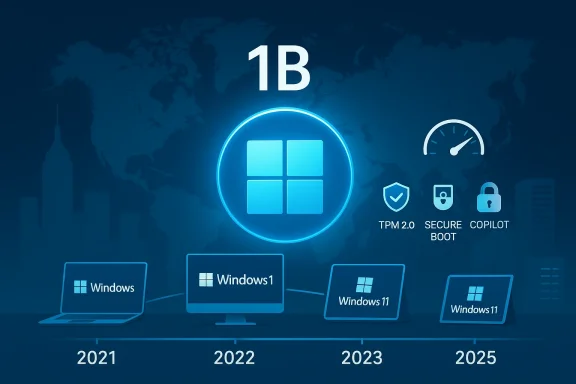
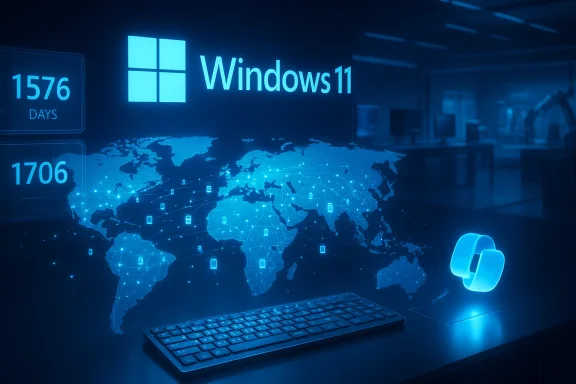
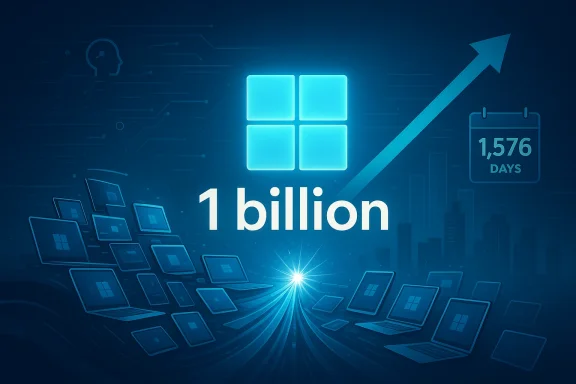
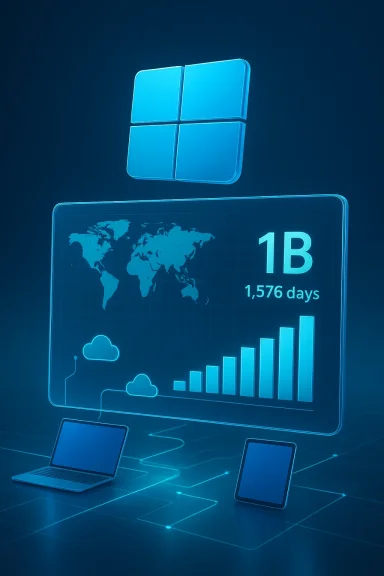
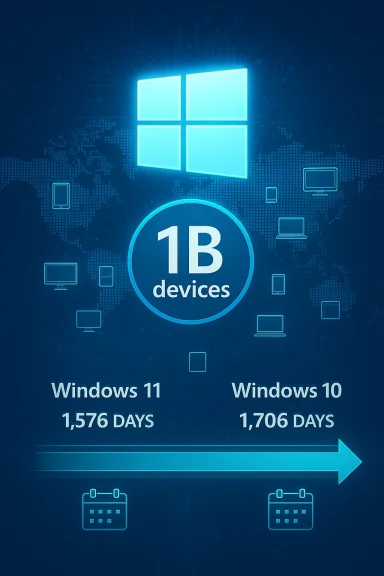
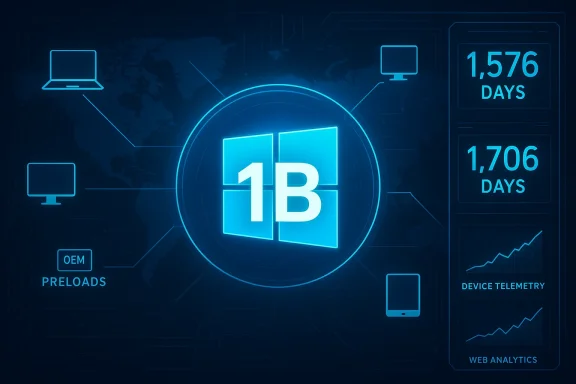
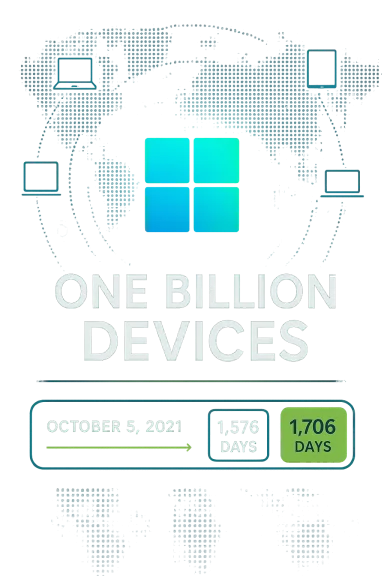
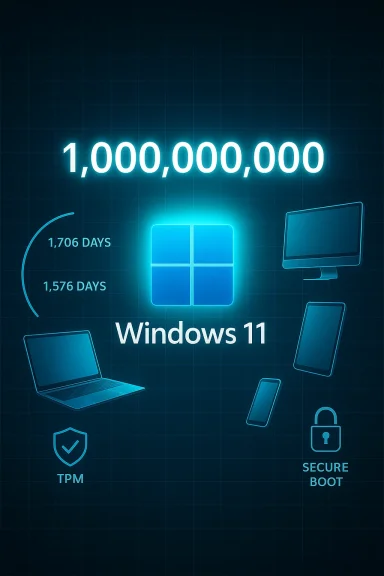
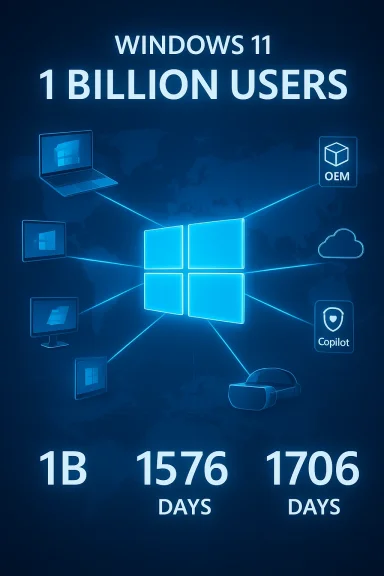
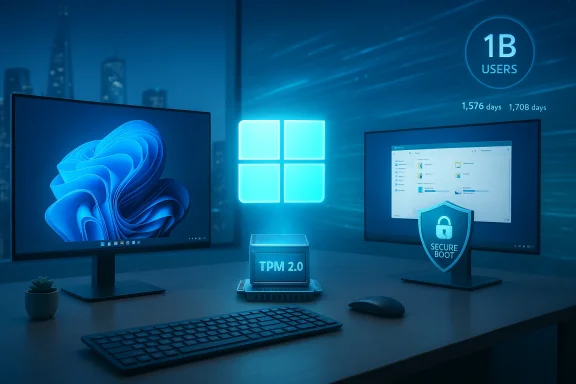
Microsoft’s CEO, Satya Nadella, referenced the new milestone during the company’s fiscal Q2, 2026 earnings commentary, saying in essence that “Windows reached a big milestone, 1 billion Windows 11 users,” and that Windows growth was “up over 45 percent year‑over‑year” for the quarter. This statement follows a related disclosure from Windows head Pavan Davuluri at Microsoft Ignite in November 2025, where he said “nearly a billion people” were already running Windows 11. Those executive remarks were reported and summarized across the tech press and industry coverage. do comparing the speed of adoption to Windows 10. The company — and later outlets reporting the company’s remarks — noted that Windows 11 reached the one‑billion mark in approximately 1,576 days, which is shorter than the roughly 1,706 days it took Windows 10 to hit a billion devices. Those day counts were cited in Microsoft‑focused coverage; however, the exact day‑count calculation depends on start and end dates and whether the company is using inclusive or exclusive counting, so the precise figure should be treated as Microsoft’s corporate metric rather than an independently audited census. I’ll examine why that matters in the verification and analysis sections below.
But don’t mistake the headline for a clean, universal switch. A very large population of Windows 10 devices remains, including a substantial subset that cannot upgrade without hardware replacement. That long tail creates real security and management work for IT teams and means OEMs still have a multi‑year upgrade market to chase. Treat the one‑billion figure as important context, not an immediate mandate — the right operational response is a measured migration plan that balances security, cost, and business continuity.
Source: The Verge Windows 11 has reached 1 billion users faster than Windows 10
 Background: what Microsoft announced and where the figure came from
Microsoft’s CEO, Satya Nadella, referenced the new milestone during the company’s fiscal Q2, 2026 earnings commentary, saying in essence that “Windows reached a big milestone, 1 billion Windows 11 users,” and that Windows growth was “up over 45 percent year‑over‑year” for the quarter. This statement follows a related disclosure from Windows head Pavan Davuluri at Microsoft Ignite in November 2025, where he said “nearly a billion people” were already running Windows 11. Those executive remarks were reported and summarized across the tech press and industry coverage. do comparing the speed of adoption to Windows 10. The company — and later outlets reporting the company’s remarks — noted that Windows 11 reached the one‑billion mark in approximately 1,576 days, which is shorter than the roughly 1,706 days it took Windows 10 to hit a billion devices. Those day counts were cited in Microsoft‑focused coverage; however, the exact day‑count calculation depends on start and end dates and whether the company is using inclusive or exclusive counting, so the precise figure should be treated as Microsoft’s corporate metric rather than an independently audited census. I’ll examine why that matters in the verification and analysis sections below.Overview: the facts we can verifylease date and timeline
- Windows 11 was broadly made available on October 5, 2021. That public availability date is Microsoft’s official launch day for Windows 11 and is the natural starting point for adoption timelines.
The one‑billion milestone and the company’s statements
- M publicly celebrated the milestone during its fiscal quarter commentary; Windows leadership had already indicated “nearly a billion” users at Ignite November 19, 2025, consistent with the later earnings remark. These are company statements and therefore authoritative about what Microsoft intends to claim.
Windows 10’s earlier one‑billion milestone
- By contrast, Windows 10 reachrestone reported by multiple outlets and confirmed by Microsoft at the time. That milestone was widely discussed in 2020 coverage and reflected the cumulative reach of Windows 10 across PCs, consoles, and other Windows‑powered devices.
Windows 10 end of support and the migration window
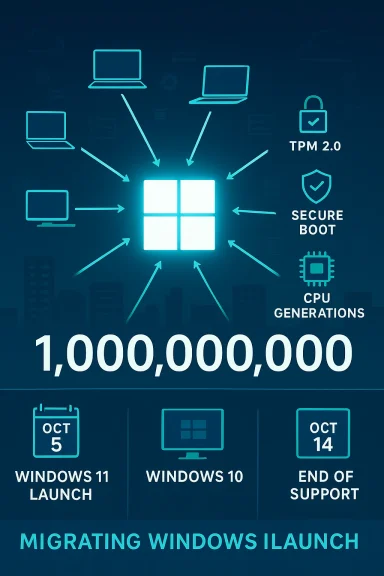
- Microsoft’s lifecycle policy shows Windows 10 mainstream support ended on October 14, 2025, with consumer Extended Security Updates (ESU) available for a limited, time‑boxed period through October 13, 2026. In other words, Microsoft set a firm migration deadline and provided an ESU bridge for customers who cannot complete an upgrade immediately. Those dates and the ESU schedule are published on Microsoft’s lifecycle pages.
OEM and market context (the Dell data point)
- OEM commentary is a crucial cross‑check. During late‑2025 earnings calls, Dell executives estimated the installed base at roughly 1.5 billion PCs and suggested that roughly 500 million machines can run Windows 11 but haven’t been upgraded, while another ~500 million are too old to meet Windows 11’s hardware baseline (TPM 2.0, Secure Boot, supported CPU generations, etc.). Dell framed this split as both a commercial opportunity and a migration challenge. Independent coverage of those Dell remarks is consistent across several outlets.
How Microsoft likely counts “users” and why that matters
When Microsoft announces a milestone such as “1 billion Windows 11 users,” there are three critical measurement choices baked into the number that change its interpretation:- Device vs. person vs. account counts. Microsoft has historically mixed device counts (monthly active devices), accounts, and aggregate reach when describing Windows metrics. For Windows 10, past Microsoft statements included Xbox consoles, HoloLens, and other non‑PC devices in the total. That inclusive approach inflates the headline relative to a pure PC census. The company’s earlier Windows 10 one‑billion messaging explicitly used a broad device scope.
- Active vs. installed. Microsoft often phrases the metric as “monthly active devices” or similar terms. That’s not the same as the count of unique human users; a single power user with multiple PCs, or corporate imaging strategies that create many active device records, can skew the tpling windows or reporting cadence.** A milestone can reflect a snapshot during a quarter (e.g., peak holiday usage), or an average over the trailing month. Microsoft’s earnings remark ties the milestone to the holiday quarter; that suggests the company saw sustained usage levels in the last reporting period consistent with the 1‑billion claim, not a one‑day spike.
Verification: cross‑checking the big claims
I cross‑checked the key claims against independent sources and Microsoft lifecycle documentation.- Windows 10’s one‑billion milestone (March 2020) was widely reported and corroborated by multiple outlets at the time; Microsoft’s earlier messaging about that milestone included a broad device scope.
- Microsoft’s Windows 10 end‑of‑support date (October 14, 2025) and the consumer ESU end date (October 13, 2026) are published by Microsoft on the Product Lifecycle and ESU documentation pages. That confirms the calendar force that likely accelerated enterprise migrations and holiday‑season OEM shipments.
- Dell’s estimate that about 500 million PCs are upgrade‑capable but un‑upgraded — and another ~500 million too old for Windows 11 — was reported consistently in late‑2025 coverage and aligns with OEM viewpoints that hardware eligibility is a real bottleneck. This independent OEM perspective is a vital cross‑check against Microsoft’s platform‑level claims.
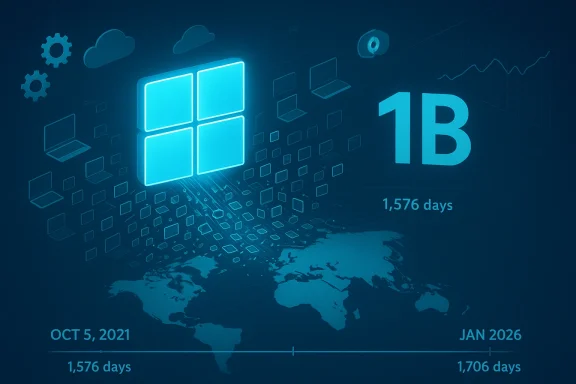
- The precise day counts (1,576 days vs. 1,706 days) used to compare Windows 11 and Windows 10 adoption speed appear in press reporting summarizing Microsoft’s statement. Day‑count arithmetic is sensitive to start and end dates and whether counts are inclusive. I recomputed the Windows 11 span using the public Windows 11 availability date (October 5, 2021) and a likely earnings‑call/late‑January 2026 milestone reference; that math yields roughly 1,575 days exclusive (1,576 inclusive) when counting from Oct 5, 2021 to Jan 27, 2026 — which matches Microsoft’s cited figure when interpreted inclusively. However, using the dows 10 milestone (March 16, 2020) generates a slightly different day count depending on which Windows 10 start date you choose (the July 29, 2015 retail release or another internal date). This difference suggests Microsoft’s day‑count comparison is a corporate metric and should be read with an understanding of the underlying counting choices. Because Microsoft has not published the precise start/end timestamps it used for the Windows 10 count, the 1,706 number can’t be independently reproduced with absolute certainty. Treat the “faster than Windows 10” claim as directionally accurate but not an audited time‑series computation.
Why Windows 11 may have reached one billion faster — drivers of adoption
Several factors line up to explain why Microsoft can credibly claim that Windows 11 crossed the billion mark faster than Windows 10:- A forced migration moment (end of Windows 10 support). Microsoft’s October 14, 2025 end‑of‑support date for Windows 10 created a migration deadline. Organizations that deferred upgrades could no longer relys and were nudged by security and compliance requirements to move sooner or enroll in ESU. That deadline likely accelerated migrations in the months that followed.
- OEM refresh cycles and holiday shipments. Microsoft and OEMs tend to see big jumps in new Windows installs during holiday sales periods and PC refresh cycles. Microsoft tied the milestone to the holiday quarter, which strongly suggests stronger OEM volume and pre‑loaded Windows 11 on new Windows PCs. OEM shipments — particularly of Copilot+ and AI‑oriented laptops — drove incremental device additions running Windows 11.
- AI hooks and new experiences. Windows 11’s integration with Copilotcessing optimizations, and other AI‑centric experiences give corporate and consumer users a fresh reason to upgrade — especially where device replacements are already planned. Microsoft has prioritized Copilot experiences that are most fully realized on Windows 11, adding a product advantage to the migration story.
- Marketing and partner momentum. Microsoft has leaned on partner programs, OEM incentives, and enterprise sales initiatives to accelerate adoption. When combined with the Windows 10 support deadline, those commercial levers create momentum that’s stronger than the organic, purely voluntary upgrade path of the earlier Windows 10 era.
The counter‑argument: why adoption still has serious limits
The billion‑user headline is important, but adoption is far from universal — and that matters for IT, security, and the PC market.- Large Windows 10 tail remains. OEM reports and telemetry indicate hundreds of millions of Windows 10 devices stillr commentary suggested roughly 1 billion PCs will not or cannot upgrade to Windows 11 without hardware refresh or significant intervention. That means Windows 11 adoption is uneven and includes a significant legacy base that Microsoft must either service via ESU or accept as unreachable for now.
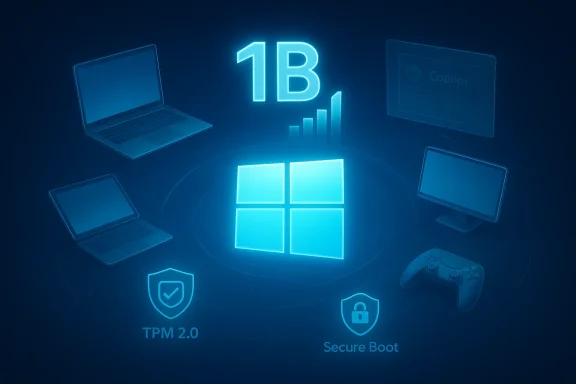
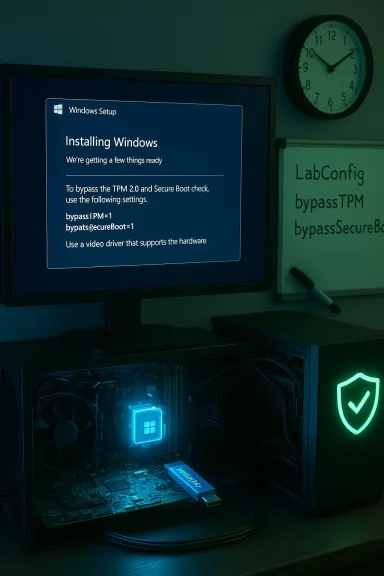
- Hardware eligibility is a real barrier. Windows 11’s security baseline (TPM 2.0, Secure Boot, newer CPU families) intentionally excludes a large swath of older devices. For enterprises with mixed device inventories, the hardware requirement creates real cost and lifecycle planning decisions: replace the device, pursue firmware/BIOS updates where possible, or remain on ESU. That increases migration friction relative to the OS‑only upgrade cycles of earlier generations.
- Measurement opacity and narrative risk. Because Microsoft’s headline counts use telemetry and a broad device scope, they can diverge from independent market metrics that count only desktop pageviews or consumer PCs. That difference introduces confusion for IT buyers and procurement teams who need accurate inventories to plan migrations. Public headlines that don’t explain methodology can create false confidence.
- User reluctance and cost sensitivity. Many consumers and organizations are simply not ready to replace otherwise healthy PCs because of marginal benefit, software compatibility risk, or budget cycles. Microsoft’s free upgrade windows are helpful, but hardware‑driven adoption economics are not easily changed by software incentives alone. Dell’s earnings commentary frames this as both a barrier and a commercial opportunity for new PC sales.
Business impact: what Microsoft and OEMs gain — and what they risk
For Microsoft:- Ecosystem leverage. A larger Windows 11 base strengthens Microsoft’s ability to bundle and cross‑sell services (Microsoft 365, Defender, Copilot integrations) and to make long‑term platform investments that assume Windows 11’s security and API baseline.
- Stronger OEM partnerships. OEMs get to sell new hardware with Windows as the anchor; Microsoft benefits from pre‑loads and OEM co‑marketing.
- Messaging advantages. Faster adoption is a public relations win that supports partner relations and developer engagement.
- Backlash on compatibility and perceived coercion. Aggressively pushing a hardware‑restricted upgrade could alienate users who feel forced into a hardware refresh to keep receiving full support.
- Security and reputational exposure from the Windows 10 long tail. Large numbers of unpatched Windows 10 devices create systemic security risks that could reflect poorly on the Windows brand and increase support load.
- Counting credibility. If analysts or customers perceive Microsoft’s counts as opaque, the marketing goodwill from a one‑billion headline can be diminished.
- The migration window is an opportunity to sell replacement devices and service contracts — but the success of that strategy depends on price, perceived value of Windows 11 features, and the health of the broader PC market. OEMs like Dell publicly framed the remaining Windows 10 base as both a challenge and a pipeline for upgrades.
Practical guidance for IT teams and end users
If you manage endpoints, these are the practical steps to do now:- Inventory and baseline. Run hardware inventory to identify which devices meet Windows 11 hardware requirements (TPM 2.0, Secure Boot, supported CPU families, and RAM/Storage minimums).
- Prioritize by risk. Map critical business apps and high‑value endpoints; upgrade or replace those first. For non‑critical machines, weigh ESU enrollment as a short‑term bridge.
- Test compatibility. Use Microsoft’s compatibility tooling and pilot groups to surface driver, firmware, and application issues before broad rollouts.
- Consider firmware and B issued firmware updates to make devices eligible for Windows 11; check vendor guidance before deciding on replacement.
- Budget for lifecycle. Factor in hardware refresh costs and savings from modern security and management improvements (e.g., zero‑touch provisioning, modern management with Intune).
- Plan for ESU if required. If you cannot migrate immediately, plan ESU enrollment timelines and cost exposure; ESU is intended as a time‑boxed bridge, not a permanent solution.
Critical analysis and caveats: why the headline should be read carefully
- Headline vs. reality. Microsoft’s “1 billion Windows tant milestone that reflects platform reach; however, it’s not a simple statement of unique active human users on new PCs. The figure is an aggregate corporate metric and uses a telemetry approach that includes multiple device categories and usage dimensions. That makes the figure useful as a directional indicator — but not as a precise inventory for procurement or compliance decisions.
- Speed comparison caveats. The claim that Windows 11 reached the milestone faster than Windows 10 is directionally plausible given the Windows 10 end‑of‑support deadline and OEM refresh dynamics. Still, the day‑count math depends on exact date choices and inclusion rules. I attempted a direct day calculation using Windows 11’s public release date (Oct 5, 2021) and a late‑January 2026 earnings window; that math checks out when Microsoft’s inclusive counting is applied. The Windows 10 timing depends on which start date the company used and so cannot be independently reproduced without Microsoft’s explicit timeline methodology. In short: faster adoption is credible, but the exact day delta is a corporate, not an audit, metric.
- Security exposure in migration. The biggest real‑world risk from the Windows 10 long tail is security. Large populations on unsupported OS builds increase exposure to unpatched vulnerabilities, compliance gaps, and operational risk. Microsoft’s ESU program mitigates the immediate calendar risk for some users but does not eliminate the long‑term need to modernize fleets.
- Market segmentation matters. Global adoption is highly uneven. Corporate fleets, public sector organizations, and enterprise customers often have structured upgrade programs and may adopt more quickly; consumer and developing‑market machines — often older hardware — will lag. This segmentation means that a single global headline can obscure very different realities across regions and industries.
Verdict: what the milestone actually means for Windows users and IT teams
Microsoft’s announcement that Windows 11 has reached one billion users is a meaningfulnd a validation of the company’s investment in Windows as a place to deliver new AI and security experiences. The milestone is believable when read as a telemetry‑driven corporate metric, and it is supported by the timing of Windows 10’s end of support, OEe holiday quarter, and marketing momentum around AI‑enabled PCs.But don’t mistake the headline for a clean, universal switch. A very large population of Windows 10 devices remains, including a substantial subset that cannot upgrade without hardware replacement. That long tail creates real security and management work for IT teams and means OEMs still have a multi‑year upgrade market to chase. Treat the one‑billion figure as important context, not an immediate mandate — the right operational response is a measured migration plan that balances security, cost, and business continuity.
Final takeaways (quick list for readers)
- The headline is real: Microsoft reported — and company executives repeated — that Windows 11 has reached one billion users; the figure reflects corporate telemetry and holiday‑quarter momentum.
- It’s faster, but methodology matters: Windows 11’s speed to a billion is plausibly faster than Windows 10’s, but exact day comparisons depend on counting choices; treat the day counts as Microsoft’s corporate metric rather than an auditable census.
- Windows 10 still matters: A large, heterogeneous Windows 10 installed base persists. Many machines are upgrade‑capable but unmodified; many others are hardware‑ineligible and will require replacement. OEM commentary underscores this reality.
- Security is the urgent driver: Windows 10’s end of support (October 14, 2025) and the ESU bridge make migration a security and compliance imperative for many organizations. Plan and prioritize accordingly.
- Action for IT: Inventory now, pilot early, budget for hardware where needed, and use ESU only as a time‑boxed bridge while you migrate critical systems.
Source: The Verge Windows 11 has reached 1 billion users faster than Windows 10