

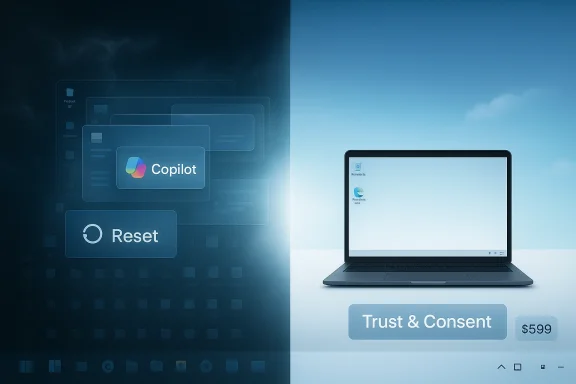
Microsoft’s latest Windows reset is less a triumphant comeback than a confession: the company has finally admitted, in public and in plain English, that too many parts of Windows 11 feel bloated, fragile, and overstuffed with features users never asked for. The timing matters, because this mea culpa lands just as Apple is making a play for budget buyers with the $599 MacBook Neo, turning an old pricing battle into a new one. What’s emerging is a sharper competitive story than a simple “Mac versus PC” rerun: Microsoft is trying to fix quality while also unwinding its most aggressive Copilot push. That combination suggests the company knows the old Windows bargain — tolerate the rough edges and the ads, and you get a flexible desktop platform in return — is breaking down.
For years, Microsoft has presented Windows as both a product and a platform, but the company’s incentives have shifted. Windows still powers more than a billion devices, according to Microsoft’s own public messaging, yet the strategic center of gravity has moved toward cloud services, subscriptions, AI, and enterprise security. That tension helps explain why so many Windows users now feel as if the operating system is being managed for someone else’s roadmap rather than their own needs. Microsoft’s recent blog language about transparency, trust, and consent makes that pivot explicit, even if the day-to-day Windows experience has not always lived up to the promise.
The current backlash did not come out of nowhere. In 2024 and 2025, Microsoft repeatedly injected AI features into inbox apps and Windows surfaces, from Notepad and Snipping Tool to Photos, Widgets, and the taskbar. In February 2024, Microsoft announced new Snipping Tool and Notepad features with Copilot hooks, including “Explain with Copilot” from inside Notepad. By mid-2025, Microsoft was positioning Windows 11 as “the home for AI on the PC,” with Copilot-adjacent experiences spread across the shell and core apps. The company was clearly betting that more AI entry points would feel like innovation, not clutter.
That bet appears to have misfired. Microsoft’s own recent Windows blog posts show a company now trying to sound more restrained, with emphasis on quality, trust, and better defaults. The language around consent-first design, user transparency, and reducing disruptive behaviors reads like an attempt to answer years of user complaints at once. It also suggests that Microsoft has recognized a very old lesson the hard way: when people say they want Windows to work, they usually do not mean they want another assistant glued to every surface. They mean the basics should behave predictably.
The broader market context makes the moment more awkward for Microsoft. Apple’s March 4, 2026 launch of the MacBook Neo at $599 gave the company a low-cost laptop that is explicitly aimed at value-conscious buyers, students, and first-time Mac owners. Several launch reports highlighted Apple’s positioning of the Neo as its most affordable Mac ever and a direct challenge to lower-end Windows machines. That does not automatically make macOS a better operating system for everyone, but it does change the frame: if Windows is struggling with confidence and consistency, Apple can now compete not only on premium polish but on credible entry price.
This is especially important because Windows users are not upset about novelty in the abstract. They are upset when updates change familiar workflows, when features are duplicated across shells and apps, or when AI is inserted into places that do not benefit from it. Microsoft’s own posts about “more intentional” Copilot placement and reduced entry points strongly imply that the company now sees this overreach as a liability. That is a notable retreat after a long phase of feature expansion.
The company has also complicated its own story by repeatedly mixing platform security work with user-facing experimentation. Microsoft has published detailed material on consent, trust, secure defaults, and safer AI use, but those messages coexist with a product surface that often feels crowded. That tension makes every reassurance sound provisional. Users hear “trust” and then immediately encounter another unrelated Copilot prompt.
There is also a branding issue. Microsoft used “Copilot” as a generic identity across Windows, the web, Microsoft 365, and consumer surfaces, but the result was conceptual confusion. If everything is a copilot, then nothing has a clear purpose. That becomes especially damaging when the user interface feels crowded with entry points that all seem to lead to the same place. The repetition makes the feature look less like a helper and more like a sales funnel.
Windows 10’s looming end of support also gave Microsoft leverage, but leverage is not the same thing as enthusiasm. Many consumers and businesses are migrating because they must, not because they want to. That matters because reluctant adopters are less forgiving. They compare the new system against the old one every day, and they notice any regression immediately. Microsoft is now paying the price for pushing users into an experience they did not emotionally buy into.
Linux sits in an entirely different category. It remains a compelling option for enthusiasts, developers, and some enterprise use cases, but it is not the mass-market consumer fallback that Microsoft should fear most. The real threat is not that everyone will move to Linux tomorrow. It is that the mainstream consumer sees Windows as the least attractive default in a three-way contest between Windows, macOS, and Chromebook-class simplicity. That is a market perception problem, not just a technical one.
That does not mean Apple suddenly owns the sub-$700 market. It does mean that Windows hardware vendors must compete against a more compelling aspirational product at a more reachable price. And when the Windows story is already clouded by quality complaints, the comparison becomes harsher. A cheap Mac that feels coherent is a bigger problem for Microsoft than a premium Mac that merely looks elegant.
Consumers are also less likely to have the vocabulary to describe what is wrong. They do not talk about shell architecture or UX debt; they say the computer “feels weird.” That phrasing matters. Once a platform acquires a reputation for feeling weird, it loses the benefit of the doubt every time a dialog appears or an app behaves oddly. Microsoft’s current challenge is as much emotional as it is technical.
That makes Microsoft’s quality push both necessary and insufficient. Necessary, because enterprises need a stable desktop. Insufficient, because enterprises do not evaluate promises; they evaluate history. If Windows 11 keeps generating stories about rough edges, Microsoft will have to prove — not merely claim — that the platform has changed.
Source: spyglass.org Microsoft Got Sloppy with Windows
 Background
For years, Microsoft has presented Windows as both a product and a platform, but the company’s incentives have shifted. Windows still powers more than a billion devices, according to Microsoft’s own public messaging, yet the strategic center of gravity has moved toward cloud services, subscriptions, AI, and enterprise security. That tension helps explain why so many Windows users now feel as if the operating system is being managed for someone else’s roadmap rather than their own needs. Microsoft’s recent blog language about transparency, trust, and consent makes that pivot explicit, even if the day-to-day Windows experience has not always lived up to the promise.The current backlash did not come out of nowhere. In 2024 and 2025, Microsoft repeatedly injected AI features into inbox apps and Windows surfaces, from Notepad and Snipping Tool to Photos, Widgets, and the taskbar. In February 2024, Microsoft announced new Snipping Tool and Notepad features with Copilot hooks, including “Explain with Copilot” from inside Notepad. By mid-2025, Microsoft was positioning Windows 11 as “the home for AI on the PC,” with Copilot-adjacent experiences spread across the shell and core apps. The company was clearly betting that more AI entry points would feel like innovation, not clutter.
That bet appears to have misfired. Microsoft’s own recent Windows blog posts show a company now trying to sound more restrained, with emphasis on quality, trust, and better defaults. The language around consent-first design, user transparency, and reducing disruptive behaviors reads like an attempt to answer years of user complaints at once. It also suggests that Microsoft has recognized a very old lesson the hard way: when people say they want Windows to work, they usually do not mean they want another assistant glued to every surface. They mean the basics should behave predictably.
The broader market context makes the moment more awkward for Microsoft. Apple’s March 4, 2026 launch of the MacBook Neo at $599 gave the company a low-cost laptop that is explicitly aimed at value-conscious buyers, students, and first-time Mac owners. Several launch reports highlighted Apple’s positioning of the Neo as its most affordable Mac ever and a direct challenge to lower-end Windows machines. That does not automatically make macOS a better operating system for everyone, but it does change the frame: if Windows is struggling with confidence and consistency, Apple can now compete not only on premium polish but on credible entry price.
The Quality Reckoning
Microsoft’s latest messaging reads like a company finally admitting that the complaint volume is not a vibe problem; it is a product problem. The shift toward “commitment to quality” matters because it implicitly acknowledges that users have stopped treating Windows 11 annoyances as isolated bugs and started seeing them as a systemic pattern. When the same sentiment shows up across performance, reliability, app behavior, UI consistency, and AI intrusions, that is not a minor release-note issue. It is a credibility issue.Why the language matters
The most revealing part of Microsoft’s tone is not what it says, but what it tries to avoid saying. Public relations language about listening to feedback can sound reassuring, yet it can also become a shield against admitting that product strategy went too far. That is why the current messaging feels like a non-apology: it acknowledges dissatisfaction while carefully sidestepping the deeper question of who authorized so much friction in the first place. In that sense, the communication problem is also a governance problem.This is especially important because Windows users are not upset about novelty in the abstract. They are upset when updates change familiar workflows, when features are duplicated across shells and apps, or when AI is inserted into places that do not benefit from it. Microsoft’s own posts about “more intentional” Copilot placement and reduced entry points strongly imply that the company now sees this overreach as a liability. That is a notable retreat after a long phase of feature expansion.
- Users are not just objecting to design changes.
- They are objecting to reliability regressions.
- They are objecting to workflow disruption.
- They are objecting to AI being forced into ordinary tasks.
- They are objecting to a product direction that feels less responsive to them.
Windows 11’s Trust Problem
A platform can survive ugly design debates. It is much harder to survive a trust problem. Windows 11 now risks being seen as an OS that surprises people too often, whether through pop-ups, app changes, shell inconsistencies, or updates that break muscle memory. Once users start expecting the next update to change behavior unpredictably, the operating system stops feeling like infrastructure and starts feeling like an experiment.The burden of the default desktop
For most consumers and enterprises, Windows is not optional background software. It is the desktop environment, the file manager, the app launcher, the collaboration layer, and the settings surface all at once. That means every regression carries outsized weight. A flawed app is an inconvenience; a flawed shell can become a daily tax. Microsoft’s challenge is that Windows 11 is not being judged only against macOS or ChromeOS. It is being judged against the user’s expectation that a desktop should simply be dependable.The company has also complicated its own story by repeatedly mixing platform security work with user-facing experimentation. Microsoft has published detailed material on consent, trust, secure defaults, and safer AI use, but those messages coexist with a product surface that often feels crowded. That tension makes every reassurance sound provisional. Users hear “trust” and then immediately encounter another unrelated Copilot prompt.
Quality versus feature velocity
Microsoft’s recent blog history suggests it is now trying to slow the pace of visible change while keeping the strategic AI layer intact. That is a difficult balancing act. If the company cuts too many AI entry points, it risks disappointing the investors and product teams that have staked the future on Copilot. If it keeps pushing, it risks alienating the broad base that just wants a cleaner desktop. The compromise is to be more selective — but selectivity after overreach can look like retreat.- Trust is built through consistency.
- Quality is noticed most when it is missing.
- Feature velocity can create strategic excitement.
- But feature velocity without restraint creates fatigue.
The Copilot Backlash
Copilot was supposed to be Microsoft’s leverage point, the feature that made Windows feel indispensable in the AI age. Instead, for many users, it became a symbol of intrusion. That is why the company’s reported decision to reduce Copilot entry points in apps like Snipping Tool, Photos, Widgets, and Notepad is so significant. It is not merely a UI tweak; it is a strategic retreat from omnipresence.Where the push went wrong
The problem with Copilot in Windows was not that AI existed. It was that Microsoft often treated AI as the answer before establishing a clear problem. In tools like Notepad or Snipping Tool, people generally value speed, simplicity, and reliability. Those are not contexts where a chat assistant is inherently unwelcome, but they are contexts where uninvited complexity is easy to resent. Microsoft had to learn that the fastest way to make users hate AI is to put it in places where users came to avoid complexity.There is also a branding issue. Microsoft used “Copilot” as a generic identity across Windows, the web, Microsoft 365, and consumer surfaces, but the result was conceptual confusion. If everything is a copilot, then nothing has a clear purpose. That becomes especially damaging when the user interface feels crowded with entry points that all seem to lead to the same place. The repetition makes the feature look less like a helper and more like a sales funnel.
The AI fatigue factor
AI fatigue is now a real design constraint. The most useful AI features tend to be the least visible: background improvements in search, accessibility, summarization, transcription, or image handling. The least welcome are the ones that interrupt an already-successful workflow. Microsoft’s own recent language about being “more intentional” suggests the company has finally absorbed that distinction. The question is whether it can correct course fast enough to matter.- Users tolerate AI when it removes friction.
- Users dislike AI when it creates friction.
- Users resent AI when it feels forced.
- Users reject AI when it replaces a simple tool with a complicated one.
- Users ignore AI when it is available but not intrusive.
The Windows 10 Shadow
The Windows 10 to Windows 11 transition remains one of Microsoft’s biggest self-inflicted wounds. By making the upgrade feel more like an obligation than a reward, Microsoft ceded enormous goodwill. Many users stayed on Windows 10 as long as they could, and the result was inevitable: the first true wave of Windows 11 criticism arrived only after people were forced onto the newer OS. That delayed backlash made the complaints look sudden, but the underlying dissatisfaction had been building for years.A migration strategy that missed the mood
Microsoft did not just want Windows 11 installed. It wanted it normalized. The company leaned on upgrade channels, hardware requirements, and messaging about security and modernity to move people forward. But if the new operating system does not feel clearly better in the everyday tasks people actually perform, then migration becomes a burden rather than a benefit. Once that happens, every interface change starts to feel like punishment.Windows 10’s looming end of support also gave Microsoft leverage, but leverage is not the same thing as enthusiasm. Many consumers and businesses are migrating because they must, not because they want to. That matters because reluctant adopters are less forgiving. They compare the new system against the old one every day, and they notice any regression immediately. Microsoft is now paying the price for pushing users into an experience they did not emotionally buy into.
Why nostalgia is becoming product demand
The phrase “just give us the old Windows back” is more than nostalgia. It is a proxy for predictability. Users usually do not want every older UI element restored verbatim. They want the behaviors that made earlier Windows versions feel stable, familiar, and quiet. In practice, that means fewer interruptions, fewer surprises, and fewer attempts to turn the desktop into an advertising or AI showcase. The more Microsoft ignores that sentiment, the more retro design preferences harden into real market demand.- Stability now matters more than novelty.
- Familiar workflows are becoming competitive advantages.
- Even small annoyances compound over a workday.
- Delayed upgrade cycles are now a rational user response.
- Trust lost during migration is hard to win back.
macOS, Linux, and the New Optics
The comparison with macOS is useful, but only to a point. Apple’s operating system certainly has its own design controversies, especially around visual treatment, transparency, and the larger “Liquid Glass” aesthetic direction. But the emotional temperature is different. On the Mac, many complaints are about style, policy, or taste. On Windows, the complaints increasingly sound like objections to basic function.Surface polish versus structural friction
A controversial UI can survive if the underlying system feels coherent. That is why macOS can weather complaints about cosmetics more easily than Windows can weather complaints about bugs or broken workflows. Visual design mistakes are often reversible or at least tolerable. Reliability problems are not. Microsoft has to understand that it is now being judged less on how modern Windows looks than on whether it feels like a trustworthy operating environment.Linux sits in an entirely different category. It remains a compelling option for enthusiasts, developers, and some enterprise use cases, but it is not the mass-market consumer fallback that Microsoft should fear most. The real threat is not that everyone will move to Linux tomorrow. It is that the mainstream consumer sees Windows as the least attractive default in a three-way contest between Windows, macOS, and Chromebook-class simplicity. That is a market perception problem, not just a technical one.
Apple’s $599 problem for Microsoft
Apple’s MacBook Neo changes the market psychology because it undercuts one of Windows’ oldest excuses: price. For years, a low-cost Windows laptop could be defended on value grounds even if the experience was mediocre. A $599 Mac from Apple disrupts that script. If the entry-level Mac is now a credible alternative for students, families, and switchers, then Microsoft and its OEM partners can no longer assume budget buyers will automatically accept Windows friction as the cost of admission.That does not mean Apple suddenly owns the sub-$700 market. It does mean that Windows hardware vendors must compete against a more compelling aspirational product at a more reachable price. And when the Windows story is already clouded by quality complaints, the comparison becomes harsher. A cheap Mac that feels coherent is a bigger problem for Microsoft than a premium Mac that merely looks elegant.
- Apple is now competing below its traditional comfort zone.
- Windows OEMs lose one of their old price advantages.
- Educational buyers become more sensitive to usability.
- First-time buyers may default to the cleaner experience.
- Windows quality complaints amplify the appeal of alternatives.
Enterprise Versus Consumer Reality
Microsoft often speaks about Windows as a single platform, but the pain points differ sharply by audience. Consumers notice friction in everyday interaction. Enterprises notice friction through support costs, update risk, application compatibility, and endpoint security. When Windows quality slips, both groups suffer — but not in the same way.Consumer pain is emotional
For consumers, the issue is annoyance. Pop-ups, changing defaults, AI prompts, and inconsistent app behavior create a sense that the machine is working against them. That is especially damaging in a household environment, where the computer is supposed to be the reliable thing in the room. If the operating system feels pushy, it becomes associated with hassle rather than productivity.Consumers are also less likely to have the vocabulary to describe what is wrong. They do not talk about shell architecture or UX debt; they say the computer “feels weird.” That phrasing matters. Once a platform acquires a reputation for feeling weird, it loses the benefit of the doubt every time a dialog appears or an app behaves oddly. Microsoft’s current challenge is as much emotional as it is technical.
Enterprise pain is financial
Enterprises experience Windows failures as cost. A broken update, a brittle app, or an unstable inbox tool can create a cascade of support tickets, lost time, and deferred rollout plans. Microsoft’s own focus on Windows resilience, secure defaults, and better update handling suggests it is aware of this pressure. But enterprise trust is conservative by nature. Once IT teams conclude that a release family is noisy or risky, they slow deployment, increase validation, and demand more proof before standardizing on the newest build.That makes Microsoft’s quality push both necessary and insufficient. Necessary, because enterprises need a stable desktop. Insufficient, because enterprises do not evaluate promises; they evaluate history. If Windows 11 keeps generating stories about rough edges, Microsoft will have to prove — not merely claim — that the platform has changed.
- Consumers judge Windows by feel.
- Enterprises judge Windows by risk.
- Consumers forgive less when prompted repeatedly.
- Enterprises forgive less when support tickets rise.
- Both groups punish inconsistency.
Strengths and Opportunities
Microsoft still has enormous assets to work with. Windows has scale, compatibility, installer familiarity, enterprise tooling, and a massive installed base. If the company uses this reset properly, it can transform the current criticism into an opportunity to rebuild confidence and simplify the product narrative. The key is to treat quality as a feature, not as a cleanup project.- Scale remains unmatched in the PC ecosystem.
- Enterprise manageability still gives Windows an edge.
- Compatibility continues to anchor professional workflows.
- Security improvements can strengthen long-term trust.
- Selective AI integration could preserve usefulness without clutter.
- Performance and reliability fixes would have immediate user impact.
- A cleaner Windows 11 could restore upgrade confidence.
Risks and Concerns
The biggest risk is that Microsoft treats this as a communications correction rather than a product correction. If the company only adjusts the language while keeping the same internal incentives, users will notice the gap quickly. Another risk is that the retreat from Copilot overexposure happens piecemeal, leaving a fragmented experience that is neither deeply AI-native nor satisfyingly simple.- Half-measures will deepen skepticism.
- Feature removal without usability gains will feel like whiplash.
- AI retreat without clarity could confuse users and developers.
- Update quality failures would undercut every public promise.
- Competitor momentum from Apple could reshape entry-level buying.
- Enterprise delay could slow Windows 11 standardization.
- Brand fatigue may make every new Windows initiative harder to sell.
Looking Ahead
The next several months will tell us whether Microsoft’s quality push is substantive or symbolic. The most important signal will not be a keynote or a polished blog post. It will be whether Windows becomes noticeably calmer: fewer interruptions, fewer redundant AI surfaces, fewer regressions, and fewer moments where users feel like the operating system is trying to renegotiate the terms of use on the fly. If that happens, the criticism may soften. If it does not, the current backlash will harden into a durable narrative.The signals to watch
- Whether Microsoft continues reducing Copilot entry points in inbox apps.
- Whether future Windows updates emphasize reliability over visible novelty.
- Whether enterprise rollout guidance becomes more conservative or more confident.
- Whether Microsoft’s public language shifts from AI-first to workflow-first.
- Whether Apple’s MacBook Neo creates measurable pressure in schools and budget buying.
Source: spyglass.org Microsoft Got Sloppy with Windows
