

Microsoft’s public pivot away from feature-first flash toward what it calls “fixing the basics” is the clearest sign yet that Windows 11’s reckoning with reliability, privacy and user trust has become a corporate priority — and an engineering emergency. In response to months of public criticism, leadership has redirected resources into cross-team “swarming” efforts to tackle regressions, slowdowns and UX regressions that have steadily eroded goodwill among power users, IT admins and privacy critics. Windows reached this inflection point
Windows 11 shipped with a bold agenda: a modern UI, tighter cloud integration, and deep hooks for on-device and hybrid AI. Those moves produced real gains in security and performance on modern hardware, and Microsoft has pointed to Windows 11’s rapid adoption as validation — the OS reached one billion users faster than Windows 10, a milestone Microsoft highlighted during its fiscal reporting. Yet adoption velocity masked a widening gap between headline features and day‑to‑day platform quality.
Two structural pressures converged and made the platform fragile. First, Microsoft’s shift to “continuous innovation” — frequent small feature drops and monthly servicing — increased the surface area for interactions between new subsystems, drivers and OEM firmware. Second, the company’s AI push introduced agentic features that capture context and state, raising both engineering and privacy stakes. When servicing assumptions fail — for instance, because a prior update left a device in an inconsistent state — even routine monthly rollups can cascade into high‑impact regressions. The result is the public drama we saw in January 2026, when Patch Tuesday updates produced a string of operational failures that required otfixes.
January 13, 2026’s Patch Tuesday cumulative updates triggered the sequence that made Microsoft’s position untenable. Within days, users and telemetry reported machines failing to shut down (or restarting after hibernation), Remote Desktop sign‑ins breaking, and cloud‑file operations (OneDrive, Dropbox) or Outlook profiles hanging or failing. Microsoft issued an initial emergency out‑of‑band (OOB) fix, but complications persisted and the company followed with a second, broader emergency update (listed as KB5078127) to stitch fixes together and stabilize the platform. Those emergency steps were necessary — and visible — but visibility alone doesn’t reassure customers facing lost productivity and recovery work.
Why the optics matter: updates that break shutdown flows, remote access, or cloud sync do more than inconvenience. They force enterprises to pause deployments, inflate helpdesk volumes, and push cautious admins to consider postponing or blocking updates entirely. For home users, repeated regressions quickly erode faith in automatic updating and Microsoft’s stewardship of the platform. Multiple community investigations and Microsoft’s othe worst failures to devices that were in a partially updated or failed‑rollback state — the fragile baseline assumption at work.
Microsoft’s engineering response was substantive and instructive. Recall was rearchitected to be:
Regulatory pressure (notably the EU’s Digital Markets Act) and public feedback have already forced Microsoft to dial back some of the most aggressive behaviors in EEA markets, and the company has publicly acknowledged the PR misstep. But default experience matters: even if quick toggles exist to disable suggestions, many users encounter upsells during OOBE (the first run), leading to resentment. Microsoft’s optics problem here is simple: selling inside the shell makes users ask whether their device is a workspace or a storefront.
But the reputational damage from repeated, visible regressions and perceived in‑OS monetization cannot be repaired overnight. Trust is a long‑tail metric that requires months of consistent, high‑quality releases, transparent communication and concrete audit signals that enterprises and privacy regulators can evaluate. Microsoft’s next wins will come from *ps in high‑impact regressions and from design changes that make user choices durable and reversible.
Rebuilding trust will require disciplined release hygiene, stronger defaults that favor predictability over promotion, and concrete auditability for privacy‑sensitive features. For Windows users, the immediate posture should be pragmatic skepticism: use available policy controls, stage updates conservatively, and treat new agentic features as opt‑in. For Microsoft, the work is to translate today’s promises into measurable declines in regressions, transparent timelines and durable user controls. Only then will Windows 11 regain the quiet, dependable status that made it the default platform for the past decade.
Source: filmogaz.com Microsoft Aims to Restore Trust in Windows
Windows 11 shipped with a bold agenda: a modern UI, tighter cloud integration, and deep hooks for on-device and hybrid AI. Those moves produced real gains in security and performance on modern hardware, and Microsoft has pointed to Windows 11’s rapid adoption as validation — the OS reached one billion users faster than Windows 10, a milestone Microsoft highlighted during its fiscal reporting. Yet adoption velocity masked a widening gap between headline features and day‑to‑day platform quality.
Two structural pressures converged and made the platform fragile. First, Microsoft’s shift to “continuous innovation” — frequent small feature drops and monthly servicing — increased the surface area for interactions between new subsystems, drivers and OEM firmware. Second, the company’s AI push introduced agentic features that capture context and state, raising both engineering and privacy stakes. When servicing assumptions fail — for instance, because a prior update left a device in an inconsistent state — even routine monthly rollups can cascade into high‑impact regressions. The result is the public drama we saw in January 2026, when Patch Tuesday updates produced a string of operational failures that required otfixes.
 The January 2026 wake‑up call: cascade, emergency fixes, and optics
January 13, 2026’s Patch Tuesday cumulative updates triggered the sequence that made Microsoft’s position untenable. Within days, users and telemetry reported machines failing to shut down (or restarting after hibernation), Remote Desktop sign‑ins breaking, and cloud‑file operations (OneDrive, Dropbox) or Outlook profiles hanging or failing. Microsoft issued an initial emergency out‑of‑band (OOB) fix, but complications persisted and the company followed with a second, broader emergency update (listed as KB5078127) to stitch fixes together and stabilize the platform. Those emergency steps were necessary — and visible — but visibility alone doesn’t reassure customers facing lost productivity and recovery work. Why the optics matter: updates that break shutdown flows, remote access, or cloud sync do more than inconvenience. They force enterprises to pause deployments, inflate helpdesk volumes, and push cautious admins to consider postponing or blocking updates entirely. For home users, repeated regressions quickly erode faith in automatic updating and Microsoft’s stewardship of the platform. Multiple community investigations and Microsoft’s othe worst failures to devices that were in a partially updated or failed‑rollback state — the fragile baseline assumption at work.
Leadership response: “swarming” and public acknowledgment
Pavan Davuluri, who leads Windows and Devices, publicly conceded that the feedback was “crystal clear” and promised a reorientation: fix core performance, reliability and everyday UX problems before layering on further agentic features. Microsoft described an engineering posture that redirects teams into targeted “swarming” to rapidly isolate and resolve high‑impact regressions. Those public acknowledgements matter — they signal an organizational priorure feature velocity toward platform stewardship. But words must be followed by measured, auditable outcomes.What users actually complained about — the “death by a thousand cuts”
The thread that tied much of the coms not a single catastrophic failure but a steady accumulation of daily frictions:- Regressions in update quality and recovery tools (unexp rollbacks, and a few UNMOUNTABLE_BOOT_VOLUME incidents on devices with prior update traces).
- Performance and reliability problems in core shell surfaces — Fwness opening folders, and Task Manager anomalies.
- In‑OS marketing and promotional nudges (Edge and Bing suggestions, “recommended” app tiles) that felt intrusive and inconsistent with a neutral OS baseline.
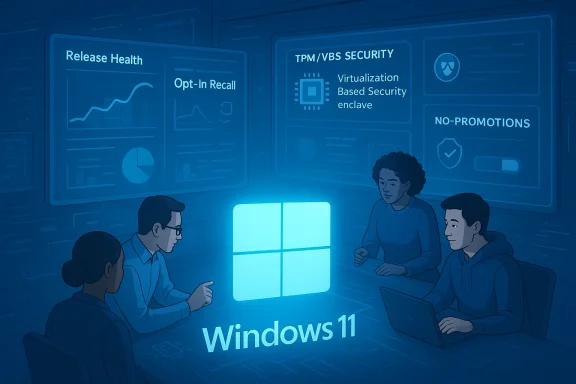
- Privacy alarms around agentic features like Recall, which sna to create a searchable on‑device memory. The original rollout’s discoverability and consent model left many users and privacy advocates uncomfortable. Microsoft reworked Recall extensively — gating it behind Windows Hello, TPM protection, VBS enclaves, and explicit opt‑in — but the initial rollout left scars.
Recall: a case study in risk, mitigation and trust repair
Recall is the poster child for both the promise and peril of adding agentic capabilities to an OS. Technically, its goals are clear: let the OS index recent onscreen interactions so users can “recall” documents, conversations or web pages without hunting. Practically, the feature touches sensitive privacy vectors: periodic screenshots, indexing of private content, and long‑term storage on a device.Microsoft’s engineering response was substantive and instructive. Recall was rearchitected to be:
- An opt‑in feature (off by default);
- Gated by Windows Hello with biometrics required for activation and searches;
- Encrypted using keys protected by the Trusted Platform Module (TPM) and accessible only inside a Virtualization‑based Security (VBS) enclave;
- Filtered by default for highly sensitive artifacts (passwords, credit card numbers) using on‑device classification; and
- Completely removable through Windows’ optional features if a user chooses to uninstall it.
Advertising, upsells and the erosion of the “neutral OS” compact
A parallel source of anger has been Microsoft’s increasing use of system UI surfaces for promotions: suggested apps in Start, promoted items in Settings, and occasional pop‑ups nudging users toward Edge or Bing. For many long‑time Windows users, the OS feels like a neutral work surface; peppering that surface with marketing shifts expectations and heightens suspicion when features behave unpredictably.Regulatory pressure (notably the EU’s Digital Markets Act) and public feedback have already forced Microsoft to dial back some of the most aggressive behaviors in EEA markets, and the company has publicly acknowledged the PR misstep. But default experience matters: even if quick toggles exist to disable suggestions, many users encounter upsells during OOBE (the first run), leading to resentment. Microsoft’s optics problem here is simple: selling inside the shell makes users ask whether their device is a workspace or a storefront.
Where the engineering work should continue — ten practical priorities
Microsoft’s public commitments and initial engineering responses are necessary but not sufficient. The community and enterprise buyers will watch for measurable change. The following is a practical, prioritized checklist that aligns with the “swarming” ethos but also roots that work in product governance and measurable outcomes:- Public Release Health metrics and a cadence. Puble‑readable release health scorecard that tracks regressions introduced, time‑to‑mitigation and the percentage of devices staged in pilot rings before broad rollout.
- Stricter pre‑release validation for recovery and boot paths. Dedicated QA for WinRE, boot‑time handlers and filesystem/volume interactions — these are high‑impact areas that deserve extra gating.
- Protect defaults: treat the shell as a neutral workspace. Remove promotional content from primary surfaces or make promotions strictly opt‑in during OOBE, and honor that preference persistently.
- Insider program fix‑feedback loop: expand Insider telemetry and map public feedback to product change logs so Insiders can see which reports led to fixes. Make the Insider channel a true participatory QA pipeline.
- Enterprise controls and auditability for agentic features: publish admin‑level toggles, tamper‑resistant audit logs, and clear exportable deletion trails for any locally indexed content.
- Conservative rollout stagohorts for code that touches recovery, storage or auth, and hold agentic features out of broad release until staged telemetry shows near‑zero regression rates.
- Central privacy ledger: a single, human‑readable panel that lists recent telemetry events, their purpose, and any outbound diagnostics. This reduces the “black box” perception of telemetry and simplifies compliance reviews.
- Small, focused updates for critical fixes: avoid bundling many unrelated changes into monthly LCUs when fixes for reliability are needed. Smaller, targeted updates reduce interaction risk.
- Tooling for IT: provide clear rollout tooling and rollback paths (guardrail IDs, known‑issue rollback flows) that let admins manage risk without atches.
- A “Professional Mode” profile for power users. Offer a persistent mode that minimizes background agents, suppresses promotions, and sets conservative telemetry defaults.
What users and administrators should do now
While Microsoft implements these programmatic changes, users and IT administrators should adopt pragmatic stances that protect productivity and privacy:- Harden update staging. Use phased deployment rings, pilot groups and imad rollout. Subscribe to Microsoft Release Health and monitor safeguard hold IDs.
- Tighten defaults: disable suggested content in Start (Settings > Personalization > Start), and use Group Policy to suppress “Microsoft consumer experiences” on Pro/Enterprise devices if you want a clean baseline.
- Treat agentic features as explicit opt‑ins. Require Windows Hello and TPM gating for Recall and other context‑capturing services, and document control and deletion processes for compliance.
- Keep robust recovery media and backups. In environments where continuity is non‑negotiable, maintain offline images and recovery USBs prior to applying monthly cumulative updates.
- Monitor and communicate. For enterprises, provide users with clear guidance when new agentic features appear and publish internal policies about whether and how such features may be enabled.
Progress to date — meaningful actions, but trust is earned slowly
Microsoft has already taken several important, verifiable steps: Recall’s rework into an opt‑in, TPM‑ and VBS‑protected experience; public acknowledgement from leadership that reliability and power‑user ergonomics are priorities; and a visible reallocation of engineers into focused swarms to triage regressions. Those moves are not trivial. They demonstrate the capacity to design mitigations and to change course.But the reputational damage from repeated, visible regressions and perceived in‑OS monetization cannot be repaired overnight. Trust is a long‑tail metric that requires months of consistent, high‑quality releases, transparent communication and concrete audit signals that enterprises and privacy regulators can evaluate. Microsoft’s next wins will come from *ps in high‑impact regressions and from design changes that make user choices durable and reversible.
Risks that remain — why the next quarter matters
Several risks could stall or reverse Microsoft’s progress:- Continued high‑impact regressions. If emergency hotfixes remain a regular part of early‑year servicing, enterprise hesitation will widen and ISVs will face a fractured testing matrix.
- Perception of insincere concessions. If opt‑outs are available but work inconsistently or are rolled back in later updates, the perceived “bait‑and‑switch” will deepen mistrust.
- Regulatory scrutiny. Agentic features that index user context — even when processed locally — invite closer regulatory scrutiny in the EEA and elsewhere. Microsoft’s mitigations lower risk but may not eliminate the need for independent audits and compliance artifacts.
- Fragmentation of the installed base. Windows 10’s end of support (October 14, 2025) accelerated movement to Windows 11 on eligible devices, but many older devices still exist and will complicate testing and support. Microsoft’s hardware gating strategy will maintain a heterogeneous installed base for years, raising maintenance costs for developers and admins.
How to judge success: measurable signals to watch
Not all progress is easy to measure, but the community and enterprises should expect tangible signs that Microsoft’s “swarming” strategy is working:- Fewer emergency OOB releases and longer intervals between high‑impact regressions.
- A transparent Release Health dashboard with objective metrics and remediation timelines.
- Clear, persistent opt‑outs for promotional content and agentic features that survive major updates.
- Strengthened Insider feedback loops that map reports to code changes and publish outcomes.
- Robust admin controls and exportable audit logs for on‑device agentic features.
Conclusion
Microsoft’s decision to redirect engineers into swarms, acknowledge the community’s pain and rework sensitive agentic features like Recall is the right first chapter in a multi‑chapter repair job. The technical fixes are achievable — TPM‑bound keys, VBS enclaves and biometric gating materially reduce attack surfaces — but engineering alone cannot restore a social contract that feels broken.Rebuilding trust will require disciplined release hygiene, stronger defaults that favor predictability over promotion, and concrete auditability for privacy‑sensitive features. For Windows users, the immediate posture should be pragmatic skepticism: use available policy controls, stage updates conservatively, and treat new agentic features as opt‑in. For Microsoft, the work is to translate today’s promises into measurable declines in regressions, transparent timelines and durable user controls. Only then will Windows 11 regain the quiet, dependable status that made it the default platform for the past decade.
Source: filmogaz.com Microsoft Aims to Restore Trust in Windows
