

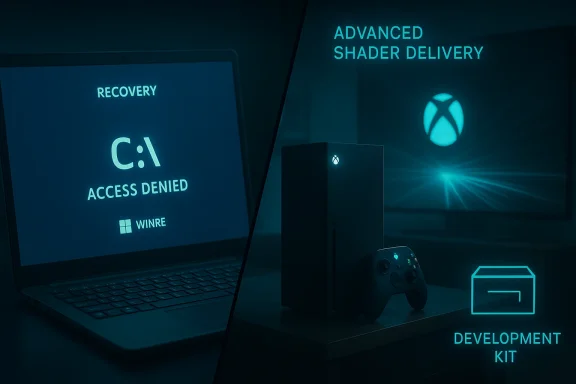
A rare but severe servicing regression in recent Windows 11 updates is leaving some users unable to access their system drive (C while Microsoft simultaneously outlines an ambitious, cross‑platform strategy for the next generation of Xbox hardware and a console‑style mode for Windows 11 — an awkward two‑front moment that demands immediate attention from IT teams, gamers, and everyday PC owners alike.
Windows updates are supposed to protect users, not strand them. Yet in early 2026 a chain of cumulative updates introduced regressions that, in a limited set of configurations, produced the stop code UNMOUNTABLE_BOOT_VOLUME or the error message “C:\ is not accessible – Access denied,” effectively making the system drive unreachable until manual recovery measures are taken. Microsoft acknowledged the problem and opened an investigation while coordinating with OEMs — Samsung Galaxy Book models were among the most commonly reported affected devices.
At the same time, Microsoft used the Game Developers Conference and related developer channels to signal a new direction for gaming. Under the codename Project Helix, Microsoft plans to push a console‑style, controller‑first “Xbox Mode” into Windows 11 as soon as April and to distribute alpha hardware for the next Xbox platform to developers beginning in 2027. The plan emphasizes a hybrid console‑PC identity built around a custom AMD system‑on‑chip, advanced rendering features including heavy investment in ray/path tracing and machine‑learning assisted graphics, and new developer tooling such as Advanced Shader Delivery and DirectX/ML features.
This dual narrative — an urgent reliability problem for current Windows update servicing versus a forward‑looking platform pivot for gaming — sets up immediate, practical questions about update safety, platform convergence, and what both mean for users and enterprises.
Separately, Microsoft's public status was to investigate and to coordinate with OEMs (notably Samsung in the Galaxy Book reports), while earlier January rollups (such as KB5074109) had already been tied to other boot and I/O regressions that required rapid out‑of‑band fixes. The pattern — regular monthly rollups followed by emergency patches — suggests Microsoft is in a fast remediation loop.
For users and IT teams, the practical takeaway is twofold: prioritize resilience today — backups, recovery media, conservative update policies — and prepare for tomorrow’s platform changes by tracking developer guidance and governance decisions as Xbox Mode and Project Helix roll out. For Microsoft, the obligation is clear: faster fixes are necessary, yes, but so is better testing, clearer communication, and safeguards that protect users when innovation touches core system components. The credibility of both Windows and Xbox depends on it.
Source: Neowin Microsoft Weekly: Serious bug cripples Windows 11 drive C and details about the next Xbox
while Microsoft simultaneously outlines an ambitious, cross‑platform strategy for the next generation of Xbox hardware and a console‑style mode for Windows 11 — an awkward two‑front moment that demands immediate attention from IT teams, gamers, and everyday PC owners alike.
 Background / Overview
Windows updates are supposed to protect users, not strand them. Yet in early 2026 a chain of cumulative updates introduced regressions that, in a limited set of configurations, produced the stop code UNMOUNTABLE_BOOT_VOLUME or the error message “C:\ is not accessible – Access denied,” effectively making the system drive unreachable until manual recovery measures are taken. Microsoft acknowledged the problem and opened an investigation while coordinating with OEMs — Samsung Galaxy Book models were among the most commonly reported affected devices.At the same time, Microsoft used the Game Developers Conference and related developer channels to signal a new direction for gaming. Under the codename Project Helix, Microsoft plans to push a console‑style, controller‑first “Xbox Mode” into Windows 11 as soon as April and to distribute alpha hardware for the next Xbox platform to developers beginning in 2027. The plan emphasizes a hybrid console‑PC identity built around a custom AMD system‑on‑chip, advanced rendering features including heavy investment in ray/path tracing and machine‑learning assisted graphics, and new developer tooling such as Advanced Shader Delivery and DirectX/ML features.
This dual narrative — an urgent reliability problem for current Windows update servicing versus a forward‑looking platform pivot for gaming — sets up immediate, practical questions about update safety, platform convergence, and what both mean for users and enterprises.
The Windows 11 servicing regression: what we know
Symptoms and scope
Reports describe two related but distinct failure modes following recent cumulative updates:- Systems fail to boot with the stop code UNMOUNTABLE_BOOT_VOLUME, leaving users at a black screen and requiring recovery using WinRE or similar tools.
- Some laptops, especially several Samsung Galaxy Book models, display the message “C:\ is not accessible – Access denied,” which effectively blocks access to the system drive after boot. These devices may still show signs of life but deny file system access, preventing normal operation. Microsoft classified the issue as “Investigating” and said it was working with OEM partners to identify root causes and mitigations.
Microsoft’s response and recent remedial steps
Microsoft has been actively triaging the regressions. In mid‑March Microsoft quietly pushed a Safe OS dynamic update (KB5079471) that refreshes the Windows Recovery Environment (WinRE) image for Windows 11 versions 24H2 and 25H2; the mechanism is described as non‑removable once applied and is designed to improve the recovery surface on affected systems. That update is part of the defensive posture and is delivered automatically through Windows Update.Separately, Microsoft's public status was to investigate and to coordinate with OEMs (notably Samsung in the Galaxy Book reports), while earlier January rollups (such as KB5074109) had already been tied to other boot and I/O regressions that required rapid out‑of‑band fixes. The pattern — regular monthly rollups followed by emergency patches — suggests Microsoft is in a fast remediation loop.
Likely technical root causes (analysis, based on observed symptoms)
Publicly available incident descriptions and Microsoft’s actions point to a servicing‑level regression rather than a random hardware fault. The indicators include:- Failures concentrated around how updates alter low‑level boot/recovery images or file system access rights, implying a problem in the servicing stack or dynamic update process.
- Microsoft’s delivery of a WinRE refresh (KB5079471) suggests the recovery image itself or components used during servicing could have been corrupted or rolled back inappropriately.
- The concentration on particular OEM models implies interaction between update servicing and vendor customizations (drivers, OEM recovery partitions, preinstalled encryption or storage drivers).
Immediate recovery and mitigation guidance
If you or users in your organization encounter the UNMOUNTABLE_BOOT_VOLUME or “C:\ is not accessible — Access denied” symptoms after a Windows update, follow this prioritized checklist. These are practical steps based on how Windows and WinRE behave and on vendor guidance for similar incidents — adapt as needed for your environment.- Remain calm and do not perform repeated forced power cycles; let the machine reach recovery options if possible.
- Boot to Windows Recovery Environment (WinRE) using automatic recovery or a manufacturer recovery key sequence; if the device will not reach WinRE, use a trusted recovery USB drive built from a known good Windows 11 image.
- In WinRE, attempt the following (in order):
- Run Automatic Repair / Startup Repair.
- Use System Restore if a restore point exists and predates the problematic update.
- Open Command Prompt and run chkdsk on the system volume: dism /online is not applicable in offline repair; use chkdsk c: /f to attempt filesystem fixes.
- If access is denied, try to take ownership and reset permissions carefully (use icacls) — but only if you have comfort with these tools; improper commands risk data loss.
- If recovery fails, back up the raw disk using drive‑image tools (boot from external Linux or recovery environment) before attempting a clean install; preserving a disk image will help forensic analysis and data recovery.
- For enterprises: hold the problematic update at the distribution point (WSUS, Intune, SCCM) until Microsoft confirms a full fix and provides guidance. Consider moving affected OEM models into a blocked deployment ring temporarily.
- Communicate promptly to users: advise them not to attempt reinstallation or repair steps that could delete recovery partitions or encryption state without backing up.
Why this matters: risk assessment for users and enterprises
For consumers and prosumers
- The immediate pain is loss of access to files and system functionality until recovery actions succeed.
- Casual users who accept updates automatically and lack recovery media are at highest risk.
- The incident underlines the value of regular backups and bootable recovery media even on modern OEM laptops with cloud services.
For IT admins and enterprises
- Regressions that affect boot or drive access are a worst‑case scenario for mass update rollouts; the cost of recovery and reputational damage can be substantial.
- Even infrequent occurrences matter when multiplied across thousands of endpoints.
- Enterprises must tighten test ring discipline, increase telemetry monitoring for early warning signals, and maintain the ability to rapidly rollback or block updates centrally.
On supply chain and OEM interplay
OEM customizations (drivers, firmware, recovery partitions) make update compatibility testing harder. When an update paths through both Microsoft servicing and OEM components, edges appear where assumptions break. Microsoft coordinating with Samsung is the right approach, but it highlights systemic risk when software suppliers and hardware vendors must fix intertwined failures under time pressure.How Microsoft’s update process is being stress‑tested
Microsoft’s servicing model is complex: cumulative rollups, dynamic Safe OS images, OEM integrations, and a fast cadence of security fixes. The recent pattern — monthly rollups followed by targeted emergency updates — shows both strengths (rapid response capability) and weaknesses (insufficient regression exposure prior to wide distribution).- Strengths: Microsoft’s ability to push a WinRE refresh automatically demonstrates control over recovery infrastructure at scale. Rapid out‑of‑band updates have fixed critical regressions in the past.
- Weaknesses: The recurrence of regressions across different updates points to gaps in test coverage for real‑world OEM configurations and for complex scenarios involving encryption, cloud‑backed file systems, and custom drivers.
Project Helix and Xbox Mode: the product pivot
What Microsoft announced (the essentials)
Microsoft is advancing a strategic pivot that intentionally blurs the boundary between Xbox consoles and Windows PCs:- Xbox Mode: a full‑screen, controller‑first session posture for Windows 11 that will begin rolling out in April, rebranding the “Full Screen Experience” and bringing a console‑like UX to PCs.
- Project Helix: the codename for the next Xbox platform, described as a hybrid console‑PC platform built around a custom AMD system‑on‑chip, with emphasis on ray/path tracing, machine‑learning assisted rendering, and developer tools that will enable closer parity of experiences across console and Windows. Alpha developer hardware is slated to reach developers in 2027.
Key technical elements Microsoft emphasized
- Custom AMD SoC design for the next Xbox generation, suggesting deep silicon engineering targeted at graphics, ML, and power/performance efficiency.
- New rendering stack investments such as FSR Diamond (an advanced FidelityFX‑derived upscaling mode), Advanced Shader Delivery (for shipping shader permutations more efficiently), and broader DirectX/ML integrations to accelerate ray/path tracing and ML workloads.
- Windows 11 receiving a console‑style shell — a separate session posture that gives PCs a controller‑first interface while leaving the underlying openness of Windows intact. That raises both UX opportunities and platform governance questions.
Strategic implications and critical analysis
Potential benefits
- Developer consolidation: a shared toolchain and rendering infrastructure may reduce porting friction and make it easier for studios to target both PC and console without maintaining sharply divergent pipelines.
- Feature parity and fidelity: focusing on ray/path tracing and ML can elevate visual fidelity across both device classes and make next‑gen titles more consistent.
- Windows as a first‑class living‑room platform: Xbox Mode could make high‑quality console experiences available to the enormous installed base of Windows PCs, providing new distribution and monetization vectors for both Microsoft and developers.
Significant risks and open questions
- Ecosystem fragmentation: a console‑style Windows session could lead to confusion about what a Windows PC is — a general‑purpose computer or a locked‑down living‑room platform — with implications for app distribution, driver models, and user expectations. Third‑party storefronts and PC gaming incumbents (e.g., Steam, Epic) may push back if the experience favors Microsoft’s own storefronts. Some reporting suggests the next Xbox may run Windows under a console shell; if true, that exponentially increases the stakes for how Microsoft governs access and APIs.
- Security surface and update complexity: the current servicing regression incidents highlight the fragility of update distribution at scale. If Windows becomes the primary substrate for console experiences, the responsibility for rock‑solid updates grows — regressions that impact boot or recovery will be even less tolerable in living‑room devices. The Helix vision requires near‑flawless coordination of firmware, drivers, and system images across OEM, silicon, and platform teams. Failures could be catastrophic for reputation.
- Competitive and regulatory scrutiny: giving Windows a console‑grade mode raises questions about favoritism in distribution, app store policies, and the potential for anticompetitive behavior. Regulators will watch closely if Microsoft uses Windows integration to privilege its own storefront or services.
Business model and market positioning
Project Helix appears to be less about launching a single, monolithic console and more about engineering a new converged platform that spans console and PC. That has promising revenue semantics for Game Pass, platform licensing, and first‑party content, but it also complicates how Microsoft positions hardware against pure PC vendors and console incumbents. The alpha hardware timeline (developer kits in 2027) signals a slow, deliberate transition rather than an immediate flip of the market.Technical expectations for Xbox Mode and Helix hardware
What Xbox Mode likely entails (engineer’s perspective)
- A separate session posture that launches a full‑screen shell optimized for controller input, media playback, and discrete game sandboxing.
- Tight integration with Xbox services (profiles, Game Pass launcher, cloud saves) while preserving underlying Windows APIs and driver layers for compatibility.
- A controlled environment for installing and launching titles that can include both Microsoft’s storefront and, potentially, third‑party stores — the exact policy model remains an open question.
What Project Helix hardware likely targets
- A custom AMD SoC designed for highly parallel graphics workloads plus ML accelerators to handle denoising, upscaling, and path tracing affordably at living‑room power envelopes.
- Hardware‑level features to accelerate ML inference for real‑time rendering pipelines and fidelity upscaling such as the touted FSR Diamond mode.
- An engineering emphasis on developer tools: efficient shader shipping (Advanced Shader Delivery), enhanced DirectX/ML primitives, and debugging/profiling kits for alpha hardware recipients in 2027.
Security, privacy, and governance: two stories converge
Microsoft’s servicing regression is a cautionary tale. Large‑scale changes to Windows to accommodate console experiences will only increase the importance of safe, reliable, and transparent update practices.- If Xbox Mode and Helix make Windows a platform for living‑room gaming at scale, update regressions that affect boot, encryption, or recovery will damage user trust more quickly and more visibly than before.
- The addition of console‑grade services and tighter store integration also raises privacy questions around telemetry, DRM, and account linking. Implementation details matter: how will Microsoft balance an integrated experience with user control and third‑party store interoperability?
Actionable recommendations
For end users
- Pause noncritical Windows updates until Microsoft confirms fixes for your device model if you use an affected OEM (Samsung Galaxy Book owners should be particularly cautious).
- Build and verify bootable recovery media today (use the Windows 11 media creation tools or OEM recovery images).
- Maintain regular backups of your user data outside the system partition (cloud backup and periodic external images).
For IT administrators
- Move potential problem updates to a blocked or pilot deployment ring until Microsoft and OEMs publish explicit guidance.
- Increase endpoint monitoring for boot errors and “C: access denied” I/O patterns; proactively remediate devices that show early symptoms.
- Ensure that device provisioning includes verified recovery images and that helpdesk teams are trained in WinRE recovery steps.
For developers and studios evaluating Xbox Mode / Helix
- Treat Xbox Mode as a new target environment with its own UX and QA profile: plan for controller‑first workflows and test for the console posture alongside desktop builds.
- Follow Microsoft’s developer guidance on Advanced Shader Delivery and DirectX/ML optimization to reduce fragmentation and take advantage of Helix hardware features when available.
What to watch next
- Microsoft’s technical post‑mortem and KB guidance for the C: drive regressions. Detailed root‑cause analysis and prescriptive recovery steps are essential for confidence in future rollouts.
- The April rollout of Xbox Mode for Windows 11: check for preview documentation, enterprise controls, and any administrative controls that permit blocking or managing the new session posture.
- Developer reception to Project Helix alpha hardware in 2027: early dev kit feedback will reveal whether the hardware and tooling deliver on Microsoft’s performance and parity promises.
Conclusion
The contrast is stark: one Microsoft narrative demands immediate operational vigilance — recoveries, blocked updates, and hardwired recovery images — while the other promises a strategic, multi‑year platform realignment that could reshape how people play on Windows and console hardware. Both matters are linked by a single, revealing truth: as Microsoft increases the scope and ambition of Windows and Xbox, the cost of error rises accordingly.For users and IT teams, the practical takeaway is twofold: prioritize resilience today — backups, recovery media, conservative update policies — and prepare for tomorrow’s platform changes by tracking developer guidance and governance decisions as Xbox Mode and Project Helix roll out. For Microsoft, the obligation is clear: faster fixes are necessary, yes, but so is better testing, clearer communication, and safeguards that protect users when innovation touches core system components. The credibility of both Windows and Xbox depends on it.
Source: Neowin Microsoft Weekly: Serious bug cripples Windows 11 drive C and details about the next Xbox
