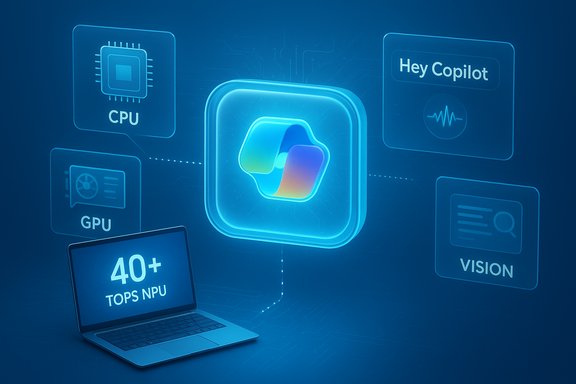
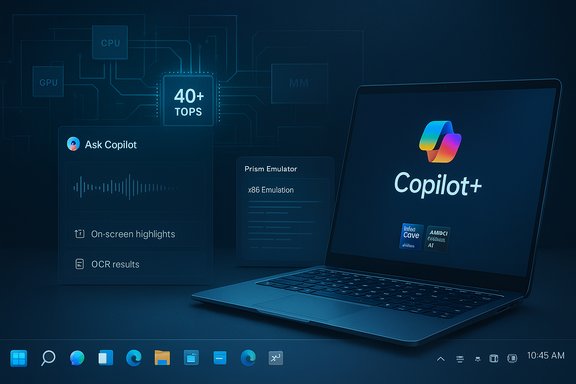
Microsoft hasn’t said “Windows 12” out loud, but the leaks, Insider breadcrumbs, and vendor roadmaps paint a clear theme: the next major Windows will be an AI-first, modular OS that leans on on‑device neural hardware, and many of the pieces are already being tested in Windows 11 and Copilot+ PCs.
Microsoft’s public roadmap and its own lifecycle rules make one thing obvious: Windows is not going back to the old three‑year cadence or a “one‑and‑done” Windows 10 play — feature updates and evolving builds are the norm. The company even documents that “new versions of Windows 11 will be released once per year” and that feature updates are accompanied by monthly quality patches, which frames how any future major‑version launch would be delivered and supported. Leaks and reporting converge on a handful of repeat themes: deeper Copilot integration, on‑device AI accelerated by NPUs, a more componentized “Core PC” codebase for lighter, modular installations, and much improved Windows on Arm compatibility via a new emulator (Prism). Those are not wild guesses so much as the logical next steps of work already visible in Insiders and OEM messaging. Key context worth keeping in mind:
Source: PCMag I Dug Through Every Windows 12 Leak—These Are the Features I'm Betting On
 Background / Overview
Microsoft’s public roadmap and its own lifecycle rules make one thing obvious: Windows is not going back to the old three‑year cadence or a “one‑and‑done” Windows 10 play — feature updates and evolving builds are the norm. The company even documents that “new versions of Windows 11 will be released once per year” and that feature updates are accompanied by monthly quality patches, which frames how any future major‑version launch would be delivered and supported. Leaks and reporting converge on a handful of repeat themes: deeper Copilot integration, on‑device AI accelerated by NPUs, a more componentized “Core PC” codebase for lighter, modular installations, and much improved Windows on Arm compatibility via a new emulator (Prism). Those are not wild guesses so much as the logical next steps of work already visible in Insiders and OEM messaging. Key context worth keeping in mind:- Microsoft’s Copilot / Copilot+ initiative is shipping now and expanding; Copilot+ PCs exist today and are explicitly built to exploit local NPUs for reduced latency and enhanced privacy.
- The Windows servicing model remains continuous: annual feature updates plus monthly fixes; enterprises and consumers will still rely on Microsoft’s lifecycle calendars to time migrations.
- Insider channel strings and Canary‑build artifacts have hinted at subscription‑style entries and “Core PC” modular code — suggestive signals, but not proofs of final policy or product packaging. Treat code strings as hints, not announcements.
What the leaks actually say — a concise, verifiable summary
1) AI baked into the shell
Windows is being retooled so AI features are no longer optional bolt‑ons but core OS affordances: semantic search across files, system‑wide Copilot actions (Click to Do), wake‑word voice control, image and screen understanding (Copilot Vision), and local recall of your recent activity. These features are shipping to Insiders and to Copilot+ hardware now.2) On‑device AI hardware matters
Microsoft and OEM partners are explicitly positioning NPUs as first‑class PC hardware. Copilot+ PCs require NPU capability (marketing has talked about a 40 TOPS threshold for the first wave), and Intel, AMD, Qualcomm, and others are shipping processors with increasingly powerful NPUs. That hardware enables faster, offline AI experiences and, crucially, a different privacy model because data and models can run locally.3) Core PC / modular Windows
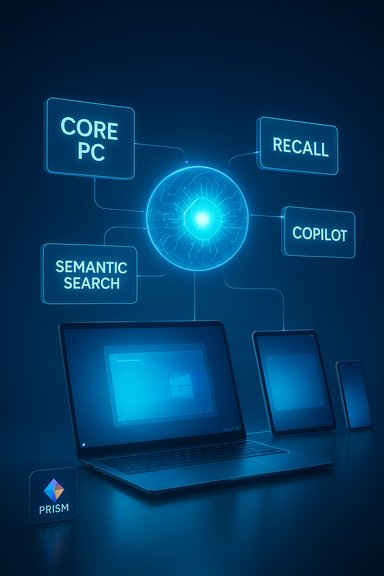
Multiple sources point to Microsoft moving toward a componentized Windows — sometimes referred to internally as Core PC — where OS subsystems can be packaged, updated, and shipped independently. The idea reduces update churn on monolithic images and enables tailored installs for tablets, thin clients, or high‑end workstations. Leaked file and forum artifacts show the concept is actively discussed and prototyped.4) Better Windows on Arm via Prism
Microsoft’s Prism emulator (and its iterative improvements) is being pushed to make x86/x64 apps run better on Arm PCs by supporting more CPU extensions (AVX, AVX2, FMA, etc.. That narrows one major compatibility gap for Arm‑based Windows devices and is a substantial engineering step toward making Snapdragon‑class machines pragmatically usable. Early reports show meaningful compatibility improvements in preview channels.5) Subscription strings and business models — unclear, but present
Canary builds have contained strings like “Subscription Edition,” “Subscription Type,” and “Subscription Status.” That discovery triggered months of speculation about whether Microsoft might adopt subscription packaging for consumer Windows, a freemium/ads model, or simply administrative flags for enterprise/cloud offerings. The evidence is real — the interpretation is not. Code strings alone do not prove a consumer subscription policy, and insiders have pushed back on sensational claims.Deeper look: the AI foundation Microsoft is building
Built‑in Copilot features to watch
- Recall: background, encrypted indexing of what you see and use on the device so you can “remember” files, images, and UI states without hunting. This is already previewed on Copilot+ machines.
- Click to Do & semantic search: highlight anything and let Copilot act on it via natural language; semantic search in File Explorer and Settings improves discoverability.
- Copilot Vision and multimodal understanding: Copilot can analyze a program window’s visual contents and act on it (e.g., summarize, translate, extract). These are being tested in beta.
- Wake‑word and voice improvements: “Hey Copilot” wake words and more natural voice interactions are being added to Insider builds and Copilot+ features.
The hardware puzzle: NPUs, TOPS, and ecosystem gating
The defining technical trend is the rise of capable NPUs. Qualcomm’s Snapdragon X Elite marketing claimed substantial multi‑core advantages versus Apple’s M3 in select benchmarks (a marketing claim that should be read with the usual caveats about power and thermal trade‑offs). Intel and AMD have responded with their own NPU strategies: Intel’s Core Ultra (Lunar Lake) and AMD’s Ryzen AI families have explicit NPU throughput targets measured in TOPS. These hardware claims underpin the Copilot+ pitch — local model inference requires silicon. Key technical reality: benchmark numbers (Geekbench, TOPS claims) are apples‑to‑oranges unless power envelopes and real‑world workloads are specified. A chip that scores well at 80W may not behave the same at 20W. That matters for thin laptops and battery life. Treat vendor toplines as directional, not definitive.Windows on Arm and Prism: compatibility re‑engineered
Microsoft’s Prism work is the pragmatic solution to one of the ecosystem’s thorniest problems: binary compatibility on different ISAs. By emulating x86/x64 more completely (including key SIMD and vector extensions), Prism reduces the need for every app to be recompiled to Arm64 overnight — which smooths the path to wider Arm adoption. Early Canary/Insider updates and reporting show progress: more games and creative apps now launch on Arm with Prism’s extended instruction support, though exceptions remain (especially kernel‑mode and certain anti‑cheat systems). Practical implications for users:- Arm laptops are no longer hobby projects — real productivity and content apps are becoming usable. That changes the value proposition for Windows OEMs.
- Emulation performance varies by workload; heavy gaming and low‑level drivers still favor x86/x64. Expect progress, not parity, at first.
Core PC (modular Windows): what it really means
A modular OS isn’t just a marketing term — it’s a different engineering model:- Smaller, isolated components reduce the blast radius of updates and allow targeted patches and feature packs.
- OEMs could ship tailored Windows builds that omit large legacy subsystems for low‑power devices.
- Developers would still need API stability, or app compatibility falls apart; Microsoft will have to guarantee core API surfaces across modular flavors.
- Faster, less disruptive updates.
- Lower resource usage on constrained hardware.
- Smaller attack surface for many threat classes.
- Fragmentation — if Microsoft doesn’t strictly guarantee app compatibility across variants, developers and IT teams face complexity.
- Testing overhead for OEMs and ISVs who must validate multiple OS permutations.
The subscription question: fact, rumor, or red herring?
Canary‑channel INI files and code strings referencing “Subscription Edition,” “Subscription Type,” and “Subscription Status” are real artifacts that sparked intense discussion. Many outlets and watchers pointed them out. But there’s a crucial distinction between strings in code and product strategy. These entries could plausibly relate to:- internal flags for enterprise licensing or Cloud PC scenarios,
- telemetry/activation states for feature gating, or
- genuine preparation for optional subscription SKUs.
Strengths — what Microsoft and the ecosystem are getting right
- Tangible on‑device value: Local NPUs unlock faster, private AI features that are genuinely useful (recall, live captions, image editing), not just headline demos. Companies and users get sensible latency and privacy tradeoffs.
- Hardware momentum: Intel, AMD, Qualcomm and OEMs are shipping silicon and systems targeted at on‑device AI, which makes software investments realistic rather than speculative.
- Prism as a practical bridge: Better emulation is a faster route to Arm ecosystem growth than forcing a universal recompilation of x86 apps.
- Modularity reduces update pain: Smaller update units reduce update times and risk — a win for enterprise patching and consumer frustration alike.
Risks and trade‑offs — what could go wrong
- Fragmentation and feature gating
If advanced capabilities (semantic search, Click to Do, Recall) are limited to Copilot+ hardware, Microsoft risks creating a two‑tier Windows where older machines and mainstream buyers see diminished value. That elevates upgrade pressure and could slow adoption if perceived as exclusionary. - Privacy and “surveillance by helpfulness”
Features like Recall are powerful but scary: background indexing of screen contents and actions invites scrutiny. Even with local encryption and opt‑in controls, expectation management and transparent retention controls will be essential to avoid a Clippy‑style backlash. - Subscription backlash and pricing politics
If Microsoft pivots to subscription packaging for consumer Windows, resistance will be visceral — users learned this lesson with other product categories. Even if only some SKUs or enterprise scenarios adopt subscriptions, the optics will matter. Code strings are not policy, but the idea is politically charged. - Developer & ISV burden
A modular Windows requires ironclad guarantees around APIs and runtime behavior. Without that, ISVs will be forced into complicated testing matrices and might delay support for new variants. - Hardware marketing vs real‑world thermals
Vendor claims (e.g., Snapdragon X Elite multi‑core bragging vs Apple M3) sometimes rely on high‑power envelopes that don’t reflect everyday usage. Real user experience hinges on sustained performance and battery life, not bursty synthetic scores. Read the metrics cautiously.
What IT teams and power users should do now
- Join Windows Insider selectively. Use Beta or Release Preview rings for early but stable previews; reserve Canary for curiosity and experimental testing. Insider channels are the best way to preview Core PC, Prism changes, and Copilot updates.
- Plan migrations around lifecycles, not rumor clocks. Microsoft's lifecycle FAQ and release cadence remain the operative guidance for when platforms lose support; plan hardware refresh and testing windows against those published dates.
- Test privacy/configuration controls for new AI features. Treat Recall and long‑term memory features as enterprise risk items until retention and admin controls are fully documented. Require opt‑in flows for sensitive deployments.
- Evaluate Copilot+ hardware needs realistically. If your workflows rely on low‑latency, on‑device AI, test representative Copilot+ devices under real workloads and power profiles; don’t choose chips based solely on headline TOPS figures.
- Maintain a compatibility test suite for Arm. If you plan to adopt Arm systems, validate anti‑cheat, kernel‑mode drivers, and mission‑critical apps with Prism updates — emulation improves quickly, but edge cases persist.
How likely is a “Windows 12” release, and when?
Predicting the exact branding is a fool’s errand — Microsoft has historically shifted naming strategies — but a major, numbered change seems plausible once componentization and the AI‑first plumbing reach maturity and OEMs ship a critical mass of Copilot+ hardware. The practical timing is tied to both engineering readiness and the Windows support calendar; many observers peg a major release window within the next few years once the ecosystem investments (silicon, drivers, app compatibility) reach sufficient scale. That timeline aligns with the pattern of major updates landing at the tail of broader platform refresh cycles.Conclusion: the shape of the next Windows
The leaks are painting the same strategic picture: Microsoft is moving Windows to an AI‑centric, hardware‑aware, componentized platform. That shift is grounded in concrete engineering work — Copilot features in current builds, Copilot+ certification for NPUs, Prism emulation improvements for Arm, and internal conversations about modular code. Each of those is already visible in previews, partner blogs, or vendor announcements, so the story is less “rumor” than “ongoing product evolution.” This evolution brings real benefits — faster local AI, smarter search, reduced update pain — but also real risks: hardware gating, privacy complexity, subscription optics, and developer fragmentation. For anyone planning forward now, the practical approach is simple: stay current with Insider previews on test hardware, validate critical apps (especially for Arm), and treat subscription claims with skepticism until Microsoft announces policy. The next Windows will arrive when the code, the silicon, and customer trust align — and the early signs say that alignment is actively being built.Source: PCMag I Dug Through Every Windows 12 Leak—These Are the Features I'm Betting On