Windows 12 is not arriving this year — and Microsoft’s roadmap makes clear why the company is leaning into Windows 11, Copilot+ hardware, and iterative feature updates instead of rushing a numbered successor.
Microsoft’s next major Windows chapter has been the subject of relentless rumor and speculation for more than two years. Early leaks and off‑hand references inside the industry suggested an internal codename such as “Next Valley” for whatever follows Windows 11, and many outlets treated a 2024–2025 launch window as likely. The short version of where we stand today: Microsoft has not announced a consumer product called Windows 12, the company is shipping substantial feature work inside Windows 11 (notably the 25H2 cycle and Copilot integrations), and independent reporting plus Microsoft’s own communications point to a continued focus on Windows 11 and AI‑enhanced PCs rather than a hard pivot to a new OS number. This reading of the landscape is reflected in the summary coverage compiled by the 9meters piece that sparked this update.
The practical consequence for users and IT teams is simple: treat Windows 11 as Microsoft’s current flagship, expect continued major feature updates inside Windows 11, and plan hardware refreshes around the arrival of Copilot+ and AI‑ready silicon rather than a single “Windows 12” replacement day. The evidence behind that guidance is drawn from Microsoft’s own technical blogs and multiple independent outlets tracking the company’s product moves.
Key points about 25H2 and the immediate roadmap:
What is verifiable:
Microsoft’s strategy right now is pragmatic: ship polished, AI‑enhanced capabilities in Windows 11, give OEMs time to deliver AI silicon, and avoid the disruption of a full version‑number switch unless doing so clearly simplifies the customer story. For users and admins, the most sensible posture is to prepare for migration from Windows 10 by the official end‑of‑support date, pilot Copilot features where they provide real benefit, and watch Microsoft’s Windows Insider and Tech Community posts for any formal announcements about product naming, system requirements, or a true “Windows 12” launch. Conclusion
The “Windows 12” conversation is now less a single release date and more a discussion about how Microsoft will stitch AI, silicon, and Windows forward‑compatibility together. That stitch is happening inside Windows 11 today. Until Microsoft issues a formal statement about a new Windows product — with published system requirements and a clear deployment schedule — the prudent approach is to plan around Windows 11 updates and hardware refresh cycles that enable Copilot and on‑device AI.
Source: 9meters Latest About Windows 12 Release Date - 9meters
 Background / Overview
Microsoft’s next major Windows chapter has been the subject of relentless rumor and speculation for more than two years. Early leaks and off‑hand references inside the industry suggested an internal codename such as “Next Valley” for whatever follows Windows 11, and many outlets treated a 2024–2025 launch window as likely. The short version of where we stand today: Microsoft has not announced a consumer product called Windows 12, the company is shipping substantial feature work inside Windows 11 (notably the 25H2 cycle and Copilot integrations), and independent reporting plus Microsoft’s own communications point to a continued focus on Windows 11 and AI‑enhanced PCs rather than a hard pivot to a new OS number. This reading of the landscape is reflected in the summary coverage compiled by the 9meters piece that sparked this update.The practical consequence for users and IT teams is simple: treat Windows 11 as Microsoft’s current flagship, expect continued major feature updates inside Windows 11, and plan hardware refreshes around the arrival of Copilot+ and AI‑ready silicon rather than a single “Windows 12” replacement day. The evidence behind that guidance is drawn from Microsoft’s own technical blogs and multiple independent outlets tracking the company’s product moves.
Why the question of “Windows 12” matters now
Three overlapping dynamics make talk about Windows 12 more than idle rumor‑mongering:- Windows 10 reaches its planned end‑of‑support, which creates migration pressure for enterprises and consumers alike. Microsoft’s lifecycle guidance pins that date and vendors have been planning around it.
- AI is rapidly shifting the PC value proposition. Microsoft’s Copilot strategy and the new class of Copilot+ PCs (machines with on‑device NPUs and new hardware gates) change upgrade calculus for users who want local AI responsiveness. Microsoft and OEMs are promoting those devices and tying AI capabilities to both hardware and software roadmaps.
- Microsoft has changed its update model several times across the last decade. The hybrid of “continuous feature updates” plus occasional bigger releases means a visible “Windows 12” could be unnecessary if Microsoft chooses to fold major changes into successive Windows 11 updates or into platform releases that target new silicon. Observers point out that today’s development cadence is flexible enough that the company can deliver substantial experience shifts without a new major number.
What Microsoft has actually said (and what it hasn’t)
Microsoft’s public message is straightforward and cautious: the company continues to invest in Windows 11 and is shipping major feature and servicing updates there. The official Windows IT Pro blog and Release Preview communications document the rollout approach for Windows 11 version 25H2, and they explain that Microsoft is using shared servicing branches to make 25H2 an incremental, low‑friction installation for existing Windows 11 users. That messaging does not include an announcement of a “Windows 12” consumer product. At community channels and Q&A pages, Microsoft staff and moderators reiterate the same point: there is no published plan to ship a major new Windows version beyond Windows 11 at this time, and customers should assume continued investment in Windows 11 feature updates and Copilot experiences. Those official signposts, read alongside Microsoft’s product marketing for Copilot+ PCs and the Windows Insider channels, are why many analysts have concluded that — practically speaking — there is no Windows 12 rollout scheduled for 2025. Important clarifications:- Microsoft’s language has been to emphasize Windows 11 as the platform where innovation will continue in the near term. That is not the same as a categorical refusal to ever use another version number in the future; it is a statement about the company’s present roadmap.
- When journalists write that “there’s no Windows 12,” they often mean “no Windows 12 arriving in 2025.” Microsoft can change its approach if strategy or market conditions demand it.
The 25H2 context: what’s shipping now and why it matters
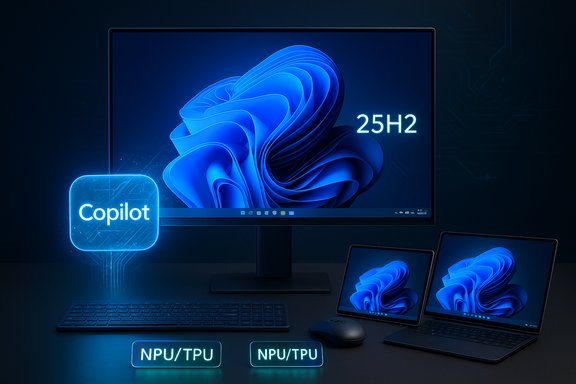
Microsoft’s 25H2 update (Windows 11, version 25H2) is emblematic of a new model: substantial experience and security work delivered with minimal disruption, plus AI‑first features that can be toggled or gated by hardware capabilities.Key points about 25H2 and the immediate roadmap:
- 25H2 is being delivered with a shared servicing branch so the installation behaves like an enablement package for many PCs — fast, low downtime, and designed to keep compatibility stable. Microsoft’s Windows IT Pro materials explicitly describe this approach.
- The update emphasizes AI features (Copilot expansions, Click‑to‑Do AI actions, summarization, File Explorer AI elements) and improvements to accessibility, gaming performance, and security. Many of the new features are progressive rollouts tied to Insiders or Copilot+ hardware.
- From a support perspective, 25H2 resets the servicing window for enterprise SKUs, making Windows 11 the platform for long‑term commercial support while Microsoft continues to innovate within that lifecycle.
Rumors vs. verifiable facts: codenames, “Next Valley,” and leaks
A recurring rumor in reporting about a successor OS is the internal codename “Next Valley” (a play on Windows 11’s Sun Valley branding). The name has appeared repeatedly in coverage of leaked UI experiments, Ignite demos and industry reporting, and reputable outlets have treated the codename as plausible — but not confirmed as a ship name or public branding. In short, “Next Valley” is a credible leak‑level codename, not an announced product name. Other leak patterns to weigh:- UI prototypes (floating taskbar, different search positioning, more adaptive layouts) first surfaced in Ignite-era imagery and subsequent Insider experiments. These prototypes show Microsoft exploring new metaphors, but prototypes are a long way from final shipping products. Treat them as design signals, not guarantees.
- Hardware vendor references (Intel, OEMs) sometimes mention compatibility with a “next Windows,” but these references are often about silicon enablement rather than a final OS shipping date. For example, hardware roadmaps that promise support for future OS features typically describe enablement windows rather than launch dates.
AI at the center: Copilot, Copilot+ PCs, and why that changes timing
Microsoft’s narrative for PC evolution now centers on AI as a platform capability. Two constructs are central:- Copilot — the system and service that embeds large‑language models, context awareness, and productivity actions into Windows and Microsoft 365 experiences.
- Copilot+ PCs — OEM and Microsoft‑certified devices with local NPU acceleration, designated to deliver the best on‑device AI experiences (lower latency, local model inference). These devices are being marketed as a category and are sold on the promise of enhanced on‑device AI.
- Microsoft can roll AI features progressively in Windows 11 and let them be hardware‑gated: users with Copilot+ silicon experience richer local features; others get cloud‑backed behaviors. This reduces the urgency of a single “Windows 12” release to add AI features — the platform already allows differentiation inside Windows 11.
- Hardware partners and Microsoft want time to ship and certify NPUs and next‑gen chips. Tying major OS features to a hardware wave takes coordination and often delays public feature availability until silicon and drivers are mature.
System requirements and compatibility: separating rumor from likely outcomes
A central anxiety for users is whether their current PC will run whatever comes next. Rumored minimums and “AI‑only” requirements vary widely in press and community threads, so it’s important to be explicit about what’s verified and what is speculation.What is verifiable:
- Windows 10’s end‑of‑support is a fixed date: October 14, 2025. That calendar event is real and should be the anchor for migration planning.
- Microsoft’s official Copilot+ hardware guidance and partner certification do specify minimum NPU/TPU performance bands for devices to qualify as “Copilot+” — in other words, Microsoft is already defining a subset of features that will work best on specifically certified hardware. Those spec documents are real and affect OEMs and device SKUs.
- Specific Windows 12 minimum system requirements (for a hypothetical Windows 12 “base” or “Pro” SKU) have not been published by Microsoft. Community leaks and rumor posts propose ranges (8–16GB RAM, modern 8th‑gen Intel or Ryzen 3000+, TPM 2.0, SSD/ NVMe), but these are educated guesses based on historical patterns and the push to AI enablement. Treat these as guidance at best.
- Claims that a future Windows will mandate an NPU or that older Windows 11‑compatible machines will be blocked are not supported by Microsoft’s public guidance. The company’s current approach is to gate advanced AI features by hardware while keeping the base OS broadly compatible. That means older compatible devices will likely run the OS at a functional level but may miss hardware‑accelerated AI features.
- Use October 14, 2025 (Windows 10 EoL) as the planning milestone for migrations and security posture changes.
- If local AI features matter, budget for Copilot+‑class hardware and consult OEM Copilot+ certification guidance rather than single leaked requirement lists.
- Expect Microsoft to continue delivering features to Windows 11 for both AI‑enabled and non‑AI devices; plan for phased rollouts rather than a one‑time big upgrade.
Release scenarios: what to expect and how to prepare
Analysts and reporting outline three reasonable scenarios for how Microsoft might proceed in the next 12–36 months:- Incremental evolution inside Windows 11 (the most likely near‑term path): Microsoft continues to deliver AI and UX changes as annual/frequency updates (25H2, 26H1/26H2 model) and ties advanced features to Copilot+ devices. This is Microsoft’s present posture and aligns with its public messaging.
- A formally numbered “Windows 12” launch timed with a hardware wave (less likely in the immediate term): Microsoft could choose to ship a new major version when a meaningful portion of the ecosystem supports on‑device AI. This would be accompanied by a classic RTM/GA cadence and significant partner marketing; however, Insider, blog, and product activity to date show Microsoft is prioritizing Windows 11 feature delivery instead.
- A hybrid approach: Microsoft launches “Next Valley” as a targeted edition for Copilot+ devices or enterprise SKUs while keeping Windows 11 as the consumer mainstream label. This modular approach would let Microsoft segment feature gates while minimizing disruption for legacy users. Some leaks and industry commentary have described modular or CorePC architectures that support this model — again, unconfirmed but possible.
- Inventory: Map which devices in your fleet are Windows 11 capable and which are stuck on Windows 10. Prioritize security‑critical systems for early upgrades.
- Pilot Copilot features: Test Copilot and privacy settings on candidate devices; evaluate whether local NPU acceleration matters to your workflows.
- Budget for hardware refresh where AI matters: For roles that will tangibly benefit from on‑device AI (content creation, dev/test, large dataset analysis), plan device replacements in FY cycles that align with vendor Copilot+ SKUs.
- Update deployment plans: Use Windows 11 25H2/26H1 lifecycle rules for update windows and servicing, and keep Extended Security Update (ESU) options in mind if you need extra runway.
Strengths and risks of Microsoft’s current strategy
Strengths- Reduced disruption: Delivering big features inside Windows 11 with shared servicing reduces the installation friction that historically accompanied OS jumps. That’s a clear operational win for IT.
- Hardware differentiation without fragmentation: Microsoft can create premium, AI‑rich experiences for Copilot+ buyers while still supporting a broad base of devices — a practical market segmentation that helps OEMs upsell without forcing a hard fork.
- Faster iteration on AI features: Building AI into Windows 11 and Copilot allows Microsoft to iterate quickly, refine agentic capabilities, and learn from telemetry before committing to a full platform rebrand.
- Confusion and upgrade fatigue: Users and admins may be confused by overlapping feature gates, “Copilot only” messaging, and shifting minimums — complicating procurement and support. Rumors about mandatory NPUs can fuel uncertainty even if they’re false.
- Platform balkanization: If Microsoft sharply differentiates AI features by hardware, some classes of customers (e.g., budget or long‑life industrial PCs) could feel excluded and shift to alternative platforms. That fragmentation could hurt the broad Windows ecosystem.
- Security and privacy tradeoffs: Deeper Copilot integration and agentic features raise legitimate questions about telemetry, local vs cloud model behavior, and data governance that enterprises must address through policy and configuration. The tradeoffs are manageable but real.
What we can verify today — and what to treat with caution
Verified (public, attributable facts):- Windows 10 end of standard support: October 14, 2025. Organizations should treat this as the migration anchor.
- Windows 11 version 25H2 is Microsoft’s current major update path and uses a shared servicing branch for faster installs and extended support windows for enterprise SKUs.
- Microsoft is actively promoting Copilot and Copilot+ PCs; OEM certification and partner communications for the Copilot+ category are public and meaningful for hardware planning.
- Any particular ship name or public branding such as “Windows 12” or “Next Valley” as an official, consumer‑facing product until Microsoft announces it. Use these names as rumor tags, not facts.
- Exact minimum system requirements for a hypothetical Windows 12 — until Microsoft publishes them — remain speculative; community lists and rumor pages should not be used as procurement specifications.
Realistic timelines and final read
Given Microsoft’s public posture, platform releases, and hardware partner cadence, the most realistic near‑term outlook is:- Short term (next 3–9 months): Continued Windows 11 feature rollouts (25H2 and smaller updates), expanded Copilot functionality, and more Copilot+ certified devices hitting the market. Enterprises should use this window to execute their Windows 10 migration plans and pilot AI features.
- Medium term (9–24 months): Possible rebranding or larger structural changes to Windows if Microsoft chooses to consolidate a major set of AI and platform changes into a new product label — but there is no publicly confirmed Windows 12 date. If Microsoft opts for a new major version, expect a phased unveiling (Insider builds → preview → staged public rollout) tied to OEM silicon readiness.
- Long term (24+ months): Microsoft’s platform choices will be clearer once silicon cycles settle, enterprise adoption of Copilot+ hardware scales, and the company decides whether a new version number improves clarity or just creates needless churn. Until there’s an official Microsoft announcement, treat major‑version timelines as speculative.
Quick takeaways and actionable checklist
- Windows 12 as a formal product is not confirmed — Microsoft is focused on Windows 11 and Copilot/AI rollouts for the near term.
- Use October 14, 2025 (Windows 10 end of support) as your operational milestone and plan upgrades accordingly.
- If on‑device AI matters to your users, budget now for Copilot+ certified hardware and validate vendor claims against Microsoft’s Copilot+ guidance.
- Treat codename leaks (e.g., “Next Valley”) and system‑requirement lists from rumor pages as useful signals, not procurement spec documents. Verify with Microsoft blog posts and Windows Insider documentation before acting.
Microsoft’s strategy right now is pragmatic: ship polished, AI‑enhanced capabilities in Windows 11, give OEMs time to deliver AI silicon, and avoid the disruption of a full version‑number switch unless doing so clearly simplifies the customer story. For users and admins, the most sensible posture is to prepare for migration from Windows 10 by the official end‑of‑support date, pilot Copilot features where they provide real benefit, and watch Microsoft’s Windows Insider and Tech Community posts for any formal announcements about product naming, system requirements, or a true “Windows 12” launch. Conclusion
The “Windows 12” conversation is now less a single release date and more a discussion about how Microsoft will stitch AI, silicon, and Windows forward‑compatibility together. That stitch is happening inside Windows 11 today. Until Microsoft issues a formal statement about a new Windows product — with published system requirements and a clear deployment schedule — the prudent approach is to plan around Windows 11 updates and hardware refresh cycles that enable Copilot and on‑device AI.
Source: 9meters Latest About Windows 12 Release Date - 9meters