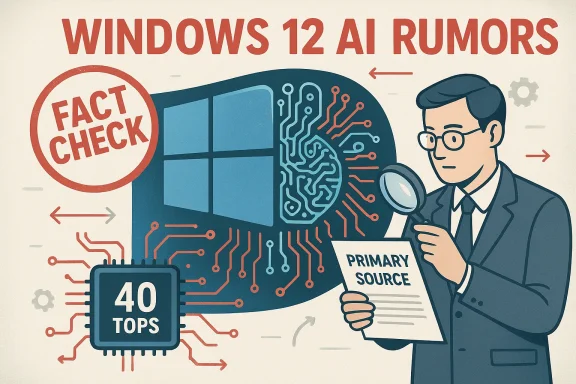
Microsoft’s roadmap rumors hit the Internet like gasoline: a translated roundup suggested a 2026 arrival for a bold, AI-first “Windows 12,” and within hours the story metastasized across forums, social feeds, and low-quality aggregator sites. The tale checked all the boxes that trigger outrage and clicks — a codename (Hudson Valley Next), a modular rearchitecture (CorePC), hardware gating via on-device NPUs rated in tens of TOPS, and the specter of a subscription-only paywall for advanced features — but it did not survive basic verification. Within days the original aggregator issued an apology and correction, veteran beat reporters pushed back hard, and Microsoft’s own public materials pointed to a far more incremental reality.
The narrative that set this week’s chorus of alarm began as a German-language piece that aggregated older reporting, internal codenames, and engineering concepts. That article was then machine-translated and republished by an English-language sibling outlet without the sourcing and editorial checks the piece required. PCWorld’s executive editor, Brad Chacos, publicly acknowledged the error, called the original piece “not meeting PCWorld’s editorial standards,” and apologized for publishing the translation in that form. Chacos said PCWorld would apply “much more scrutiny to translated articles going forward.”
What went wrong was textbook modern rumorcraft: plausible fragments (Microsoft’s public AI push, device-tier marketing, past leaks about “Hudson Valley” and CorePC experiments) were stitched into a deterministic timeline and framed as news. The result amplified existing anxieties about subscription creep, data collection, and forced hardware upgrades — anxieties that, when framed as imminent product policy, produce a very particular kind of digital panic.
Strengths:
Source: bgr.com New Windows 12 Rumors Were Immediately Debunked - BGR
 Background: how a translation turned into a tech panic
The narrative that set this week’s chorus of alarm began as a German-language piece that aggregated older reporting, internal codenames, and engineering concepts. That article was then machine-translated and republished by an English-language sibling outlet without the sourcing and editorial checks the piece required. PCWorld’s executive editor, Brad Chacos, publicly acknowledged the error, called the original piece “not meeting PCWorld’s editorial standards,” and apologized for publishing the translation in that form. Chacos said PCWorld would apply “much more scrutiny to translated articles going forward.”What went wrong was textbook modern rumorcraft: plausible fragments (Microsoft’s public AI push, device-tier marketing, past leaks about “Hudson Valley” and CorePC experiments) were stitched into a deterministic timeline and framed as news. The result amplified existing anxieties about subscription creep, data collection, and forced hardware upgrades — anxieties that, when framed as imminent product policy, produce a very particular kind of digital panic.
Overview: what the viral claims said — and what we can verify
The viral summary of the story included several striking claims:- A consumer product named Windows 12 (codename Hudson Valley Next) would ship in 2026.
- The OS would be AI-first, elevating Copilot to a system-level agent with deep local model execution.
- Advanced local AI capabilities would require a dedicated NPU and a performance target often quoted as ~40 TOPS.
- Some premium AI functionality would be locked behind subscriptions, effectively converting core experiences into recurring revenue streams.
- PCWorld’s translated roundup lacked sourcing and was corrected by PCWorld’s executive editor.
- Veteran Microsoft reporters with reliable contacts concluded there is no announced plan for a retail Windows 12 launch in 2026; instead, the company’s near-term work focuses on evolving and stabilizing Windows 11 and expanding Copilot features incrementally.
- Microsoft’s public materials do, however, document a Copilot+ PC device tier that advertises an NPU performance target of 40+ TOPS for richer on-device AI experiences — but Microsoft frames this as a device classification for premium experiences, not an installer gate that prevents the OS from running on older hardware.
Anatomy of the rumor cascade: why it spread so fast
Threeticular rumor especially sticky.- Plausibility. Microsoft has publicly embraced AI as a platform priority, it sells many subscription products, and OEMs are promoting devices with dedicated NPUs. Those trends make talk of a new, AI-centered Windows feel believable on first pass.
- Cognitive pattern matching. Humans (and many automated systems) naturally map a succession of version numbers to a cadence; when Windows 10’s long lifecycle ended and the company pushed Copilot, it became easy to infer a “Windows 12” milestone even without a direct roadmap announcement.
- Syndication and automated rewriting. A translation (and a handful of speculative aggregators) was enough for dozens of low-effort sites and social reposts to treat the claim as fact. In such an environment, repetition is mistaken for corroboration — and language models or content farms amplify that mistake. Community threads collected in uploaded discussion logs document this pattern vividly: recycled excerpts, circular citations, and the emotional velocity of outrage-driven sharing.
What’s verifiably true right now
Let’s separate the core, verifiable facts from the rumor drama:- Microsoft has not issued a public announcement naming a retail product “Windows 12” with a 2026 ship date. There is no Microsoft blog post, Insider preview, or developer roadmap page that confirms a 2026 retail Windows 12 launch. Multiple reputable outlets that follow Microsoft closely have reflected this absence.
- Microsoft continues to evolve Windows 11, and corporate communications indicate priorities for stabilization, reliability, and incremental AI integration into Windows 11 builds rather than a wholesale consumer OS relaunch this year. Zac Bowden and others who track Microsoft’s product plans report contacts indicating 2026 is more of a Windows 11 repair/stabilize cycle than a Windows 12 ship year.
- Microsoft’s public Copilot+ PC program defines an NPU performance target of 40+ TOPS to qualify for theeriences marketed under that label. This is a classification for premium devices, and the documentation frames it as enabling smoother local inference — not as a boot-time requirement that bricks unsupported hardware. The 40+ TOPS figure is therefore a device-tier marker, not an OS activation lock.
- Windows 10 reached its end of support on October 14, 2025, which is a firm lifecycle milestone that does create practical urgency for organizations and consumers, but it does not imply Microsoft must ship a new “Windows 12” immediately. The EOL timing simply increases interest in future Windows direction and understandably elevates concern about migration paths.
Technical reality check: NPUs, TOPS, and CorePC
Many readers focused on the technical shorthand thrown around in the rumor — “NPUs” and “40 TOPS” — without the nuance.- What is TOPS? TOPS (Trillions of Operations Per Second) is a vendor-provided throughput metric for an inference accelerator. It’s a coarse but useful indicator of raw parallel compute capability. Importantly, TOPS alone does not measure real-world performance. Software stack maturity, memory bandwidth, model quantization, runtime optimizations, thermal constraints, and power budgets are all decisive in whether an NPU can deliver a pleasant, low-latency local model experience.
- Microsoft’s Copilot+ guidance cites 40+ TOPS as a practical target for devices capable of advanced local inference. That target helps OEMs and enterprises plan device tiers, but it is not presented as a system-wide requirement that prevents Windows from running on older hardware. Expect feature differentiation: premium local capabilities optimized for Copilot+ machines, with cloud fallbacks or reduced experiences on legacy systems.
- CorePC and modular rearchitecture are valid engineering directions. Splitting a monolithic OS into modular components (smaller update surfaces, immutable system partitions, specialized images per device class) can improve update velocity and reduce attack surfaces. But such rearchitectures are complex for an ecosystem the size of Windows: drivers, enterprise management, ISVs, OEM firmware, and deployment tooling all have to align. Historically, Microsoft transitions major platform changes over multiple years; a sudden toggle from Windows 11 to a fully modular Windows 12 across the installed base is an impractical scenario in the near term.
The commercial angle: subscription fears versus reality
Subscription fears are real — Microsoft already sells subscription products (Microsoft 365, Windows 365 Cloud PC) and has a long history of converting formerly perpetual-license offerings into recurring services. But converting that trend into a firm claim that Microsoft will require subscriptions to boot a consumer PC is a leap that lacks substantiation.- Microsoft sells and markets Windows 365 (Cloud PC) and Microsoft 365. Those are explicit subscription products and represent real expansion of recurring revenue in Microsoft’s commercial portfolio. Confusing those for a mandatory subscription base OS is a common mistake; Cloud PC is a streamed, hosted desktop product for businesses and is marketed separately from retail Windows licensing.
- The viral claim that “Windows 12 will be subscription-only” conflates subscription-capable SKUs and internal licensing artifacts with a global policy change. The available evidence supports expanded premium subscriptions for advanced AI features or cloud-based model access — not a blanket requirement that consumers must pay a monthly fee to use their desktop. Several informed reporters and Microsoft-aware analysts emphasized this distinction in their rebuttals.
The role of journalism and moderation in a fast-moving rumor cycle
This episode is a small case study in the obligations of technology media in the era of instant syndisummarization.- Editorial hygiene matters. A machine translation or lightly edited aggregation layered with dated leaks can become a viral “scoop” if republished without sourcing. PCWorld’s admission that the piece did not meet standards and its public correction is an important accountability step, but the damage had already spread.
- Beat reporters and primary documents still matter. Experienced Microsoft beat writers w contacts — people who repeatedly brief and correct the record — were able to push back quickly and restore context. That kind of verification remains the most reliable guard against rapid misinformation cascades.
- Community vigilance is helpful but imperfect. Enthusiast forums and social platforms are where rumor is tested and amplified in real time; they also collect useful evidence. The uploaded community threads show the lifecycle of the rumor: aggregation, emotional amplification, fact-checking, and correction. That living record is valuable for researchers and readers who want to see how narratives form.
Practical guidance for users, IT pros, and OEMs
The rumor should not change immediate procurement or security posture — but it does suggest sensible planning steps:- For consumers on Windows 10: remember Windows 10 reached end of support on October 14, 2025. Unsupported OSes are security liabilities; evaluate upgrade options or Extended Security Updates where available. Do not delay necessary hardware purchases waiting for rumored product changes.
- For Windows 11 users: keep your system patched and enrolled in appropriate Insider channels only if you want early previews. If your workflows are stable on Windows 11, Microsoft’s near-term focus appears to be stabilization rather than forced migration. Take a conservative upgrade posture and test major changes in controlled rings.
- For IT and procurement teams: inventory your fleet and categorize machines by realistic capability (CPU class, presence of NPU or AI accelerator, RAM, storage). Pilot any AI-enhanced features on a small group first. When OEMs or Microsoft publish Copilot+ certification guidance, align procurement gates to measured business value, not fear.
- For OEMs and partners: treat internal codenames and engineering concepts as exploratory until Microsoft issues formal partner guidance. Avoid using a leaked or translated rumor to alter public marketing or recommended upgrade cycles.
Strengths, weaknesses, and the long view
The rumor episode performs several useful functions in the marketplace of ideas.Strengths:
- It focused attention on real technology trends that matter — on-device AI, model acceleration, modular OS design, and subscription economics. These are important strategic vectors that deserve scrutiny.
- The backlash forced clearer editorials and a rapid correction, which is a healthy feedback les meet informed critique.
- The viral narrative conflated exploratory engineering work with announced product policy; that conflation misleads consumers and can cause unwarranted market panic.
- Repeated, unverified stories like these amplify distrust toward large platform companies and can incentivize sensationalist coverage that values virality over verifiable facts.
- Microsoft’s investment in AI across Windows and cloud is real and long-standing; expect more Copilot integrations, more emphasis on device-level acceleration, and more subscription options for premium features. But turning those investments into a single, mandatory, subscription-only Windows 12 in 2026 would require a coordinated, public, and staged rollout — not a single translated rumor. Industry transitions of this scale usually involve months (or years) of previews, partner briefings, developer tooling changes, and enterprise guidance before they become binding policy.
How to read future Windows rumors responsibly
When another breathless headline arrives, run it through this checklist before changing purchase decisions or amplifying panic:- Look for Microsoft confirmation — corporate blog posts, Insider docs, or official partner guidance.
- Check for corroboration from more than one trusted outlet, ideally one that cites named sources or primary documents.
- Distinguish between internal codenames/experiments and announced consumer SKUs.
- Treat specific hardware gates (e.g., “40 TOPS required to boot”) as unverified until they appear in official system requirements.
- Avoid repeating claims that trace back to a single translation or a single speculative leak.
Conclusion
The short, evidence-based takeaway is simple: the viral claim that Microsoft will ship a subscription-locked, AI-first “Windows 12” in 2026 does not hold up to verification. The initial spark was a poorly sourced translation that overstated speculative engineering fragments, and strong pushback from veteran Microsoft reporters and the publisher’s own editor corrected the record. That does not mean the industry isn’t moving toward more capable on-device AI, or that Microsoft won’t offer premium, subscription-based AI services tied to richer hardware in the future. It means that, for now, the company’s public posture points toward evolving Windows 11 with tiered Copilot experiences and certified Copilot+ hardware classes — a careful, multi-year evolution rather than an abrupt, subscription-only reboot. Readers and IT professionals should anchor decisions to primary Microsoft channels and trusted beat reporting, not the velocity of syndication and translation-driven rumor.Source: bgr.com New Windows 12 Rumors Were Immediately Debunked - BGR