• Thread Author
A week of frenetic headlines and social posts claimed Microsoft was readying a shocking pivot: an AI-first Windows 12 arriving in 2026, locked to machines with on‑device NPUs and sold via a subscription model that would change how consumers pay for their OS. The story was wrong in nearly every headline-friendly detail. Careful reporting, public Microsoft documentation, and veteran Windows beat reporters show that no such product or timetable has been announced — what circulated was a recycled stack of engineering fragments, speculation, and AI‑generated amplification that metastasized into “news.”

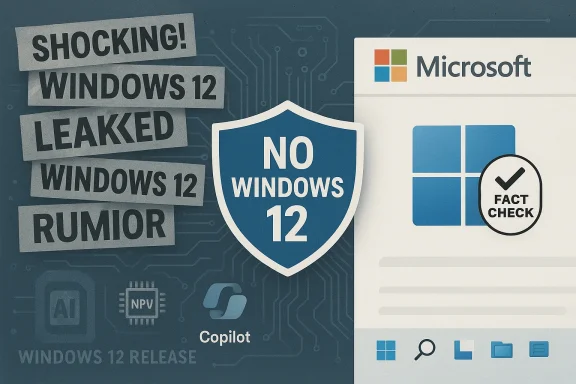
Graphic about Windows 12 leaks, featuring a 'NO WINDOWS 12' shield and a Microsoft fact-check badge.Background: what people saw and why it felt believable​

In early March 2026 a single speculative article and a handful of aggressively worded posts laid out an attractive narrative: Microsoft had a modular, subscription‑centric Windows coming soon, codenamed “Hudson Valley” or “CorePC,” that would require specialized neural processors on the device. The idea checked boxes that excite both tech enthusiasts and anxious customers — AI, new hardware tiers, and recurring revenue — so it spread fast.
That spread followed a now‑familiar pattern: one publishable claim, often based on internal codenames or leaked architectural notes, gets republished and rephrased by thin‑staffed outlets and automated content services. Social platforms then compress the story into simple, outraged headlines. Community threads show the same echo: bits of older reporting repackaged as current “breaking” news, and users forwarding those summaries as factual updates.
Why it felt plausible
  • Microsoft has publicly signalled an AI-first direction for Windows, embedding Copilot and local model support into Windows 11 and cloud services. That makes talk of AI‑native OS work seem plausible.
  • The company has run multiple internal platform projects over the past three years (names like CorePC or other platform experiments appear in past reporting), which creates a ready pool of loosely defined codenames and design notes. Recycled engineering artifacts are easy to misinterpret as imminent shipping plans.
But plausibility is not proof — and the record shows no confirmed Microsoft announcement for a commercially shipped Windows 12 in 2026. Microsoft’s public channels and long‑standing Windows reporters have repeatedly said as much.

Overview: what is verifiably true today​

This section lists the key, verifiable facts readers should anchor to.
  • Microsoft has not announced a product named “Windows 12” or provided any official public roadmap promising a 2026 full‑numbered successor. Multiple industry outlets that traced the rumor concluded the story was unverified and relied on dated or misinterpreted engineering notes.
  • Microsoft’s current public investment is in evolving and stabilizing Windows 11, shipping platform updates (26H1/26H2 cycles) and building AI experiences into that codebase rather than pushing a separate consumer OS this year. Windows Insider activity and Microsoft’s own roadmap signals show platform work inside Windows 11 builds.
  • Microsoft offers subscription services — notably Windows 365 Cloud PC (a streamed Cloud PC for business) and Microsoft 365 (productivity suite) — but those are enterprise or consumer productivity subscriptions distinct from shipping a subscription‑only core OS. Windows 365 pricing is publicly listed in Microsoft’s documentation; Microsoft 365 Personal pricing is similarly published by Microsoft. These are real offerings that are frequently misunderstood when people talk about “subscription Windows.”
Community and forum uploads in the files you provided show conversation threads where this very confusion repeated — users conflating Cloud PC (server‑streamed desktops) and Windows 11 feature licensing with a hypothetical consumer subscription OS. Those threads trace back to the same pattern of recycled internal names and AI‑driven reposting.

How the rumor formed and propagated​

The origin story: engineering artifacts + creative AI​

Microsoft and its OEM partners have historically run internal platform experiments to modernize update mechanics, component separation, and reliability. Names like CorePC or internal codenames surface in logs, code repos, or presentation slides. Those artifacts are engineering context — not necessarily product plans. When a single speculative article assembled those fragments into a cohesive narrative (a modular AI OS that ships next year and forces hardware upgrades), it created a tidy story that outlets and algorithms could easily repeat.
Exacerbating the problem: AI writing tools and low‑margin content farms can produce quick rewrites and clickbait titles that look like reportage but lack journalistic sourcing. The resulting articles often cite each other while pointing to no primary evidence. The viral cascade is then accelerated by social platforms where outrage and fear compound shares. Community files and forum threads from your uploads show multiple instances of the same recycled language passing as newly discovered facts.

The amplification mechanics​

  • Scrape → Rewrite: an initial speculative post is copied or paraphrased by dozens of low‑quality sites.
  • Social condensation: complex caveats are stripped out into one‑line assertions (e.g., “Windows 12 will be subscription only”).
  • Echo chambers: users in forums and social feeds see multiple confirmations that are effectively mirror images of the same original claim, creating an illusion of independent corroboration.
This pattern is not new — it’s the operational reality of low‑cost digital publishing when combined with generative AI.

Fact‑checking the central technical claims​

Below I examine the most consequential technical assertions and what the evidence actually supports.

Claim: Windows 12 will require an on‑device NPU (e.g., 40 TOPS)​

Status: unverified / likely false as an exclusive requirement for a general‑purpose consumer OS.
Why: Reporting that pushed an absolute NPU threshold conflated internal hardware research and hypothetical “Copilot+” tiers with general OS rollout plans. Public documentation and Microsoft statements about device requirements for Windows 11 and Copilot‑branded experiences emphasize optional on‑device AI acceleration for richer local inference, but Microsoft has not published a universal hardware requirement that would gate a consumer OS to a specific NPU performance metric. Veteran reporting that dug into the sourcing found the NPU claim tied to outdated internal prototypes, not a shipping policy. Treat the strict NPU requirement as an unverified rumor, not a confirmed roadmap item.

Claim: Windows 12 will be modular and built on CorePC (a ground‑up rewrite)​

Status: partially true in concept, misinterpreted in timing and productization.
Why: Microsoft has explored modular architectural improvements (CorePC and related concepts have appeared in engineering notes and Insider previews historically). Those projects aim to improve update reliability and component separation — sensible engineering goals that can be incorporated into the existing Windows 11 platform. Historically, internal architecture experiments often become part of subsequent Windows releases rather than spawning a standalone retail product the moment they appear in logs. Multiple fact‑checks concluded the CorePC narrative was a misreading of where the work sits in Microsoft’s multi‑year platform roadmap.

Claim: Microsoft plans to sell Windows as a consumer subscription replacing perpetual licenses​

Status: unsupported by public evidence.
Why: Microsoft already sells services and device‑streamed Windows to businesses via Windows 365 Cloud PC, and sells productivity subscriptions via Microsoft 365. Neither is the same as a subscription‑only retail OS replacement for Windows Home/Pro. Public pricing for Windows 365 (business Cloud PC starting tiers) and Microsoft 365 Personal (consumer productivity subscription) are easily verifiable in Microsoft’s published pages; those show business‑focused Cloud PC pricing and consumer productivity pricing but do not show a consumer OS subscription replacing Windows license models. Conflating these offerings with a forthcoming subscription OS is a common misunderstanding and was central to the viral claim.

What Microsoft actually offers today (and how that differs from the viral claim)​

  • Windows 11 remains the mainstream desktop OS; Microsoft is shipping feature updates and platform changes through Insider channels and targeted releases. The company has explicitly treated 2026 as a year focused on platform hardening and Windows 11 quality improvements rather than a full consumer OS renaming.
  • Windows 365 Cloud PC is a business service (Cloud PC) that allows organizations to stream Windows desktops from Microsoft datacenters. Pricing pages (publicly available) show business‑oriented monthly plans beginning at low tens of dollars per user for modest Cloud PC hardware profiles — for example, listings show a 2 vCPU / 4 GB / 128 GB configuration in the low‑$30s per user per month range in many currencies. This is infrastructure for enterprises, not an OS subscription sold to consumers that replaces a boxed Windows license.
  • Microsoft 365 (consumer and business productivity subscriptions) is priced and packaged independently; Microsoft 365 Personal is listed at $99.99 per year in current Microsoft pricing tables, reflecting the company’s consumer subscription strategy. That price covers apps and cloud storage — again, not the OS core.
Those distinctions matter: enterprise Cloud PCs and consumer productivity subscriptions are adjacent businesses, not evidence of an imminent consumer OS subscription that supersedes current Windows licensing.

The risks and consequences of amplifier‑driven OS rumors​

When uncertain, technical or strategic claims about a platform as central as Windows go viral, the fallout is real:
  • Consumer panic and unnecessary hardware upgrades. If readers believe a future OS will require expensive NPUs, they may prematurely buy new hardware or reject future purchases — either choice harms user trust and the broader PC market.
  • Enterprise procurement disruption. IT departments making multi‑year refresh plans might re‑evaluate purchases or deployments based on false timelines.
  • Reputation damage for responsible outlets. When outlets or social feeds publish unverified AI‑generated content as news, it erodes trust in legitimate reporting and raises the cost of subsequent accurate corrections.
  • Policy confusion. Talk of subscription‑only OS models triggers regulatory attention and consumer-rights debates — often before regulators have facts to consider.
Forum threads in the supplied files show exactly these dynamics: confusion about upgrade paths, fury over perceived vendor lock‑in, and calls to “skip Windows” altogether — reactions rooted more in rumor than in verifiable policy changes.

Why generative AI made this worse: hallucination and scale​

Generative models are powerful editors and ideation tools — but they are also prone to hallucinations: confidently worded statements that lack grounding in primary sources. When an AI model is used to spin a story from a mix of internal names, old leaks, and editorial fill, the result can sound authoritative while being inaccurate.
Key mechanisms:
  • Models blend patterns without citation. If a training set contains previous rumor articles and internal codenames, the model stitches them into plausible but unsupported narratives.
  • Scale amplifies mistakes. A single hallucinated article, once syndicated and reformatted by automated agents, can appear to be multiple independent confirmations.
  • Editorial shortcuts remove skepticism. Low‑cost publications often lack the resources for direct sourcing or verification, so an AI‑augmented rewrite can pass as journalism without the work of real reporting.
Those systemic weaknesses explain how a thin claim became a viral, multi‑platform “revelation.” Community moderation logs and forum comment metadata in the uploaded files show users calling out recycled copy and AI slop while others continued amplifying it.

How to assess and verify future OS rumors (a practical checklist)​

  • Look for an official Microsoft channel confirmation (blog, press release, or official documentation) before treating a rumor as fact. Microsoft’s own product pages and Windows Insider announcements are authoritative for roadmap changes.
  • Check for multiple independent, reputable reporters with named sources. Long‑time Windows reporters (bylines at Windows Central, The Verge, Ars Technica) are more likely to have repeatable sourcing and to clarify when claims are based on engineering prototypes.
  • Distinguish enterprise product announcements from consumer OS changes. Windows 365 and Microsoft 365 are real subscriptions, but they are not the same as replacing retail Windows licenses.
  • Trace codenames back to primary evidence. Codenames in slides or repos can refer to experiments; they are not automatic indicators of consumer productization.
  • Treat single‑source leaks and sensational thresholds (e.g., exact TOPS numbers for NPUs) with skepticism unless corroborated by OEM partner documentation or Microsoft developer guidance.
  • Pause before sharing. If multiple independent confirmations aren’t available, wait — sharing amplifies noise and makes the rumor harder to debunk later.

What reporters and publishers should change now​

The Windows rumor cycle exposes weaknesses across the industry that can be mitigated:
  • Invest editorially in source verification. Publish follow‑ups that say “we could not independently verify” rather than voyaging into speculative extrapolation.
  • Mark AI‑assisted pieces explicitly and require human review for claims about roadmaps, hardware baselines, and pricing.
  • Prioritize traceability: name sources (even anonymously) and describe what was actually seen (a slide, a code snippet, an OEM email) rather than summarizing the inferred product strategy.
  • For syndicated and automated publishing networks: implement gating rules that prevent republishing anything that lacks two independent verifiable sources, especially for product and regulatory claims.
Those changes raise costs, but they will also restore a degree of credibility badly needed in an era of easy amplification.

What you, the reader, should do today​

  • Continue using Windows 11 as your baseline platform. Microsoft is shipping quality and security updates, and many feature improvements are arriving incrementally through 2026 Insider and platform releases.
  • If you manage purchasing or procurement, treat 2026 roadmaps as fluid. Do not base refresh cycles on an unconfirmed OS renaming or hardware requirement. Consult OEM and Microsoft support channels for warranty and upgrade guidance.
  • For privacy and cost concerns: examine what you already pay for. If you’re worried about subscription creep, review whether you use Windows 365 (business customers) or Microsoft 365 (consumer productivity) and assess value against actual usage. Microsoft’s pricing pages list current options and plan details.

Final analysis: strengths, weaknesses, and the long view​

Strengths of the viral claim
  • It focused attention on real trends: Microsoft is clearly building AI into the Windows experience, and hardware makers are designing devices with on‑device acceleration in mind. These are legitimate strategic vectors that deserve scrutiny and discussion.
  • It sparked constructive debate about the future of OS ownership and subscription economics, which is a healthy conversation for enterprises and consumers.
Weaknesses and risks of the viral claim
  • It conflated engineering research with a shipping product, misrepresenting the timeline and practicalities of OS releases. Multiple reputable reporters and public Microsoft materials refute the claim that a consumer Windows 12 will ship in 2026.
  • It weaponized public fear about subscriptions and hardware lock‑in without evidence, pressuring community discourse and potentially influencing buyer behavior on false premises.
  • The story’s lifecycle demonstrates how AI‑assisted content creation and syndication can create the false appearance of corroboration when, in fact, all “confirmations” trace back to the same speculative origin.
The long view
Microsoft’s strategy toward AI and Windows will be incremental and multidimensional. Expect continued investment in Copilot features, local and cloud inference options, and device OEM partnerships that highlight on‑device accelerators for premium devices. But converting those investments into a single, subscription‑only “Windows 12” for consumers would be a major strategic and communication lift — one that would require clear announcements, developer previews, and partner briefings long before a 2026 ship date.
Until Microsoft publishes an official roadmap entry, lifecycle change, or product announcement, treat Win12 speculation as rumor. Use the practical checks above before acting on or amplifying headline claims. Community threads in the uploaded files document the cycle of rumor and correction — a useful living case study in how modern information cascades form and how they can be resisted with better sourcing and a little patience.

The immediate takeaway is simple: no, Windows 12 is not a confirmed 2026 release; and no, Microsoft has not announced a subscription‑only consumer OS that replaces retail Windows licensing. What you are seeing is the intersection of real platform engineering work, valid subscription offerings aimed at businesses and productivity customers, and the rapid, sometimes reckless amplification power of AI and social media. Treat big OS claims with skepticism, demand primary sources, and follow the Microsoft channels and trusted reporting for confirmation before you act.

Source: Gadget Review AI Creates Mass Hallucination and Makes Internet Think Windows 12 Releases Soon
 

Microsoft’s product cycle and the internet’s appetite for deus‑ex‑machina stories collided spectacularly this week: a widely circulated report claiming an imminent, AI‑first Windows 12 — complete with an NPU hardware gate and Copilot as a mandatory system service — spread across tech sites and social feeds, but closer inspection shows the story is fragmentary, partially sourced, and in at least one case published without the editorial safeguards expected of a major outlet. The upshot for Windows users, gamers, IT managers, and OEMs is simple: treat the Windows 12 chatter as a rumor that needs verification, not an inevitability. Read on for a detailed breakdown of what was claimed, what can be verified, what’s likely fiction or misinterpretation, and what each stakeholder should do now.

Blue neon Windows logo with an NPU chip and a 40 TOP5 badge on a circuit background.Background / Overview​

The rumor cascade began with a translation of reporting that traced a set of internal names — notably the codename Hudson Valley Next and an architecture term CorePC — and combined them with industry chatter about stronger AI integration in future Windows releases. The piece described a Windows successor that:
  • Treats AI as a foundation rather than an optional add‑on, elevating Copilot into a centrally integrated OS agent.
  • Requires dedicated on‑device AI hardware — a Neural Processing Unit (NPU) — with claims that full functionality would need roughly 40 TOPS (trillions of operations per second).
  • Embraces a modular architecture (CorePC) allowing tailored builds for gaming, ultraportables, and cloud‑centric devices.
  • Introduces premium or subscription components for advanced AI features while potentially keeping a base OS license.
Within 48 hours the reporting drew pushback from better‑connected Microsoft observers and reporters who said the narrative conflated past engineering experiments and leaked prototypes with an active shipping plan. One prominent rebuttal argued Microsoft’s 2026 roadmap centers on fixing Windows 11’s user experience and reputation — not shipping a full, numbered successor this year.
This episode is worth dissecting because it exposes how modern rumor ecosystems amplify partial facts, how AI can play a role in creating or reshaping narratives, and how real product strategy signals (executive interviews, hardware roadmaps) can be misread as imminent product plans.

What the report actually said — and how it was published​

The core claims​

The circulated piece made three headline claims that drove coverage and outrage:
  • Windows 12 (codenamed Hudson Valley Next) is scheduled for release in 2026 with full system‑level AI and a modular CorePC architecture.
  • Microsoft would make on‑device NPUs effectively mandatory for the “full” Windows 12 experience — the rumor specified a 40 TOPS threshold.
  • Copilot would transition from an optional assistant to an integrated, pervasive system service, changing how Windows looks and behaves at a platform level.
Those claims are unmistakably provocative: they imply a nontrivial hardware gate, a shift from optional AI features to compulsory system service, and a potential business model shift toward subscription‑tied premium AI.

How the content was produced and republished​

The original longform piece originated as a localized/translated writeup of coverage that had earlier appeared in a European sibling publication. When republished on an English site, it carried a headline and presentation that implied original reporting. After complaints and corroboration attempts, the publisher appended an editorial note acknowledging the article “does not meet [its] standards” and that it was a translation that lacked adequate sourcing and original reporting context.
That editor’s note is an important detail: it confirms the article was not the outcome of fresh investigative sourcing at the publishing outlet and that internal review judged the piece insufficiently verified.

The immediate fact‑check: strong rebuttal from well‑connected reporters​

Within hours of the PC‑style writeup circulating, veteran Microsoft reporters and outlets pushed back:
  • Longstanding Microsoft beat writers publicly stated their Microsoft contacts see no plan to ship a Windows 12 in the stated timeframe, calling the viral piece a conflation of older prototypes and engineering experiments with an active release plan.
  • Those rebuttals argued the company’s immediate 2026 focus — based on internal roadmaps and direct contacts — is repairing Windows 11: addressing UI regressions, rethinking intrusive AI placements, and restoring features users have repeatedly asked for.
When two different types of reporting collide — one analyzing leaked artifacts and industry signals, another reporting direct conversations with company insiders — the latter typically carries more weight for product schedule matters. In this case, the rebuttals came from reporters with sustained Microsoft coverage and sources inside partner and engineering circles, and they painted the viral account as speculative or regressive (recycling older concepts such as CorePC that aren’t currently slated for shipment).

Technical reality check: can the hardware gate (40 TOPS NPU) be true?​

One of the most consequential and concrete claims was the 40 TOPS NPU requirement. That number deserves close scrutiny because it would effectively exclude almost every current mainstream PC from receiving “full” operating system functionality.
Here’s the hardware situation as of early 2026:
  • Intel’s mainstream Arrow Lake (Core Ultra series) family, widely employed in consumer laptops and mini‑PCs, has NPUs in the low‑teens TOPS range — often cited around 13 TOPS for on‑die NPUs on current Arrow Lake silicon.
  • AMD’s Ryzen AI‑equipped desktop APUs and laptop parts advertise combined system TOPS figures that can approach the high‑30s, but those are aggregate numbers (CPU + GPU + NPU), and the dedicated on‑die NPU components themselves typically sit below 20 TOPS. For example, some Ryzen‑8000 family parts report an NPU alongside aggregate system TOPS of ~39, with the standalone NPU contributing a subset (for instance, ~16 TOPS).
  • High‑end discrete accelerators (dedicated AI chips) exceed those figures, but they are not ubiquitous consumer hardware on desktops or laptops and are primarily targeted at servers, workstations, or premium creator machines.
  • On the vendor roadmaps side, some future codenames and silicon generations are expected to push NPU performance higher (Nova Lake, next‑gen NPUs), but those parts were not broadly available across the installed base at the time the rumor circulated.
Interpretation: a hard 40 TOPS on‑die NPU minimum would instantly disqualify mainstream Intel and AMD consumer platforms on the market today and force either a strategic retreat by Microsoft (making the requirement optional) or an abrupt hardware turnover that OEMs and channel operators would find disruptive.
Conclusion on technical feasibility: the claim that Windows 12 would require a 40 TOPS NPU as a baseline for installation is not supported by the consumer hardware landscape in early 2026; it is either an overstated interpretation of internal guidance, a vendor marketing artifact, or a speculative extrapolation. The number is plausible as a performance target for advanced Copilot+ premium devices, but not as an across‑the‑board install gate for a mass‑market OS rollout.

Microsoft’s public signals: AI is central — but timing and form matter​

Microsoft executives have been explicit about making AI a foundational part of future Windows experiences. Public interviews and corporate messaging describe a trajectory toward a more agentic, contextual operating system: features that understand user intent, blend local and cloud AI processing, and enable multimodal inputs (voice, vision, text).
Key nuance to keep in mind:
  • Saying “Windows will be more AI‑centric” is a strategic direction; it is not the same as announcing a specific product release or hardware requirement.
  • Microsoft’s roadmap conversations — as reported independently — show an agenda in the near term that emphasizes improving Windows 11’s reputation and usability, reducing intrusive AI placements, and listening to feedback. The move from research/vision to shipping a full‑numbered OS is a distinct and larger commitment.
Put plainly: Microsoft executives are telegraphing an AI‑first intent for the platform, but deliberate product management and partner coordination make a sudden wholesale OS replacement with hard NPU gates an unlikely immediate move without extended partner planning and public announcements.

Why the rumor spread and how AI may have amplified it​

Several forces combined to accelerate the rumor:
  • Translations and republishing: A German piece containing synthesis of leaks and earlier reports was translated and localized; the translation process and headline framing made the piece seem like new, original reporting in English.
  • Conflation of toyed‑with engineering names: Internal code names like “CorePC” and “Hudson Valley” had been discussed publicly in prior years as experiments or exploratory projects; republished pieces without timeline context made these appear current.
  • Echo chambers and click dynamics: Headlines that promise radical change and clear timelines attract attention and rapid sharing; social platforms amplify the loudest narrative regardless of verification.
  • AI‑generated content / poor editorial hygiene: Several reporters flagged the viral article for showing signs of AI‑assisted summary or drafting and for insufficient sourcing. When pieces are assembled quickly from scattered online fragments, errors and outdated references are easy to introduce and hard to catch.
The result is a fast‑moving false positive: the story felt plausible (given Microsoft’s AI push), but plausibility does not equal confirmation.

Consumer and gaming backlash: why people reacted strongly​

If Windows 12 truly forced NPU hardware requirements and made Copilot unavoidable, backlash would be predictable and intense. Here’s why:
  • Users value choice and minimalism: Many Windows customers prefer to install only the apps and services they want. System‑level AI that can’t be disabled is perceived as bloatware by design.
  • Gamers are particularly sensitive: Gamers prioritize predictable performance, driver compatibility, and low‑latency behavior. Mandatory agentic services that run background inference could create new attack vectors for stutter, input lag, and driver instability.
  • Privacy and ethical concerns: Grouping system telemetry, on‑device AI, and cloud features raises data governance questions. If AI features rely on cloud processing or opaque models, that increases user concern.
  • The “Microslop” episode: Microsoft’s official Copilot community channels briefly banned a mocking nickname for Copilot, which then snowballed into broader mockery and a moderation backlash. That incident crystallizes public sentiment: users have an identity‑level reaction to perceived heavy‑handedness from vendors.
All of these dynamics mean Microsoft has to manage not only technical execution if it chooses to expand OS‑level AI, but also messaging, opt‑out mechanisms, and user controls.

Practical implications and what to watch next​

For different audiences, the practical moves vary:
  • Windows users (consumers and power users)
  • Don’t jump to upgrade expectations: There is no confirmed, company‑announced Windows 12 shipping imminently. Treat media writeups as rumor until Microsoft publishes an official plan.
  • If your machine is running fine on Windows 11, there’s no immediate need to buy hardware for a hypothetical OS that may never require it.
  • Review your privacy, telemetry, and account settings now so you’re prepared for any future feature announcements.
  • IT administrators and enterprises
  • Treat the rumor as a low‑probability, high‑impact scenario: run a compatibility inventory to understand which devices could meet an aggressive AI hardware baseline, but do this as part of routine lifecycle planning — not emergency procurement.
  • Use the end of mainstream Windows 10 support (October 14, 2025) as the real planning anchor for migrations rather than speculative Windows 12 release dates.
  • Gamers and enthusiasts
  • Monitor Microsoft’s Xbox and DirectStorage roadmap announcements for any real gaming‑specific OS changes. Game compatibility and driver ecosystems will be essential tests for any OS redesign.
  • Avoid panic upgrades; game performance will be a visible barometer of whether AI features are being implemented responsibly.
  • OEMs and hardware partners
  • Continue to evaluate NPU integration roadmaps, but favor flexibility: modular offerings (AI‑enhanced SKUs vs. baseline SKUs) will preserve the broadest market reach.
  • Coordinate with OS vendors about upgrade qualifications and marketing language to avoid “Windows 12 ready” confusion.

How journalists, editors, and readers should handle similar future claims​

The episode highlights best practices for media and readers:
  • Confirm explicit company statements before treating roadmap rumors as definitive.
  • Trace claims back to original sources; translations and republished summaries can introduce timing and sourcing errors.
  • Distinguish strategic statements (executive vision) from product announcements (ship dates, system requirements).
  • Look for corroboration from multiple independent sources, including hardware vendors and engineers, before accepting sweeping hardware gates like a 40 TOPS minimum.
  • Treat content that reads like a compiled summary without named sources as procedural reporting, not original investigation.
For editorial teams: add a verification step for any high‑impact product rumor that could influence buying decisions or stock market perceptions. A short contact round to the vendor and key OEM partners is inexpensive insurance.

Strengths and potential benefits of an AI‑centric Windows — if implemented carefully​

It is worth acknowledging that many of the concepts described in the rumor point to real, desirable directions when done with user control and transparency:
  • Smarter contextual assistance could reduce friction for knowledge workers: real‑time summaries, semantic search across local files, and automated document categorization can be genuine productivity wins.
  • On‑device NPUs can improve latency and privacy for select workloads when they keep sensitive processing local rather than sending everything to the cloud.
  • A modular CorePC architecture could reduce attack surface and enable lighter, faster builds for constrained devices if executed with compatibility and developer support in mind.
These are theoretical benefits. Real value depends entirely on implementation details: opt‑in vs. opt‑out, performance tradeoffs, compatibility with legacy apps, and transparent data use policies.

Risks and pitfalls Microsoft must avoid​

If Microsoft pursues a more agentic, AI‑driven Windows, the missteps to avoid are clear:
  • Forcing hardware upgrades via a hard gate will fragment the user base and create negative PR, particularly if the gate excludes the majority of installed devices.
  • Making Copilot impossible to disable — or burying the opt‑out deeply — will magnify distrust.
  • Shipping AI features without clear model provenance, data handling guarantees, and robust error‑handling will exacerbate hallucination, bias, and privacy concerns.
  • Rushing to monetize advanced AI via subscription tiers that lock core productivity features behind paywalls risks customer pushback and regulatory scrutiny.
Addressing these risks requires transparent, incremental rollouts; strong customer control and disclosure; and clear backward compatibility guarantees.

Bottom line: what to believe, and what to prepare for​

  • Believe the trajectory: Microsoft has publicly stated that AI is a major strategic priority for Windows. Expect continued integration of AI features, both local and cloud‑assisted, with experiments across Copilot and agentic capabilities.
  • Don’t accept the timeline or the hard hardware gate: there is no confirmed plan to ship a full‑numbered Windows 12 in the immediate term with a universal 40 TOPS NPU install requirement. That specific claim is inconsistent with the current consumer silicon landscape and was reported in a piece later flagged by editors as not meeting standards.
  • Prepare pragmatically: keep Windows 11 patched, inventory your organization’s hardware against reasonable NPU/AI hardware profiles, and monitor Microsoft’s official channels for any formal announcements. If you run legacy systems, use support and ESU pathways and plan upgrades based on confirmed end‑of‑support dates — not rumor cycles.

Final recommendations for readers and for Microsoft​

  • For readers: be skeptical of viral OS rumors. Look first for direct vendor confirmation or multiple independent reports before acting. When in doubt, assume the safer course: wait for official announcements before buying hardware or changing enterprise rollout plans.
  • For Microsoft: prioritize clear communication. If the company wants to nudge an AI hardware ecosystem forward, it should announce phased certification tiers, explicit upgrade paths, and opt‑in/opt‑out controls that respect user choice and backwards compatibility. Transparency will lower resistance and reduce the kind of reputational blowups we saw with community moderation decisions or forced feature placements.

Microsoft’s long game — moving the PC toward richer AI capabilities — is real. The short story that circulated this week, however, is an example of how fast a translation, a partial leak, and a social media echo chamber can conspire to turn speculation into apparent fact. For most people and organizations the sensible posture is one of preparedness, not panic: track official signals, audit hardware on reasonable timelines, demand clear user controls, and judge the company by what it ships — and how it lets people opt out — rather than by the most sensational headlines.

Source: GAMINGbible Windows 12 Rumours Surface, But Don't Believe Them
 

A month of sensational headlines has crystallized into one simple fact: a widely circulated report claiming Microsoft will ship a dramatically redesigned, AI‑first “Windows 12” this year — gated to machines with a 40 TOPS Neural Processing Unit (NPU) and pushing advanced features behind paid subscriptions — is a mixture of real engineering signals, speculation, and unverified leaks. The technical fragments in that story are plausible; the product conclusions are not confirmed. Readers deserve a clear, evidence‑based account of what was reported, what is verifiable, and what to prepare for next — without panic and without rumor-driven financial decisions.

Glowing holographic Windows logo floats above a base, with AI Copilot and tech posters nearby.Background: where the story came from and why it spread​

The narrative that “Windows 12” is imminent combines several repeating elements from the Windows ecosystem: internal codenames (notably Hudson Valley), an engineering concept called CorePC (a modular architecture idea), Microsoft’s Copilot integration push, and industry chatter around on‑device NPUs for local AI inferencing. Those pieces have circulated in reporting and forum threads for years; the recent surge was catalyzed by a translated article and multiple republished summaries that assembled them into a single, deterministic timeline. Veteran Microsoft reporters and multiple community threads quickly pushed back, noting that the most dramatic claims — a consumer product named Windows 12 shipping in 2026, a binding 40 TOPS hardware requirement, and a subscription‑only gating of the OS — do not appear in any official Microsoft roadmap and lack independent confirmation.
Why this spread so fast is textbook modern rumor dynamics: plausible technical fragments (AI + NPUs + modular OS) meet low‑quality aggregation and social amplification. The result looks like corroboration even when multiple outlets are rehashing the same initial, thin source. Community analysis uploaded to local forums documents this cascade and counsels skepticism until primary sources appear.

Overview: the core claims and what we can verify​

  • Claim: Microsoft will ship a consumer OS called Windows 12 by the end of 2026, built on a modular CorePC architecture and codenamed Hudson Valley Next.
  • What’s verifiable: Microsoft has repeatedly explored modular Windows architectures and Hudson Valley/Hudson Valley–adjacent names have appeared in past reporting as internal codenames or project groups. However, there is no confirmed consumer product announcement for a retail‑branded Windows 12 with a published ship date. Veteran reporters say Microsoft’s near‑term focus remains on stabilizing and evolving Windows 11, not a full consumer‑grade successor in 2026.
  • Claim: The OS will require a device NPU capable of at least 40 TOPS to run, effectively locking older hardware out.
  • What’s verifiable: Industry coverage and OEM certification efforts have discussed 40 TOPS as a target for some Copilot+ and AI PC experiences, and reviewers/OEM roadmaps have referenced TOPS thresholds for on‑device inference. The specific assertion that the OS will refuse to run without a 40 TOPS NPU is not backed by an official Microsoft requirement or technical specification. Treat the numeric claim as an unverified leak/benchmark rather than a published minimum.
  • Claim: Microsoft will convert Windows into a subscription product — charging monthly or annual fees for the OS or its advanced AI features.
  • What’s verifiable: Microsoft already sells multiple subscriptions (Microsoft 365, OneDrive tiers, Windows 365 Cloud PC) and has experimented with paid cloud PC offerings; some reporting suggests Microsoft prototypes or SKU flags for premium AI features could be paired with subscription models. There is no primary evidence that Microsoft has committed to replacing the traditional one‑time Windows license for all consumers with a mandatory subscription for the base OS. The “subscription Windows” framing in many headlines conflates existing cloud/enterprise subscription products with an unconfirmed retail pivot.
These are the load‑bearing claims that shaped the headlines. For each one, the responsible position is: plausible strategic direction, not confirmed product fact. The community files collected during the rumor wave illustrate exactly that distinction.

Technical reality check: NPUs, TOPS, and what they mean​

What is an NPU and what does “TOPS” measure?​

A Neural Processing Unit (NPU) is specialized silicon designed to accelerate AI model inference (matrix multiplies, convolutions, transformer ops) more efficiently than a general CPU or GPU. TOPS — Trillions of Operations Per Second — is a throughput metric vendors use to compare raw inference capacity. Higher TOPS can improve on‑device processing for large models, multimodal features, and low‑latency private AI tasks.

Is 40 TOPS a realistic gating threshold?​

Some OEM and industry discussion has positioned ≈40 TOPS as a meaningful threshold for richer local generative AI features on laptops; PC and OEM coverage of Copilot+ certification efforts cites similar numbers for premium on‑device experiences. But TOPS alone is not a complete performance measure: software stack, model size, power budgets, memory bandwidth, and quantization all change real‑world behavior. Many current NPUs shipped in 2024–2025 fall below 40 TOPS; a few newer chips have moved higher. Therefore:
  • Interpreting 40 TOPS as a design target for premium experiences is reasonable.
  • Interpreting 40 TOPS as an absolute, hard‑coded requirement for the OS to boot or function is not supported by public documentation.

Practical implications for buyers and IT teams​

  • Performance tiers are likely to appear: devices marketed as “AI PC” or “Copilot+” will carry better NPUs and therefore provide a richer on‑device Copilot experience. Expect OEM certification language to emphasize NPU throughput along with DSP and heterogeneous compute.
  • Legacy devices may retain baseline OS capability but lose advanced on‑device AI features — if Microsoft follows a tiered experience model. This is less disruptive than a complete hardware gate but still creates fragmentation risk for software compatibility and security lifecycle support.

CorePC, Hudson Valley, and Copilot at the center: design vs. branding​

CorePC: engineering concept, not a shipping SKU​

The idea of a modular, state‑separated Windows — sometimes referenced as CorePC — has been an engineering thread inside Microsoft for years (recall earlier experiments like Windows Core OS and 10X). CorePC aims to isolate OS components for faster updates and smaller, maintainable surfaces. That concept can be implemented incrementally inside Windows 11 without a consumer‑facing version number change. Many of the alarmist narratives treated CorePC as synonymous with an entirely new retail OS, which conflates architecture with release branding.

Hudson Valley: a codename with a history​

Hudson Valley has appeared in reporting as an internal label linked to AI‑focused workstreams. Codename usage at Microsoft is fluid; the same name can be associated with prototypes, experimental branches, or long‑running platform efforts. Reporters who track Microsoft closely emphasize that a codename does not equal a shipping product or committed marketing name. Treat the codename signals as breadcrumbs, not press releases.

Copilot integration: direction is real, permanence is not​

Microsoft’s strategy to elevate Copilot across the OS and Microsoft 365 is indisputable: Copilot features are being rolled into Windows 11 and Microsoft’s productivity stack, and Microsoft has marketed partner device classes designed to optimize local AI inference. That strategic push explains why rumors about a Copilot‑centric OS feel credible. What remains uncertain is whether Copilot becomes a mandatory system service that cripples non‑Compliant devices or whether Microsoft adopts a multi‑tier model that offers sensible fallbacks and cloud augmentation for older hardware.

The subscription question: business model vs. fearmongering​

Microsoft already sells subscriptions: Microsoft 365, OneDrive storage tiers, Xbox Game Pass, and enterprise services like Windows 365 Cloud PC. That existing subscription footprint makes headlines about a “subscription Windows” emotionally resonant, but conflating these services with a mandatory subscription for the base retail OS is a leap.
  • The conservative scenario most analysts consider plausible is a tiered model: a base OS (one‑time license or OEM packaging) with optional premium AI features behind a Microsoft subscription or tied to cloud credits. This mirrors how Apple and Google have separated base OS capability from cloud or AI premium features.
  • The more alarming scenario — Microsoft converting all retail Windows licenses into a subscription that is required for basic operation — has no independent confirmation and would be a massive strategic shift with enormous regulatory, enterprise, and consumer backlash.
When the rumor wave suggested everything would be subscription‑gated overnight, that claim ignored Microsoft’s existing product segmentation and enterprise dependencies. Analysts who have dug into Microsoft’s public filings and partner programs see subscription growth as a priority, but not as a short‑term extermination of traditional retail licensing.

Misinformation mechanics: why responsible readers should be skeptical​

Several postmortems of the rumor pointed to a familiar pattern: a single aggressive translation or thinly sourced article gets copied, repackaged, and amplified by automated content engines and social aggregators. Forum and community threads collected in the wake of the story illustrate how a rumor can acquire apparent corroboration when dozens of downstream sites cite the same provenance instead of independent verification. This is a textbook modern hallucination: plausible technical facts + weak sourcing + rapid amplification = perceived consensus.
Key warning signs that a Windows‑12 style scoop is suspect:
  • No official Microsoft blog post, no Insider channel preview, and no partner OEM documentation accompanying the claim.
  • Heavy reliance on single translations, uncredited leaks, or dated internal strings.
  • Recycling of older codename references without new corroboration from separate Microsoft contacts.
Watch for those signs before acting on headline claims.

Benefits — if Microsoft pursues an AI‑first Windows deliberately and responsibly​

If Microsoft executes an AI‑first Windows evolution carefully, some real benefits are possible:
  • Faster, safer, and incremental updates from a modular architecture (CorePC concepts aim at this). Component isolation can reduce update regressions and improve security hardening.
  • Low‑latency, private AI features when capable NPUs are present, improving productivity for tasks like on‑device summarization, code completion, and photo editing without sending all data to the cloud.
  • Improved battery and thermal efficiency for common AI workflows if models are optimized for specialized silicon.
These are attractive outcomes if Microsoft prioritizes compatibility, graceful degradation, and clear admin controls for enterprises. Many proponents argue that enabling powerful local AI will unlock new classes of offline capabilities that are currently only viable in the cloud.

Risks and trade‑offs: privacy, e‑waste, fragmentation, and trust​

Pursuing richer on‑device AI and subscription tiers also creates tangible risks:
  • Privacy and telemetry: deep system integration of an assistant like Copilot multiplies the amount of contextual telemetry flowing through OS components. Without robust governance and transparency, that can erode user trust and complicate compliance. Enterprises must demand clear audit trails, consent flows, and MDM controls.
  • Fragmentation and e‑waste: if premium features require specialized NPUs at scale and Microsoft or OEMs move quickly, many working devices could be functionally deprecated for key features, pressuring consumers to buy new hardware and creating environmental and upgrade hassles. This is a realistic concern if Microsoft ties essential work features to new silicon without a long transition period.
  • Software compatibility: a major architecture shift increases the surface for regressions. Developers and enterprises will need time and toolchains to validate line‑of‑business apps against any modular changes.
  • Monetization backlash: aggressive subscription gating risks significant consumer and regulatory pushback. Microsoft would have to balance revenue ambitions against erosion of goodwill and antitrust scrutiny if it attempted a wholesale conversion to mandatory subscriptions.
The responsible path for platform owners is slow, consented rollouts with clear fallbacks; the faster vendors try to monetize platform control, the higher the political and market risk.

What to do now: practical guidance for consumers and IT teams​

Whether the Windows‑12 headlines are true or not, the underlying trends (more AI in Windows, device classes emphasizing NPUs, cloud subscription expansion) are real and actionable. Here’s a pragmatic checklist:
  • Inventory devices now. Record CPU, GPU, and any accelerators (NPUs, DSPs) in your estate. Prioritize machines nearing end‑of‑life for replacement planning if AI features are business critical.
  • Test fallback strategies. Evaluate Windows 365 Cloud PC and other cloud‑augmented Copilot experiences as fallbacks for older machines that can’t support on‑device acceleration. Know how functionality degrades in cloud mode.
  • Harden privacy and governance. Pilot Copilot features in a controlled ring, update DLP policies, and require opt‑in behavior for sensitive workflows. Combine Microsoft admin policies with AppLocker/WDAC and tenant‑level controls.
  • Ask OEMs about upgrade paths. If you plan to buy new hardware, ask vendors for explicit NPU specs, model support windows, and driver update commitments. Devices marketed as “AI PCs” should include clear performance claims and warranty coverage for long‑term support.
  • Pause panic buying. Do not rush to replace working machines purely because of headlines. The most likely scenarios involve tiered features and transitional support for legacy hardware. Budget for upgrades based on validated feature needs, not fear.

Alternatives and the broader ecosystem response​

If Microsoft does push harder into subscription models or hardware gating, alternatives exist:
  • macOS and Apple Silicon: Apple continues to ship multi‑year OS updates for many Mac models and has its own local model inference story on Apple Silicon, though it also tightens hardware‑feature maps over time. For many users, switching ecosystems is a real option, particularly in the consumer and creative markets.
  • Linux: For power users and some enterprises, Linux offers a subscription‑free route and rapid adoption of open AI tooling — but compatibility with some Windows‑centric apps (notably some games and proprietary line‑of‑business software) remains a blocker.
  • Hybrid cloud: Windows 365 and cloud PC offerings give customers a way to access modern Windows experiences from older endpoints; expect those services to become more relevant if local silicon becomes a gating factor.

How to interpret future announcements: a short checklist for healthy skepticism​

  • Look for primary Microsoft sources: official blog posts, Windows Insider preview channels, or partner OEM certifications before treating a rumor as an imminent product plan.
  • Demand multiple independent confirmations: two distinct reporter sources quoting different Microsoft contacts are stronger evidence than a single translated article.
  • Separate architecture signals from branding: CorePC‑style work can ship as internal evolution inside Windows 11 rather than as a consumer product called Windows 12.

Conclusion​

The recent wave of “Horror: Windows 12” headlines drew energy from three forces that are all real: Microsoft’s legitimate push to embed AI across Windows, the rise of NPUs and TOPS as practical device metrics, and the company’s increasing subscription footprint. What isn’t verified is the dramatic package many outlets described — a consumer Windows 12 shipping in 2026 that refuses to boot on anything below 40 TOPS and forces users into a subscription to access core OS functions. That combination is plausible as a speculative business scenario, but it is not a confirmed product plan.
For readers and IT leaders the sensible posture is precaution, not panic: inventory your estate, pilot Copilot features in controlled rings, demand transparency from vendors, and avoid rash upgrade purchases driven by sensational headlines. Watch Microsoft’s official channels and Windows Insider previews for primary confirmation; until then, treat the viral claims as a cautionary tale about how modern rumor ecosystems can transform plausible technical trends into near‑apocalyptic headlines.


Source: Inbox.lv Horror: A New Windows 12 with Ubiquitous Paid Subscriptions is Coming
 

Microsoft’s denial of an imminent, AI‑first “Windows 12” for 2026 was blunt and — in practical terms — overdue, because a single speculative report had already catalyzed a week of frantic headlines, social outrage, and purchase‑cycle anxiety across the PC ecosystem on March 4–5, 2026. The quick reality: Microsoft has not announced a retail, subscription‑only operating system called Windows 12 scheduled for 2026, and the more dramatic technical claims—mandatory on‑device neural processors measured in tens of TOPS and a wholesale conversion of Windows to a subscription model—remain unverified and inconsistent with public Microsoft roadmaps and well‑connected industry reporting.

A Windows desktop with a shielded security emblem and a ~40 TOPS AI processor.Background / Overview​

The recent rumor cycle combined three powerful, accelerating industry trends into one alarming headline: heavier AI at the OS level, subscription monetization as a recurring revenue model, and device‑level hardware differentiation via on‑chip NPUs (Neural Processing Units). Those trends are real in isolation: Microsoft has been integrating Copilot and related AI features into Windows, OEMs are building devices with larger accelerators, and Microsoft sells cloud and productivity services on subscription bases such as Windows 365 and Microsoft 365. But the leap from these real signals to a consumer‑facing, subscription‑only Windows 12 shipping in 2026 is a leap unsupported by primary evidence.
In late February and early March 2026, veteran reporters and multiple specialist outlets pushed back: the company’s public statements and the evidence in Microsoft’s own Insider channels point toward incremental evolution of Windows 11, targeted updates for specific silicon classes (notably an ARM‑optimized 26H1 build), and continuing investment in Copilot features — not a brand‑new, mandatory, subscription‑gated OS launch this year.

What was claimed — and what Microsoft actually said​

The viral claims, summarized​

  • A consumer OS labeled Windows 12 (often referenced by the codename “Hudson Valley Next”) would launch in 2026.
  • That OS would be AI‑first, elevating Copilot to a pervasive, always‑on system agent.
  • Advanced features would be gated behind a subscription, effectively converting core desktop functionality into a paywall.
  • A strict hardware requirement — typically cited as a dedicated NPU capable of ≈40 TOPS — would be necessary for the “full” experience, leaving older machines functionally limited.

Microsoft’s posture and public signals​

Microsoft’s public posture in early March 2026 and the preceding months has been consistent and less sensational than the rumor. The company has:
  • Continued to roll out Copilot features within Windows 11, including partnerships and device programs that highlight machines optimized for richer local AI experiences.
  • Reiterated the continued lifecycle and planned updates for Windows 11 through 2026, with platform updates targeted at particular silicon families rather than an across‑the‑board consumer OS replacement.
  • Not issued any official announcement, roadmap entry, or developer preview explicitly labeling a 2026 consumer OS release called Windows 12 or announcing mandatory subscription licensing for the base OS.
Put another way: Microsoft is actively building AI into Windows, but the move is incremental, productized through existing channels and device programs — not a sudden, mandatory reboot of OS licensing and minimum hardware.

Why the rumor spread so quickly​

1. Plausibility meets pattern matching​

The rumor felt plausible: Microsoft has openly embraced AI and subscription revenue streams, and OEMs advertise NPUs and other accelerators. Those facts were combined with internal codenames and engineering discussion (things like CorePC and Hudson Valley in prior reporting) into a tidy narrative that was easy to repeat.

2. Thin sourcing and amplification​

A small number of speculative write‑ups, then broad syndication and automated rewrites, created the appearance of corroboration. Automated summarizers and content farms frequently echo one another, and social platforms compress nuance into sensational headlines — a perfect storm for rapid, high‑emotion amplification.

3. Cognitive and commercial incentives​

Outrage performs. For readers worried about subscription creep, privacy, or forced hardware upgrades, the story triggered strong reactions and rapid sharing. For publishers, an attention‑grabbing headline about a “subscription Windows” sells clicks. For AI content systems trained on patterns, repeated statements are treated as increased evidence, even when the original sourcing was thin.

Technical claims examined: the 40 TOPS NPU and hardware gating​

What is TOPS and why it matters​

TOPS (Trillions Of Operations Per Second) is a throughput metric vendors use to describe an NPU’s raw ability to perform matrix operations and inference. Higher TOPS can enable more sophisticated, lower‑latency on‑device AI experiences, particularly for larger models and multimodal tasks.

Why a hard TOPS requirement is suspicious​

Operating systems traditionally specify platform capabilities rather than hard numeric gates for core functionality. Requiring a specific numeric NPU threshold (e.g., “40 TOPS”) for the OS to operate would be unprecedented and disruptive in several ways:
  • It would instantly lock out a huge installed base of PCs.
  • It would require explicit, widely publicized minimum system requirements and migration pathways.
  • It would generate immediate regulatory and OEM backlash, and dramatically accelerate e‑waste concerns.
In practice, vendors and platform teams are far more likely to declare tiered experiences: some advanced, premium features function best on devices with stronger NPUs, while a baseline OS experience remains supported on existing hardware. Treat the specific 40 TOPS figure as an unverified design target or talking point rather than an official, ship‑day system requirement.

Business model claims examined: subscription Windows?​

Microsoft has gradually expanded subscription offerings in the Windows ecosystem: Windows 365 (Cloud PC), Microsoft 365, and premium AI SKUs are real, live products. But there is a crucial distinction:
  • Windows 365 is a streamed, cloud‑delivered PC for business customers, explicitly subscription‑based.
  • Microsoft 365 is a productivity subscription bundle, also subscription‑based.
  • A subscription model for certain premium AI features is plausible and consistent with Microsoft’s commercial direction.
  • A blanket conversion of the base Windows license (the one OEMs ship and consumers buy) to a mandatory subscription would be a major policy change requiring explicit, public communication, developer outreach, OEM renegotiations, and consumer migration options.
Until Microsoft publishes clear documentation or an official licensing roadmap, portrayals of a mandatory subscription Windows in 2026 are speculative and should be treated as such.

The immediate implications for users and organizations​

For consumers​

  • Do not panic‑buy. Replace or upgrade hardware only if your current device fails to meet your needs, not because of unverified rumors.
  • Inspect Copilot settings and privacy controls before enabling new AI features. Microsoft has been iterating opt‑in controls and enterprise management settings; understanding them matters.
  • If you rely on a specific application or workflow, verify compatibility with publishers or hardware vendors rather than reacting to rumor.

For IT administrators and procurement teams​

  • Test — don’t assume. Use normal ring‑based testing for updates and wait for official guidance before committing to mass hardware refreshes.
  • Inventory and risk‑profile. Map critical endpoints, and identify which systems might benefit from local AI acceleration—then pilot accordingly.
  • Update governance policies. Review data loss prevention (DLP), acceptable use, and telemetry policies with an eye on agentic features (memory, cross‑app automation).
  • Require vendor confirmation. If an OEM claims a device is “Windows 12‑ready” or “Copilot+ certified,” ask for explicit technical specs and Microsoft‑aligned certification documentation.

Strategic reasons Microsoft would avoid an abrupt subscription OS shift​

  • Consumer trust: Windows has a vast, diverse installed base that values continuity and compatibility. A sudden forced subscription would damage trust.
  • OEM relationships: OEMs build long‑term business models around hardware sales, licensing and service contracts. Abrupt licensing changes would demand deep OEM negotiation.
  • Regulatory and antitrust scrutiny: Forcing core desktop functionality behind a subscription could attract regulatory attention in multiple jurisdictions.
  • Technical complexity: A full OS rearchitecture that forces modern NPUs into the minimum platform would create fragmentation and a cascade of support headaches across drivers, peripherals, and applications.
For these reasons, Microsoft’s more likely tactic — and one supported by public signals — is incremental tiering: enabling richer local AI on high‑end hardware and keeping a functional base OS broadly available.

Strengths and sensible elements buried in the rumor​

Not everything in the original fever dream was baseless. There are legitimate, constructive trends to watch:
  • Modularity and state separation (CorePC‑like concepts) can reduce update complexity and improve security isolation.
  • On‑device acceleration improves latency, privacy (less cloud dependency), and can enable features when off‑line.
  • Subscription tiers for advanced features make commercial sense; enterprises and power users often pay for convenience and capability.
Those are real strategic directions. The sensible, incremental adoption of those ideas could produce meaningful user benefit if Microsoft and partners execute with clarity and respect for legacy hardware.

Key risks if Microsoft (or any major vendor) mishandles the transition​

  • Fragmentation and e‑waste: Forcing hardware upgrades accelerates disposal of still‑functional machines.
  • Privacy and telemetry creep: Agentic Copilot experiences increase the surface for data collection; without transparent controls, trust suffers.
  • Security and manageability challenges: New on‑device AI stacks expand the attack surface and require robust patching and management workflows.
  • Economic exclusion: Subscription gating can disadvantage users in lower income brackets or regions where subscription economics are less feasible.
These risks argue for measured rollouts, clear opt‑in policies, and explicit support commitments for older hardware.

How to read future claims responsibly — a practical checklist​

  • Treat single‑source reports with skepticism — especially if they recycle internal codenames into definitive timelines.
  • Demand primary evidence: official Microsoft roadmaps, Microsoft‑issued blog posts, Insider preview channels with documentation, OEM certification pages, or direct statements from Microsoft spokespeople.
  • Be cautious of numeric thresholds quoted without vendor documentation (e.g., specific TOPS numbers).
  • Look for corroboration from multiple, independent beat reporters with a track record covering Microsoft and Windows roadmaps.
  • Differentiate between product experiments, internal codenames, and announced product plans.

Where Microsoft should go next (and what to expect)​

Microsoft faces a communications and trust problem. To navigate this era responsibly, it should:
  • Publish clear, human‑readable guidance about what AI features are optional, which are premium, and what hardware benefits provide.
  • Offer migration paths for legacy hardware—cloud fallbacks, staged feature rollouts, and clear performance expectations.
  • Engage OEMs transparently about certification thresholds and avoid abrupt unilateral license changes.
  • Continue to harden Windows 11 first: performance, reliability, driver quality and user experience improvements will do more to restore goodwill than marketing a new major version number.
Expect Microsoft’s 2026 roadmap to emphasize Windows 11 stabilization and iterative enhancement, targeted platform updates (including device‑class specific builds), and gradual expansion of Copilot capabilities across tiers — not an overnight, subscription‑only OS launch.

Final analysis and guidance​

The rumor that Microsoft would launch an AI‑focused, subscription‑gated Windows 12 in 2026 was, in large part, a modern internet hallucination: plausible fragments assembled into a sensational conclusion. The correct journalistic posture is simple: treat this as a cautionary case of how engineering breadcrumbs, internal codenames, and a rapidly syndicating web ecosystem can create false certainty.
For readers and IT professionals:
  • Anchor decisions to official Microsoft communications and Insider channels.
  • Assess hardware needs based on real workloads, not rumor.
  • Maintain conservative change control and test updates in controlled rings.
  • Push vendors for explicit compatibility and certification documentation before altering procurement strategies.
The true story is less dramatic but more important: an industry‑wide, incremental evolution of Windows and PC hardware driven by AI capabilities and subscription economics. That evolution can benefit users profoundly if it’s pursued openly, with clear opt‑in controls, reasonable migration paths, and explicit guardrails against fragmentation and privacy erosion. Until Microsoft publishes official product documentation announcing any major OS rebranding or licensing change, treat the Windows 12 2026 headlines as speculative, and plan accordingly.

Source: Mix Vale Microsoft denies AI-focused Windows 12 launch rumor for 2026
 

Microsoft has not announced a product called “Windows 12,” and the torrent of 2026 release-date headlines is best read as a fast-moving rumor cascade built from leaked crumbs, AI‑generated rewrites and aggressive republishing — not a confirmed Microsoft roadmap. ]

Monitor displays Copilot onboarding steps; Windows 12 is crossed out with a 40+ TOPS badge.Background / Overview​

The past week’s headlines about a 2026 “Windows 12” collapse into three repeating threads: whispers of codenames like Hudson Valley and CorePC, engineering discussion about a modular Windows designed to host on‑device AI, and a fixation on expensive‑sounding numeric thresholds (commonly ~40 TOPS) for Neural Processing Units (NPUs). Those pieces are real ast the jump from those signals to a consumer release date and mandatory subscription model is not supported by primary evidence.
Microsoft’s public posture in early 2026 is straightforward: stabilize and evolve Windows 11 while integrating Copilot and richer AI features, and certify device tiers for enhanced local AI performance — not to ship an immediately mandatory retail OS called Windows 12 this year. Multiple reputable outlets and community investigations pushed back on the more sensational claims within days of the rumor going viral.

What the viral reports actually claimed — and which parts hold up​

A compact version of the rumor looked like this:
  • A consumer product called Windows 12 (sometimes labelled Hudson Valley Next) would ship in 2026.
  • The OS would be AI‑first, elevating Copilot to a system‑level agent and embedding on‑device model execution.
  • Advanced features would be subscription‑gated, and a hardware gate — typically an NPU capable of ~40 TOPS — would be required to run the full expese claims are verifiable?
  • Microsoft has not published any official announcement, roadmap entry, or Build/Insider preview that uses “Windows 12” as a shipping product name for 2026. Treat any story giving an exact ship month or day as unverified.
  • Microsoft is explicitly pushing deeper AI integration in Windows 11 and has defined a device tier called Copilot+ PCs that targets NPUs rated at 40+ TOPS for the richest local inference experiences. That hardware threshold appears in Microsoft’s developer guidance anabout Copilot+ machines.
  • Subscription offerings for cloud and productivity services (for example, Microsoft 365 and Windows 365 Cloud PC) are real and expanding, but there is no evidence Microsoft has committed to a *sumer OS that would lock basic desktop usage behind a monthly fee. Those scenarios remain hypothetical and fear‑inducing.
Put plainly: the strategic direction — AI features, modularity work, a Copilot+ device tier — is real. The dramatic product narrative — a subscription‑only Windows 12 shipping in 2026 with a hard 40 TOPS hardware requirement — is unproven and likely a synthesis of aggressive extrapolation.

Why the 2026 date keeps resurfacing​

Several predictable forces made the 2026 rumor sticky:
  • Pattern‑matching release cycles. Observers naturally map a rough 5–6 year cadence between major Windows numbers and infer a successor date. The math looks neat, but Microsoft’s release cadence is noisy and often punctuated by feature‑level evolution rather than clean version jumps.
  • Windows 10’s end‑of‑support created urgency. With Windows 10 officially reaching end of support on October 14, 2025, many users and organisations felt they needed a straightforward “what’s next?” story — and “Windows 12” filled that slot. The fact of ot in dispute, but EOL anxiety is fertile ground for premature upgrade advice.
  • The AI + subscription beat is click‑friendly. Headlines with “AI,” “subscription,” and a specific release year drive traffic and social engagement. Thinly‑sourced articles and AI‑assisted rewrites can make a single speculative piece look like widespread corroboration overnight.

The technical reality: NPUs, TOPS and CorePC modularity​

What is an NPU and why TOPS matter​

An NPU (Neis a dedicated accelerator for AI inference workloads — matrix multiplies, transformer ops, quantized model execution — tuned for power‑efficient local inference. Vendors commonly quote throughput in TOPS (Trillions of Operations Per Second); higher TOPS suggests greater throughput for large models or parallel tasks. However, TOPS is a coarse metric: architecture, memory bandwidth, quantization support and software stacks (runtimes, acceleration libraries) matter at least as much as the raw number.
Microsoft’s Copilot+ developer guidance explicitly references 40+ TOPS as a practical target for devices that can deliver advanced on‑device experiences without falling back to cloud inference. That does not automatically mean the OS will refuse to boot on anything with lower TOPS; it means premium local AI workflows are defined around that performance band.

CorePC / modular rearchitecture: plausible, hard to ship​

“CorePC” and related modularization concepts have shown up in developer and industry discussions for years. The core idea is to split Windows into smaller, more isolated modules — immutable system partitions, lighter recovery images, and targeted builds for device classes (ultraportable, gaming, cloud‑centric). Technically, modularization can enable faster updates, better securiter footprints for low‑end devices.
But a modular rearchitecture introduces major ecosystem work: driver compatibility, ISV testing, enterprise management tools and a long migration runway. Historically, Microsoft has preferred multi‑year transitions rather than overnight clean breaks. Treat reports tying CorePC directly to a consumer product number and an immediate ship date as premature.

What we can verify now (short checklist)​

  • Microsoft has not announced a retail product named “Windows 12” or specified a 2026 ship date.
  • Windows 10’s mainstream support ended on October 14, 2025; users should treat unsupported systems as security risks unless covered by an Extended Security Updates (ESU) program.
  • Microsoft’s device program and documentation define Copilot+ PCs and call out NPUs capable of 40+ TOPS for advanced on‑device experiences. That is a real technical target, not a proven OS installer gate.
  • Multiple reputable outlets and community threads have debunked or down‑graded the 2026 Windows 12 narrative; the conversation is currently one of evolution, not imminent replacement.

Practical advice for UAE users inust plans​

The useful question for most readers is not “When will Microsoft slap a ‘12’ on the installer?” but “What should I do with my PC today?” The answer depends on your curr# If you’re still on Windows 10
Windows 10 reached end of support on October 14, 2025. Running an unsupported OS exposes you to unpatched vulnerabilities and compatibility issues. Your practical options:
  • Upgrade in place to Windows 11 if your hardware meets the requirements and your workflows are compatible. Many machines sold in the past several years qualify; check TPM, Secure Boot and CPU compatibility before you begin.
  • Buy a sensible new Windows 11 PC now — don’t delay a necessary purchase waiting for a rumor‑driven Windows 12. Focus on hardware that matches your real needs: RAM, SSD capacity, display quality and battery life matter for day‑to‑day use.
  • If you want to avoid Windows entirely, consider macOS or a Linux distribution — both are valid migration paths but require planning for app compatibility and peripheral drivers.
  • For those who must stay on legacy units for a while, explore official Extended Security Updates (ESU) or vendor support contracts — these can buy time but come with additional cost and potential account requirements.

If you’re already on Windows 11​

You’re in the low‑risk category. Microsoft’s near‑term effort is stabilizing Windows 11 and rolling AI features into that codebase, and major new functionality will likely flow through that channel. Recommended actions:
  • Keep Windows Update enabled and apply platform updates from Microsoft and your OEM.
  • If you want the best local AI experience, consider Copilot+ PC hardware choices (devices advertising AI acceleration or NPUs). Those machines are more expensive but deliver lower latency and offline inference options for Copilot features.

If you’re shopping for a new PC in the UAE in 2026​

A straightforward decision tree will save money and regret:
  • Do you need a new machine now? If yes, buy one. Don’t sit on a failing PC waiting for a rumor.
  • If you want future‑proofing for richer AI features, prioritise CPUs and systems that support on‑device acceleration: Intel Core Ultra, AMD Ryzen AI, and Qualcomm Snapdragon X‑class devices are the names ets and retail tags. Aim for Copilot+ certified hardware if local AI performance is important.
  • Balance AI readiness with core needs: more RAM, a fast NVMe SSD and a bright, color‑accurate screen will improve daily experience more than chasing an imaginary OS number.

Enterprise & IT leader checklist​

Organisations should assume the next several years will be an incremental path, not an abrupt waterfall:
  • Inventory: document hardware, drivers, line‑of‑business apps and firmware update paths.
  • Pilot: build test images and pilot Copilot/AI features on representative hardware before mass procurement.
  • Procurement rules: when NPUs matter to your workload, define acceptance criteria (TOPS, SDK support, upgradeable firmware).
  • Migration timeline: demand clear Microsoft guidance before scheduling mass migrations tlease. Historically, Microsoft gives months or years of overlap when sunsetting major platform versions.

The opportunity and the risk — a balanced view​

There are real positives in Microsoft’s AI strategy:
  • On‑device AI can reduce latency, preserve privacy by keeping inference local, and enable richer, offline experiences for productivity and accessibility.
  • Modular updates and smaller system partitions can mean faster, safer patches and simpler recovery.
But the risks are tangible:
  • Fragmentation: if features are gated by hardware tiers, users will encounter inconsistent experiences across devices.
  • Cost: NPUs and silicon with substantial TOPS add BOM cost; initial Copilot+ devices will be a premium tier.
  • Compatibility churn: modular rearchitectures must protect drivers and enterprise management tools or risk a long tail of support headaches.
Successful transition depends on clear communication, long overlap windows, and explicit migration tooling from Microsoft and OEM partners — none of which are guaranteed simply because a rumor article publishes a date.

How to read future Windows rumours (a short media‑literacy primer)​

  • Demand primary sources: an official Microsoft blog post, a Build keynote slide, or an Insider channel preview are authoritative. Press aggregations and translated pieces are not.
  • Watch the ecosystem signals, not single headlines: hardware certification docs, developer pages and OEM partner briefings reveal the direction; product names and ship dates require a formal announcement.
  • Distinguish product features from commercial models: cloud and productivity subscription expansion does not automatically equal a subscription‑only OS.
  • Treat published numeric thresholdformance targets* for premium experiences, not strict installer blockers — unless Microsoft states otherwise in formal requirements.

Conclusion — a clear, practical posture for 2026​

The smart stance for users and IT teams in 2026 is to treat “Windows 12” as a possible future label for work Microsoft is already doing — not as a reason to delay essential security upgrades or to hold off buying a needed PC. The immediate risk is sitting on unsupported Windows 10 systems; the medium‑term reality is that richer AI features are arriving through Windows 11 and Copilot programs, and hardware with on‑device NPUs will command a premium.
Act on what’s verified: move off Windows 10 if you haven’t already (Windows 10 support ended on October 14, 2025), keep Windows 11 systems patched, and when buying new hardware aim for AI‑ready silicon if you need those features — but don’t let rumor cycles dictate urgent consumer purchases. Monitor Microsoft’s official channels and Insider previews for concrete announcements; until then, plan for preparedness, not panic.

Source: Tbreak Media Windows 12 release date: what we know in 2026
 

Back
Top