Windows 11 AI Upgrades: No Windows 12 or Mandatory NPU Gate

  • Thread Author
Microsoft’s most recent public posture is simple and strategically pragmatic: there is no confirmed, imminent “Windows 12” consumer launch that replaces Windows 11, and Redmond’s near‑term priority is to evolve Windows 11 with deeper artificial‑intelligence features rather than forcing a hard migration to a subscription, hardware‑gated OS.

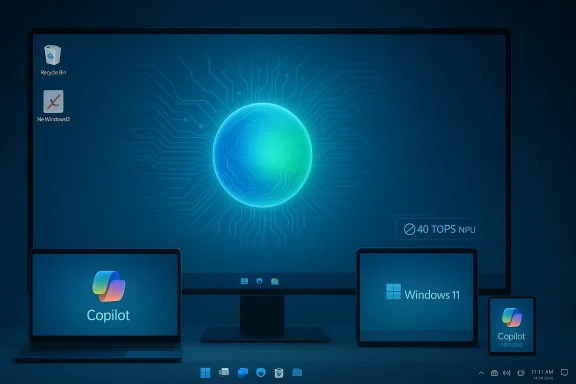
Futuristic AI Copilot ecosystem across Windows 11 devices with a glowing circuit globe.Background​

Microsoft’s messaging over the last two years has been loud and consistent: Windows will become more AI‑centric, and Copilot is central to that strategy. That signal—paired with real engineering experiments, internal codenames, and OEM roadmaps—created fertile soil for a viral narrative that a brand‑new, subscription‑only “Windows 12” was imminent. The rumor stack typically bundled three claims: a consumer OS rebrand (commonly called Windows 12 or “Hudson Valley Next”), an AI‑first architecture that elevates Copilot to a system agent, and a strict hardware gate (often reported as a ≈40 TOPS NPU requirement) that would lock advanced features to new devices. Multiple community analyses and Windows beat reporters pushed back on those claims in early March 2026.
The reality observed in Microsoft’s public channels and Insider activity is more measured: continued, incremental Windows 11 updates (including targeted platform releases like 26H1), expanded Copilot integrations, and device‑class programs that advertise Copilot‑optimized hardware—not a sudden conversion of the retail OS into a subscription‑only product.

What the Viral Claims Said — and Why They Mattered​

The headline claims​

  • A new consumer OS (branded in many headlines as Windows 12 and sometimes associated with internal names such as “Hudson Valley Next” or “CorePC”) would ship in 2026 as a ground‑up redesign.
  • Copilot would be elevated from an optional assistant to an always‑on, pervasive OS agent.
  • Full experience would be gated to devices with a dedicated NPU capable of roughly 40 TOPS of inference throughput.
  • Advanced AI capabilities would be behind subscription tiers, effectively making parts of the desktop paywalled.
Those claims had emotional resonance: they hit three user pain points at once—mandatory upgrades, subscription creep, and privacy/telemetry worries—so they spread fast across social platforms and low‑quality publishing pipelines. Community and specialist reporting showed those elements were plausible when taken one by one, but the asserted package and timeline lacked authoritative confirmation.

Why the specific technical claims were suspicious​

The most technical component—the “≈40 TOPS NPU” threshold—was a red flag. TOPS (trillions of operations per second) is an aggregate throughput metric used by silicon vendors to describe accelerator performance. It’s useful for comparing chips at a high level, but it is not the sole determinant of model performance: memory bandwidth, software stacks, model quantization, runtime support, and system integration are equally important. Historically, operating systems prefer capability descriptors or supported feature lists rather than hard numeric gates; demanding a specific TOPS figure as the requirement for the OS to run would be unprecedented and economically disruptive. Multiple analyses flagged that the 40 TOPS figure was likely an engineering benchmark or prototype target, not a published Microsoft minimum.

What Microsoft Actually Said (and Did)​

Microsoft’s public posture in late February and early March 2026—across official posts, Windows Insider builds, and partner programs—showed continuity with prior messaging: enhance Windows 11, roll AI features into the platform, and work with OEMs to offer Copilot‑optimized devices. There is no public Microsoft announcement, developer preview, or official roadmap entry that confirms a consumer Windows 12 shipping in 2026, a subscription‑only retail OS, or a mandatory NPU gate tied to a specific TOPS number. In short: the company has been evolving Windows 11, not issuing an immediate replacement.
Microsoft also already sells subscription products—Windows 365 Cloud PC and Microsoft 365 among them—but these are distinct commercial services targeting different scenarios (streamed cloud PCs, productivity suites) and should not be conflated with a base‑OS retail subscription. The conflation of Windows 365 or enterprise subscription flags with a universal “subscription Windows” narrative appears to be a common misreading.

How the Rumor Spread: Anatomy of a Modern Tech Myth​

  • Fragmented facts recombined
  • Internal codenames, earlier engineering notes, and prototype benchmarks leaked or were republished over time.
  • Translation and republishing
  • A translated item or synthesis can sound like fresh reporting; translations sometimes omitted time context or sourcing caveats.
  • Automated amplification
  • Content farms and AI rewriting tools recycled the claim across many outlets, creating the illusion of corroboration.
  • Social condensation
  • Platforms compress nuance into outrage‑driven headlines that are easy to share.
This exact pattern—engineering breadcrumbs + translation errors + automated rewrites + social amplification—was documented in community threads and specialist follow‑ups. The lesson is technical plausibility is not the same as official confirmation.

Technical Reality Check: NPUs, TOPS, and On‑Device AI​

What TOPS measures — and what it doesn’t​

  • TOPS measures raw integer operations throughput in accelerators. It’s a marketing‑friendly shorthand for how many operations a silicon block can perform per second.
  • It does not directly map to model quality or latency. Model architecture, quantization, compiler optimizations, and memory subsystem throughput are equally important.
  • An OS requirement anchored solely on TOPS would be brittle—different NPUs achieve comparable inference quality with differing TOPS figures depending on the workload.

On‑device vs. cloud processing​

Microsoft’s practical approach appears to be hybrid: offer on‑device acceleration where low latency or privacy is valuable, and fall back to cloud processing where models exceed local capacity. That model supports tiered experiences without making the desktop unusable on older hardware. Device classes (e.g., Copilot+ PCs) let OEMs market enhanced local AI without forcing a hard exclusion of prior generations.

Software stack and compatibility​

Real on‑device AI capabilities require:
  • Runtime support (drivers, secure execution)
  • Model optimization (quantization, pruning)
  • Memory and I/O tuning
  • OS integration for power and privacy controls
Microsoft and OEM partners must coordinate all of the above; it is unlikely they would switch to a hard numeric gate without months—if not years—of developer previews and partner alignment.

Commercial and Regulatory Dimensions​

Subscription concerns: why users worry​

Microsoft’s success with subscription models in productivity and cloud services understandably raises anxiety about “subscription creep” for system level functionality. But subscription offerings such as Windows 365 target different use cases (streamed Cloud PCs for enterprise) and are priced and managed differently than a hypothetical retail OS subscription. Conflating those makes for sensational headlines but misunderstands how Microsoft currently monetizes platform services.

Regulatory attention and governance​

A deeper Copilot integration into system surfaces raises legitimate governance questions:
  • What personal or telemetry data does an agent collect and store?
  • When do model inferences occur locally vs. in the cloud?
  • How are opt‑out and enterprise controls implemented?
These are not hypothetical concerns—they are precisely the kinds of issues policymakers, enterprise buyers, and privacy advocates will scrutinize as on‑device AI becomes more common. Microsoft would need to provide clear enterprise controls, privacy safeguards, and auditability to avoid regulatory friction.

Risks and Downsides If Microsoft Took the Alarmist Path​

  • Platform fragmentation: Hard hardware gates risk creating two classes of Windows users—those with full AI features and those without—exacerbating e‑waste and upgrade pressure.
  • Enterprise migration headaches: Business apps and drivers often require long certification windows; a forced OS jump could create compatibility and security risks.
  • Trust erosion: Poor communication or perceived coercion into subscriptions would further erode goodwill among consumers and IT admins.
  • Gaming and real‑time workloads: Background agentic services doing inference could introduce latency unpredictability unless carefully sandboxed.
Multiple community feeds and industry analysis emphasized these risks, urging measured communication from Microsoft and sensible migration pathways from OEMs.

Practical Guidance: What Consumers, IT Pros, and OEMs Should Do Now​

For consumers (short and practical)​

  • Don’t panic‑upgrade your PC based on the rumor. If Windows 11 runs your workloads today, you have time.
  • Audit your Microsoft subscriptions and turn on two‑factor authentication if you haven’t already.
  • If you care about privacy, review Copilot and AI privacy settings before enabling advanced features.

For IT and procurement​

  • Inventory devices by CPU/GPU/NPU capability and categorize critical systems that must remain supported.
  • Test Windows Insider builds in a small pilot ring before mass deployment.
  • Coordinate with app vendors and OEMs to validate drivers and line‑of‑business applications.

For OEMs and hardware partners​

  • Publish clear Copilot+ certification guidelines and migration timelines.
  • Provide transparent performance and power trade‑offs for neural accelerators.
  • Offer downgrade or rollback paths for corporate buyers concerned about compatibility.
These steps were recommended repeatedly in technical community guidance as the sensible way to convert rumor anxiety into concrete, budgetable action.

What to Watch Next​

  • Official Microsoft posts and clarified system requirements published via the Windows Blog and Windows Insider channels; those are the only reliable sources for OS‑level policy changes.
  • Insider previews and release notes for targeted platform updates (e.g., 26H1) that may announce device‑class features rather than a wholesale OS rebrand.
  • OEM certification programs and marketing for Copilot‑optimized devices that will reveal the practical feature sets tied to new silicon.
  • Clear Microsoft statements about what is optional vs. mandatory for Copilot features—especially details about on‑device vs. cloud inference and subscription gating.
These channels will be decisive. Until Microsoft publishes minimum system requirements, any hard numeric figure floated in secondary reporting (for example, the oft‑cited 40 TOPS number) should be treated as speculative.

Critical Analysis: Strengths, Weaknesses, and Final Verdict​

Strengths of Microsoft’s practical approach​

  • Incremental evolution of Windows 11 with added AI features reduces disruption for the installed base.
  • Copilot as a layered feature (not mandatory) allows progressive enhancement and better testing.
  • Device‑class distinctions (Copilot+ PCs) let OEMs innovate without forcing a universal gate, preserving compatibility.
These strengths support a pragmatic, market‑friendly path: enhance where you can, leave the rest compatible, and monetize through value‑added services rather than a forced base‑OS subscription.

Weaknesses and risks in Microsoft’s position​

  • Communication gaps: mixed messaging or poor transparency about what’s optional could fuel more rumor cycles.
  • Upgrade incentives: even optional premium features create buyer pressure for hardware refreshes that may not be necessary for most users.
  • Privacy and governance: embedding agents into the OS amplifies demands for clearer privacy controls and enterprise governance.

Final verdict​

The breathless headline—a subscription, AI‑first Windows 12 that locks out existing PCs unless they include a 40 TOPS NPU—is not supported by verifiable, primary evidence. What is verifiably happening is less sensational but more consequential: Microsoft is deepening AI integration into Windows 11, offering enhanced experiences on newer silicon, and expanding subscription‑style cloud services in parallel. That trajectory will change the PC landscape over time, but the change will be evolutionary, staged, and accompanied by developer previews and partner programs—not an overnight, mandatory replacement of the desktop. Treat primary Microsoft channels and Windows Insider releases as the canonical sources for any changes that would affect compatibility, licensing, or minimum hardware requirements.

Bottom Line for Windows Users Today​

  • Continue using Windows 11 with normal lifecycle planning and security patching.
  • Base procurement and refresh cycles on documented support timelines and OEM guidance—not on viral rumor headlines.
  • Monitor Microsoft’s official communications and Insider channels for real, confirmed change announcements.
  • Evaluate AI features on merit: many will be optional and provide productivity gains, but choose what you enable and understand where processing occurs (local vs. cloud).
The PC ecosystem stands on the verge of meaningful AI‑driven improvements. The difference between a healthy, inclusive transition and a disruptive one will be communication, opt‑in control, and sensible migration pathways. Microsoft’s current public behavior suggests it understands those constraints—and for now, that is the most reassuring fact of all.

Source: Mix Vale Microsoft refutes rumors about new system and prioritizes evolution of Windows 11 with artificial intelligence
 

The past week’s “Windows 12” frenzy was loud, fast and — for most readers — unnecessary. What began as a speculative translation and a handful of thinly sourced posts metastasized into breathless headlines about a subscription-only, NPU‑gated OS landing in 2026. In reality, the evidence points the other way: Microsoft is iterating Windows 11, expanding Copilot experiences and defining device tiers (Copilot+ PCs) that lean on on‑device acceleration — not shipping a retail “Windows 12” that forces consumers into subscriptions or immediate hardware swaps. The viral claims recycle internal codenames and prototype benchmarks into a false inevitability; careful reporting and official documentation show this is rumor-first, confirmation‑later coverage. ]

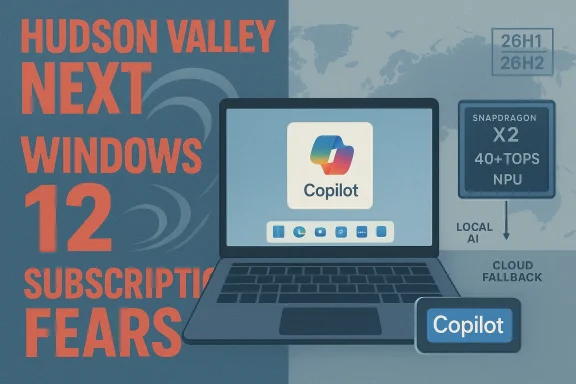
Promotional tech poster about Windows 12 subscription fears, with Copilot on a laptop.Background / Overview​

The particular rumor wave named a codename — “Hudson Valley Next” — and an architectural shorthand — “CorePC” — then linked both to dramatic product-level assertions: a new major Windows release in 2026, deep system‑level Copilot integration, mandatory NPUs rated at roughly 40 TOPS, and subscription gating for advanced AI features. That packaging made for great clickbait because each element is individually plausible: Microsoft has internal codenames, it is aggressively folding Copilot into Windows, and it sells subscription services such as Microsoft 365 and Windows 365. But plausible building blocks do not equal an official, shipped product. Community investigations and several experien quickly flagged the story as unverified, and multiple outlets corrected or retracted the more dramatic claims.
What we can say with confidence today:
  • Microsoft has not announced a consumer‑facing product called “Windows 12” with a 2026 ship date. The strongesry lack primary documentation and rely on recycled engineering fragments.
  • Microsoft is shipping Windows 11 updates in 2026 (26H1 / 26H2 cadence) and is rolling Copilot features into that platform; some targeted platform releases (26H1) are device‑specific (ARM/Snapdragon X2), while a broader H2 update is expected later in the year.
  • Microsoft has formalized a Copilot+ device tier that references NPUs capable of 40+ TOPS as the performance target for premium local inference experiences — a guideline, not a universal OS boot gate.
Those three facts reshape the conversation: this is an evolution of Windows 11 and the PC ecosystem, not a forced wholesale reset to a subscription‑only operating system.

Where the rumor came from — anatomy of a modern tech myth​

Internal breadcrumbs turned headlines​

A typical rumor cascade starts with internal or partner documents (codenames, prototype notes, certification targets) that lack public context. Those fragments get translated, republished and aggregated. Automated summarizers and low‑quality syndication multiply the claim, and social feeds compress nuance into outrage‑friendly headlines. The “Windows 12” cycleched together Hudson Valley references, a modular CorePC idea, and public conversation about NPUs and Copilot into a single, dramatic timeline. Community archives of the original posts show this exact recombination.

Why the technical pieces felt believable​

  • Microsoft’s public messaging in the last two years has emphasized AI, Copilot integration, and cloud+device hybrid models. That makes AI‑first narratives feel credible.
  • PC OEMs and silicon vendors are promoting NPUs and quoting TOPS as a headline metric; a 40+ TOPS target circulates in partner documentation and in Microsoft’s Copilot+ guidance. That created a focal number for headlines. ([learn.microsoft.com](Copilot+ PCs developer guide commercial pivot to subscriptions for productivity and cloud services (Microsoft 365, Windows 365 Cloud PC) encourages a mental model where everything will eventually be subscriptionized — even if Microsoft has not said the core retail OS will change.
All three are real trends; the leap to a single, imminent product plan was not.

Microsoft’s actual 2026 posture: iterate Windows 11, formalize Copilot tiers​

Windows 11 updates, not a new major OS​

Publicly observable activity shows Microsoft continuing to evolve Windows 11. In 2026 the company has introduced targeted platform releases (26H1) aligned to new silicon (notably Snapdragon X2) and plans a broader H2 feature update — commonly referred to in reporting as 26H2 — later in the year. Observers report 26H1 is effectively a device‑specific release while 26H2 will be the usual wide‑platform annual update. That cadence explains why engineering strings and new platform numbers appear in Insider channels without signaling a fresh consumer product number.
Windows 11 remains the supported base, and Microsoft’s public roadmap and Insiders activity reflect incrementalism: material feature rollouts, performance and reliability work, and opt‑in Copilot experiences rather than a wholesale restart.

Copilot+ PCs and the 40+ TOPS guidance​

Microsoft now markets a class of devices called Copilot+ PCs whose certification emphasizes on‑device NPU capability. Microsoft’s developer and device guidance cites NPUs capable of more than 40 TOPS as the practical target for delivering the richest local Copilot experiences, including low‑latency inference for features such as Recall, local model execution and media generation. That guidance is explicit in Microsoft documentation and on official Copilot+ device pages.
Important nuance: the 40+ TOPS figure is a performance target for premium experiences, not a binary hardware lock to boot the OS. Microsoft’s device certification describes what qualifies as a Copilot+ experience; it does not (publicly) state that Windows will refuse to run on hardware below that threshold. Multiple technical caveats matter here — TOPS is a coarse throughput metric, and real model performance depends on memory bandwidth, quantization, runtime support and the entire software stack. Treat the TOPS number as a practical performance baseline for premium on‑device AI, not as a universal system requirement.

Incremental AI features and opt‑in controls​

Rather than converting the desktop to an always‑on agent that is mandatory and paywalled, Microsoft appears to be pursuing a layered approach:
  • Optional local AI features (Recall, Live Captions, Windows Studio Effects) appear as previews or Copilot+ exclusives on certified devices.
  • Cloud fallbacks remain available — devices that lack fast NPUs can still use cloud inferenceences at some latency and privacy tradeoffs.
  • Subscriptions continue to be Microsoft’s preferred mechanism for advanced cloud services and productivity suites, but there is no public statement converting the retail Windows license into a subscription‑only product.
Multiple reliable followups and Microsoft’s own pages make this layered, opt‑in approach visible; the volatility came when some outlets collapsed all lpay up or be left behind” narrative.

What the rumor got wrong — claim by claim​

Below I take the most widely repeated claims and show what we can verify today.
  • Claim: Windows 12 will ship in 2026.
  • Reality: No Microsoft announcement for a retail‑named “Windows 12” in 2026. Public signals point to Windows 11 26H1 (device‑specific) and 26H2 (mainline) in 2026, with continuing Windows 11 servicing beputable outlets that examined the original rumor called it unverified or retracted the most extreme assertions.
  • Claim: Microsoft will make the OS subscription‑only.
  • Reality: Microsoft already sells subscription services (Microsoft 365, Windows 365 Cloud PC) but has not announced replacing the retail/perpetual licensing model with a mandatory consumer subscription for basic desktop functionality. The rumor conflated cloud PC and enterprise subscription models with a universal consumer OS policy.
  • Claim: A hard NPU gate (≈40 TOPS) will be required to run Windows.
  • Reality: Micrlot+ device class that targets 40+ TOPS NPUs for enhanced local AI experiences. That is a certification/performance target for premium local inference, not a published minimum for the OS to boot. TOPS is a single metric among many that determine on‑device AI performance.
  • Claim: CorePC modular architecture equals a brand‑new consumer OS.
  • Reality: “CorePC”‑style modularization is a long‑running engineering concept that can be applied incrementally. Microsoft historically phases such changes over many releases; internal architectural work does not automatically translate to a single retail product number or an immediate break with past compatibility.
Two independent fact‑checks — longform reporting from established outlets and Microsoft’s own documentation — converge on the same practical conclusion: the radical packaged narrative is unproven; the company is refining Windows 11 and carving out device tiers for richer local AI.

The practical impact for users and IT teams (what to do in March 2026)​

If you saw the headlines and felt compelled to pause purchases or freeze upgrades, here is a practical, defensible plan.

1. Inventory first​

  • Use the built‑in PC Health Check and enterprise inventory tools (Intune, SCCM, third‑party tools) to map devices, TPM/TPM 2.0 status, RAM, storage and whether a machine qualifies as Copilot+ capable. Copilot+ guidance and Microsoft device pages list the 40+ TOPS target and other baseline factors for certification; use those as a planning reference, not an alarm bell.

2. Prioritize security and10 reached end of support on October 14, 2025. Devices still on Windows 10 face increased risk without special extended updates; prioritize upgrades or ensure you have ESU/compensating controls where needed. Microsoft’s lifecycle pages confirm the EOL date and the availability of ESU programs.​

3. Upgrad​

  • If your PC meets Windows 11 requirements and you are comfortable with Windows 11 today, upgrade. There is no benefit to waiting for a mythical Windows 12 that may not exist in the marketed form. For shoppers, mainstream retail cycles (Memorial Day, back‑to‑school, Black Friday) remain valid times to buy Copilot‑capable machines if you want local AI performance. Vendor promotions routinely discount certified Copilot+ machines around those events.

4. Enterprise approach​

  • Test Copilot features in pilot rings before broad deployment.
  • Insist on OEM certification and clear compatibility matrices for Copilot+ features.
  • If stability matters more than features, plan to rely on long‑term servicing channels (LTSC or enterprise ESUs) and wait for broad H2 platform updates to mature — enterprise guidance from Microsoft and channel partners often recommends waiting for H2 releases before organization‑wide rollouts.

5. Don’t buy into fear or hype​

  • Indiscriminate hardware upgrades driven by panic are expensive and often unnecessary. Many existing on‑market Intel and AMD platforms with hybrid acceleration support will deliver Copilot experiences through cloud fallbacks or via partial local acceleration. The published Copilot+ program is a premium path, not a universal gate.

Strengths and risks in Microsoft’s approach​

Notable strengths​

  • Pragmatic device segmentation: Copilot+ gives OEMs and users a way to distinguish premium local AI ability without breaking compatibility for evrosoft showcase new experiences on devices where they run well, while allowing cloud fallbacks elsewhere.
  • Incremental engineering path: Building AI features into Windows 11 and delivering them via feature updates and Copilot packages reduces the risk of a massive, disruptive break for applications and drivers. Microsoft’s 26H1/26H2 cadence demonstrates this incrementalism.
  • Clear device guidance: Public Copilot+ documentation and partner materials define performance targets and certification criteria, enabling vendors and enterprises to plan procurement.

Real risks and concerns​

  • Perception of subscription creep: Microsoft’s subscription business model for productivity and cloud services raises rational fears — those fears are what powered the Windows 12 headlines. Microsoft must be careful to separate optional upsells from basic OS functionality. The rumor cycle shows how fragile trust can be.
  • Privacy and security with on‑device features: Features like Windows Recall sparked controversy because they index and snapshot user activity. Microsoft’s response has been to make such features opt‑in, encrypt local data and present controls — but the technical complexity and attack surface remain real concerns. Security patches and clear controls are necessary.
  • Fragmentation risk: If premium local features arrive on limited Copilot+ hardware while mainstream devices rely on cloud fallbacks, the ecosystem could fragment experiences in ways that confuse users and complicate support for ISVs and enterprise admins.

How we verified the key technical claims (transparency)​

Good journalism requires verifying the load‑bearing facts. For the most consequential claims I cross‑checked primary Microsoft documentation and at least two independent reporting outlets:
  • Copilot+ device guidance and the 40+ TOPS target: validated against Microsoft Learn and Microsoft’s Copilot+ product pages; corroborated by industry reporting and partner materials that reference the same threshold.
  • Windows 11 servicing cadence (26H1/26H2) and platform strategy: corroborated with reporting from Windows Central and PCWorld, which have direct Insider reporting on 26H1 device rollouts and 26H2 timing.
  • Denials and corrections to the Windows 12 rumor: cross‑checked with multiple reputable outlets that reviewed the originating pieces and labeled the strongest claims as unverified or retracted the more sensational assertions. PC Gamer and WindowsLatest produced clear rebuttals.
  • Windows 10 end‑of‑support date: verified directly via Microsoft lifecycle and support pages.
Where claims in social threads or thin aggregator pages could not be independently confirmed — for example, the specific “70% Windows 11 US market share by Q1 2026” line that circulated widely — I could not find reliable, public third‑party metrics (StatCounter, NetMarketShare, or analyst releases) to back that exact percentage. Treat such precise market‑share statementss they cite a named research firm and a report you can access. Transparency matters: if you see a precise statistic, ask for the underlying source and the sampling methodology before acting on it.

Short checklist for evaluating future Windows rumors​

  • Look for primary Microsoft confirmation (official blog posts, documentation, Windows Insider release notes).
  • Demand multiple independent corroborations from reputable outlets with named sources.
  • Differentiate internal engineering codenames and partner test guidance from shipping product names.
  • Treat single numeric hardware thresholds (TOPS, specific NPU numbers) as performance targets until Microsoft places them in a compatibility or system requirements table.
  • Verify dates and lifecycle steps (e.g., Windows 10 EOL) against Microsoft lifecycle pages before making security or procurement decisions.

Conclusion​

The “Windows 12” headlines were an instructive case study in modern rumor dynamics: plausible fragments + weak sourcing + rapid amplification = panic. The sober view — reflected in Microsoft documentation, device partner guidance and careful reporting — is far less dramatic and far more actionable: Microsoft is investing in on‑device AI, formalizing Copilot+ device tiers with performance targets (40+ TOPS) and iterating Windows 11 across 2026 through targeted platform releases and an H2 feature update. Those are real, consequential developments that merit planning, not panic. Inventory your estate, prioritize stability and security (Windows 10 reached end of support on October 14, 2025), and treat extreme headlines that promise a radical, immediate OS reset with healthy skepticism. The future of AI on the PC is coming — in measured steps, with hardware tiers and optional experiences — not as an overnight subscription ambush.

Source: battleofguardians.com Windows 12 Rumours Surface, But Don't Believe Them
 

Microsoft did not announce a consumer product called “Windows 12” for 2026 — the viral claim that Redmond is preparing a subscription‑only, NPU‑gated, AI‑first Windows 12 is a classic modern rumor built from recycled leaks, AI‑generated amplification, and editorial shortcuts rather than a verified roadmap entry. ]

Laptop projects glowing holographic UI tiles labeled 'Copilot Plus' and '40 TOPS.'Background / Overview​

The late‑February / early‑March 2026 rumor cycle tied together three familiar threads: internal Microsoft codenames (notably “Hudson Valley”), long‑running engineering experiments (sometimes labelled CorePC), and Microsoft’s visible push to embed Copilot and local AI inference into Windows. Taken together, those pieces made for a sensational narrative: a full‑numbered Windows successor arriving in 2026 that would make advanced AI features subscription‑only and require a dedicated on‑device Neural Processing Unit (NPU) rated at roughly 40 TOPS for the “full” experience.
That narrative spread rapidly across tech sites and social feeds, but the reporting chain that amplified it was flawed. The authoritative correction came quickly: the initial roundup that catalyzed the frenzy was updated and walked back by its publisher; multiple Windows beat outlets concluded the strongest claims were unverified; and Microsoft’s public channels show continued evolution of Windows 11 rather than an announced, retail‑branded Windows 12 for 2026.
Below I unpack what is verifiably true, what was misinterpreted, why the rumor spread, and what the practical implications are for users, IT teams, and OEMs.

What is verifiably true today​

  • Microsoft has not published an official announcement, developer preview, or roadmap entry that confirms a consumer product called Windows 12 shipping in 2026. Coverage from established Windows reporters and follow‑ups to the original story reached that same conclusion: treat the retail Windows‑12 claim as unproven.
  • Microsoft is actively expanding AI functionality inside Windows 11, and it has formalized hardware and device programs (for example, Copilot+ PCs) that target high‑performance on‑device inference. Those programs are real and include specific performance guidance (an NPU performance target of 40+ TOPS) intended for premium local AI experiences — a device certification/performance target, not a boot‑time numerical gate that would prevent older machines from running the OS.
  • The internal codename Hudson Valley is associated with Windows 11 feature updates (the 24H2 / 2024 Update family), and much of the leaked UI artwork and prototype discussion circulating online are re‑workings or old prototypes tied to earlier internal explorations rather than proof of a new retail OS shipping this year. Microsoft’s public documentation for Windows 11, version 24H2 lists the feature set and distribution details of that release.

Anatomy of the rumor: how plausible fragments became a viral story​

1) Plausibility plus pattern‑matching​

Micr the past few years has been obvious: integrate Copilot and AI into Windows, work with OEMs to define device classes that accelerate local inference, and expand subscription services where appropriate. Each of those threads is factual; that made the leap to a single, dramatic narrative feel plausible to many readers. Plausibility, however, is not confirmation.

2) Sources that cited one another (the echo chamber effect)​

Investigations into the rumor’s spread show a recurring pattern: a translated or aggregated article republished older leaks and prototyut context; smaller sites then republished the summary and sometimes used each other as “verification”; social platforms compressed the claims into alarmist headlines; and automated content engines trained on the public web treated repetition as corroboration. The result was a self‑reinforcing loop where weak sourcing looked like consensus.

3) Misreading engineering artifacts as product intent​

Codenames, prototype UI experiments, and internal engineering concepts such as CorePC are common at large platform vendors. They don’t necessarily represent a finalized product plan. Historically, Microsoft has run years of internal R&D, prototypes, and alternate shell experiments before shipping real consumer features — and often those prototypes never ship. Conflating them with a shipped product timeline is the central error behind the Windows 12 narrative.

The specific claims — examined and verified​

Claim: Windows 12 will ship in 2026 as a retail successor to Windows 11​

Reality: Unverified. No Microsoft roadmap entry or official announcement supports a consumer Windows 12 release in 2026. Established Windows reporters and editorial follow‑ups to the original story concluded the claim was not backed by primary sources.

Claim: Windows 12 will be subscription‑only for consumers​

Reality: Unverified and unlikely in short term. Microsoft already sells subscription services (Microsoft 365, Windows 365 Cloud PC) and has enterprise subscription models; but there is no evidence Microsoft has committed to replacing the consumer retail license with a mandatory subscription. Many of the “subscription” references in leaked artifacts appear to be flags or indicators for enterprise/cloud scenarios, not a consumer paywall for baseline desktop functionality.

Claim: Windows 12 will require a dedicated NPU of ~40 TOPS to unlock full functionality​

Reality: Misinterpreted. Microsoft’s Copilot+ device class targets NPUs capable of 40+ TOPS as a performance guideline for richer local AI experiences, but this is a certification/performance tier rather than a kernel‑level numeric boot requirement that prevents the OS from running. TOPS is a high‑level throughput metric and does not alone determine model performance; memory bandwidth, runtime support, quantization, and system integration matter as much or more. Microsoft’s guidance for Copilot+ PCs and the Learn docs explain which features are exclusive to such devices.

Claim: “Hudson Valley” proves Windows 12 exists​

Reality: Misreading nomenclature. The codename Hudson Valley has appeared in Microsoft’s Windows release lifecycle as an internal label for Windows 11 major updates (notably 24H2). Codenames reappear across years and projects; using a codename as proof of an imminent numbered OS release is a categorical error. Microsoft’s documentation for Windows 11, version 24H2 remains the authoritative record for what Hudson Valley represented.

Why this matters: technical and non‑technical implications​

The rumor’s viral shape matters because it affects purchasing decisions, enterprise procurement cycles, and public trust. Whether or not Microsoft ever ships something called Windows 12, several legitimate trends in the PC ecosystem deserve attention:
  • AI is moving to the system level. Expect more local inference capabilities, hybrid cloud+device flows, and integration of agent‑style features into the OS experience. That trend is real and deliberate.
  • Device tiering will create fragmentation pressure. Copilot+ devices — those meeting the 40+ TOPS guidance — will be marketed and certified for premium local experiences, which can lead to perceived feature gaps between device classes even when the base OS remains the same.
  • Subscription-based revenue models are expanding, but their application differs by audience. Microsoft’s subscription bets today are primarily in productivity and cloud services (Microsoft 365, Windows 365) rather than a wholesale replacement of retail OS licensing for consumers. Confusion between Cloud PC (Windows 365) and a consumer subscription OS was a repeated theme in the rumor.

Strengths in Microsoft’s direction — and where risk lives​

Strengths (what Microsoft is getting right)​

  • Incremental integration over radical flips: embedding Copilot features gradually into Windows 11 lets Microsoft iterate and stabilize features with feedback loops from Insider builds and OEM partners rather than forcing a once‑only, disruptive transition.
  • Clear hardware classing with Copilot+: by defining performance tiers (40+ TOPS), Microsoft gives OEMs and enterprise customers guidance for delivering reliable local AI experiences and hardware partners a target to optimize toward. That clarity helps developers and ISVs plan richer local AI integrations.
  • Investment in device privacy/safety knobs: Copilot+ guidance and modern device security features (Secured-core, Microsoft Pluton) show awareness that on‑device AI raises privacy and model governance concerns that must be addressed at the platform level.

Risks and downsides to watch carefully​

  • Fragmentation and perceived obsolescence: if advanced AI features appear exclusive to Copilot+ devices, users and enterprises with older hardware may feel forced into upgrades to access what they view as “basic” OS function.
  • Pricing and trust: hurried or opaque introductions of paywalled AI functionality would inflame consumer distrust — a vulnerability the rumor capitalized on. Microsoft must be explicit about what remains free, what is subscriptioned, and what tradeoffs exist.
  • Compatibility and software ecosystem churn: modular architectures and hardware‑accelerated feature sets complicate driver, virtualization, and compatibility matrices. Enterprises will need clear compatibility matrices and migration guidance.

Practical guidance for users, IT admins, and buyers​

If you saw headlines and felt compelled to pause purchases, freeze deployments, or panic — don’t. Instead, follow this pragmatic checklist.

For consumers and individual buyers​

  • Inventory your needs. If you want local, fast AI features (image generation, offline voice/translation, Recall), consider Copilot+‑class machines — but understand those features are an extra, not a mandatory base.
  • Don’t delay necessary security upgrades. If your device meets Windows 11 requirements and you need security or app compatibility, upgrade or plan to upgrade based on your actual timeline, not rumor. Microsoft’s Windows 11 servicing and support pages explain lifecycle and how to get 24H2 and other updates.
  • Buy for use case, not hype. For many users, a mainstream Windows 11 laptop will continue to meet needs for years; only niche workflows demand the highest NPU performance today.

For IT t1. Use controlled rings and pilot deployments. Test Copilot features in pilot rings and collect telemetry before broad rollout. Demand clear OEM certification and compatibility documentation for Copilot+ claims.​

  • Inventory and prioritize by risk. Map device fleet capabilities (RAM, storage, TPM, NPU presence/performance) and prioritize security and critical application compatibility first.
  • Anchor decisions to primary sources. Base procurement or migration plans on Microsoft’s official communications, Insider builds, and validated OEM guidance — not on aggregated rumors or social media.

How journalists and researchers should handle similar rumor cycles​

  • Verify primary sources: when technical claims hinge on internal strings, codenames, or engineering concepts, ask for the original primary artifact or an authoritative Microsoft statement. Don’t treat multiple recycled pages as independent confirmation.
  • Watch for AI amplification effects: automated content farms and model‑assisted rewriting can generate the illusion of corroboration. A claim repeated across dozens of low‑quality domains can mislead models and humans alike. Be especially skeptical of translation chains where time context has been lost.
  • Demand clarity on metrics: numbers like “40 TOPS” are useful performance targets but are often misused as deterministic gating criteria. Reporters should explain what metrics mean and why they do or do not imply hard restrictions.

A clear, evidence‑backed read on the likely near term​

Put simply: the most explosive elements of the Windows 12 rumor — a 2026 retail launch, a subscription‑only consumer OS, and a hard numeric NPU boot gate — are unproven. Microsoft’s observable public posture is more incremental: evolve Windows 11 with Copilot and local AI features, certify Copilot+ devices for premium local inference experiences (40+ TOPS guidance), and expand subscription services where they make sense in cloud and productivity contexts. That direction is meaningful and real; the dramatized story of an imminent, mandatory, subscription‑gated Windows 12 is not.

What to watch next (signals that would change the story)​

Keep an eye on these verifiable signals; any credible pivot toward a new retail OS would be signaled here first:
  • Microsoft product blogs, Windows Insider releases, and formal roadmap pages announcing a developer preview or official product name for a numbered successor.
  • OEM partner briefings and certification documents that explicitly reference a shipping product name, licensing changes, or mandatory hardware gates.
  • Changes to Microsoft’s licensing documentation (for example, a clear consumer price model or SKU change) or updated EULA guidance that explicitly moves baseline OS functionality behind a subscription.
  • Official Microsoft statements to the press acknowledging a change to consumer licensing models or an OS renaming.
If none of those appear, treat the social‑media myth as that: a cautionary tale about how plausible fragments — amplified by AI and repetition — can masquerade as breaking news.

Final assessment: opportunity — but no immediate emergency​

The debate that followed the viral Windows 12 story matters because it highlights a real transition point: AI is seeping into the OS, and hardware vendors and Microsoft are defining new performance tiers for local AI. Those changes will create opportunities for richer, lower‑latency experiences and new security/privacy capabilities when implemented thoughtfully.
But the panic was unnecessary. The lesson for users and IT pros is practical: plan for AI‑capable hardware where it makes sense, insist on primary sources before you change procurement decisions, and treat sensational, thinly sourced stories as unverified until multiple, independent, primary documents support them. This episode should be a reminder to journalists, administrators, and consumers alike that steady verification and clear communication matter more than viral certainty.
Conclusion: Microsoft is steering Windows toward deeper AI integration and a device‑tiered approach to advanced features; that strategic direction is real and consequential. But the headline that Microsoft is shipping an AI‑first, subscription‑only Windows 12 in 2026 is a myth — a cautionary example of how modern rumor ecosystems can turn plausible technical signals into a false inevitability. Plan accordingly, verify relentlessly, and rely on the official channels for the true roadmap.

Source: Trak.in AI-Powered Windows 12 OS Is a Huge Myth, Microsoft Clarifies - Trak.in - Indian Business of Tech, Mobile & Startups
 

The wave of breathless headlines declaring a brand‑new, subscription‑driven “Windows 12” had barely cooled before veteran Windows reporters, Microsoft watchers, and insider channels pushed back: there is no confirmed consumer product called Windows 12 shipping in 2026, and the viral story that framed it as an AI‑first, NPU‑gated OS with mandatory subscription hooks has been widely debunked.

Futuristic AI chip (NPU) glows beside a Copilot card and a bold 'NO WINDOWS 12' graphic.Background / Overview​

Microsoft’s public posture in early 2026 is clear: the company is intensifying AI integration into Windows 11 and improving the platform’s quality and reliability, not abandoning Windows 11 in favor of an immediate retail successor. Multiple follow‑ups to the original viral piece show the reporting that launched the frenzy relied on dated prototypes, internal codenames (for example, iterations tied to earlier Windows 11 feature work), and thinly sourced aggregation — not on an official Microsoft roadmap or primary confirmations.
The core elements that made the rumor plausible were real in isolation: Microsoft has publicly invested heavily in Copilot and on‑device AI; the company has defined device tiers aimed at richer local inference (sometimes referenced as Copilot+ classes); and Microsoft already runs subscription services such as Microsoft 365 and Windows 365. But stitching those facts into a single deterministic narrative — “Windows 12 arriving in 2026, locked to NPU silicon and behind a subscription paywall” — collapses crucial context about how Microsoft develops, tests, and ships platform work.

What the viral claim said — and what is verifiably true​

The breathless version​

The viral articles and social posts presented a tightly packaged story:
  • A full‑numbered retail OS called Windows 12 (codename “Hudson Valley Next”) would launch in 2026.
  • The OS would be AI‑first, elevating Copilot to a system‑level agent running local models.
  • Advanced AI experiences would require a dedicated on‑device NPU with performance targets commonly cited as ~40 TOPS.
  • Some premium experiences would be locked behind subscription fees, effectively converting core OS capabilities into recurring revenue.

The verifiable reality​

When we trace those claims back to primary confirmations, the record is different and far less sensational:
  • Microsoft has not announced a retail product named Windows 12 with a 2026 ship date. The company’s near‑term public roadmap centers on Windows 11 evolution.
  • Microsoft is indeed expanding AI experiences in Windows 11 and working with OEMs to define device classes for richer local inference (for example, Copilot+ hardware guidelines). These device programs include performance targets such as 40+ TOPS for premium on‑device inference — but that is a device capability target, not an installer gate that would prevent Windows from running on existing hardware.
  • A high‑profile article that catalyzed the rumor was retracted/corrected and acknowledged by its publisher as having fallen short of editorial standards; that correction significantly undermines the original, viral narrative.

How the rumor formed and why it spread so fast​

1) Plausibility bias​

The industry has seen the past several years of Microsoft moving toward AI: Copilot integrations, cloud‑connected experiences, and collaborations with silicon partners. That trend made an “AI‑first Windows” a mentally easy next step for many observers. Plausibility is not confirmation — but it makes sensational claims easier to accept and share.

2) Prototype leakage ≠ product intent​

Large platform vendors run many internal experiments, prototypes, and proof‑of‑concepts. Names like “CorePC” or codenames attached to engineering branches are normal. Those artifacts are research inputs — not definitive product plans. The rumor conflated internal design experiments and old UI concepts with an imminent consumer launch.

3) Syndication and automated amplification​

A translation or summary posted on one site was picked up by automated content pipelines and republished widely. Repetition was mistaken for corroboration. Social feeds compressed complex, uncertain reporting into outrage‑fueled headlines that spread rapidly.

What Microsoft is actually doing in 2026​

Focus areas (public signals)​

Microsoft’s observable priorities are evolutionary, not revolutionary:
  • Stabilize and improve Windows 11: performance, reliability, and UX pain points are top priorities for the Windows team. The emphasis is on meaningful improvements rather than a wholesale retail rebrand.
  • Expand Copilot experiences: Microsoft continues to embed Copilot into Windows 11 as an integrated assistant with an emphasis on optionality and user control. Expect more system integrations, not an immediate wholesale redefinition of the OS.
  • Define premium device classes: Copilot+ or premium device classifications are being refined with NPU guidance for richer local inference; again, these are device targets for premium experiences.

Windows 11 updates, not Windows 12​

In practical terms, Microsoft appears to be delivering major feature updates, enablement packages, and quality improvements to Windows 11 rather than shipping a full‑numbered consumer successor immediately. The company’s enablement/update cadence (for example, 24H2/25H2 cycles) supports a steady evolution model instead of a disruptive replacement strategy.

Technical reality: NPUs, local models, and device tiers​

What the NPU guidance means​

  • The 40+ TOPS figure that circulated in the rumor corresponds to guidance for premium on‑device inference, not a minimum required to boot or install the OS. It is a performance target intended for OEMs to guarantee a certain level of local model responsiveness.
  • Devices without dedicated NPUs can still run Windows and enjoy many cloud‑backed AI experiences; they may simply rely more on cloud inference or less ambitious local models. The distinction between “can run” and “optimized for” matters enormously here.

Why Microsoft and OEMs push NPUs​

  • On‑device inference reduces latency, improves privacy (less data sent to the cloud), and enables richer offline scenarios.
  • OEMs want clear product differentiation: premium devices with NPUs can legitimately advertise superior local AI responsiveness.
  • But if premium features are optional and tiered, the ecosystem can offer both new experiences and backward compatibility — if Microsoft and OEMs choose that path responsibly.

Strategic and consumer implications​

For consumers​

  • Panic buying or forced upgrades are premature. There is no verified announcement requiring users to buy new hardware or subscribe to keep basic Windows functionality.
  • Evaluate AI features on practical benefits: some will matter daily (productivity boosts), others will be niche. Opt‑in controls, transparency about where data is processed, and clear settings will be decisive.

For IT teams and enterprises​

  • Continue to plan around documented support lifecycles and official guidance, not viral headlines. Inventory, test, and pilot any new AI features in controlled environments.
  • Watch official Microsoft channels and Windows Insider previews for actual change notifications that would affect compatibility or licensing.

For OEMs and the supply chain​

  • OEMs who build for NPU‑enabled experiences will market these as premium. That may accelerate a two‑tier hardware market theoretically — but the practical impact depends on how Microsoft positions features (optional vs. mandatory) and how enterprises adopt them.

Strengths and weaknesses of Microsoft’s approach to AI in Windows​

Strengths (what Microsoft is doing well)​

  • Incremental roll‑out: Evolving Windows 11 through previews and enablement packages reduces churn and gives admins time to test.
  • Device classification clarity: Public guidance on device targets (e.g., Copilot+ classes) helps OEMs and partners design for expected capabilities.
  • Choice and optionality: Public messaging emphasizes enhancing Windows 11 rather than forcing a wholesale replacement — this preserves backward compatibility for many users.

Risks and weaknesses​

  • Communication gaps: Mixed or unclear messaging about what’s optional versus required creates fertile ground for rumor and fear. The viral Windows 12 claim exploited that uncertainty.
  • Upgrade pressure: Optional premium features can still create social or procurement pressure to upgrade hardware or subscribe — especially for organizations wanting the best AI experience.
  • Privacy and governance: Deeply integrated assistants raise real questions about data handling, auditability, and enterprise controls. Clearer guardrails will be essential.

Practical guidance for users and IT pros​

  • Inventory: Catalog your estate — hardware capabilities, firmware status, and which devices may benefit from on‑device AI. This grounds upgrade decisions in data.
  • Pilot: Use Windows Insider builds and targeted pilot groups to test Copilot integrations and any new AI features before broad rollouts.
  • Prioritize: Focus on features that return measurable productivity improvements (for example, automation or search enhancements) rather than chasing “all the features” headlines.
  • Communicate: Explain to end users what is optional, what requires new hardware, and what Microsoft has officially published as roadmap guidance.
  • Watch official channels: Microsoft’s blog posts, Windows Insider release notes, and OEM certification pages are the canonical sources for compatibility and licensing changes.

Why the Windows naming narrative matters beyond clickbait​

The debate about “Windows 12” is not only a journalistic cautionary tale — it highlights several structural pressures reshaping the PC landscape:
  • The convergence of silicon, software, and services means OS owners can now segment experiences by hardware capability more easily than ever.
  • Subscription business models and cloud services are established parts of Microsoft’s portfolio; conflating those with a forced retail subscription for the OS creates unnecessary alarm.
  • Public trust depends on clarity: if platform owners don’t clearly delineate which experiences are optional, premium, or legacy‑compatible, rumor cascades will continue to cause disruption in procurement and consumer behavior.

Assessing the long‑term outlook: when might a Windows successor arrive?​

Predicting a major‑version release is inherently speculative. Veteran reporting and Microsoft contacts suggest that if a wide‑scale, retail‑branded successor (a.k.a. Windows 12 in press shorthand) appears, it is unlikely to surface as a surprise consumer product in 2026. Some analysts suggest major new retail releases tend to follow long incubation cycles — and the path to any eventual successor will likely be signaled publicly via Insider channels, partner briefings, and developer previews. In short: don’t expect a sudden, mandatory OS replacement this year based on the evidence available now.

Final analysis: separate plausible strategy from probabilistic claims​

The dramatic notion of a subscription‑only, NPU‑gated Windows 12 made for an attention grabbing headline — but it collapsed nuanced truths into deterministic claims. Here’s the sober take:
  • Microsoft is real about embedding AI into Windows and about encouraging premium local experiences on capable hardware. That strategy is consequential and warrants planning.
  • The specific viral claim of a retail Windows 12 launching in 2026, with mandatory NPUs and a paywall for core experiences, is not supported by reliable primary reporting and has been repudiated by more thorough fact‑checks and follow‑ups.
  • The likely path forward is evolutionary: continued Windows 11 feature updates, clearer device classifications for richer AI experiences, stronger enterprise controls, and measured communication — all of which give users and IT teams time to adapt responsibly.

What to watch next (practical signals)​

  • Official Microsoft announcements and Windows Insider release notes for any new SKU, licensing change, or compatibility policy.
  • OEM certification pages and Copilot+ hardware guidance for any changes to device capability targets or marketing classes.
  • Editorial corrections or clarifications from outlets that published the original claims; those corrections often contain the clearest sign that the narrative has been reassessed.

The real takeaway for Windows users, IT professionals, and hardware partners is measured vigilance: plan for the meaningful technical shifts — on‑device AI, hybrid inference, and new device tiers — while insisting on authoritative, primary confirmations before making costly upgrade or procurement decisions. The age of AI‑enhanced operating systems is coming, but the shape of that future will be revealed in careful steps, not abrupt leaps announced one morning by rumor and amplification.

Source: GB News One billion people have now upgraded to Windows 11, but is Microsoft planning to release Windows 12 already?
 

The Windows rumor mill has kicked into overdrive again, and this time the controversy centers on talk of a “Windows 12” that some claim will be AI‑first, hardware‑gated, and subscription‑heavy. The pushback has been fierce—especially from long‑time critics of Windows 11—and for good reason: the viral narrative bundles legitimate industry trends (on‑device AI, Copilot expansion, and subscription monetization) into a single, alarming timeline that many users read as a mandate to upgrade or pay more. Careful scrutiny of the reporting, official signals, and community analysis shows a more measured reality: Microsoft is indeed accelerating AI work in Windows and formalizing a Copilot+ device tier, but the most dramatic claims—an enforced NPU boot‑gate, a subscription‑only consumer OS arriving in 2026, or wholesale obsolescence of existing hardware—are not confirmed and, in several cases, have been corrected or retracted by publishers who rushed versions of the story into the wild. erview
Microsoft’s public posture since 2024 has been consistent: fold AI more deeply into Windows, improve Copilot integrations, and stabilize the overall Windows 11 experience. At the same time, Microsoft and OEM partners have been promoting a new device class—Copilot+ PCs—marketed as optimized for local AI inference, and accompanied by guidelines that reference NPU performance targets. Those public moves are real and observable; they are also the kernel that rumor writers combined with leaked codenames and industry chatter to produce the “Windows 12” scare story.
Two crucial baseline facts you should accept before parsing any rumor stack:
  • Microsoft officially ended mainstream support for Windows 10 on October 14, 2025. This is the company’s lifecycle decision and is documented on Microsoft’s support and lifecycle pages.
  • Microsoft has publicly defined and promoted Copilot+ PCs—a set of devices aimed at delivering richer local AI experiences—while clarifying that Copilot+ is a device tier and not a redefinition of Windows licensing.
Those two points explain why the conversation is charged: millions faced with Windows 10’s end of support are watching Microsoft’s device and AI messaging closely, and a small number of dramatic claims can catalyze rumers and IT buyers. Community compilations of the rumor cycle show the anatomy of that panic, documenting how translation, aggregation, and thin sourcing amplified partial facts into near‑certain prophecy.

Split image: left shows Windows 12 rumors; right shows a Windows laptop with Copilot AI.What was actually reported — and what was later corrected​

The viral narrative in plain language​

Across dozens of social posts and dozens of low‑quality syndication sites, the viral narrative coalesced into three headline claims:
  • A full‑numbered successor called “Windows 12” (often tied to internal names such as Hudson Valley Next or CorePC) would ship in 2026 as a ground‑up, modular, AI‑first OS.
  • The “full” experience would be gated to devices with dedicated NPUs (Neural Processing Units) meeting a roughly 40 TOPS performance target, creating a hardware gate for advanced features.
  • Many advanced AI features would be available only behind a subscription, effectively converting parts of the OS into recurring‑fee functionality.
Those three threads—brand renaming, hardware minimums, and subscription gating—are what made the story grip forums and comment sections. Each element had indepMicrosoft has been integrating Copilot across Windows, device makers are advertising NPUs, and Microsoft sells many products as subscriptions. But plausibility is not the same as proof.

How reputable outlets and Microsoft responded​

One of the more prominent sparks for the viral cycle was a long article republished in English that, after criticism, was acknowledged by its publisher to have “not met editorial standards.” PCWorld explicitly admitted errors and corrected its Windows 12 piece; that public correction significantly undermined the original viral framing. Independent reporting from established Windows beat outlets and analysts further rebutted the claim that Microsoft planned to ship a subscription‑only Windows 12 in 2026, noting instead that Microsoft’s near‑term roadmap emphasizes improving and stabilizing Windows 11.
Community and technical analyses repeatedly made the same distinction: device certification targets (for example, Copilot+ device guidance) exist and mention 40+ TOPS as a performance ballpark for premiu—but a certification target is not the same as an OS hard requirement that prevents booting or basic use on older machines. The difference matters because the latter would be an unprecedented, disruptive move; the former is a marketing and engineering signal for premium device experiences.

Verifying the key technical claims​

Windows 10 end of support: the fact​

Microsoft’s official lifecycle pages confirm that Windows 10 support ended on October 14, 2025. After that date Microsoft no longer delivers free security updates, features, or technical assistance for Windows 10 in the same fashion as before. Organizations that require extended protections must evaluate Microsoft’s ESU (Extended Security Updates) options or migrate to supported platforms. This hard date is not a rumor.

Copilot+ and the “40 TOPS” figure: what it means and what it doesn’t​

Microsoft has published Copilot+ materials and partner guidance describing a new class of AI‑optimized PCs. Those pages and partner documents reference performance thresholds (commonly described as 40 TOPS or “40+ TOPS”) as a device‑level guideline for a premium on‑device inference experience. The TOPS number is a hardware marketing shorthand—useful for comparing accelerators at a high level—but it is not the single determinant of real‑world model performance. Memory bandwidth, model size and quantization, driver/SDK quality, thermal and power envelopes, and runtime optimizations all influence user experience. In short: 40 TOPS is a certification target for premium local AI, not an absolute OS gate that prevents installation or basic functionality on machines below that mark.
Why that nuance matters: some versions of the rumor presented 40 TOPS as a hard floor—“Windows 12 won’t run unless your NPU hits 40 TOPS”—which would raise cascading compatibility, affordability, and e‑waste problems. Public documentation and Microsoft’s own Copilot+ messaging do not support that claim; they instead describe Copilot+ as a way to surface richer local AI features on select devices.

Subscription gating: precedent and limits​

Microsoft already sells many products and features on subscription: Microsoft 365, Windows 365 (Cloud PC), Azure services, and add‑on tiers such as Microsoft 365 Premium and Copilot for Microsoft 365. That commercial history makes the idea of paid AI tiers plausible. However, the viral leap—that Microsoft will convert core consumer OS functionality into a subscription paywall with the release of a Windows‑12‑style product in 2026—was not supported by primary Microsoft communications and was explicitly challenged by well‑connected reporters. Existing Microsoft channels emphasize optional premium tiers and device certification programs rather than a wholesale transformation of the retail Windows license into a monthly bill. Treat the subscription claim as plausible as a business strategy, but unproven as an imminent product decision.

Microsoft’s stated roadmap and leadership signals​

Windows 11 updates and the 26H‑series cadence​

Rather than signaling a full retaiicrosoft’s public signals and Insider build channels have pointed to continued Windows 11 evolution—targeted platform updates, hardware‑specific releases (for example, 26H1 builds aimed at ARM and specialized silicon), and broader feature updates later in the year such as 26H2. Those releases are consistent with an iterative strategy: fix and refine Windows 11 while expanding Copilot and device‑targeted enhancements. The community analysis in the uploaded materials underscores this point, urging readers to differentiate modular architecture work from a consumer product rebranding.

Leadership tone: Pavan Davuluri and rebuilding trust​

Pavan Davuluri, who oversees Windows and devices, has publicly acknowledged that Microsoft needs to address user concerns around recent AI feature rollouts and overall Windows quality. His messaging—and Microsoft’s organizational focus on integrating Windows engineering and device teams—indicates an emphasis on user experience restoration and engineering discipline rather than a reckless, publicity‑driven launch of a subscription‑first successor. That leadership posture fits with the more cautious, incremental roadmap signaled across Microsoft’s official communications.

What’s plausible — and what would be a real red flag​

Plausible near‑term moves​

  • Microsoft will continue to deepen AI into Windows 11 and ship more Copilot features, some of which may run locally on devices with capable NPUs. This expands choice for users who want locicrosoft.com]
  • Microsoft and OEM partners will market and certify Copilot+ devices with performance targets (40+ TOPS) to differentiate premium machines that deliver faster local inference and richer features. That program will affect OEM messaging, preinstall experiences, and enterprise procurement decisions.

Red flags to watch for (and how to interpret them)​

  • A formal Microsoft minimum system requirement that explicitly prevents Windows from booting unless a device meets a TOPS figure. That would be a game‑changer; watch for any WHCP (Windows Hardware Compatibility Program) pages or formal minimum requirements that say precisely that. So far, no such OS‑level boot condition has been published.
  • Clear, official Microsoft language tying core OS functions (beyond optional AI features) exclusively to a paid subscription with no usable free baselint a commercial pivot far bigger than Copilot+ or Windows 365 messaging. At present the company’s commercial positioning emphasizes optional, value‑added subscriptions—not the conversion of the base retail license into a paywall.

Practical guidance for users, IT managers, and buyers​

If the Windows 12 rumor wave has you worried, act deliberately. Here’s a short, practical playbook.
  • For consumers:
  • Inventory your needs and devices. If you do basic browsing, media, or Office work, most Windows 11 devices will continue to perform well for years.
  • Don’t panic‑upgrade. A marginal feature offered only on Copilot+ devices is not a reasonable reason to discard a perfectly functional PC.
  • If you need advanced local AI (large image/video editing or heavy on‑device inferencclass devices—but buy for use case, not hype.
  • For IT and procurement:
  • Start with pilot rings. Test Copilot and new AI integrations in controlled environments to measure compatibility and telemetry impact.
  • Map device capability. Create an inventory of thermals, NPUs, RAM, and storage; document what matters for your critical workflows.
  • Require OEM compatibility matrices and Microsoft guidance for any device purchases premised on Copilot+ features.
  • Prioritize security and application compatibility above marketing claims. Microsoft’s lifecycle guidance on migrating from Windows 10 should be a planning input.
  • For gamers and power users:
  • Keep a tested fallback path. If a premium AI feature proves unstable, maintain a recovery plan that includes known‑good drivers and imaging tools.
  • Watch driver and virtualization compatibility if you plan to run OS‑level AI features alongside legacy applications; modular architecture claims could complicate compatibility.

The wider implications: competitiare lifecycles​

Microsoft’s Copilot‑centric direction fits a broader industry pattern: major vendors are pushing local inference when possible, offering cloud fallbacks, and packaging advanced features as premium services. That pattern contains both benefits and trade‑offs.
  • Benefits:
  • Lower latency and improved privacy for some features that run locally.
  • New productivity patterns—faster summarization, cross‑app automations, and creative tools that let non‑specialists produce complex content.
  • Hardware innovation that can yield better battery life and performance for sustained AI workloads.
  • Trade‑offs and risks:
  • Two‑tier user experiences where older or budget hardware is functionally limited for advanreater complexity for enterprise compatibility, governance, and procurement.
  • The political and regulatory risk of perceived coercive monetization—if users think they’re being forced into subscriptions to access what were once free features, trust will suffer. The viral Windows 12 narrative successfully weaponized that fear.

Timeline, speculation, and what to watch next​

A handful of articles and community posts have proposed a tight timeline—preview builds in mid‑2027 and a full retail launch in October 2027. Those projections are speculative and derive from pattern‑matching rather than primary Microsoft confirmation. Treat them as conditional possibilities rather than facts. The correct way to move a rumor into verified news is straightforward: Microsoft would need to publish a formal announcement, a developer preview with a product name and hardware minimums, or WHCP/compatibility rules that explicitly change what “Windows” means at the OS level. Absent those signals, the safer assumption is incremental evolution of Windows 11.
Watch for three definitive signals that would materially change the story:
  • An official Microsoft product page, developer preview, or blog post that names a new retail OS (with a name and ship window).
  • A Windows Hardware Compatibility Program or minimum system requirement page that lists an NPU TOPS figure as mandatory for core OS functions.
  • Clear, commercial terms from Microsoft tying previously free, core OS functions to a paid susable free baseline.
If you see none of those things—but do see more Copilot+ marketing, Copilot feature rollouts inside Windows 11, and incremental Windows 11 servicing updates—then what you’re witnessing is evolutionary product strategy, not an instant revolution.

Final assessment — separating signal from scare stories​

The Microsoft ecosystem is changing, and that will create winners and losers. The most important conclusions for readers are:
  • What is confirmed: Windows 10 reached end of support on October 14, 2025; Microsoft is publicly investing in Copilot and Copilot+ devices; device certification language references a 40+ TOPS target for premium local AI experiences. ([learn.microsoft.com](Windows 10 reaching end of support - Microsoft Lifecycle is probable: Microsoft will continue to evolve Windows 11 with deeper AI features, device‑class programs, and optional paid add‑ons in its existing subscription portfolio (Microsoft 365, Windows 365). These are business and engineering moves that fit observed behavior.
  • What remains unproven and needs cautionary treatment: the claim that Microsoft will ship a subscription‑only, NPU‑locked consumer OS called “Windows 12” in 2026. That narrative was fueled by thin sourcing, translation errors, and one corrected piece that failed to meet editorial standards—facts that reputable reporters have cited while debunking the stronger versions of the story.
For readers, the best posture is pragmatic skepticism: inventory your estate, pilot new AI features in controlled rings, prioritize security and compatibility, and resist upgrade panic driven by sensational headlines. The industry is moving toward on‑device AI and subscription monetization in various forms—but the apocalyptic version of a mandatory, subscription‑gated Windows 12 that bricks older PCs is, at present, an intriguing rumor rather than a verified product plan.

In short: take the “Windows 12” scare stories seriously as an indicator of where parts of the industry are heading, but treat them skeptically as predictions about near‑term product decisions. Follow official Microsoft channels (product blogs, Copilot+ pages, Windows lifecycle notices) and trusted beat reporters for primary confirmation before you adjust purchasing, migration, or upgrade schedules. The landscape is changing—prepare for it thoughtfully, not reflexively.

Source: FilmoGaz Windows 12 Draws More Criticism from Windows 11 Detractors
 

Back
Top